

Entrance landscaping for a business property is defined as the deliberate design of plants, hardscape, lighting, and pathways at your property’s entry point to create a functional, welcoming, and brand-consistent arrival experience. When you plan entrance landscaping for a business property, you are making a direct investment in customer trust. Research confirms that entrance landscaping builds immediate trust and reflects your service quality before a visitor ever walks through the door. In commercial design, this discipline is often called “commercial entry landscape design,” and it covers everything from walkway grading and drainage to plant selection and pathway lighting.
What are the essential components of a business entrance landscape?
A well-designed business entrance relies on four core elements: walkways, lighting, signage framing, and plant selection. Each one serves a specific function, and neglecting any one of them creates a gap that visitors notice immediately.
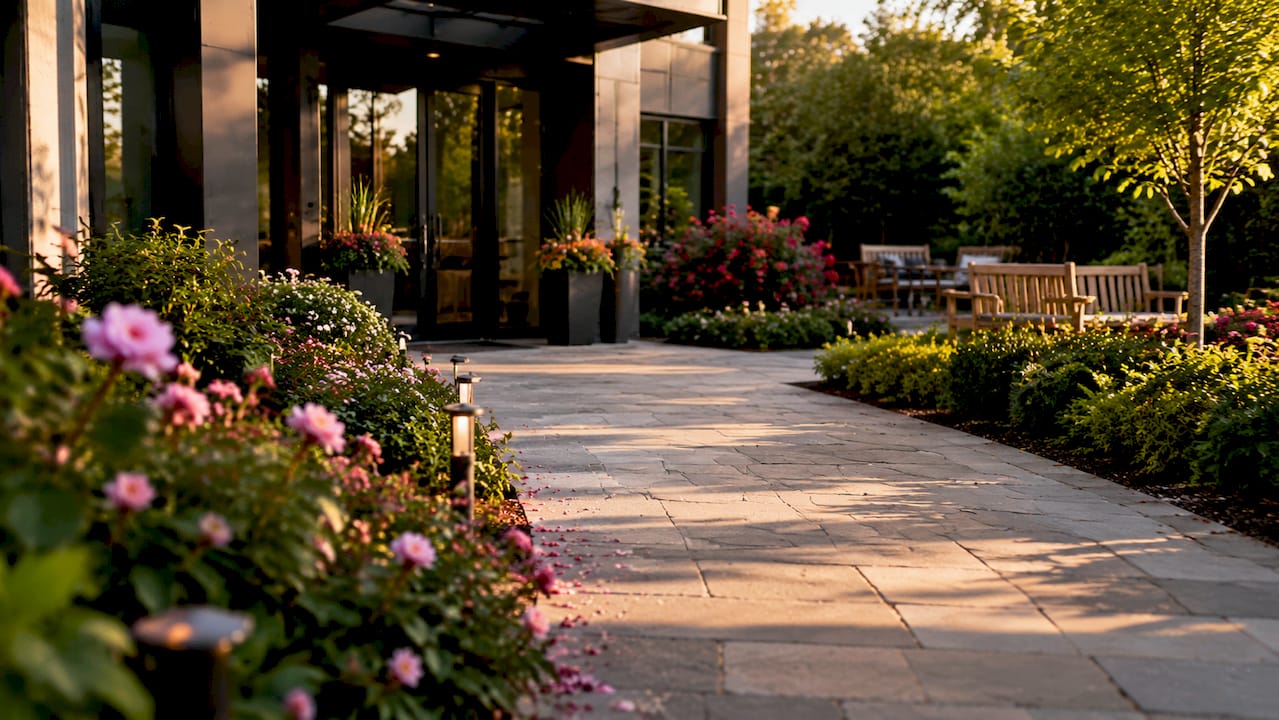
Walkways
Walkway width is the most commonly underestimated factor in commercial entrance design. Main walkways need 36–48 inches of clear width to allow two people to walk side by side and to meet basic accessibility expectations. That width also accommodates wheelchairs and strollers without forcing visitors onto grass or gravel. For high-traffic commercial entries, 48 inches is the better target.
Material matters as much as width. Concrete, natural stone, and brick pavers all provide the non-slip, durable surface a commercial property requires. Avoid loose gravel near main entry doors since it shifts underfoot and creates drainage problems in New Hampshire’s freeze-thaw cycles.
Lighting
Path lighting placed 10–15 feet apart provides consistent illumination for safe nighttime navigation. That spacing prevents dark gaps between fixtures without creating harsh, overlapping pools of light. Low-voltage LED bollard lights work well along walkways, while uplighting on specimen trees or signage adds visual depth after dark.
Signage framing and plant selection
Plants frame your signage and reinforce your brand identity. Low-growing shrubs placed at the base of a sign keep the text visible from the road while adding color and texture. Taller plantings on either side of the entry drive create a natural gateway effect without blocking sightlines.
- Choose plants with a mature spread that fits the space without pruning every season
- Use at least two layers: a taller background shrub and a lower foreground ground cover or perennial
- Select species with multi-season interest such as ornamental grasses, inkberry holly, or dwarf conifers
- Avoid thorny plants near pedestrian paths
- Confirm mature height will not obstruct lighting fixtures or signage
Pro Tip: Select plants by their mature size, not their nursery size. A plant that looks small at installation can block your sign or walkway within three years if you choose the wrong species.
How to plan your entrance landscaping layout effectively
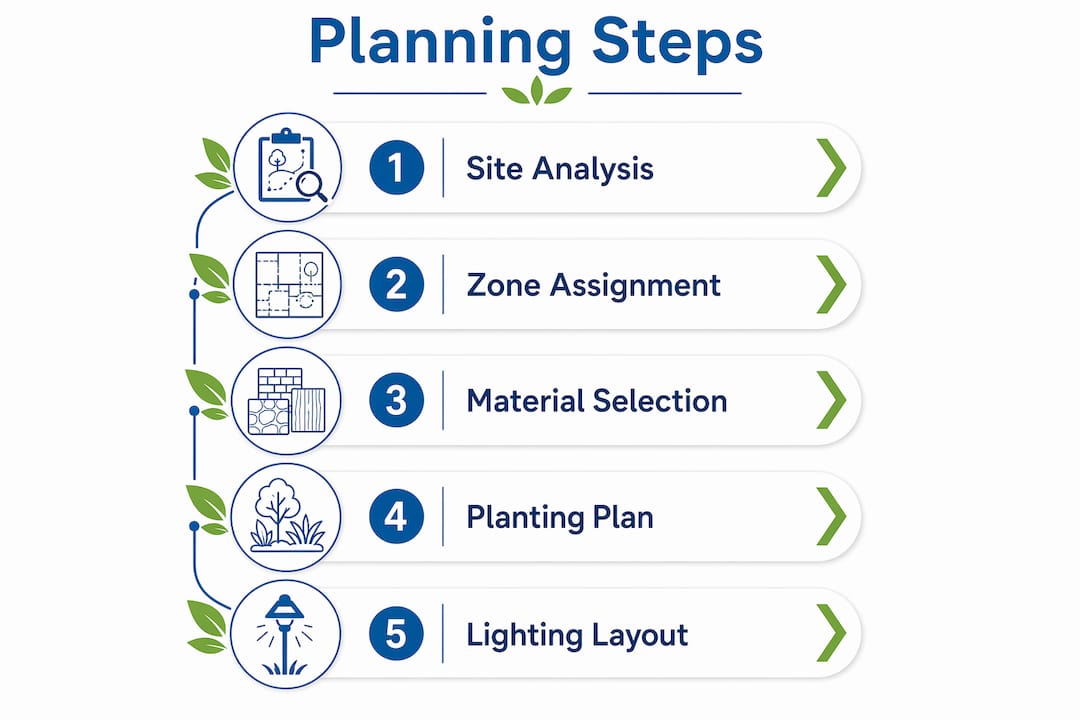
Effective layout planning starts with dividing your property into functional zones before you draw a single plant bed. Zoning your site into distinct areas such as the main entrance, parking, and service zones keeps each area purposeful and prevents resources from being wasted on decorative plantings in low-visibility corners.
Follow these steps to build a reliable layout plan:
- Walk the site as a visitor. Start at the street and walk toward your front door. Note where your eye goes, where the path feels unclear, and where lighting is missing.
- Sketch a base plan. Draw the property outline, building footprint, existing trees, utility lines, and hardscape. A simple hand sketch works for initial planning. For larger properties, a CAD drawing produced by a landscape designer gives you accurate dimensions for permitting and contractor bids.
- Mark your zones. Label the main entry zone, parking perimeter, service access, and any secondary entrances. Each zone gets its own planting and hardscape treatment.
- Establish sightlines. Draw a line from the street to your front door. Anything that interrupts that line needs to be relocated or removed. Visitors need to see your front door within 2–4 seconds of arriving. That visibility is not decorative. It is functional.
- Choose New Hampshire-appropriate materials. Granite pavers, bluestone, and poured concrete all handle freeze-thaw cycles well. Avoid materials that crack or heave after a hard winter.
The table below shows how to match each zone to its primary design priority:
| Zone | Primary design priority | Recommended materials |
|---|---|---|
| Main entrance | Visibility, accessibility, brand impression | Bluestone or brick pavers, LED lighting |
| Parking perimeter | Safety, screening, drainage | Hardy shrubs, concrete curbing |
| Service access | Durability, clear marking | Asphalt or concrete, minimal planting |
| Secondary entrance | Wayfinding, low maintenance | Ground cover, bollard lighting |
What are the best plants for entrance landscaping year-round?
Plant selection is where most commercial entrance designs either succeed or fail over time. The most common mistake is choosing plants that look great in summer but leave your entrance bare and uninviting from november through april. In New Hampshire, that is nearly half the year.
The proven solution is a 2/3 evergreen to 1/3 deciduous ratio. Evergreens provide structure, color, and screening through every season. Deciduous plants add seasonal interest with spring flowers, summer foliage, and fall color. That ratio keeps your entrance looking intentional and maintained even when nothing is blooming.
| Plant type | Best use | New Hampshire examples |
|---|---|---|
| Evergreen shrubs | Year-round structure and screening | Inkberry holly, dwarf Alberta spruce |
| Deciduous flowering shrubs | Spring and summer color | Spirea, viburnum |
| Ornamental grasses | Texture and fall interest | Karl Foerster, little bluestem |
| Perennials | Seasonal color, low cost | Black-eyed Susan, coneflower |
| Annuals | Immediate color near entry door | Marigolds, petunias |
Foliage should overlap walkways by only a few inches at most. Overgrown plants that spill onto paths create tripping hazards, reduce effective walkway width, and signal poor maintenance to visitors. Plan for mature plant spread at installation, not current nursery size.
Pro Tip: Add one container planting near your front door and swap it seasonally. A single well-maintained container delivers more visual impact per dollar than a large bed of plants that peaks once a year.
For more ideas on how plant selection affects curb appeal at the property level, the curb appeal landscaping guide from Divinelandscapingllc covers practical principles that apply directly to commercial entries.
How to integrate pedestrian safety and accessibility into your entrance design
Safety and accessibility are not optional features in commercial entrance landscaping. They are baseline requirements that protect your visitors and reduce your liability exposure.
- Walkway width: Maintain a minimum of 36 inches of clear, unobstructed width at all points along the path. Forty-eight inches is the preferred standard for two-way pedestrian flow and wheelchair access.
- Surface quality: Use smooth, non-slip materials. Textured concrete, brushed stone, and brick pavers all provide grip in wet or icy conditions. Avoid polished stone near entry doors.
- Drainage: Grade walkways away from the building at a minimum slope to prevent standing water. In New Hampshire, standing water freezes and creates ice hazards from november through march.
- Lighting continuity: Place path lights 10–15 feet apart along the full length of the entry walkway. A single dark gap between fixtures is enough to cause a fall.
- Clear sightlines: Remove any planting or signage that forces pedestrians to step off the path or change direction unexpectedly.
A well-lit, clearly marked walkway of proper width is the single most cost-effective safety investment you can make in your commercial entrance. It reduces hazards, signals professionalism, and meets accessibility expectations without requiring expensive materials or complex design.
Hardscape details such as edging, curbing, and step construction also affect safety. Divinelandscapingllc’s overview of hardscape services explains how structural elements like retaining walls, steps, and edging work together to create safe, durable commercial entries.
Key takeaways
A successful business entrance landscape combines proper walkway dimensions, year-round plant structure, continuous lighting, and clear sightlines to create a safe and professional arrival experience.
| Point | Details |
|---|---|
| Walkway width matters | Use 36–48 inches of clear width to meet accessibility standards and two-way pedestrian flow. |
| Evergreen ratio is critical | A 2/3 evergreen to 1/3 deciduous ratio keeps your entrance attractive through New Hampshire winters. |
| Lighting spacing | Place path lights 10–15 feet apart for consistent, safe nighttime navigation. |
| Zone your site first | Divide the property into entrance, parking, and service zones before selecting plants or materials. |
| Sightlines drive first impressions | Visitors need a clear view of your front door within 2–4 seconds of arriving at your property. |
What I have learned planning business entrances in New Hampshire
After working on commercial entrance projects across New Hampshire, the pattern I see most often is this: property owners treat the entrance as decoration and then wonder why it stops working in january. The entrance is not decoration. It is the first physical interaction your customers have with your business. That interaction shapes their expectation of everything that follows.
The “winter gap” problem is real and preventable. Most entrance designs I review look excellent in photographs taken in june or september. By february, the same entrance looks abandoned. Bare deciduous shrubs, empty mulch beds, and dark pathways communicate neglect even when the building itself is well maintained. A year-round structure built on evergreens solves this completely, and it costs no more than a seasonal-only design.
The other mistake I see consistently is narrow walkways. Property owners install 24-inch paths because they look proportional in a sketch. In practice, two people cannot pass each other without stepping onto the lawn. That forces visitors into an awkward interaction before they reach your door. Forty-eight inches feels generous on paper and correct in person.
My honest advice: invest in the design phase before you spend a dollar on plants or hardscape. A clear site plan with accurate dimensions, zone assignments, and plant schedules saves money at every stage that follows. Skipping the plan is the most expensive decision you can make.
— Damian
Divinelandscapingllc can build your business entrance right
Your entrance sets the standard for every customer interaction that follows. Divinelandscapingllc designs and builds commercial entrance landscapes across New Hampshire, combining professional landscape design with hardscape installation, lighting, and seasonal planting programs tailored to your property’s specific conditions.
If you manage multiple commercial properties, the multi-tenant property landscaping guide from Divinelandscapingllc covers the specific challenges of maintaining consistent entrance standards across several sites. For a project-specific plan and pricing, request a quote and a member of the team will follow up with next steps.
FAQ
What is the minimum walkway width for a commercial entrance?
The minimum recommended width is 36 inches, which allows two people to pass side by side. Forty-eight inches is the preferred standard for high-traffic commercial entries and wheelchair accessibility.
How do I keep my business entrance looking good in winter?
Use a 2/3 evergreen to 1/3 deciduous plant ratio. Evergreens such as inkberry holly and dwarf conifers maintain structure and color through New Hampshire winters when deciduous plants go dormant.
How far apart should path lights be placed at a business entrance?
Path lights should be spaced 10–15 feet apart along the full length of the entry walkway. That spacing provides consistent illumination without dark gaps that create safety hazards at night.
How long does it take to plan a commercial entrance landscape?
A basic site plan with zone assignments and plant schedules typically takes one to three weeks depending on property size and complexity. Larger properties requiring CAD drawings or permitting take longer.
What plants work best for entrance landscaping in New Hampshire?
Inkberry holly, dwarf Alberta spruce, spirea, Karl Foerster grass, and black-eyed Susan all perform well in New Hampshire’s climate. They offer multi-season interest, tolerate freeze-thaw cycles, and require minimal maintenance once established.