
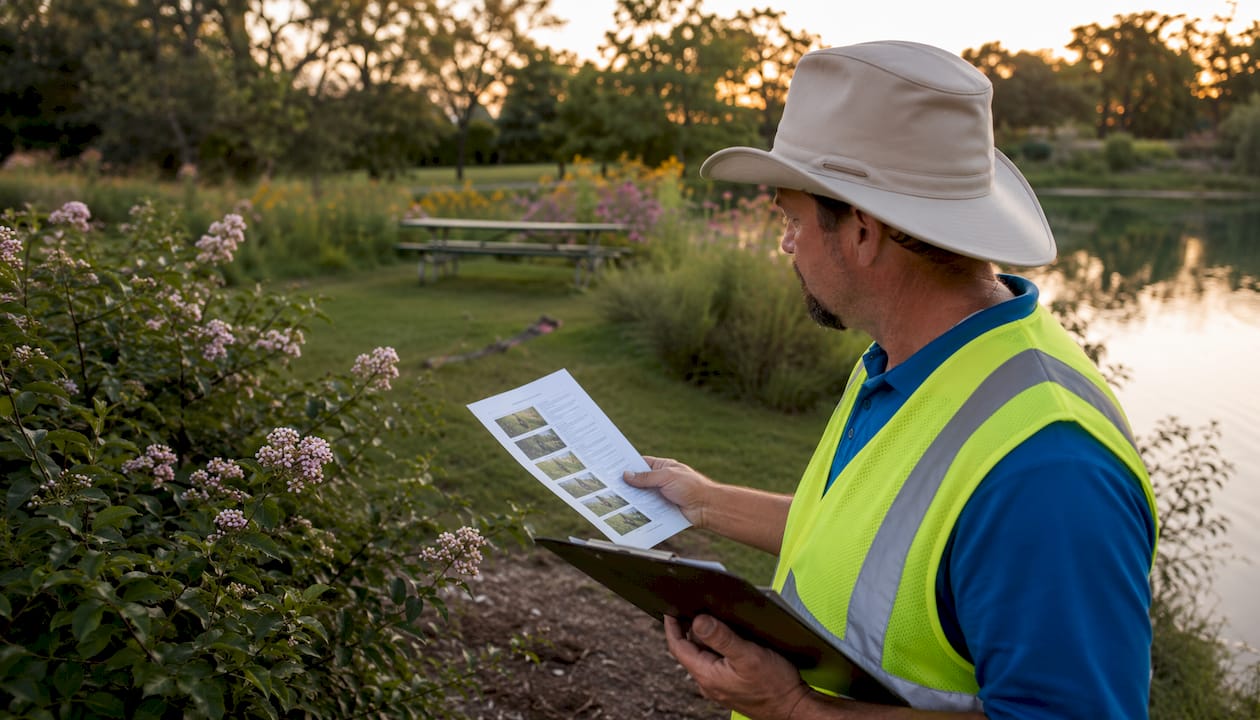
A commercial landscape inspection is a visual, safety-and-performance-focused walkthrough of a property’s exterior grounds. The inspector documents plant health, irrigation function, drainage conditions, hardscape integrity, and liability hazards, then ranks findings by priority so you can act on them. Per ComSOP Section 6.5.2, landscaping is explicitly included in a commercial property inspection — a meaningful distinction, since InterNACHI’s residential standards exclude it entirely from a standard home inspection.
The inspection’s primary questions are practical, not aesthetic:
- Always checked: safety hazards (trip hazards, overhanging branches, failing walls), drainage and erosion conditions, and irrigation function
- Usually out of scope: plant design decisions, color palette choices, and purely decorative evaluations
- Verdict on inclusion: ComSOP defines the inspection as a visual walk-through that collects observations and produces a meaningful report. Landscaping falls under Section 6.5.2 of the Exterior category, making it a required component of any compliant commercial property inspection.
Table of Contents
- What does a commercial landscape inspection actually cover?
- What will an inspector actually do — and what falls outside their scope?
- Red flags inspectors find most often — and what they cost you
- How inspection reports should be structured — and how to act on them
- How often should you schedule a commercial landscape inspection?
- Which standards and credentials should you reference?
- How to make every inspection strategic — budgeting, collaboration, and brand alignment
- Key Takeaways
- What actually separates a useful inspection from a wasted walkthrough
- Divinelandscapingllc turns inspection findings into real remediation
- Useful sources and standards to consult
What does a commercial landscape inspection actually cover?
A thorough commercial landscape assessment goes well beyond curb appeal. According to industry guidance, a complete walkthrough should address irrigation efficiency, tree and shrub health, drainage, hardscape integrity, and lighting. Here is the full checklist of site elements to confirm during any walkthrough:
Vegetation and plant health
- Trees: canopy condition, dead limbs, proximity to structures and utilities, root encroachment at paving
- Shrubs and groundcover: signs of disease, die-back, or overgrowth that blocks sightlines or signage
- Turf: bare patches, compaction, weed pressure, and evidence of irrigation miscoverage
- Mulch beds: depth, condition, and whether mulch is piled against building foundations
Drainage and grading
- Surface grade: does water drain away from the building, or pool near the foundation?
- Catch basins and inlets: clear of debris and functioning? Drainage maintenance at portfolio scale is one of the most underestimated cost drivers in commercial property management.
- Erosion channels: concentrated flow paths that are widening or undercutting hardscape
Irrigation
- Controller settings and seasonal programming
- Head coverage: dry zones, overspray onto pavement or buildings
- Visible leaks, broken heads, or standing water between cycles
Hardscapes
- Paving, curbs, and walkways: cracks, settlement, heave, or trip-hazard lips above ¼ inch
- Retaining walls: leaning, cracking, missing cap stones, or drainage failure behind the wall
- Steps and ramps: ADA compliance, surface condition, and handrail integrity
Site safety and operations
- Exterior lighting: coverage at entries, parking areas, and pedestrian paths; burned-out fixtures
- Signage visibility: vegetation obscuring wayfinding or traffic-control signs
- Debris and waste: accumulation near dumpster pads, storm drains, or building entries
- Sightlines at driveways and crosswalks: vegetation height and density
Contract and documentation checklist
- Confirm inspection frequency matches contract terms (pre-season and mid/end-of-season walkthroughs are standard per contract guidance)
- Verify photo coverage for every documented issue
- Confirm recommended trade referrals are noted in writing
What will an inspector actually do — and what falls outside their scope?
The inspector’s job is visual observation of readily accessible areas. ComSOP is explicit: the inspection should answer whether landscaping affects a building system, creates a pedestrian hazard, or shows signs of deferred maintenance — not whether the plant palette is attractive or the design is current.

| The inspector documents | The inspector does not do |
|---|---|
| Visible dead or declining vegetation | Invasive root probing or soil sampling |
| Trip hazards at paving and walkways | In-depth pest or disease diagnosis |
| Drainage patterns and erosion evidence | Irrigation pressure testing or flow measurement |
| Retaining wall movement or cracking | Structural engineering calculations |
| Irrigation coverage gaps and visible leaks | Plant design or species selection consulting |
| Lighting coverage and fixture condition | Horticulture or arborist-level tree risk assessment |
| Debris accumulation and sightline obstructions | Geotechnical or hydrological evaluation |
When findings exceed the visual scope, referrals matter. Call a certified arborist when a tree shows significant structural defects, decay, or proximity risk to the building. Bring in an irrigation technician when controller faults, pressure anomalies, or system-wide coverage failures are suspected. A structural engineer is warranted for retaining walls showing active movement or significant cracking. A landscape architect is the right call when findings point to a systemic design problem, not just deferred maintenance.
Red flags inspectors find most often — and what they cost you
Most commercial landscape liability claims trace back to a short list of recurring issues. Catching them early is almost always cheaper than reacting after an incident.
- Trip hazards at paving joints and walkways: Root uplift or frost heave can raise a slab edge above the ¼-inch threshold that creates a slip-and-fall exposure. A single incident can generate legal costs that dwarf the repair.
- Overhanging or dead branches: A dead limb over a parking area or entry walk is a documented liability. Removal is typically a few hundred dollars; a damage or injury claim is not.
- Failing retaining walls: Walls that lean, crack, or show drainage failure behind the face are at risk of sudden collapse. Rebuilding a failed wall costs significantly more than stabilizing one that is showing early distress.
- Clogged drains and concentrated erosion: Blocked catch basins redirect water toward foundations. Chronic erosion channels can undercut paving and destabilize slopes within a single season.
- Irrigation miscoverage and leaks: A zone running onto pavement or a head spraying a building facade can cause surface damage and mold conditions. Undetected leaks inflate water costs and saturate soils near foundations.
- Poor nighttime lighting: Inadequate coverage at entries and parking areas creates both a safety hazard and a tenant safety concern that property managers are often held accountable for.
- Vandalism and debris build-up: Accumulation near storm drains can trigger municipal compliance issues; debris near HVAC equipment or building entries creates fire and pest risk.
Pro Tip: When budget constraints force you to prioritize, address any finding that creates direct personal-injury exposure first, drainage issues second, and deferred vegetation maintenance third. Liability risk always outranks aesthetics in the repair queue.
How inspection reports should be structured — and how to act on them
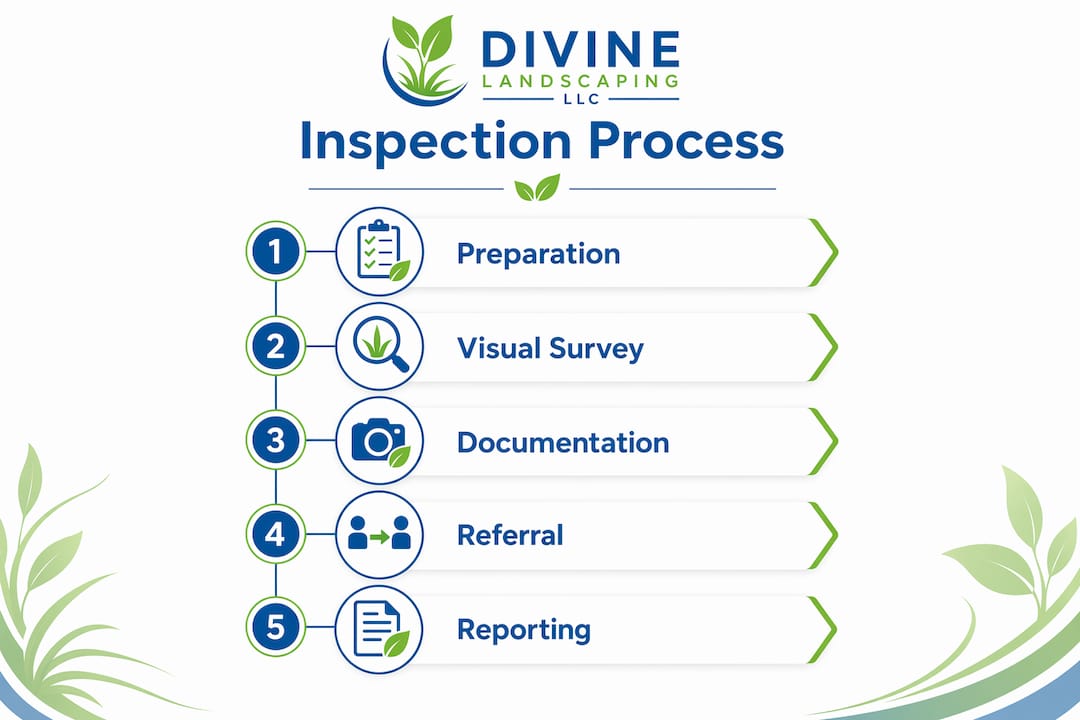
A useful inspection report delivers photos, prioritized recommendations, and clear action items. Here is what a well-structured report includes:
Report contents
- Executive summary: overall condition rating and the top three priority findings
- Photo-documented findings: each issue with location, description, and severity rating (critical, moderate, or monitor)
- Recommended trades: which contractor type should address each finding
- Urgency and budget notes: estimated timeframe for remediation and rough cost tier
- Appendix: full photo log, irrigation zone map if available, and prior inspection comparison
Converting the report into action
- Assign priority. Separate critical findings (immediate safety or building-impact risk) from moderate and monitor items.
- Obtain bids. Use the report’s finding descriptions as your scope of work when soliciting contractor proposals. Specific language reduces scope creep.
- Schedule remediation. Sequence work so drainage and structural repairs precede vegetation work — fixing a retaining wall after replanting the slope wastes both.
- Verify completion. Walk the site after each repair and photograph the corrected condition. This closes the loop for liability documentation.
For commercial landscape renovation planning, the inspection report is your baseline. It tells you what to fix before you decide what to improve.
How often should you schedule a commercial landscape inspection?
Frequency depends on property type, traffic volume, and contract terms. The table below gives a practical starting point.
| Property type / traffic level | Recommended inspection cadence |
|---|---|
| Low-traffic office or light industrial | Semi-annual (pre-season and post-season) |
| Retail strip, mid-traffic commercial | Quarterly minimum |
| High-traffic plaza, medical, or hospitality | Monthly formal inspection; weekly account manager check |
| Properties with complex irrigation or hardscape | Monthly during growing season |
| Post-storm or post-construction | Immediate out-of-cycle inspection |
Contract-based pre-season and mid/end-of-season walkthroughs are standard for most commercial landscaping agreements, but they are distinct from the weekly or bi-weekly quality checks an account manager performs. Both serve different purposes — do not substitute one for the other.
Event triggers that require an out-of-cycle inspection:
- Significant storm (wind, ice, or flooding)
- Post-construction activity near landscape areas
- Major tenant turnover or lease transition
- Suspected irrigation leak or controller failure
- Pest or disease outbreak in trees or turf
- Seasonal transitions: pre-winter shutdown and spring startup
Document every visit with date, inspector name, conditions observed, and photos. Consistent records are your best defense if a liability claim arises months after a known condition was identified and addressed.
Which standards and credentials should you reference?
The primary reference for commercial landscape inspections in the United States is the CCPIA (Certified Commercial Property Inspectors Association) and its governing document, the ComSOP (International Standards of Practice for Inspecting Commercial Properties). Section 6.5.2 of the ComSOP places landscaping within the Exterior inspection category and defines the inspection as a visual walk-through that produces a meaningful written report.
Key credentials and references to verify:
- Commercial inspection certification: Look for inspectors credentialed through CCPIA or an equivalent commercial inspection body. Residential-only certifications do not cover ComSOP scope.
- ISA Certified Arborist: When tree risk is a concern, verify the arborist holds International Society of Arboriculture credentials.
- Irrigation Association credentials: For irrigation audits beyond visual scope, an IA-certified technician provides defensible documentation.
- Municipal stormwater guidance: Most U.S. municipalities publish stormwater management requirements that affect how drainage findings must be addressed. Check your local MS4 permit requirements.
Useful references to keep on file:
- CCPIA’s ComSOP for inspection definitions and reporting expectations
- CCPIA’s dedicated article on inspecting landscaping at commercial buildings for scope guidance
- Irrigation Association technical guides for system testing protocols
- Your local municipality’s stormwater ordinance for drainage compliance thresholds
How to make every inspection strategic — budgeting, collaboration, and brand alignment
Most property managers treat inspections as a compliance checkbox. The ones who get the most value out of them treat each walkthrough as a planning session.
There are two distinct inspection types, and conflating them reduces the value of both. A due diligence inspection is investment-focused, typically performed by a certified commercial inspector following ComSOP, and produces a formal written report. An operational walkthrough is tactical, performed frequently by a landscape account manager, and focuses on maintenance quality and emerging issues. You need both.
Walking the site with your account manager transforms a routine check into a strategic session. Bring maintenance timelines and notes on chronic trouble spots. That context helps the account manager distinguish a new problem from a recurring one, and it changes the remediation recommendation.
Collaboration checklist for joint walkthroughs:
- Bring prior inspection reports and maintenance logs
- Note any tenant complaints about exterior conditions
- Flag areas with known drainage or irrigation history
- Discuss upcoming seasonal transitions and their impact on current conditions
- Set budget expectations before the walkthrough, not after
On budgeting: setting aside 10–15% of your annual landscape budget as a contingency for unplanned events — storm cleanup, irrigation repair, emergency tree removal — converts reactive spending into a predictable line item. Properties that plan for this spend less overall.
Your exterior also functions as a commercial brand touchpoint. Inspections are an opportunity to verify that the grounds support the experience your tenants and visitors expect, not just that they meet a minimum safety threshold.
Pro Tip: Keep a simple decision log for each inspection cycle: finding, chosen remediation, budget allocated, contractor assigned, and completion date. A one-page log per quarter gives you a defensible paper trail and a clear picture of where your landscape dollars actually go.
Key Takeaways
A commercial landscape inspection is a safety-and-performance walkthrough governed by ComSOP Section 6.5.2, producing a photo-documented, prioritized report that property managers use to schedule repairs, manage liability, and plan budgets.
| Point | Details |
|---|---|
| ComSOP requires landscape inspection | Section 6.5.2 of the ComSOP places landscaping within the Exterior category of every commercial property inspection. |
| Safety and building impact, not aesthetics | Inspectors assess trip hazards, drainage, irrigation, and structural conditions — not plant design or color choices. |
| Cadence by property type | Low-traffic commercial properties are typically inspected semi-annually (pre-season and post-season); retail and mid-traffic sites are best served by quarterly inspections; high-traffic or complex properties require monthly formal inspections, with weekly account manager checks during peak season. |
| Budget a 10–15% contingency | Reserve a portion of your annual landscape budget for unplanned events like storm cleanup or irrigation repair. |
| Divinelandscapingllc for NH remediation | Divinelandscapingllc converts inspection findings into documented proposals and phased remediation for commercial properties in New Hampshire. |
What actually separates a useful inspection from a wasted walkthrough
The most common mistake property managers make is scheduling an inspection without preparing for it. An inspector who walks a site cold, without access to prior reports or maintenance history, will document what they see — but they will miss the pattern. A retaining wall that has moved two inches over three years looks different from one that shifted two inches last month. Without the history, both get the same note.
Walking the property with both the inspector and the landscape account manager changes the diagnostic quality of the visit. The account manager knows which irrigation zone has been problematic since spring. The inspector knows what that symptom looks like in a report that will hold up if a claim is filed. Together, they catch things neither would alone.
One scenario that illustrates this: a property manager at a mid-size retail strip noticed a slight depression forming along a walkway near the building’s north entry. It had been noted as “monitor” in two prior reports. On the third inspection, the account manager pointed out that the depression aligned with an irrigation zone that had been running long cycles. The inspector flagged it for a drainage evaluation. The subsequent repair revealed a slow leak that had been saturating the sub-base for over a year. Catching it before the walkway failed saved a full pavement replacement and eliminated a documented trip-hazard exposure.
Before a walkthrough, inspectors benefit most when property managers provide:
- Prior inspection reports and any contractor invoices for past remediation
- A list of tenant-reported exterior complaints from the past 12 months
- Irrigation zone maps and controller logs if available
- Any known drainage or grading concerns, even informal ones
Divinelandscapingllc turns inspection findings into real remediation
Inspection reports tell you what needs fixing. Getting it fixed efficiently is a different problem — and that is where Divinelandscapingllc comes in. For commercial property managers in New Hampshire, Divinelandscapingllc provides a direct path from documented findings to completed work, without the coordination burden of managing multiple unrelated contractors.
Services map directly to the most common inspection findings: irrigation repair and seasonal startup, hardscape stabilization and retaining wall repair, drainage corrections, tree and shrub maintenance, and emergency storm cleanup. For multi-tenant properties, Divinelandscapingllc coordinates phased implementation so remediation work does not disrupt tenant operations.
The process is straightforward: a walkthrough with your property manager, a documented proposal tied to your inspection findings, and a phased implementation schedule you can align with your budget cycle. Ready to move from report to repair? Request a quote or schedule a site visit with the Divinelandscapingllc team.
Useful sources and standards to consult
- CCPIA ComSOP: The governing standard for commercial property inspections in the U.S. Start here for inspection definitions, reporting expectations, and scope guidance. Section 6.5.2 covers landscaping specifically.
- CCPIA: Landscaping in Commercial Inspections: A focused article explaining what the ComSOP requires for landscape assessment and what falls outside inspector scope.
- CCPIA: Inspecting Landscaping at Commercial Buildings: Practical guidance on what to look for during the landscape portion of a commercial walkthrough.
- Irrigation Association (IA): Publishes technical standards for irrigation system audits and efficiency testing. Use IA-credentialed technicians when inspection findings point to system-level irrigation problems.
- Your local MS4 stormwater permit: Municipal separate storm sewer system requirements govern how drainage findings must be addressed. Check your municipality’s public works or environmental services department for current requirements.
- ISA (International Society of Arboriculture): The credential authority for arborists. Verify ISA Certified Arborist status when tree risk assessment is warranted by inspection findings.