
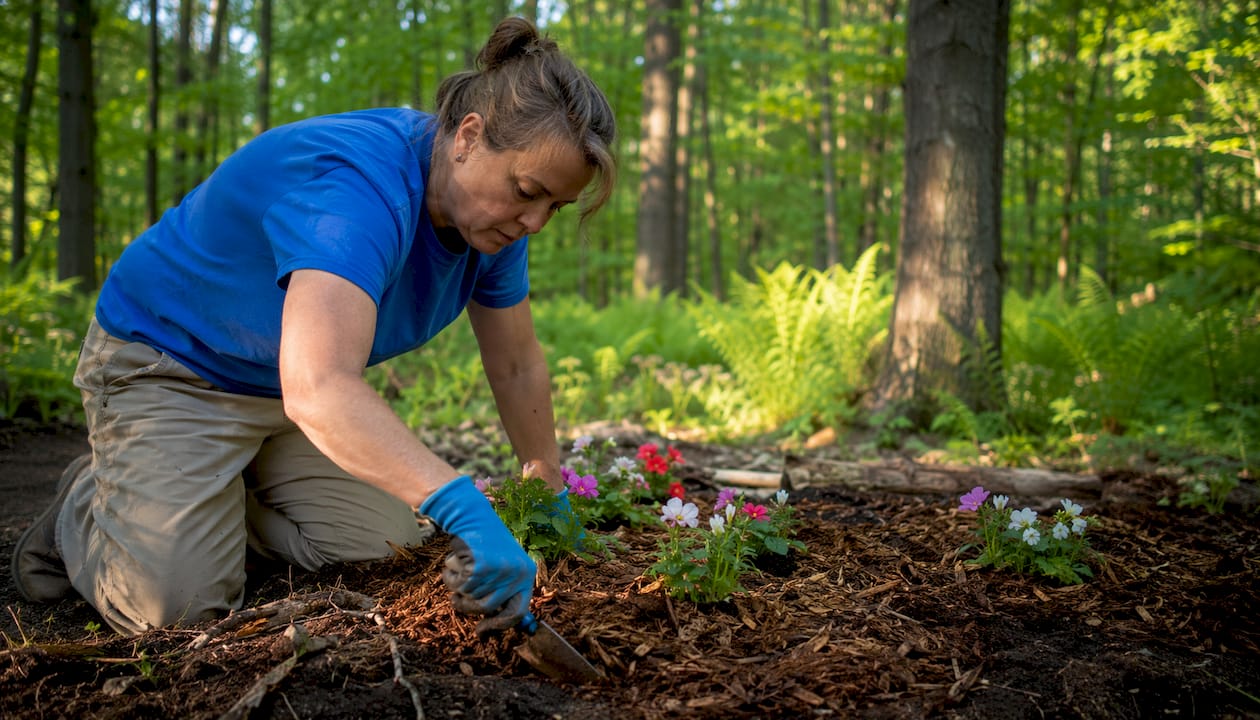
Mulch conserves moisture, suppresses weeds, moderates soil temperature, and — when organic — builds soil health over time. Applied correctly, it is one of the highest-return investments you can make in your yard. The two rules that matter most: keep settled depth between 2 and 4 inches, and never pile mulch against tree trunks.
Mulch’s five core functions at a glance:
- Moisture retention — reduces soil evaporation so plants stay hydrated between waterings
- Weed suppression — blocks light and physically impedes germination
- Temperature moderation — insulates roots from summer heat spikes and winter freeze-thaw cycles
- Erosion control — absorbs raindrop impact and slows surface runoff
- Soil building — organic mulches decompose into humus, feeding soil biology over time
Table of Contents
- What is mulch and where do you use it in your yard?
- How mulch helps your plants and soil — the core functions explained
- What are the common mulch types and their trade-offs?
- How do you choose the right mulch for your yard?
- How do you apply mulch correctly?
- When and how should you refresh mulch and fix common problems?
- What does the research say about mulch and long-term soil health?
- What are the practical rules every homeowner should follow?
- Key Takeaways
- A landscaper’s practical perspective on mulching
- Professional mulch installation and landscape maintenance from Divinelandscapingllc
- Useful sources and further reading
What is mulch and where do you use it in your yard?
Mulch is any material spread over the soil surface to modify the growing environment around plants. That covers a wide range of products, but they all fall into two categories: organic (wood chips, shredded bark, leaves, compost, straw, grass clippings) and inorganic (stone, gravel, rubber, plastic film, landscape fabric). Organic types decompose and feed the soil; inorganic types last longer but contribute nothing to soil fertility.
Homeowners use mulch in:
- Planting beds around trees, shrubs, and perennials
- Vegetable and herb gardens
- Foundation plantings along the house
- Slopes and erosion-prone areas
- Pathways and between stepping stones
- Rock gardens and hardscape accents
Living mulches — low-growing cover crops like clover or creeping thyme — are a fourth option worth knowing. They work well in orchard understories or large open areas where you want ground coverage without annual replenishment, though they compete with nearby plants for water and nutrients and are not ideal for most residential beds.
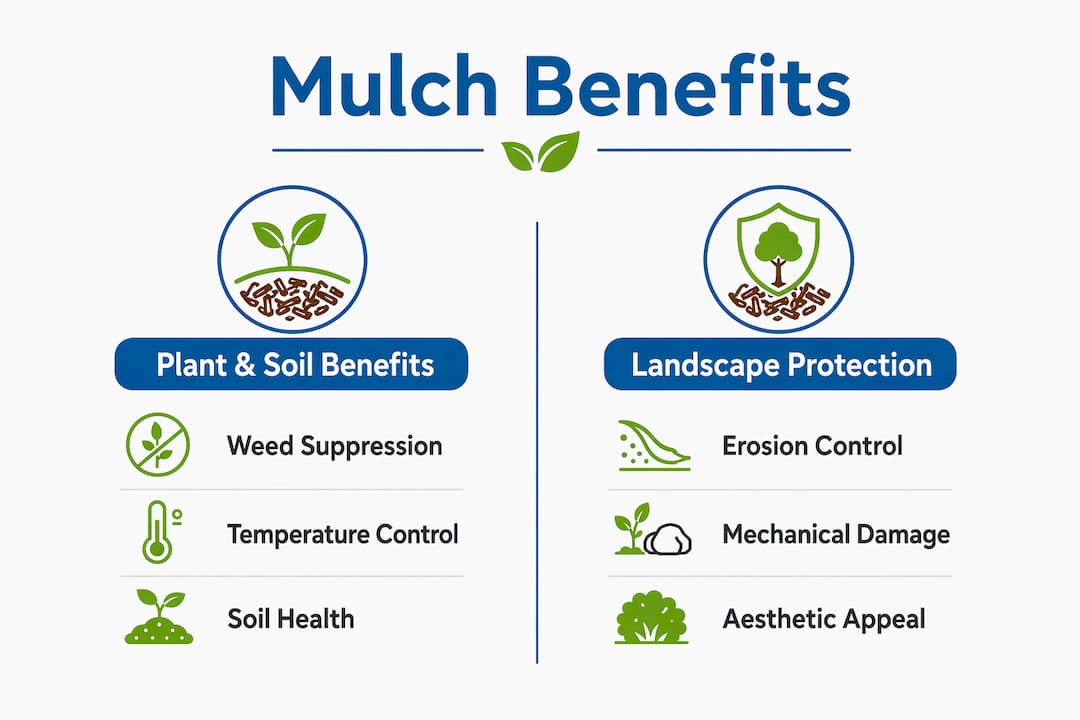
How mulch helps your plants and soil — the core functions explained
Moisture retention
Mulch reduces soil evaporation, helping maintain consistent moisture between rain events or irrigation cycles. Research shows that even a relatively thin layer of straw reduced evaporation by roughly 35% compared to bare soil. For homeowners, that translates to fewer watering days per week and lower water bills through a dry New England summer.
Statistic callout: A layer of straw just 1.5 inches thick reduced evaporation by about 35% compared to bare soil in controlled research — a meaningful reduction achievable with any organic mulch at proper depth.
Weed suppression
A moderate layer blocks the light that weed seeds need to germinate. Mulch also creates a physical barrier that slows emergence. You will still see some weeds push through, especially perennial types with deep root systems, but consistent mulching dramatically cuts the time you spend hand-weeding each season.
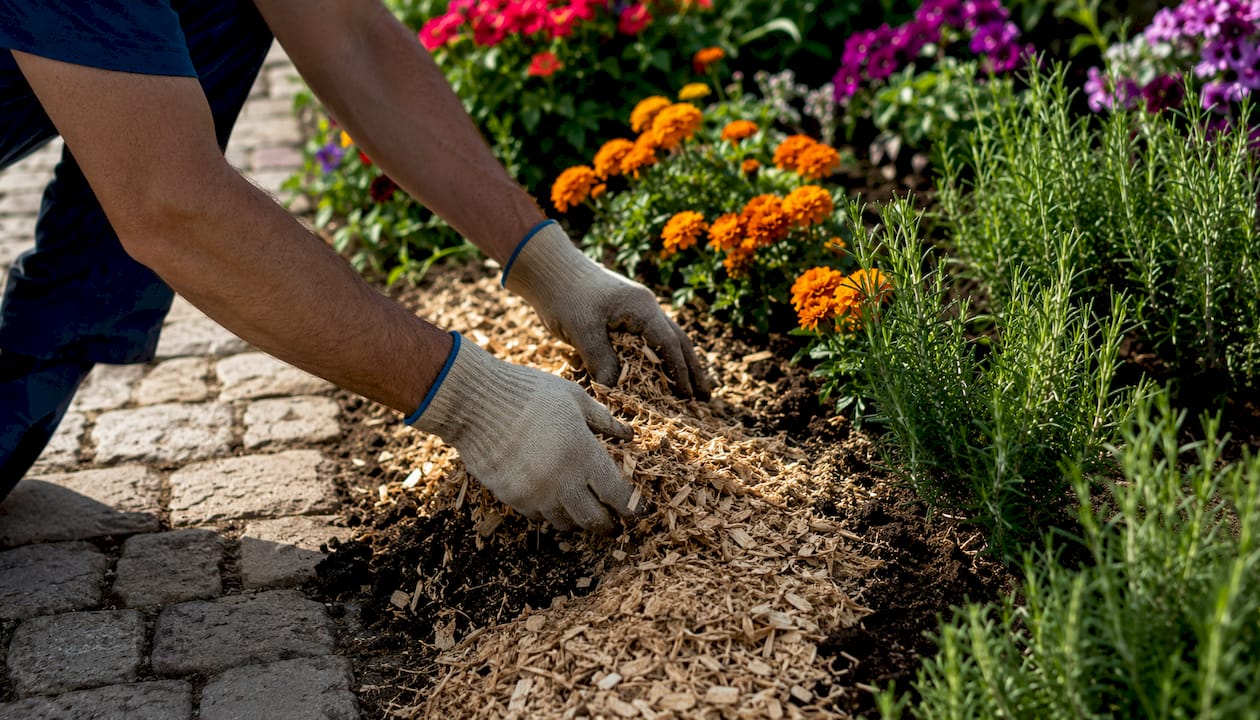
Temperature moderation
Bare soil swings widely between daytime heat and nighttime cold. Mulch acts as insulation, keeping root zones cooler in summer and warmer during early frosts. In northern climates like New Hampshire, that buffer also reduces frost heave — the cycle of freezing and thawing that can push shallow-rooted perennials right out of the ground over winter.
Erosion control
Mulch protects soil from raindrop impact and slows surface runoff, which is especially valuable on slopes and in exposed beds. Without that protective layer, heavy rain compacts bare soil, forms a surface crust, and carries topsoil away. A mulched slope holds its grade season after season.
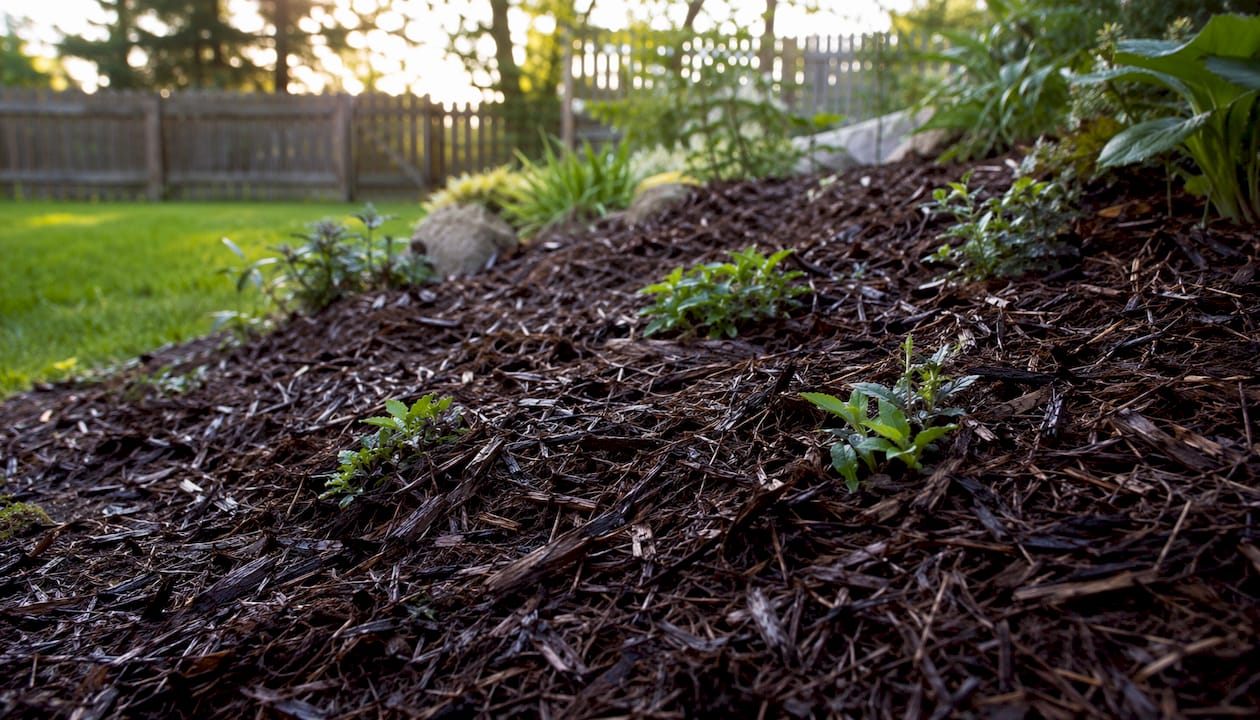
Soil biology and organic matter
Organic mulches decompose over time, adding humus that feeds soil microbes, earthworms, and beneficial fungi. Those organisms produce sticky compounds that bind soil particles into aggregates, improving drainage and oxygen infiltration. Inorganic mulches offer none of this — they are permanent ground covers, not soil builders.
Protection from mechanical damage
Mulch rings around trees and shrubs keep mowers and string trimmers away from bark. Bark damage is one of the most common — and preventable — causes of long-term tree decline in residential landscapes.
What are the common mulch types and their trade-offs?
Organic mulches
- Wood chips and shredded bark — the most widely used option for beds and tree rings. They decompose slowly, suppress weeds well, and improve soil over time. Coarser chips resist compaction better than finely shredded bark.
- Leaves (shredded) — free, locally sourced, and excellent for soil biology. Whole leaves can mat and repel water; run them through a mower or shredder first.
- Compost — adds nutrients immediately but breaks down quickly and offers less weed suppression than wood-based mulches. Best used as a thin top-dressing under a coarser mulch.
- Straw — ideal for vegetable gardens and strawberry beds. Lightweight, easy to apply, and breaks down in one season. Avoid hay, which carries weed seeds.
- Grass clippings — useful in thin layers (1 inch or less). Thick layers mat, heat up, and can produce ammonia odors.
Inorganic mulches
- Stone and gravel — long-lasting and low-maintenance, but they absorb and radiate heat, which can stress plants in full sun. Best suited for rock gardens, dry-climate plantings, and pathways.
- Rubber mulch — made from recycled tires, it lasts for years and cushions playground surfaces. It does not improve soil and can leach compounds over time; not recommended for vegetable gardens.
- Black plastic film — warms soil and boosts yields for heat-loving vegetables like tomatoes and peppers. It blocks water infiltration and prevents soil building, so it is not suitable for perennial beds.
- Landscape fabric — allows some water and air movement but clogs with sediment over time. More on its long-term trade-offs in the research section below.
Pro Tip: Before you buy bulk mulch, smell it. Sour mulch — material that smells like vinegar, ammonia, or sulfur — has fermented anaerobically and can emit toxic gases that damage or kill plants. Ask your supplier for composted, screened, weed-free material and request a compost analysis if you are buying in volume.
How do you choose the right mulch for your yard?
The right mulch depends on what you are planting, where it is growing, and how much maintenance you want to do. Run through this checklist before you buy:
- Soil drainage: Heavy clay soils benefit from coarser wood chips that resist compaction. Sandy soils retain moisture better under finer, compost-rich mulches.
- Plant sensitivity to heat: Avoid stone or rubber near heat-sensitive perennials and foundation shrubs. Organic mulches keep root zones cooler.
- Desired longevity: If you want a set-it-and-forget-it solution, stone or gravel lasts years. If you want soil improvement, choose organic and plan to replenish annually.
- Slope and erosion risk: Use coarser, heavier chips on slopes. Fine, light materials wash away in heavy rain.
- Budget: Locally sourced wood chips from a tree service are often free or very low cost. Dyed or bagged bark is convenient but more expensive per cubic yard.
Quick case examples:
- Small perennial bed: 2–3 inches of shredded bark or compost-topped wood chips. Keeps roots cool and feeds soil.
- Vegetable garden: Straw between rows, or black plastic for heat-loving crops. Remove plastic at season’s end.
- Foundation plantings: Shredded bark at 2–3 inches, kept 2–3 inches away from the base of each shrub and the house foundation.
- Sloped bed: Coarse arborist chips at 3–4 inches. Their weight and texture resist runoff better than fine bark.
- Rock garden: Pea gravel or crushed stone matched to the planting style. Avoid organic mulch, which looks out of place and can hold too much moisture for drought-tolerant plants.
For homeowners interested in sustainable mulch sourcing, look for locally produced material, certified compost, or arborist chips from a regional tree service. Imported or dyed mulches carry a larger carbon footprint and sometimes contain weed seeds or invasive plant material.
How do you apply mulch correctly?
Follow these steps for a clean, effective application every time.
- Clear the bed. Pull or cut all existing weeds. Do not bury them under mulch — perennial weeds will push through.
- Edge the bed. A clean edge keeps mulch contained and gives the bed a finished look. Proper edging also prevents grass from creeping into the mulched area.
- Check existing mulch depth. If you already have mulch in the bed, measure it. If the total will exceed 4 inches after adding new material, remove the excess first.
- Apply at the correct settled depth. See the table below for guidance by use type.
- Keep mulch away from plant bases. Maintain a 2–3 inch gap between mulch and the base of shrubs, perennials, and tree trunk flares.
- Water the bed. A light watering after application helps settle the mulch and initiates decomposition in organic types.
- Finish the edges. Tuck mulch neatly to the bed edge. Avoid mounding it against structures or fences.
Recommended settled mulch depth by use
| Use | Recommended Settled Depth | Notes |
|---|---|---|
| Perennial and shrub beds | 2–4 inches | Use 2 in. on clay soils; up to 4 in. on well-drained soils |
| Tree rings | 2–4 inches | Extend to drip line; never touch trunk flare |
| Vegetable gardens (straw) | a moderate depth | Remove or till in at season’s end |
| Foundation plantings | a moderate depth | Keep away from siding and plant crowns |
| Stone or gravel paths | depth varies depending on traffic and drainage needs | Depth depends on traffic and drainage needs |
Warning — avoid mulch volcanoes: Piling mulch against tree trunks is one of the most damaging practices in residential landscaping. It promotes stem girdling roots, bark decay, and vascular strangulation — all of which can kill a tree over several years. Keep a 2–4 inch mulch-free gap at the trunk flare and spread the ring outward toward the drip line instead. If you have existing volcano mulch, pull it back now and check the trunk for early signs of girdling roots.
When and how should you refresh mulch and fix common problems?
Seasonal maintenance checklist
- Spring: Fluff compacted mulch with a rake before adding new material. Check depth. Apply fresh organic mulch after soil has warmed slightly but before peak weed germination.
- Summer: Monitor for hydrophobic (water-repelling) dry patches in wood-based mulch. Break up the crust with a rake and water thoroughly.
- Fall: Add a light layer (1 inch) to protect perennial root zones from freeze-thaw cycles. Do not mulch too early — wait until after the ground has experienced its first hard frost in northern climates.
- Annual replenishment: Most organic mulches need topping up once per year. Stone and rubber mulches rarely need replenishment.
Troubleshooting common problems
- Sour mulch odor: Spread the mulch thinly and let it off-gas for 24–48 hours before applying to beds. If the smell persists, return it to the supplier.
- Excessive depth: Measure before adding. If total depth already exceeds 4 inches, remove the bottom layer rather than adding more.
- Rodent activity: Keep mulch 2–3 inches away from plant bases and house foundations. Voles in particular use thick mulch as cover to chew bark and girdle plants.
- Compaction and matting: Rake organic mulch annually to break up compacted layers and restore aeration.
- Landscape fabric clogging: Fabric that has been in place for several years often becomes embedded with sediment and debris, blocking water and air. At that point, removal and replacement with a fresh organic layer is more effective than trying to clean it.
Pro Tip: Check existing mulch depth before every application. Push a ruler or stick into the mulch layer in several spots. If you are already at 4 inches, skip the new material entirely and just fluff what is there. Adding more is one of the most common — and most avoidable — mulching mistakes homeowners make.
For a broader look at seasonal landscape maintenance in New England, timing your mulch refresh to align with the rest of your yard care calendar makes the whole process more efficient.
What does the research say about mulch and long-term soil health?
The evidence from Extension and university research is consistent: organic mulches build healthier soils over time, while inorganic mulches do not. As organic material decomposes, it feeds soil microbes that produce the sticky compounds binding soil particles into aggregates. Those aggregates improve drainage, oxygen infiltration, and root exploration. Bare soil loses this structure quickly through oxidation and compaction.
Landscape fabric presents a specific long-term risk that many homeowners underestimate. Research cited by Washington State University Extension shows that fabric can drastically reduce soil-atmosphere gas exchange compared to wood chip mulch. Over several seasons, that restriction harms root health and suppresses the soil biology that organic mulches are designed to support. Landscape fabric may suppress weeds in year one, but by year three or four it is typically clogged with sediment, lifting at the edges, and doing more harm than good in planted beds.
Sustainability and sourcing also matter. Key risks to watch for:
- Invasive species: Some wood chip sources contain seeds or plant material from invasive species. Ask your supplier where the material originates.
- Sour mulch: Improperly composted material can emit toxic gases on contact with moist soil. Always smell-test before applying.
- Dyed mulches: Colorants are generally considered safe, but dyed mulches are often made from recycled wood pallets that may have been treated with chemicals. When in doubt, choose undyed, locally sourced material.
- Allelopathic effects: A small number of organic materials — notably fresh black walnut chips and eucalyptus — release compounds that inhibit the growth of nearby plants. Avoid using them in beds with sensitive perennials or vegetables.
A short sourcing checklist for buyers: ask for composted and screened material, confirm the source species, request a compost analysis for large orders, and reject anything that smells fermented.
What are the practical rules every homeowner should follow?
Five rules cover the vast majority of mulching situations:
- Apply a moderate settled depth, enough to balance weed suppression with soil aeration. Use 2 inches on clay soils and up to 4 inches on well-drained sandy soils. More is not better.
- Keep mulch 2–4 inches away from trunk flares. This single rule prevents the majority of mulch-related tree damage.
- Choose composted organics for planted beds. They improve soil biology, moderate temperature, and reduce maintenance over time.
- Inspect before you add. Measure existing depth every spring. Replenish only what has decomposed.
- Avoid permanent landscape fabric in planted beds. It degrades soil gas exchange and becomes a maintenance problem within a few seasons.
Consistent mulching simplifies garden management, reduces cultivation needs, and builds the kind of living soil that supports healthy plants year after year. Applied at the right depth, with the right material, and kept away from plant crowns and trunk flares, mulch is one of the most practical tools available to any homeowner who wants a lower-maintenance, better-looking yard.
Key Takeaways
Organic mulch applied at 2–4 inches of settled depth is the single most effective, low-cost step a homeowner can take to improve plant health, reduce watering, and build long-term soil quality.
| Point | Details |
|---|---|
| Correct depth matters | Apply 2–4 inches of settled organic mulch; never exceed 4 inches total in any bed. |
| Mulch volcanoes cause real damage | Keep a 2–4 inch mulch-free gap at every trunk flare to prevent girdling roots and bark decay. |
| Organic mulches build soil | Wood chips, bark, and leaves decompose into humus that feeds soil biology; stone and rubber do not. |
| Landscape fabric has limits | Fabric clogs with sediment over time, restricting gas exchange and harming root health in planted beds. |
| Divinelandscapingllc can help | Professional mulch installation, bed prep, and sourcing guidance are available from Divinelandscapingllc for New Hampshire homeowners. |
Pro Tip: Keep a bag of composted mulch on hand for spot repairs after heavy rain events. A quick top-up on eroded areas takes five minutes and prevents a much larger soil-loss problem by the end of the season.
A landscaper’s practical perspective on mulching
What professionals actually do differently
Most homeowners think about mulch once a year, in May, when the garden centers stack it by the pallet. Professionals think about it in March, before the ground fully thaws, and again in October, before the first hard frost. That timing difference alone produces noticeably better results.
Site assessment comes first. Before any mulch goes down, the bed gets inspected: existing depth measured, compacted layers broken up, and any sour or matted material removed. Skipping that step and just adding new mulch on top is how beds end up with 6 or 8 inches of decomposing material that repels water and suffocates roots.
For foundation plantings, the preference at Divinelandscapingllc is shredded bark at 2–4 inches, kept well clear of both the house siding and the plant crowns. For tree rings, coarser arborist chips at 2–4 inches, extended as far toward the drip line as the property allows. The wider the ring, the more benefit the tree gets. A 2-foot ring looks tidy but does very little for a mature tree’s root system.
Sourcing is where many homeowners cut corners without realizing it. Bagged mulch from a big-box store is convenient, but bulk composted material from a local supplier is almost always better quality and significantly cheaper per cubic yard. Ask for the compost analysis. If the supplier cannot provide one, that tells you something.
The mulch-volcano problem is so common in residential neighborhoods that it is worth repeating: those mounded cones of mulch piled against tree trunks are not decorative. They are slow-motion tree killers. Pull the mulch back, expose the trunk flare, and keep it clear every season.
Professional mulch installation and landscape maintenance from Divinelandscapingllc
Your yard deserves more than a bag of mulch tossed down in May. Divinelandscapingllc provides complete mulch installation, bed preparation, and seasonal refresh programs for residential properties across New Hampshire. The difference between a well-mulched bed and a poorly mulched one shows up in plant health, water bills, and curb appeal — and it starts with sourcing quality composted material, applying it at the right depth, and keeping it away from plant crowns and trunk flares.

Every project starts with a site assessment. Divinelandscapingllc evaluates existing bed conditions, measures current mulch depth, identifies problem areas like compaction or sour material, and recommends the right mulch type for your soil, plants, and aesthetic goals. Whether you need a one-time installation or a recurring landscape maintenance program, the team handles sourcing, delivery, and application so you do not have to. For homeowners planning larger projects that include new beds, edging, or planting, the landscape design service integrates mulching strategy from the start. Ready to get a clear picture of what your yard needs? Request a quote and a Divinelandscapingllc team member will follow up to schedule a site visit.
Useful sources and further reading
These Extension and university resources back the recommendations in this article. Use them to verify specific guidance, ask better questions when buying mulch, or go deeper on any topic.
- Garden Mulches Fact Sheet — UNH Extension: Covers mulch types, application timing, and depth guidance for New England homeowners. A practical starting point for anyone new to mulching.
- Mulching for Soil and Garden Health — UMN Extension: Explains moisture retention, soil tilth, and the long-term benefits of consistent organic mulching. Use this to understand why mulch reduces irrigation needs.
- Organic Mulches — University of Illinois Extension: Detailed breakdown of organic mulch types and their soil-building properties. Useful when comparing wood chips, bark, and compost.
- Wood Mulch and Tree Health — UW-Madison/WDNR: Covers depth recommendations, sour mulch risks, and the importance of keeping mulch away from trunk flares. The primary source for the 2–4 inch depth guidance cited here.
- Is Landscape Fabric a Good Idea? — WSU Extension (Dr. Linda Chalker-Scott): The most authoritative research-backed critique of permanent landscape fabric in planted beds. Essential reading before you install any weed barrier.
- Mulches — Missouri Botanical Garden: Covers erosion control, mulch categories, and use-case guidance. Helpful for slope and drainage situations.
- Mulching: Purpose, Benefits, and Essential Information — Virginia Tech Extension: Addresses plastic mulch, soil warming, and when inorganic options are appropriate for vegetable production.
- Impact of Mulches on Landscape Plants and the Environment — University of Nebraska-Lincoln: Peer-reviewed literature review comparing organic, inorganic, and living mulches across soil moisture, root health, and plant establishment outcomes. The source for the 35% evaporation reduction figure.
- Mulch Volcanoes — Pacific Arboriculture: Detailed explanation of how volcano mulching causes stem girdling roots, bark decay, and vascular strangulation. Use this when advising anyone who has mounded mulch against tree trunks.
- Shining a Spotlight on Mulch Volcanoes — Ohio State University BYGL: Ohio State Extension’s practical guide to proper mulch ring application and the long-term consequences of over-mulching. Backs the 2–3 inch depth recommendation for tree rings.
- Divinelandscapingllc Blog: Local perspective on mulching, seasonal maintenance, and landscape care in New Hampshire, with additional resources for homeowners planning bed installations or refreshes.