

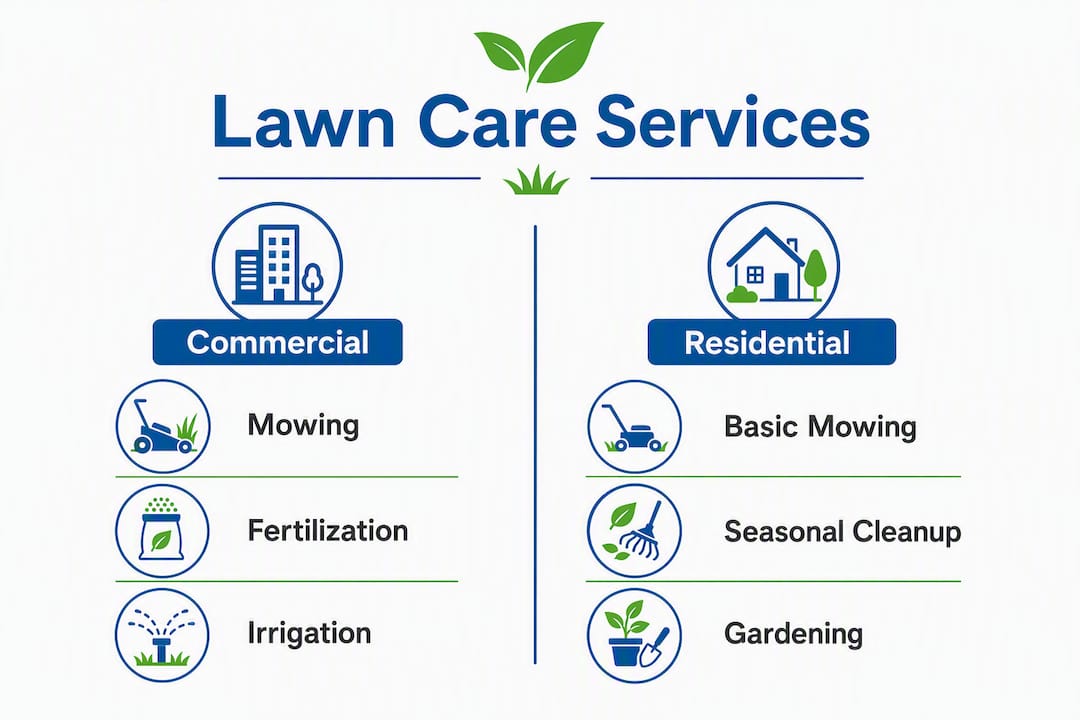
Commercial lawn care is the professional management of outdoor turf and grounds on business, retail, municipal, or multi-tenant properties. It typically covers routine mowing and edging, turf health programs (fertilization, weed control, and pest monitoring), irrigation management, and seasonal services such as aeration, overseeding, and leaf removal. Think of it as grounds management rather than simple grass cutting: the goal is a consistently maintained exterior that protects your property’s value, reduces liability, and meets any local environmental or water-use requirements.
Core services at a glance:
- Mowing, edging, and debris cleanup on a defined schedule
- Fertilization, weed control, and turf health programs
- Irrigation startup, monitoring, and mid-season repairs
- Pest and disease monitoring
- Seasonal services: aeration, overseeding, leaf removal, bed maintenance
The sections below walk through why this investment matters, what a contract should include, what it costs, and how to choose a provider you can trust.
Table of Contents
- Why commercial lawn care matters for your property’s bottom line
- What services commercial lawn care covers and how they appear in a contract
- How commercial lawn care differs from residential service
- Typical pricing models and what to watch for in contracts
- How to evaluate and choose a commercial lawn care provider
- What the research says about the financial and environmental payoff
- Key Takeaways
- What a commercial landscaper actually prioritizes in your contract
- Divinelandscapingllc handles commercial grounds so you can focus on your property
- Useful sources and further reading
Why commercial lawn care matters for your property’s bottom line
Your property’s exterior is the first thing tenants, customers, and visitors see. A well-maintained lawn signals that the building is managed professionally, and that impression has measurable financial weight. Quality landscaping and healthy lawns can increase property values by roughly 10–15%, and that uplift tends to support stronger lease rates and faster tenant attraction.

Safety and liability are equally concrete. Overgrown turf, uneven ground, and poorly maintained beds create slip and trip hazards along walkways and parking areas. On a commercial property with regular foot traffic, those hazards translate directly into liability exposure. A documented maintenance program with a clear schedule and service logs gives you a defensible record if a claim arises.
Regulatory compliance adds another layer. Many municipalities in the U.S. impose water-use restrictions, stormwater management requirements, or pesticide-application rules that apply specifically to commercial properties. A provider who understands local ordinances keeps you on the right side of those rules without you having to track every update yourself.
Statistic callout: Research from the National Association of Landscape Professionals cites noise reductions of about 30–40% for well-maintained green spaces compared to hard surfaces, along with significant cooling effects versus asphalt. For a retail or office property, that translates to a more comfortable exterior environment and potential energy savings on cooling.
Treating grounds maintenance as an asset-management line item, rather than a discretionary expense, is the framing that holds up when you present the budget to stakeholders.

What services commercial lawn care covers and how they appear in a contract
Commercial landscaping covers a broader scope than most owners expect when they first request a quote. Providers typically structure contracts in two tiers: a base maintenance agreement and separately priced supplemental programs.
Base maintenance (usually included in the recurring fee):
- Mowing and edging: Performed on a fixed schedule (weekly or bi-weekly during the growing season). Covers turf cutting at the correct height for the grass species, crisp edging along walks and curbs, and blowing clippings off hard surfaces.
- Trimming and bed maintenance: String-trimming around obstacles, pruning ornamental shrubs to maintain shape, and keeping bed edges defined. Frequency varies by property type.
- Debris and trash cleanup: Removal of clippings, leaves, and litter from turf and paved areas after each visit.
Supplemental programs (commonly billed separately):
- Fertilization and weed control: A seasonal program, typically four to six applications per year, tied to soil temperature and turf growth cycles. Pre-emergent and post-emergent herbicide applications are usually separate line items.
- Pest and disease monitoring: Scouting for grubs, chinch bugs, fungal disease, and other turf threats. Integrated Pest Management (IPM) protocols reduce chemical use and are increasingly required by municipal contracts.
- Irrigation startup, monitoring, and repairs: Spring activation, mid-season head adjustments, and winterization. Repairs to broken heads or controllers are typically billed at an hourly rate.
- Aeration and overseeding: Fall core aeration improves drainage and reduces compaction; overseeding fills thin areas. Almost always a separate line item.
- Leaf removal: Scheduled fall cleanups, often priced per visit or as a seasonal package.
Pro Tip: Ask every provider to supply a written scope of work that lists each service, its frequency (e.g., “mowing every 7 days, May through October”), and what triggers an add-on charge. Vague language like “as needed” in a base contract is the most common source of billing disputes.
How commercial lawn care differs from residential service
The gap between a residential lawn service and a commercial grounds program is wider than most property owners realize. It is not just about acreage.
| Dimension | Residential | Commercial |
|---|---|---|
| Equipment | Walk-behind or small zero-turn mowers | Industrial-grade mowers with wider decks, higher engine output, and heavy-duty frames |
| Crew size | 1–2 technicians | 2–6+ crew members depending on site size |
| Scheduling | Flexible, weather-adjusted | Fixed windows, often before or after peak business hours |
| Documentation | Informal or none | Service logs, photo records, and COI required |
| Insurance | Basic liability | Commercial general liability, bonding, and workers’ comp |
| Contract structure | Month-to-month or seasonal | Annual or multi-year with defined SLAs |
| Regulatory compliance | Minimal | Water-use, pesticide licensing, and stormwater rules may apply |
A few practical differences to confirm in any commercial proposal:
- Certificate of insurance (COI) naming your property as an additional insured
- Crew size and equipment types assigned to your site
- Defined service windows that avoid disrupting tenants or customers
- A clear escalation process for irrigation failures or storm damage
- State pesticide applicator license number for any chemical programs
One important note: “commercial” describes the scale and operational structure of the service, not necessarily the quality of materials used. A commercial contract gets the job done faster and at higher volume. Premium turf products, specialty plantings, or design upgrades are separate conversations.
Typical pricing models and what to watch for in contracts
Commercial lawn care pricing follows a few standard models. Understanding which one a provider is using helps you compare quotes accurately.
| Pricing model | How it works | Best for |
|---|---|---|
| Per-visit flat fee | Fixed charge per service visit | Small properties with simple scope |
| Per-acre rate | Charged by acreage mowed | Mid-size to large sites |
| Hourly rate | Billed by crew hours on site | Variable-scope or add-on work |
| Seasonal flat fee | One price covers all base visits for the season | Predictable budgeting |
| Annual line-item contract | Full-year program with each service priced separately | Multi-service programs |
Published cost data from HomeGuide puts commercial landscape maintenance at $40–$80 per hour per worker, mowing at $50–$150 per acre for properties under 5 acres, and $25–$60 per acre for sites of 5 acres or more. A full-service package runs $800–$1,600 per acre monthly. Those ranges shift based on your region, property complexity, and the services bundled in.
Contract clauses to review carefully:
- Scope clarity: Every service should be named, not implied. If fertilization is not listed, assume it is excluded.
- Frequency schedule: Specific numbers (“8 mowing visits per month, April–November”) beat open-ended language.
- Add-on authorization: Who approves unplanned work, and at what rate?
- Insurance requirements: COI with your property named, plus workers’ compensation coverage.
- Termination and notice: Standard commercial contracts require 30–60 days’ written notice. Shorter is better for you.
- Force majeure: How weather delays are handled and whether missed visits are rescheduled or forfeited.
- Invoicing cadence: Monthly in advance or in arrears? Confirm before signing.
On timeline: expect visible turf improvements within 4–6 weeks of starting a fertilization and weed control program. Full turf recovery from compaction or thin areas after aeration and overseeding typically takes one full growing season.
How to evaluate and choose a commercial lawn care provider
Choosing the right provider is a vetting process, not just a price comparison. Here is a structured framework.
Selection criteria checklist:
- Commercial general liability insurance and bonding (request the COI before signing)
- References from comparable commercial properties (office parks, retail centers, multi-tenant buildings)
- Localized experience with your region’s turf types, climate, and municipal rules
- Written scope of work with defined frequencies and SLAs
- State pesticide applicator license for any chemical programs
- IPM training or certification for pest and weed management
- Equipment appropriate to your site’s size and access constraints
- Documented safety procedures and crew training records
Questions to ask during a site visit or RFP:
- What is the crew size assigned to this property, and do you use subcontractors?
- How do you handle missed visits due to weather, and what is your makeup schedule?
- Can you provide your state pesticide license number and proof of current insurance?
- What is explicitly excluded from the base contract?
- How do you document service completion (photos, digital logs, sign-off sheets)?
- What is your response time for irrigation failures or storm damage?
Red flags to watch for:
- Frequency described as “as needed” with no defined schedule
- No written scope of work offered before signing
- Missing or expired insurance certificate
- Quotes delivered without a site walk
- Pressure to sign a multi-year contract with no performance SLAs
- No answer on pesticide licensing
Industry guidance on commercial landscaping compliance recommends requiring certificates of insurance that name your property, written maintenance schedules, and documented safety procedures to reduce owner liability. For multi-tenant properties, service logs and post-visit photos are especially useful when tenant complaints arise.
Pro Tip: Request that service logs be delivered digitally after each visit. A provider who documents their work with photos and timestamps is one who stands behind their SLAs.
What the research says about the financial and environmental payoff
The business case for professional grounds management is backed by more than curb appeal. Turfgrass research from Kansas State University Extension documents that healthy turf filters stormwater runoff, reduces erosion, traps dust and pollen, and contributes to soil health. For a commercial property, those functions reduce your stormwater management burden and can support compliance with municipal runoff ordinances.
Statistic callout: University of Minnesota Extension notes that turfgrass provides flood control, reduces noise, creates a cooling effect during warm weather, and prevents erosion on slopes. On a commercial site, the cooling effect alone can reduce heat island conditions around building entrances and parking areas.
The financial picture is similarly clear. Industry data shows property value uplifts of roughly 10–15% tied to quality landscaping, and professional grounds management often pays for itself through higher property values and reduced deferred maintenance costs. A retail property with a consistently maintained exterior attracts higher-quality tenants and supports stronger lease negotiations.
For owners weighing the investment, the benefits of professional landscape design extend beyond aesthetics: reduced erosion, better drainage, and lower long-term maintenance costs are all measurable outcomes of a well-planned grounds program.
Key Takeaways
Commercial lawn care is a structured grounds management program that protects property value, reduces liability, and delivers measurable environmental and financial returns when contracted with the right provider.
| Point | Details |
|---|---|
| Define the full scope upfront | Base contracts cover mowing and cleanup; fertilization, irrigation, and aeration are typically billed separately. |
| Require documentation and insurance | Always request a COI naming your property and ask for digital service logs after each visit. |
| Budget with real cost ranges | Commercial maintenance runs $40–$80 per hour per worker or $800–$1,600 per acre monthly for full-service programs. |
| Vet providers on certifications | Confirm state pesticide licensing, IPM training, and commercial liability coverage before signing. |
| Divinelandscapingllc for NH and MA properties | Divinelandscapingllc provides commercial landscaping and grounds programs for business properties in New Hampshire and neighboring Massachusetts. |
What a commercial landscaper actually prioritizes in your contract
Most property owners focus on price when comparing proposals. After working with commercial properties across New Hampshire and Massachusetts, we at Divinelandscapingllc consistently see the same pattern: the contracts that cause problems are the ones with vague frequency language and no documentation requirements, not the ones with the lowest price.
Our recommendation is to prioritize three things above everything else. First, a written scope with specific visit counts and defined service windows. Second, a COI that names your property as an additional insured. Third, a clear escalation path for irrigation failures, because a broken zone left unaddressed for a week can undo months of turf work.
We schedule irrigation checks at startup, mid-season, and winterization, and we provide proof-of-service reporting after each visit. For multi-tenant properties, that documentation record is not optional; it is the difference between a manageable tenant complaint and a liability claim.
Local licensing matters too. In New Hampshire, pesticide applicators must hold a valid state license issued by the NH Division of Pesticide Control. Ask for that license number before any chemical program begins, and verify it is current. Any provider who hesitates on that request is a provider worth reconsidering.
Divinelandscapingllc handles commercial grounds so you can focus on your property
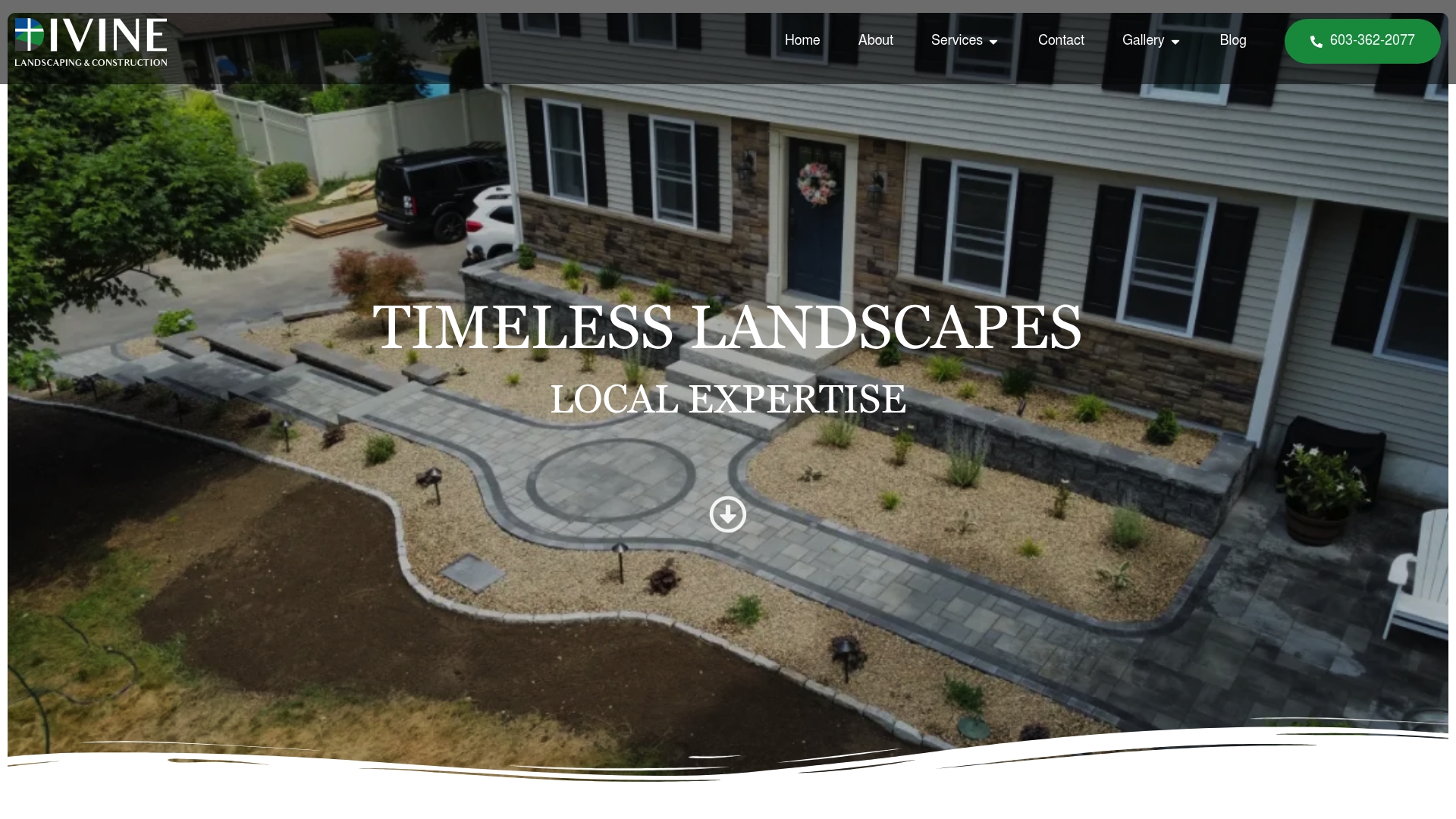
Property owners in New Hampshire and Massachusetts who want a single contractor for grounds maintenance, irrigation, and landscape installation get a cleaner result when those services come from one team with a shared plan. Divinelandscapingllc brings commercial landscaping experience across office, retail, and multi-tenant properties, with written scopes, documented service logs, and full insurance coverage on every contract.
Whether you manage a single commercial building or a multi-tenant property with complex grounds needs, the starting point is a site walk and a line-item proposal. You will know exactly what is included, what is billed separately, and what the schedule looks like before you sign anything. Request a quote to get a written proposal for your property.
Useful sources and further reading
The following sources informed this guide and are worth bookmarking for deeper research:
- Environmental benefits of healthy lawns — UMN Extension: University-backed overview of turfgrass functions including erosion control, flood management, and cooling effects.
- Benefits of Healthy Turfgrass (MF2940) — Kansas State University Extension: Research summary on noise reduction, water filtration, and soil health benefits of maintained turf.
- Six benefits of healthy lawns — National Association of Landscape Professionals: Industry summary of environmental and economic benefits, including the 30–40% noise reduction figure.
- Commercial lawn care cost — HomeGuide: Current market-rate data for hourly, per-acre, and full-service pricing across the U.S.
- Commercial landscaping: maximize value and compliance — ProZone LTD.: Practical guidance on documentation, insurance, and compliance best practices.
- Commercial landscaping for New Hampshire property owners — Divinelandscapingllc: Scope, contract structure, and service details specific to NH commercial properties.
For state- or municipality-specific water-use restrictions and pesticide application rules, contact your local university cooperative extension office or your municipal public works department. Rules vary by county and are updated regularly, so a direct inquiry is more reliable than any general guide.