
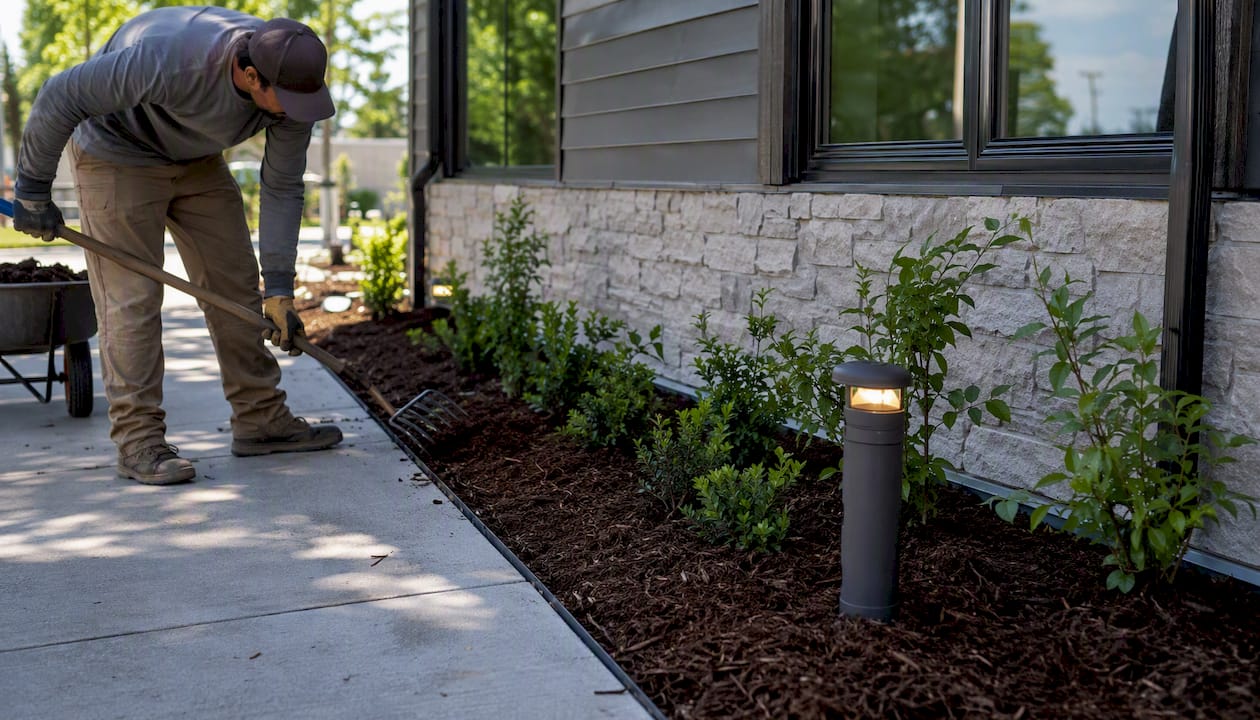
Five moves account for most of the visible improvement on a commercial property: pressure washing and concrete repair, exterior lighting and signage upgrades, a durable landscaping refresh, a cleaner entry sequence, and a documented maintenance schedule that keeps all of it looking intentional. Property managers who tackle these in that order usually see the fastest shift in how tenants and customers perceive the site, because professional landscaping delivers measurable benefits including improved property value, tenant retention, and customer traffic, according to the National Association of Landscape Professionals.
Here’s why the order matters. A fresh landscape bed next to cracked pavement or a flickering light fixture reads as neglect, not investment. Clean first, repair second, then layer in the upgrades that make people stop and look. At Divine Landscaping LLC, we’ve built commercial programs around this exact sequence for property owners across New Hampshire and Massachusetts, and the pattern holds regardless of property type: strip mall, office park, or multi-tenant building.
Start this week with:
- Schedule a pressure washing pass on sidewalks, building facades, and parking areas.
- Walk the parking lot and flag every cracked slab, faded stripe, and burned-out light.
- Clear sightlines at the entrance so the storefront or lobby is visible from the road.
- Refresh mulch beds and remove any dead or overgrown plant material.
- Book a window cleaning service for street-facing glass.
Pro Tip: Photograph the property before you start any work. Before-and-after photos are the single most persuasive tool you’ll have when justifying a budget to ownership or showing prospective tenants what’s changed.
Key Takeaways
Improving commercial property curb appeal works best when cleaning and repair come first, followed by lighting, signage, and landscaping upgrades tracked against a real business metric.
| Point | Details |
|---|---|
| Clean and repair first | Pressure washing, striping, and concrete patching create the biggest visible change per dollar spent. |
| Layer in lighting and signage | Even, warm lighting and legible signage improve safety and evening visibility for tenants and customers. |
| Choose durable, low-maintenance plants | Native and drought-tolerant species cut ongoing costs and support clear sightlines near entrances. |
| Fix hardscape and ADA compliance | Cracked pavement and unclear accessible routes create liability, not just an appearance problem. |
| Track a real metric | Tie every upgrade to lease velocity, foot traffic, or fewer safety claims rather than treating it as decoration. |
| Work with a specialist for larger scopes | Divine Landscaping LLC scopes commercial projects from site assessment through phased installation and maintenance. |
Table of Contents
- Eight High-Impact, Low-Cost Curb Appeal Fixes
- Facade, Windows, and Roofline Repairs That Signal Care
- Commercial Landscaping That Looks Sharp Without Raising Costs
- Walkways, Parking, and Accessibility Fixes That Reduce Liability
- Lighting and Signage That Sell the Property After Dark
- Designing an Entry Sequence That Invites People In
- Budgeting and Scheduling Curb Appeal Work in Phases
- Curb Appeal Mistakes That Waste Budget
- A Commercial Curb Appeal Renovation, Start to Finish
- Signage and Wayfinding That Guide Visitors In
- Getting Property Managers, Tenants, and Contractors on the Same Page
- Making Your Brand Visible in the Landscape Itself
- What I’ve Learned Walking Commercial Properties With Owners
- How Divine Landscaping LLC Can Help You Get Started
- Sources
Eight High-Impact, Low-Cost Curb Appeal Fixes
You don’t need a six-figure renovation to change how a property feels. Sweeping, pressure washing, and striping provide the most visible results per dollar spent, and most of these fixes can happen within a week or two of deciding to act.
- Pressure wash sidewalks, facades, and dumpster pads. Cost: low ($200 to $600 for a mid-size property). Time: half a day to a full day.
- Restripe the parking lot, including ADA stalls and fire lanes. Cost: low to medium ($500 to $2,000 depending on lot size). Time: one day, plus cure time before reopening.
- Replace burned-out or yellowed exterior light fixtures. Cost: low ($50 to $300 per fixture). Time: a few hours per fixture.
- Clear sightlines at the entrance by trimming or removing overgrown shrubs. Cost: low. Time: a few hours.
- Lay fresh mulch in all visible beds. Cost: low ($3 to $6 per bag or bulk pricing for larger beds). Time: one to two days.
- Paint or refinish the front door, trim, and any faded railings. Cost: low ($100 to $400 in materials). Time: one day.
- Clean all street-facing and lobby windows. Cost: low ($150 to $500 depending on square footage). Time: half a day.
- Remove damaged signage, dead planters, and accumulated debris. Cost: minimal. Time: a few hours.
A national survey on business exteriors found that consistent cleaning and landscaping maintenance can meaningfully increase customer traffic and perceived reliability at retail and office properties alike. None of these eight items requires a permit or a design consultation. Hand the list to your maintenance team or a landscaping contractor and most of it can be done within a single work week.
Quick checklist for this week:
- Confirm all exterior lights are on a working timer or photocell.
- Verify striping meets current visibility standards, not just what was painted five years ago.
- Check that no signage is missing letters, cracked panels, or peeling vinyl.
Facade, Windows, and Roofline Repairs That Signal Care
Roughly seven seconds. That’s often cited as how quickly a first impression forms, and most of that impression comes from vertical surfaces: the facade, the windows, and the roofline. Roof condition, gutters, and coherent exterior systems matter for both perception and structural performance, which means a sagging gutter or streaked masonry does more damage to a property’s image than most owners realize.
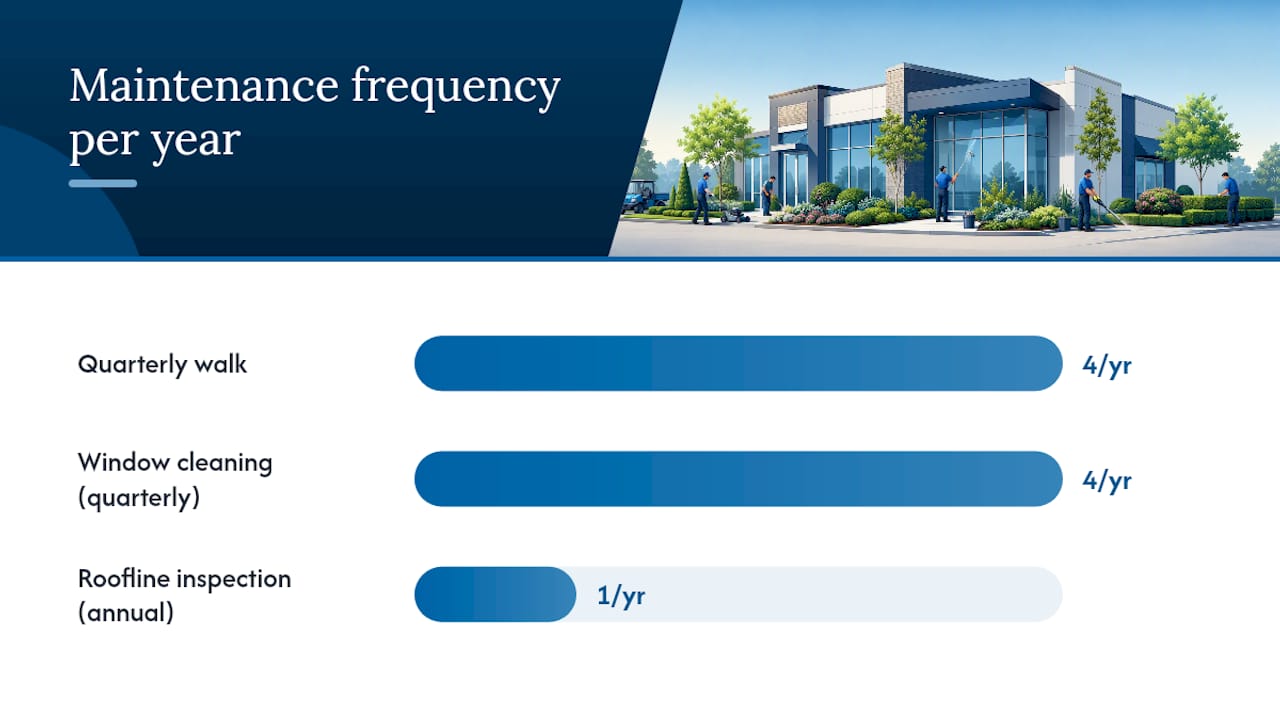
Work through this checklist during a quarterly walk:
- Touch up peeling or faded paint on trim, doors, and exterior columns.
- Repoint cracked or crumbling masonry before it spreads.
- Clear gutters and downspouts, and check for rust streaks or separation at the joints.
- Inspect soffit and fascia boards for water damage or pest entry points.
- Schedule a roofline inspection annually, even if nothing looks obviously wrong.
Commercial window cleaning deserves its own line item. Hard water stains and accumulated grime on street-facing glass make even a freshly painted building look tired, and clear entry glass matters more than most owners assume: it’s the first thing a customer or prospective tenant sees before they ever step inside. A quarterly cleaning contract usually runs a few hundred dollars per visit for a mid-size property and pays for itself in perception alone.
Pro Tip: Keep a simple folder, digital or physical, of every repair invoice, warranty document, and photo. When you’re negotiating a lease renewal or refinancing the property, that documentation turns “we maintain this building” from a claim into proof.
Commercial Landscaping That Looks Sharp Without Raising Costs
Plant selection determines whether your landscaping budget compounds or evaporates. Species chosen for the specific site and climate reduce ongoing labor, while the right plant palette also supports wayfinding and safety when placement is intentional rather than decorative.
- Choose drought-tolerant and native perennials over annuals wherever the budget allows; they cost more upfront but need far less water and replanting.
- Keep taller plantings at least three feet from sightlines near driveways, entrances, and pedestrian crossings.
- Avoid large shade trees within ten feet of sidewalks and foundations to prevent root heaving and pavement cracking.
- Edge beds with a durable material (steel or concrete edging) rather than plastic, which warps and lifts within a season or two.
- Refresh mulch twice a year, spring and fall, using a consistent color and material across the property.
- Rotate seasonal color at entrances and high-visibility beds while relying on evergreens and perennials for the bulk of the landscape.
Irrigation deserves a second look every spring. Check zone timing so beds near pavement aren’t overwatering and leaving mineral stains on concrete or sidewalks. A five-minute walk after each irrigation cycle, watching for pooling or runoff onto walkways, catches most problems before they become a stained curb or a soggy lawn that customers have to walk around. For a deeper look at plant selection and bed design that works in both residential and commercial contexts, our guide on improving curb appeal through landscaping covers the fundamentals in more detail.
Walkways, Parking, and Accessibility Fixes That Reduce Liability
Cracked pavement isn’t just unattractive. It’s a liability sitting in plain sight. A parking lot with faded striping, unclear ADA routes, and standing water tells visitors the property isn’t actively managed, and it exposes the owner to real risk.
Run through this safety list before anything else on the hardscape side:
- Repair heaved or cracked concrete sections, especially near entrances and handicap spaces.
- Confirm ADA-compliant routes are unobstructed, correctly striped, and free of curb height violations.
- Add or repaint curb ramps where the transition from lot to sidewalk exceeds accessible slope standards.
- Eliminate trip hazards: uneven slabs, exposed rebar, and loose pavers.
- Address drainage issues that cause puddling near entrances or staining on concrete.
- Restripe parking stalls, fire lanes, and speed-management markings (speed bumps, painted arrows) on a two to three year cycle.
Ballpark costs vary by scope, but concrete patching typically runs $8 to $15 per square foot, while a full restriping job for a standard lot often falls between $500 and $2,500 depending on stall count and lane markings. Most of these projects finish within a few days, though larger lots with drainage work can stretch to a week or two. Visible, correctly striped ADA stalls and clearly marked pedestrian crosswalks do double duty: they keep the property compliant and they signal, at a glance, that someone is paying attention. For patios, retaining walls, or larger walkway rebuilds, our hardscape services cover design through installation.
Lighting and Signage That Sell the Property After Dark
A property that looks sharp at 2 p.m. and disappears into shadow at 7 p.m. is only half finished. Exterior upgrades such as lighting, signage, and well-planned hardscape can increase lease velocity and reduce operational risk when they genuinely improve access and safety after dark, not just when the sun is up.
Think of exterior lighting in layers:
- Entry and pathway lighting guides foot traffic and should be bright enough to read signage from twenty feet away.
- Facade uplighting highlights architectural features and brand colors without creating glare on windows.
- Parking lot illumination needs even coverage; a lot with bright spots and dark pockets feels less safe than one with consistent, moderate light.
- Timed or motion-activated controls cut energy costs while keeping the property lit during actual hours of use.
Aim for warm white light (around 3000K to 4000K) at entrances for a welcoming feel, and reserve cooler light for parking areas where visibility matters more than ambiance. Uniformity matters more than raw brightness. A parking lot with three glaring floodlights and dark corners in between feels riskier than one with evenly spaced, moderate fixtures.
On signage, legibility at road speed is the test that matters most. A sign readable from a parked car but not from 35 miles per hour is a wasted investment. Keep letters large, surrounds clean, and if the property has a directory, make sure it’s illuminated and current. Upgrading to LED fixtures across the property typically pays back within two to four years through energy savings and consistent light levels that don’t degrade the way older sodium or halogen fixtures do. Our irrigation and lighting page covers package options if you’re planning both systems together.
Designing an Entry Sequence That Invites People In
The path from the parking lot to the front door is the most underused branding opportunity on most commercial properties. Get it right and visitors feel guided. Get it wrong and they feel like they’re navigating an obstacle course.
Walk your entry sequence and check for:
- A clear, unobstructed sightline from the parking lot to the main entrance.
- A defined pedestrian route, ideally separated from vehicle traffic by landscaping or a curb.
- An attractive door treatment, awning, or canopy that gives the entrance visual weight.
- Durable seating or waiting areas near high-traffic entrances.
Small amenities pay disproportionate dividends in commercial settings. Covered waiting areas near entrances, bike racks for employees and customers, benches along walkways, and a small landscaped plaza for a short-stay seating area all signal that a property was designed for people, not just parked cars. Choose materials built for heavy foot traffic: powder-coated steel benches, composite decking for small platforms, and pavers rated for commercial load rather than residential-grade concrete. For guidance on staging plantings and amenities near a building’s main entrance, see our piece on planning entrance landscaping for business properties.
Budgeting and Scheduling Curb Appeal Work in Phases
Trying to do everything at once is how curb appeal budgets get wasted on the wrong priorities. Phase the work instead, starting with the cheapest, most visible fixes and building toward capital projects as budget allows.
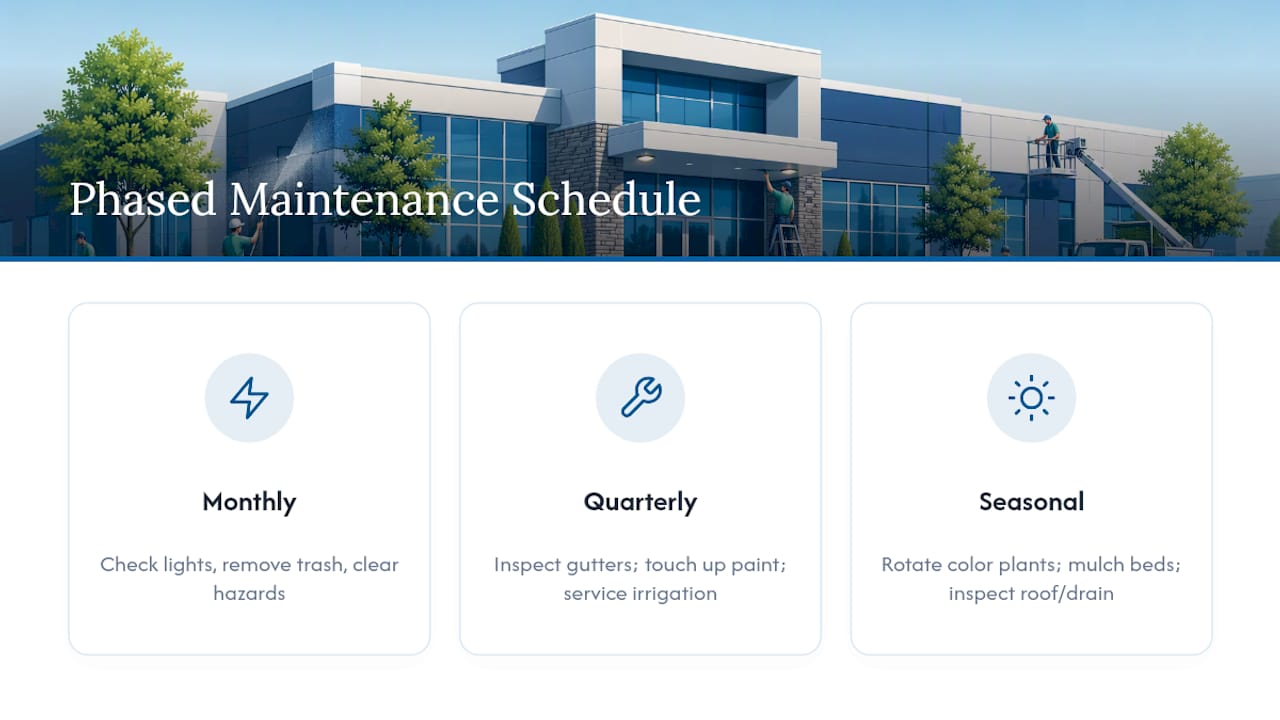
A basic maintenance schedule keeps the property from sliding back to where it started. Monthly: walk the lot for burned-out lights, trash, and obvious hazards. Quarterly: inspect gutters, touch up paint, service irrigation zones. Seasonally: rotate color plantings, mulch beds, and schedule a roof and drainage inspection before winter.
When bidding out larger work, get at least two contractor quotes, confirm what’s covered under warranty, and keep every invoice. That documentation matters later, whether you’re pitching a rent increase or refinancing the property, because documenting measurable outcomes materially improves an owner’s ability to justify the spend internally and to lenders. For a full renovation, our guide to planning a commercial landscape renovation walks through scoping and sequencing in more depth.
Curb Appeal Mistakes That Waste Budget
Some of the most expensive curb appeal decisions are the ones that look good in a rendering and fail in practice. Watch for these patterns.
- Overplanting near entrances and driveways, which blocks sightlines and creates hiding spots that raise safety concerns.
- Choosing high-maintenance species because they looked good in a catalog, then paying for constant pruning and replacement.
- Signage that doesn’t match the brand on the building itself, which confuses visitors and undercuts the property’s identity.
- Treating cleaning as optional once the “real” upgrades are installed. A gorgeous new entry with a dirty sidewalk looks worse than a plain one that’s spotless.
A useful red flag test: if a proposed project can’t be tied to a specific outcome, like faster leasing, fewer slip-and-fall claims, or higher walk-in traffic, question whether it’s solving a business problem or just decorating. Mapping every exterior upgrade to a performance metric separates genuine investment from vanity spending. Before signing a contractor, get the scope of work in writing, ask what’s included versus billed as an add-on, and confirm whether maintenance after installation is part of the price or a separate ongoing cost.
A Commercial Curb Appeal Renovation, Start to Finish
A typical mid-size storefront or small strip property arrives at this kind of project the same way: leasing has slowed, walk-in traffic has dropped, or ownership simply notices the property looks tired compared to newer developments nearby. The pattern that works is consistent: clean and repair first, then layer in lighting, signage, and landscaping, then track the result against a real metric like time-on-market or leasing inquiries.
A realistic scope for a mid-size property often includes:
- Pressure washing and concrete repair across the lot and entry walks.
- Restriping, including ADA-compliant stalls and crosswalks.
- New or refreshed exterior lighting at the entrance and parking areas.
- A landscape refresh with durable, low-maintenance plantings and seasonal color at the entrance.
- Signage cleanup or replacement to match current branding.
.
Before hiring a contractor, ask these questions during the site tour and bidding process:
- What’s the phased timeline, and can the work happen without disrupting tenant access?
- What warranty covers the hardscape and lighting work, and for how long?
- How will drainage be handled to prevent future pooling or staining?
- What ongoing maintenance is included, and what becomes a separate service call?
…
For multi-tenant properties, the scope often expands to shared amenity areas. Our manager’s guide to multi-tenant landscaping design covers how to balance shared maintenance costs across tenants.
Signage and Wayfinding That Guide Visitors In
Good wayfinding removes friction before a visitor ever reaches the door. If someone has to circle the parking lot twice to find the entrance, that confusion undercuts every other improvement you’ve made.
Start with the property’s main identification sign. It should be legible from the road at driving speed, lit for evening visibility, and free of peeling vinyl or missing letters. From there, secondary wayfinding, directional arrows to visitor parking, accessible entrances, and tenant directories, should use consistent fonts and colors so the whole system reads as one coordinated effort rather than a patchwork added over the years. For multi-tenant buildings, an illuminated directory near the main entrance saves visitors from wandering and reduces the number of people walking into the wrong suite. Replacing a faded, hand-painted directory with a clean, backlit one is a modest cost that visitors notice immediately.
Getting Property Managers, Tenants, and Contractors on the Same Page
Curb appeal projects fail more often from poor coordination than from bad design. A property manager who greenlights a landscaping refresh without looping in tenants might find delivery trucks blocked by new planters, or a restaurant tenant upset that construction noise hit during lunch rush.
Loop in tenants early, especially for any work that affects parking, deliveries, or foot traffic during business hours. A short notice two weeks out, explaining the timeline and expected disruption, prevents most complaints before they start. When multiple tenants share a property, get consensus on shared-cost items like lighting and entry landscaping before the contractor shows up, not after the invoice arrives. Contractors, for their part, should walk the site with both the property manager and a representative from any affected tenant, since ground-level details, delivery schedules, outdoor seating hours, employee parking, often shape the final scope more than the initial plan.
Making Your Brand Visible in the Landscape Itself
The best curb appeal work does more than look good. It reinforces what the property already stands for. Brand colors in planter choices, signage that matches the building’s identity system, and consistent materials across multiple locations all turn landscaping into a quiet extension of marketing.
If a retail brand’s identity leans on clean, modern lines, ornate wrought iron fencing sends the wrong signal, even if it’s well built. A property with a warm, community-focused brand benefits from softer plantings and wood accents over stark concrete and steel. For multi-location owners, keeping plant palettes, signage fonts, and lighting temperature consistent across properties helps customers recognize the brand before they even read a sign. It’s a small detail that compounds across a portfolio.
What I’ve Learned Walking Commercial Properties With Owners
Every commercial property tour follows the same pattern in the first ninety seconds. Owners and prospective tenants notice the lot before they notice the building, and the pavement condition before the paint color. That’s not a design opinion. It’s just how people process a space when they’re deciding whether to trust it with their business or their lease.
What Divine Landscaping LLC prioritizes on every commercial walkthrough comes down to three things: safety first, tenant experience second, and whether the property tells a rent story that justifies the asking price. A cracked sidewalk or a dark parking lot isn’t just unattractive, it’s a liability conversation waiting to happen, and it undercuts every dollar spent on the pretty stuff.
If you’re weighing where to start on your own property, request a scoped assessment or browse our project gallery to see how these priorities play out on real sites.
How Divine Landscaping LLC Can Help You Get Started
You don’t have to figure out the sequencing, budgeting, and contractor vetting alone. Divine Landscaping LLC handles the full range of commercial exterior work, from landscape design and hardscape installation to irrigation, lighting, and ongoing maintenance programs, so you get one point of contact instead of juggling three separate vendors.
We start every commercial engagement with a site assessment: a walk of the property with a checklist covering pavement condition, lighting coverage, plant health, and signage visibility. From that walkthrough, you get a phased proposal with realistic cost ranges, so you can decide what happens this quarter versus next year. Whether the project is a quick cleanup ahead of a lease renewal or a full hardscape rebuild for a multi-tenant property, the same team stays on the job from design through maintenance. If you’re ready to see what a scoped plan looks like for your property, request a commercial site assessment and we’ll walk the property with you.
Sources
- Benefits of Landscapes — National Association of Landscape Professionals
- Commercial curb appeal improvements that deliver real returns — C & D Commercial Services
- 6 exterior upgrades that add value to a commercial property — Randy Lemmon
- Boost your business curb appeal: attract more customers — Cultivate HD
- 20 strategies to reduce commercial real estate investment risks — Forbes