
A professionally installed pergola typically costs in a moderate range that can vary widely, while DIY kits start more affordably and fully motorized louvered systems can reach very high prices. Size, material, and roof type drive most of that spread, with labor rates close behind. Expect a permit conversation for anything attached to your house or built over 200 square feet, and a professional quote once footings, wiring, or slope enter the picture.
TL;DR:
- DIY pergola kits cost between $500 and $3,000, but larger or more complex structures significantly increase overall expenses.
- Material choice affects cost per square foot, with pressure-treated pine starting around $15 and cedar reaching $50, and vinyl or aluminum offering low-maintenance options at similar or lower prices.
- Site conditions such as soil type, slope, and whether the pergola attaches to the house can add hundreds to thousands of dollars due to extra excavation, permits, and reinforcement.
- Regional labor rates vary widely, often influencing total project costs by 15-50% from the national average, making local market data essential for accurate estimates.
Table of Contents
- Pergola Cost Ranges: From DIY Kit to Luxury Build
- What Does a Pergola Cost Per Square Foot by Material?
- Is It Cheaper to Build a Pergola Yourself?
- How Do Site Conditions and Permits Affect Pergola Pricing?
- How Much Do Louvered Roofs and Add-Ons Add to the Price?
- How to Get an Accurate Pergola Quote From a Contractor
- Does Pergola Cost Vary by Location?
- What Real Pergola Projects Actually Cost in New England
- What Homeowners Usually Get Wrong About Pergola Costs
- Get a Pergola Estimate Built Around Your Yard, Not a National Average
- Sources
Pergola Cost Ranges: From DIY Kit to Luxury Build
Most homeowners land in one of four bands, and knowing which one fits your project before you call a contractor saves a lot of back-and-forth.
DIY kits start around $500 to $3,000 and include pre-cut posts, beams, and hardware you assemble yourself over a weekend or two, according to installed cost data from Constructlytools. You supply the footings and any finishing touches. This band works for a simple 10×10 wood or vinyl kit where you’re comfortable with a post hole digger and a level.
Installed basics cover pressure-treated wood or vinyl pergolas built by a contractor. A 10×10 typically lands between $2,500 and $5,500 installed, while a 12×16 runs $3,000 to $10,500 depending on your market and site conditions. That range reflects labor, footings, and standard hardware, not just materials.
Mid-range builds use cedar or composite framing with better joinery and finish work. A 12×16 cedar pergola commonly costs $4,800 to $9,600 installed, a figure echoed across several market cost guides that also note patio surfaces and footings are usually priced separately from the structure itself.
Luxury and motorized systems push well past $10,000. Bioclimatic louvered roofs, which open and close to control sun and rain, run $10,000 to $40,000 depending on size, automation, and integrated lighting.
Here’s how those bands typically break down:
- DIY kit (10×10): $500–$3,000, self-assembled
- Installed basic wood or vinyl (10×10 to 12×16): $2,500–$10,500
- Mid-range cedar or composite (12×16): $4,800–$9,600
- Luxury motorized louvered system: $10,000–$40,000+
What Does a Pergola Cost Per Square Foot by Material?
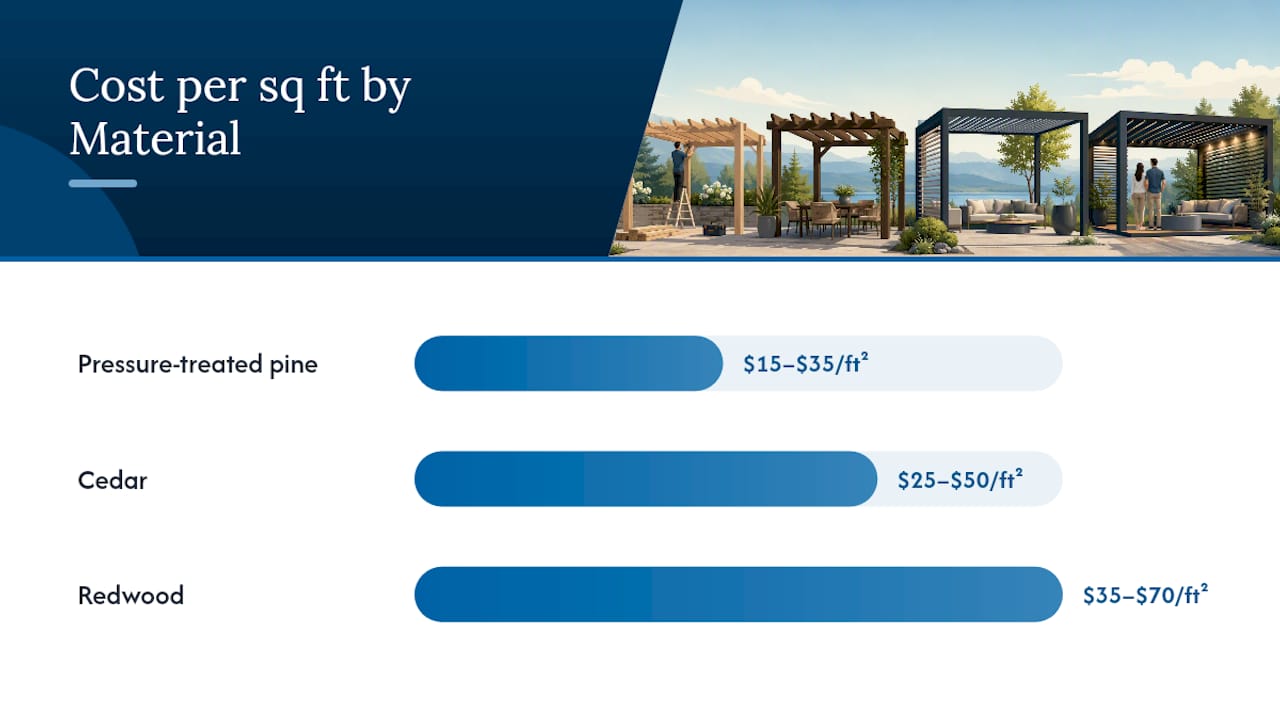
Material choice affects your bottom line more than almost anything else, and our guide on pergola lifespan can help inform your maintenance expectations and material trade-offs, making the per-square-foot math easier to evaluate. Pressure-treated pine sits at the affordable end, running roughly $15 to $35 per square foot installed. It handles moisture reasonably well when sealed, but expect to reseal or stain it every two to three years to prevent graying and splitting.
Cedar climbs to $25 to $50 per square foot and rewards you with natural insect resistance and a warmer look that ages gracefully even without heavy maintenance. Redwood runs even higher, $35 to $70 per square foot, and offers similar durability with a richer grain, though supply and regional availability affect pricing more than with cedar.
Vinyl pergolas land at $15 to $50 per square foot. They never need staining and resist rot completely, which appeals to homeowners who want a low-maintenance pergola without the upkeep cycle wood requires. Aluminum, particularly open-rafter styles, runs $15 to $40 per square foot and offers similar low-maintenance benefits with a more modern, minimalist look. Composite decking-style materials for pergola framing run $30 to $65 per square foot, splitting the difference between wood’s warmth and vinyl’s durability.
Most custom wood pergolas land in the $25 to $50 per square foot range once labor and standard hardware are factored in, according to per-square-foot cost breakdowns from HardHatCalc. That band is a useful gut check when a quote comes in far outside it.
| Footprint | Pressure-Treated | Cedar | Vinyl | Aluminum |
|---|---|---|---|---|
| 12×12 | $2,500–$5,500 | $3,000–$10,500 | $2,500–$10,500 | $2,500–$5,500 |
| 12×16 | $2,500–$5,500 | $4,800–$9,600 | $4,800–$9,600 | $2,500–$10,500 |
| 16×20 | $4,800–$9,600 | $10,000 or more | $4,800–$9,600 | $4,800–$9,600 |
One quirk worth knowing: larger pergolas often cost less per square foot than smaller ones, because fixed expenses like permits, delivery, and footing setup get spread across more square footage. A 16×20 build isn’t simply double the cost of a 12×12 on a per-foot basis.
Is It Cheaper to Build a Pergola Yourself?
Labor typically makes up 35% to 40% of the total installed cost for wood pergolas, but only about 20% to 25% for vinyl or aluminum kit-based systems, according to labor-share data from Constructlytools. That gap matters when you’re deciding whether to swing a hammer yourself.
On a $6,000 cedar pergola, DIY assembly could theoretically save $2,100 to $2,400 in labor. On a $3,000 aluminum kit, the savings shrink to $600 to $750, since kit-based materials already ship with most of the fabrication done. The lower the labor share, the less DIY actually saves you.
Before committing to a weekend build, walk through this checklist:
- Time commitment. A basic 10×10 kit takes an experienced DIYer one to two weekends; a custom 16×20 cedar structure can take two to three weeks of evening and weekend work.
- Tool access. You’ll need a post hole digger or auger, a level, a circular saw, and ideally a helper for lifting beams.
- Site complexity. Flat, unobstructed yards are DIY-friendly; sloped or rocky lots are not.
- Permit comfort. Some towns require permits even for freestanding structures over a certain size, and pulling one yourself means you’re responsible for passing inspection.
Hire a professional when the pergola attaches to your house, when the site has slope or drainage challenges, when electrical work is involved, or when you want a manufacturer or contractor warranty backing the build.
Pro Tip: Even if you plan to build the frame yourself, hire a licensed contractor to pour and inspect the footings. A footing that’s undersized or set above the frost line is the single most expensive mistake to fix after the fact.
How Do Site Conditions and Permits Affect Pergola Pricing?
Footings are where quotes quietly diverge. Standard concrete footings run $150 to $400 each depending on depth and soil type, and a typical four-post pergola needs four to six footings. In northern New England, frost depth often requires footings 42 to 48 inches deep, considerably more than the 12 to 18 inches common in warmer climates, which adds both material and labor cost, based on sitework guidance from HUD.
A few other site factors that shift the total:
- Attaching a pergola to your house requires flashing and engineered ledger connections, typically adding $300 to $800 to the project.
- Sloped or rocky sites often need additional excavation or graded footings, which can add several hundred dollars per post.
- Permit fees generally range from $100 to $400, and most towns require one for any structure attached to the home or exceeding a specific square footage.
- An engineer’s stamp, often needed for motorized roofs or spans over 16 feet, adds $300 to $800.
These add-ons rarely appear in a headline price, which is exactly why a written scope matters before you sign anything.
How Much Do Louvered Roofs and Add-Ons Add to the Price?
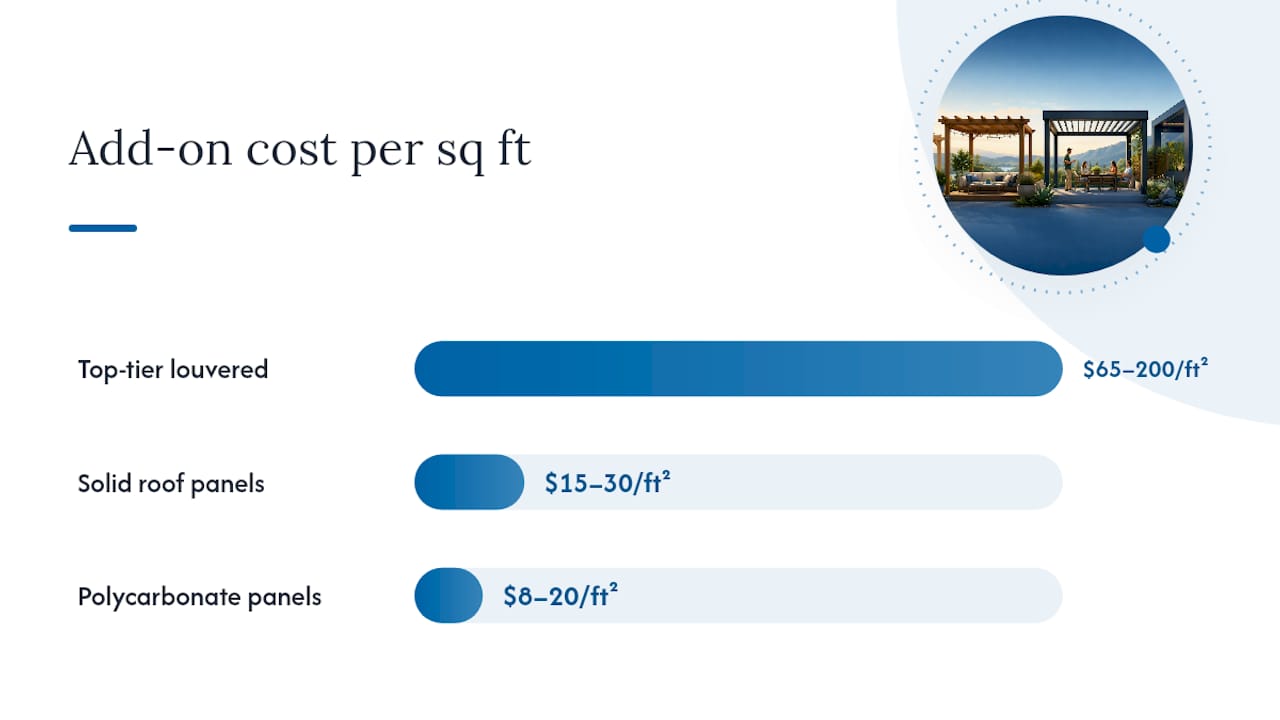
A motorized louvered roof is the single biggest multiplier available. Compared to an open-rafter baseline, a covered or louvered system typically runs 2.5 to 4 times the cost, and top-tier aluminum louvered systems can reach $65 to $200 per square foot once motors, sensors, and remote controls are included.
A conservative rule of thumb: budget roughly 2.5 times your open-rafter estimate if you want a covered or louvered roof, a multiplier several pergola cost calculators use as a practical middle ground rather than the vendor ceiling.
Other upgrades and their typical price bands:
- Solid roof panels (metal or shingled): adds $15 to $30 per square foot over an open-rafter base
- Polycarbonate roof panels: adds $8 to $20 per square foot, a budget-friendly step toward weather protection
- Integrated LED lighting: $300 to $1,500 depending on complexity
- Retractable privacy or bug screens: $500 to $2,500 per side
If you’re weighing upgrades against resale value, prioritize weather protection first. A solid or polycarbonate roof extends your usable season by months, while decorative lighting and screens matter more for personal enjoyment than for what a future buyer will pay.
How to Get an Accurate Pergola Quote From a Contractor
Contractors can only price what they can see, so give them what they need up front. Photograph your yard from multiple angles, measure your desired footprint, note whether you want the structure attached to your house, and flag any nearby utilities, sprinkler lines, or sloped grade.
Once quotes start coming in, ask every contractor the same five questions so you’re comparing apples to apples:
- Who pulls the permit, and is that fee included in the quote?
- How deep will the footings go, and what’s the reasoning given local frost depth?
- If attaching to the house, what connection method and flashing detail will be used?
- What’s covered under warranty, and for how long?
- What’s the payment schedule, and what triggers each payment?
Run a quick sanity check against the per-square-foot ranges earlier in this guide. If a quote for a 12×16 cedar pergola comes in at $2,000, something is being left out, whether that’s footings, permits, or a lower material grade than advertised.
Pro Tip: Ask to see the itemized breakdown, not just the bottom-line number. A vague one-line quote is the easiest way to end up with change orders halfway through the build.
Does Pergola Cost Vary by Location?
National price ranges are a starting point, not a promise. Labor rates swing significantly by region, and adjusting for your local market keeps expectations realistic.
A rough multiplier framework: rural and Midwest markets often run about 0.85 times the national average, mid-sized metro areas track close to 1.0, high-cost metros like Boston or coastal New Hampshire run around 1.25, and very high-cost markets can reach 1.5 times baseline. A $6,000 cedar pergola in a lower-cost region might land closer to $5,100, while the same build in a high-cost metro could reach $7,500.
The most reliable way to localize labor costs is checking Bureau of Labor Statistics wage data for construction trades in your metro area, rather than relying on a single national average.
What Real Pergola Projects Actually Cost in New England
Two recent projects show how quotes shift once the site gets involved. A homeowner in a Manchester suburb wanted a simple 10×10 DIY kit assembled by our crew rather than sourced through us. The base kit ran about $2,200, but rocky soil under two of the four footing locations added roughly $400 in extra excavation, a cost that only surfaced after we dug the first hole.
A second client wanted a custom 16×20 cedar pergola attached to an existing deck. The frame and labor priced out around $9,200, but hidden irrigation lines near the house required rerouting before we could set footings, adding another $650.
Divine Landscaping LLC pulls all required permits, uses engineered footing depths appropriate to New Hampshire frost lines, and backs every pergola build with a workmanship warranty separate from the manufacturer’s material warranty.
What Homeowners Usually Get Wrong About Pergola Costs
The biggest cost surprise isn’t the pergola itself. It’s the timeline. Permitting can add two to six weeks depending on your town, and homeowners who don’t budget that time often end up rushing decisions or paying rush fees to hit a deadline like a graduation party or a wedding.
My advice: lock in structure and drainage decisions before you touch finishes or lighting. A gorgeous cedar pergola over poorly graded soil is a problem waiting to happen. And if one bid comes in dramatically lower than the others, ask for the written scope before you celebrate. Missing footings, vague material specs, or no permit line are the usual reasons.
— Damian
Get a Pergola Estimate Built Around Your Yard, Not a National Average
National price ranges are a useful starting point, but your actual quote depends on your soil, your town’s permit process, and the frost depth under your yard, details a generic online calculator can’t see. Divine Landscaping LLC handles the full scope for New Hampshire and Massachusetts homeowners: design, permit pulls, engineered footings where required, installation, and a workmanship warranty on every build.
If you’re comparing a pergola against other backyard upgrades, our hardscape services page walks through patios, retaining walls, and outdoor living spaces we build alongside pergola projects, since many homeowners tackle both at once. Browse our project gallery for real examples of finished pergolas and outdoor living spaces across the region. When you’re ready for numbers specific to your yard, request an estimate and send along your footprint measurements and a few photos of the space. We’ll walk the site, flag anything that could affect footing depth or permitting, and give you a written scope you can actually compare against other bids.
Sources
- Pergola Cost Calculator — Free Estimate | HardHatCalc
- Pergola Cost Calculator (Per Sq Ft & Total Cost) – Free Tool
- HUD sitework guidance
- Bureau of Labor Statistics, Occupational Employment and Wage Statistics (OES)
- Pergola Installation Cost 2026: $3,000–$10,000 Installed