
Yes, most backyard wood fire pits in New Hampshire need a written permit before you strike a match, unless the ground has 100 feet of complete snow cover around the fire site. Everything else depends on how big the fire is and how far it sits from your house, garage, or fence. Get the permit from your town’s Forest Fire Warden or the NH Division of Forests and Lands online portal before your first cookout.
TL;DR:
- A written permit is usually required for backyard wood fire pits in New Hampshire unless there is complete snow cover within 100 feet of the fire site.
- Fire pits are categorized into three size and clearance classes, with Category I requiring at least 25 feet of distance from structures and Category II and III needing 50 feet.
- Burning is typically allowed all day for Category I fires, but restricted to 5 p.m. to 9 a.m. for larger fires, unless it’s raining or snow cover is present.
- Fire permits are obtained through online or in-person applications, and visible documentation on-site can prevent compliance issues during inspections.
- Only untreated wood, seasoned firewood, and natural brush are permitted for burning; prohibited materials include treated lumber, household trash, and tires.
Table of Contents
- What Counts as a Fire Pit Under NH Fire Pit Regulations?
- What Are the NH Fire Permit Height and Size Categories?
- When Can You Legally Burn: Hours, Rain, and Snow Exemptions
- How Do You Get a Fire Permit in New Hampshire?
- What Can You Legally Burn in a Fire Pit in NH?
- What Happens If You Break NH Fire Pit Rules?
- Fire Pit Safety Guidelines NH Homeowners Should Follow Before Building
- Where to Verify NH Fire Pit Rules and Permits
- Get Your Fire Pit Built Right the First Time
- The Permit System Rewards Homeowners Who Ask First
- Sources
What Counts as a Fire Pit Under NH Fire Pit Regulations?
New Hampshire’s administrative rules, known as Res 5601, don’t split hairs between a $40 steel bowl from a hardware store and a stone fireplace you had built into your patio. Both fall under the same permit framework if they burn wood and release sparks outdoors. The rule that trips people up most: your Forest Fire Warden decides whether a device needs a permit based on its spark transmission potential and construction, not on what the retail box calls it.
A chiminea, a manufactured fire pit, and an open masonry hearth can all land in different categories depending on size and containment. Here’s how homeowners typically encounter this in practice:
- A small portable steel bowl with a spark screen often qualifies as a Category I fire.
- An open masonry fire pit built into a patio usually needs the same 25 to 50 foot clearances as a wood pile burn.
- A commercially sold “portable fireplace” can still require a permit at the warden’s discretion, so don’t assume the store receipt exempts you.
When in doubt, call your local warden before you buy the pit, not after.
What Are the NH Fire Permit Height and Size Categories?
Res 5601 breaks outdoor fires into three categories, and the category you fall into determines your clearance from structures and, often, what hours you’re allowed to burn.
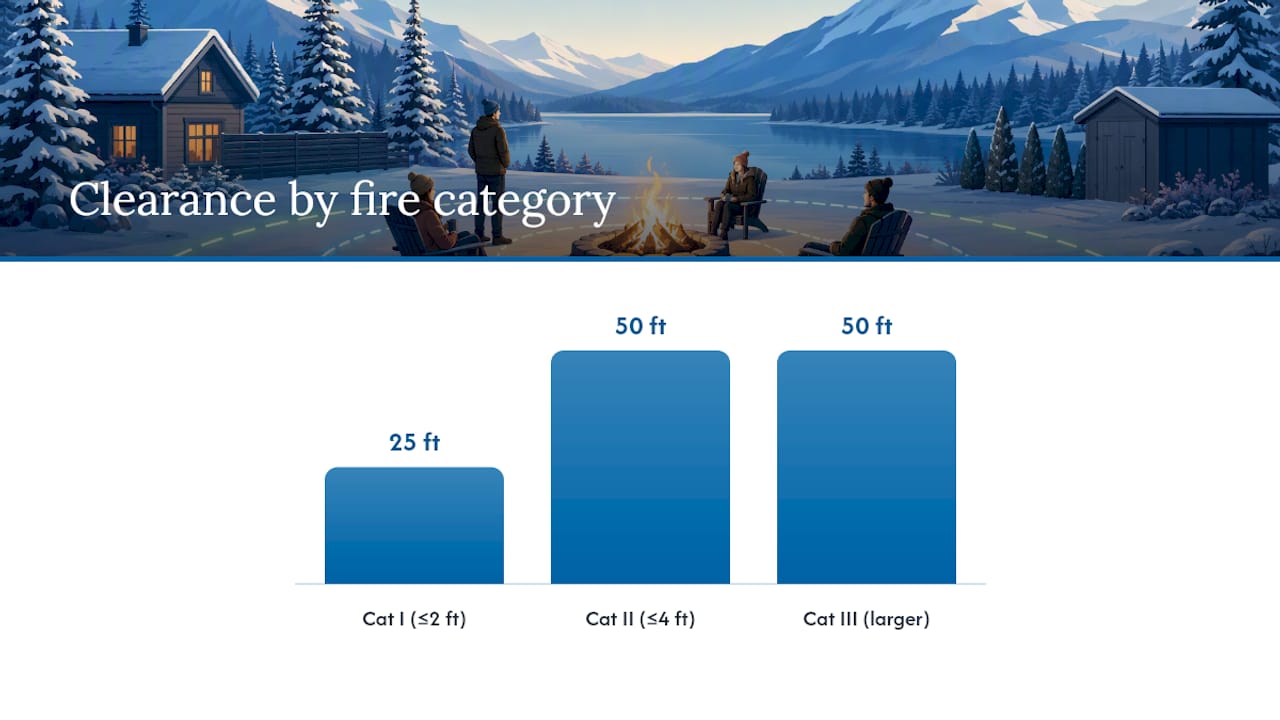
- Category I cover small camp or cooking fires up to roughly 2 feet in diameter, requiring at least 25 feet of clearance from structures. These are generally allowed at any time of day with a valid permit.
- Category II fires run up to about 4 feet in diameter and need 50 feet of clearance. Burning hours are typically restricted to 5 p.m. to 9 a.m., unless it’s actively raining.
- Category III fires are larger or uncontained, carry the same 50 foot clearance requirement, and face the strictest permit conditions of the three.
The clearance rule that matters most: a fire pit sitting 30 feet from your deck is compliant under Category I but a violation under Category II. Measure before you build, not after your neighbor calls the fire department.
Municipalities can layer their own procedures on top of the state framework, so a town-issued permit may specify slightly different local hours or inspection steps than the state baseline.
When Can You Legally Burn: Hours, Rain, and Snow Exemptions
Timing rules trip up more homeowners than size limits do. Category I fires generally have no time restriction. Category II and III fires are typically confined to the window between 5 p.m. and 9 a.m.
- Actively raining conditions can lift the hourly restriction in some towns, but many jurisdictions still require you to hold a valid permit even while it’s raining.
- The one universal exception is complete snow cover: a 100-foot radius of continuous snow around your fire site removes the permit requirement entirely.
- Don’t assume “it rained yesterday” or “there’s some snow on the lawn” qualifies. Confirm current ground conditions with your local warden before skipping the permit step.
Local fire departments post daily burn status updates during high-risk seasons, and those postings override the general hours listed above when danger is elevated.
How Do You Get a Fire Permit in New Hampshire?
Getting compliant is more paperwork than plumbing. Here’s the sequence that works in most towns:
- Check whether your town participates in the NH Division of Forests and Lands online permitting system, since not every municipality issues digital permits.
- Apply online or in person. Online applications through the state portal typically carry a small convenience fee, and you’ll need to print and sign the permit for it to be valid in many jurisdictions, according to Londonderry’s outdoor fire permit rules.
- Contact your local Forest Fire Warden directly if your town doesn’t participate online. Many issue free permits in person, and some, like Gilmanton, require a one-time site inspection before approving a seasonal permit.
- Consider a seasonal permit if you burn regularly. These stay valid through the calendar year, saving you repeat trips to town hall.
- Sign up for suspension notices. Many towns send email or text alerts when burning is suspended due to drought or high wind, which keeps you from getting caught mid-burn.
Pro Tip: Keep your signed, printed permit taped inside a kitchen window or garage door facing the yard. If a fire warden drives by during an inspection sweep, visible paperwork saves you an awkward conversation.
What Can You Legally Burn in a Fire Pit in NH?
The materials question is where state health rules and fire rules overlap. NHDES regulations under the Env-A 1000 series and RSA 125-N draw a hard line on what’s allowed in any outdoor fire, permitted or not.
- Untreated firewood, seasoned campfire wood, and cleared brush are generally permitted, subject to your category’s size limits.
- Household trash, treated or painted lumber, and tires are prohibited outright under NHDES open-burning rules, largely because of the toxic emissions they release.
- Charcoal in an off-ground container and gas-fueled fire features are often exempt from the wood-burning permit system, but confirm the exemption with your town since local ordinances vary.
Burning debris to “clean up the yard” is one of the fastest ways to turn a routine fire pit evening into a citation.
What Happens If You Break NH Fire Pit Rules?
Ignoring clearance distances or burning without a permit carries real teeth, not just a warning letter.
- Fire wardens can summarily suspend a permit on the spot for a violation, and repeat or serious offenses can escalate to misdemeanor charges.
- If an unpermitted or improperly placed fire spreads and endangers woodland, the responsible party can face felony-level charges depending on the damage caused.
- Beyond criminal exposure, you can be held civilly liable for suppression costs. If the fire department has to respond, that bill lands on you, not the town.
Contact your local warden before you burn, even when you’re fairly sure you’re compliant. A five-minute phone call is cheaper than a suppression invoice.
Fire Pit Safety Guidelines NH Homeowners Should Follow Before Building
Permits get you legal. Placement gets you safe. Many homeowners have found that a fire pit location that looks fine on paper can turn into a problem once wind, roof overhangs, or dry mulch beds are considered.
- Measure your clearance first, not last. Mark out the full 25 or 50 foot radius from your house, deck, shed, and fence line before you order materials, and factor in tree canopy and prevailing wind direction, since embers travel farther downwind than most people expect.
- Build on a noncombustible base. Gravel, pavers, or poured concrete under the pit, with a clear zone of at least 10 feet free of mulch or dry leaves, cuts your risk substantially, especially for open masonry designs.
- Keep extinguishing tools within reach. A hose, bucket of sand, or extinguisher belongs next to the pit every time it’s lit, and fires should never be left burning unattended or buried while still smoldering underneath.
- Document your setup. A phone photo of your fire pit’s distance from structures, plus your printed permit kept on site, resolves most disputes with a warden before they start.
- Vet your contractor if you’re building in. For a masonry or built-in fireplace, confirm the contractor references NFPA 211 guidance and current state fire code amendments, since attached fireplace designs carry stricter spark-arrestor and clearance standards than a freestanding pit.
Pro Tip: If you’re pouring a patio around a future fire feature, plan the noncombustible zone into the hardscape design from day one. Retrofitting a 10-foot buffer after the patio is already laid usually means tearing out pavers you just installed.
For homeowners weighing patio material and base prep against these clearance rules, our patio installation guide for NH homeowners covers the noncombustible surface question in more depth. And if you’re building near a deck or elevated structure, the code context in this New Hampshire glass railing guide is a useful cross-reference for clearance planning around adjacent structures.
Where to Verify NH Fire Pit Rules and Permits
Rules shift by town even when the state framework stays constant, so bookmark these before your first burn:
- NH Division of Forests and Lands for the statewide permit portal and Res 5601 category definitions.
- NH Division of Fire Safety for state fire code adoption and Saf-FMO 300 amendments.
- NHDES open-burning rules for material restrictions and air-quality limits.
- Your town’s own fire department page for local hours, inspection steps, and notification sign-ups.
Get Your Fire Pit Built Right the First Time
If you’re planning a hardscaped fire pit or an outdoor living area built around one, the placement decisions you make before construction matter more than anything you do after. Some landscaping companies design and build patios, retaining walls, and outdoor living spaces with clearance and drainage considerations factored in from the start, rather than added after issues arise. Our hardscape services team can walk your yard, confirm workable placement against your lot lines, and build a fire feature that holds up to both New Hampshire winters and the rules that govern them. Reach out to Divine Landscaping LLC to talk through your project before you break ground.
The Permit System Rewards Homeowners Who Ask First
The state’s own language makes this clear: Res 5601 isn’t designed as a revenue tool or a bureaucratic hoop. It functions as a communication channel between wardens and residents about when the woods are dry enough to be dangerous. That’s the piece most homeowners miss. They treat the permit as paperwork to get past, when it’s actually the mechanism that tells you whether today is a bad day to burn at all.
Where conventional advice falls short is the assumption that a “portable fire pit” bought at a home improvement store is automatically exempt from anything. It isn’t. Construction and spark potential decide that, not the packaging. If you take one thing from this guide, prioritize the clearance measurement over the paperwork. A permit you can produce on demand is useless if your pit sits 20 feet from a wood fence that Category II rules say needs 50.
Ask your warden before you build, not after your neighbor complains. That single habit prevents most of the trouble this article describes.
— Damian
Sources
- Fire Permits | NH Division of Forests and Lands
- State Building and Fire Codes | NH Division of Fire Safety
- Open burning rules | NHDES
- Outdoor Fire Permit Rules | Town of Londonderry