
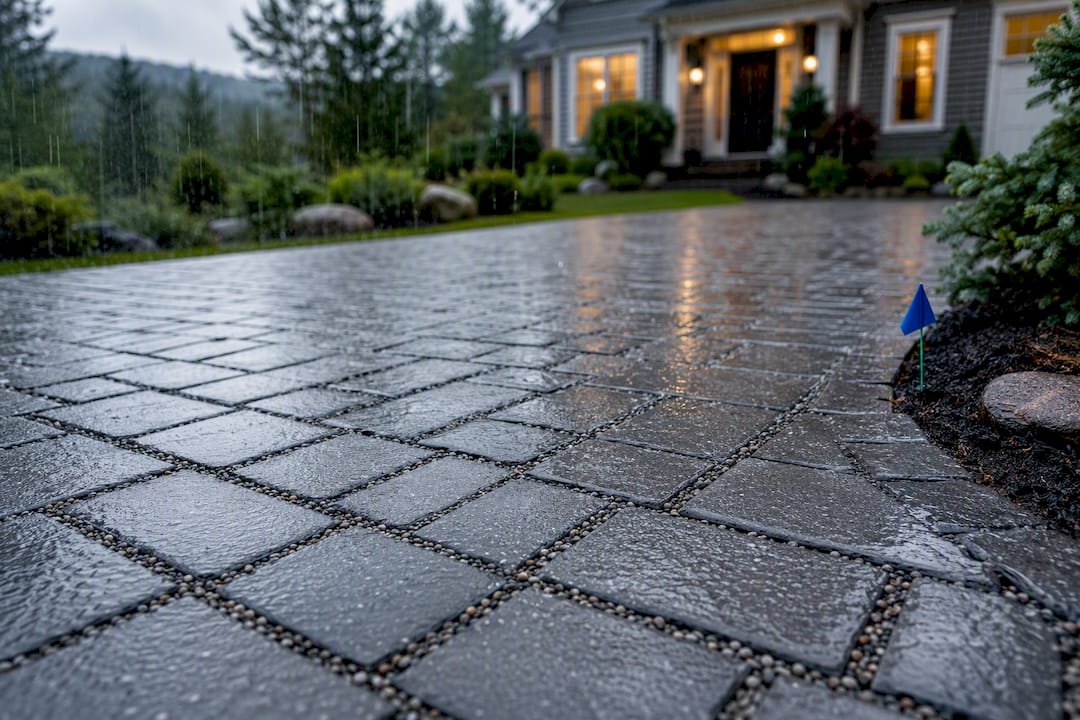
A permeable paver driveway is a smart choice if your soil drains reasonably well, your slope stays under 5%, and you want to cut stormwater runoff while adding real curb appeal. It costs more upfront than plain asphalt, but that gap often closes over the system’s lifespan once you factor in stormwater fee credits and lower repair costs. Before you commit, get a percolation test done or talk with a hardscape contractor who can walk your site.
TL;DR:
- Proper site evaluation, including a percolation test and site-specific design, is essential to determine if a permeable driveway will function effectively.
- A well-constructed system includes permeable pavers, a layered stone reservoir, and proper edge restraints, with optional underdrains for slow or poorly draining soils.
- Long-term performance depends on correct installation practices such as adequate compaction, proper joint stone size, and avoiding heavy traffic or site disturbances during construction.
- Permeable driveways generally cost $10 to $40 per square foot, with higher costs associated with poor infiltration soils, vehicle load requirements, or complex patterns.
- Maintenance requires annual sweeping or vacuuming to prevent joint clogging, and any repairs are sectional, making upkeep more manageable than traditional asphalt.
Table of Contents
- What Is a Permeable Paver Driveway, and How Does It Work?
- What Are the Real Benefits of a Permeable Driveway?
- When Are Permeable Pavers Not a Good Fit?
- Which Permeable Paver Materials Should You Choose?
- How Is a Permeable Paver Driveway Installed?
- What Does a Permeable Paver Driveway Cost?
- How Do You Maintain a Permeable Paver Driveway?
- How Do You Choose a Contractor for a Permeable Driveway?
- What Divine Landscaping’s Crews See on Real Driveway Projects
- Why the Conventional Pitch on Permeable Pavers Misses the Point
- Divine Landscaping LLC: What to Expect if You Move Forward
- Where to Verify the Details Yourself
- Sources
What Is a Permeable Paver Driveway, and How Does It Work?
A permeable paver driveway looks like a standard paver surface, but it’s built to do something asphalt and poured concrete can’t: let water pass straight through it instead of running off into the street. Interlocking concrete pavers sit on top of a layered stone base, with narrow joint openings between each unit filled with small, clean stone instead of sand. Rain hits the surface, drops through those joints, and moves into a reservoir of crushed stone below, where it either soaks into the native soil or moves slowly toward an outlet.
That reservoir layer is doing more work than most homeowners realize. It stores water temporarily during heavy rain, releases it gradually, and let’s fine sediment and pollutants settle out before the water ever reaches groundwater or a storm drain. The EPA’s overview of permeable pavement confirms this dual function: reduced peak runoff and pollutant filtering, both from the same system.
Depending on your soil and local code, the system may include an underdrain pipe near the bottom of the stone bed that carries excess water to daylight or a storm system when infiltration alone can’t keep up. Not every driveway needs one. Sites with sandy, well-draining soil often infiltrate everything on-site with no pipe at all.
The components that make the system work:
- Permeable pavers with wide joint spacing, set on a bedding layer of small stone rather than sand.
- Open-graded stone reservoir, typically several inches to over a foot deep, that stores and slowly releases water.
- Geotextile fabric or filter layer, in some designs, that keeps native soil from migrating up into the stone and clogging it.
- Optional underdrain, used where infiltration is limited or municipal code requires an overflow path.
- Edge restraints, which lock the paver field in place and keep it from spreading under vehicle loads.
Some municipalities offer stormwater utility fee credits to homeowners who install permeable systems, since the driveway is doing part of the job a public stormwater system would otherwise handle. Whether that applies to you depends entirely on your town or county, so it’s worth a call to your local public works or stormwater office before you budget the project.
What Are the Real Benefits of a Permeable Driveway?
The environmental case for permeable paving is well documented, but the homeowner case is just as strong once you look at the numbers over time. Reduced runoff means less water pooling at the end of your driveway, less erosion along the edges of your property, and less strain on whatever storm system serves your neighborhood. Because the system filters pollutants like oil residue and sediment through the stone bed before that water reaches soil or groundwater, it’s doing quiet environmental work every time it rains.
Pro Tip: Ask your town’s public works or stormwater management office directly whether a permeable driveway qualifies for a fee credit. Many programs exist but aren’t advertised anywhere obvious.
Beyond the environmental angle, here’s what actually shows up on a homeowner’s radar:
- Lower risk of standing water and ice sheeting near the garage or entry.
- Potential stormwater fee credits or rebates, depending on your municipality’s program.
- Easier spot repairs. Individual pavers lift out and reset without the patchwork look asphalt repairs leave behind.
- A cleaner, more upscale appearance than asphalt, with paver color and pattern options that raise curb appeal.
Life-cycle cost studies from the National Concrete Pavement Technology Center found that permeable systems can come out ahead of traditional pavement on total cost once municipal stormwater fees and mitigation requirements are factored in, even though the sticker price at installation is higher. That’s the number that rarely makes it into a contractor’s sales pitch, and it’s the one that matters most if you’re weighing this as a 20 or 30-year investment rather than a one-time expense.
When Are Permeable Pavers Not a Good Fit?
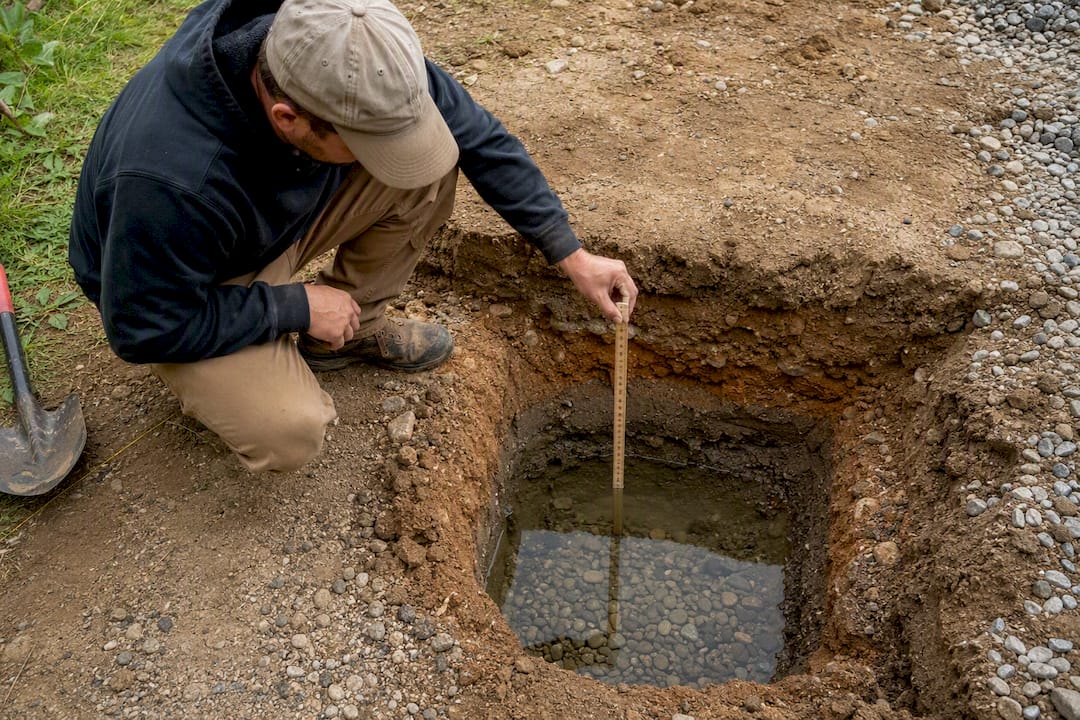
Not every lot is a candidate, and figuring that out early saves you from paying for a design that never should have been proposed. The first test any qualified contractor should run is a percolation test, which measures how fast water moves through your native soil. Heavy clay soils, high water tables, or bedrock close to the surface can all disqualify a site or force a much deeper, more expensive reservoir design with an underdrain.
Slope matters just as much as soil. Guidance from Arlington County’s stormwater program recommends keeping installed slope under 5%, or adding flow barriers and check dams above that threshold, since steeper grades push water sideways across the surface faster than it can infiltrate, undermining the whole point of the system.
A few other conditions that should raise questions before you sign a contract:
- Mid-driveway sags that concentrate flow into one low spot, overwhelming that section’s infiltration capacity.
- Regular heavy-truck traffic, like oil delivery or moving trucks, which requires a reinforced base design most standard residential bids don’t include by default.
- Contributing runoff from adjacent impervious area, such as a roof or neighboring pavement, that exceeds roughly five times the permeable surface area without an upsized reservoir.
- Sites needing engineered underground storage, where a simple stone reservoir can’t handle the volume and a below-grade tank or vault becomes necessary.
Pro Tip: If a contractor skips the percolation test and jumps straight to a quote, that’s a signal to ask more questions, not a signal to sign.
Municipal permits often apply to permeable installations even though they’re technically a stormwater management improvement, so check with your local building department before excavation starts. Skipping that step can mean tearing out finished work.
Which Permeable Paver Materials Should You Choose?
Three main system types dominate residential permeable driveways, and the right one depends on how much weight and traffic the surface needs to handle.
Permeable interlocking concrete pavers (PICP) are the standard for daily vehicle use. They’re dense, durable, and engineered with precise joint spacing to keep infiltration rates consistent for decades, but they only perform correctly when paired with the right joint stone gradation and a properly compacted base. Skimp on either and you’ll see rutting or joint stone migration within a few seasons.
Plastic or grass grid systems cost less and work well for driveways that see occasional or light traffic, like a secondary parking pad or a rural gravel-adjacent drive. They’re not built for daily heavy vehicle loads, and grass-filled versions require more upkeep to keep the turf healthy under tire wear.
Natural stone, like permeable-set flagstone or cobble, gives the most upscale look and can be designed for infiltration with the right joint spacing and base, but it comes at a premium and usually needs more precise, labor-intensive installation than manufactured concrete pavers.
A few material decisions that affect performance as much as looks:
- Joint fill: small, angular, clean stone (commonly 1/4 inch) that locks pavers in place while staying open enough to drain.
- Edge restraint: concrete curb, an anchored plastic edge strip set into a dense-graded berm, or a cut pavement edge. Soil backfill alone won’t hold the field in place under vehicle load, according to Rockville’s design guide.
- Pattern and paver size: larger units with wider joints generally infiltrate more water per square foot than smaller units with tight joints.
For a broader look at how these materials compare on cost and appearance outside of permeable applications, these material tradeoffs are worth a read too.
How Is a Permeable Paver Driveway Installed?
Every legitimate bid follows roughly the same sequence, and knowing it lets you spot a shortcut before it becomes a five-year-old problem.
- Site survey and percolation test. A contractor digs a test pit and measures how quickly water drains through your native soil, which determines reservoir depth and whether an underdrain is required.
- Utility locate and permitting. Underground utilities get marked, and any required municipal stormwater or building permits get filed before excavation begins.
- Excavation to design depth. A common baseline is 15 inches, per Rockville’s municipal guidance, though poor infiltration soils often require deeper excavation to store more water before it can soak away.
- Stone reservoir installation in lifts. Open-graded stone goes in layered passes, with each layer compacted before the next is added. Skipping compaction passes is one of the most common causes of settlement down the road.
- Edge restraint installation. Concrete curb, anchored plastic edging, or a cut pavement edge locks the field boundary before paver setting begins.
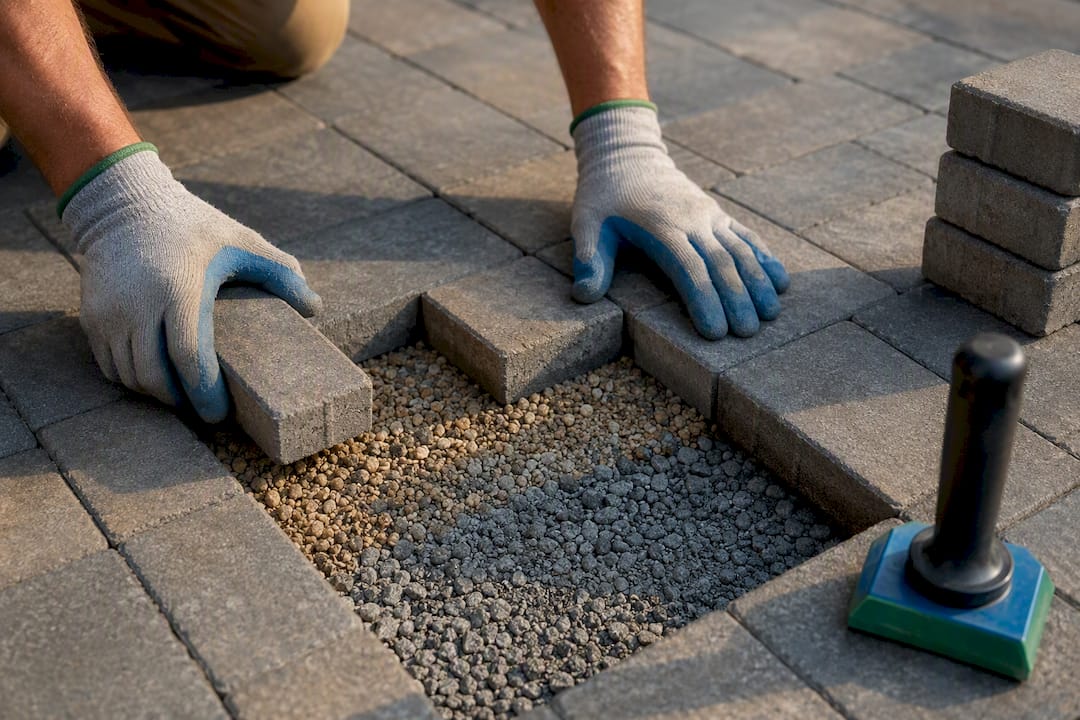
- Bedding screed. A thin, uniform layer of small bedding stone gets screeded flat to give the pavers a consistent setting surface.
- Paver placement. Units go down according to the chosen pattern, with attention to consistent joint spacing throughout the field.
- Joint filling. Small stone, often 1/4 inch, gets swept into the joints and vibrated in to lock the pavers together while keeping the surface open.
- Final compaction. A plate compactor runs over the finished surface to seat the pavers and settle the joint stone.
This Old House’s installation walkthrough covers this sequence in more detail, and it’s a useful reference if you want to compare it against a bid you’ve received.
Overflow design is the part homeowners tend to overlook. On a well-draining site, surface overflow during extreme rain events is often acceptable by design. On sites with slower infiltration or strict local codes, the reservoir may need to be lined with an impermeable liner on the downhill side and paired with an underdrain, so excess water has a controlled path out instead of surfacing unpredictably in your yard.
Pro Tip: Ask any contractor bidding your project how many compaction passes they run on the stone base, and in how many directions. Two passes in perpendicular directions is a reasonable baseline; a vague answer here is worth pushing on.
The most common shortcuts that undermine long-term performance: skipping the percolation test entirely, using sand instead of stone for bedding and joint fill (it clogs the system fast), under-compacting the stone base to save time, and installing the paver system before other heavy site work is finished. That last one matters more than it sounds. Rockville’s design guide specifically warns that permeable pavement should go in after other construction is complete, since heavy equipment traffic before final installation compacts the soil and clogs the system with sediment before it’s ever used.
If you want a closer look at how base construction principles apply across hardscape projects generally, our patio base guide breaks down excavation depth and aggregate layering in more detail.
What Does a Permeable Paver Driveway Cost?
Installed costs for permeable paver driveways commonly run $10 to $40 per square foot, according to HomeAdvisor’s cost data, a wider range than you’ll see quoted for plain asphalt or poured concrete. Porous asphalt and porous concrete tend to land toward the lower end of comparable permeable options, while plastic grass-grid systems are typically the least expensive route if your traffic needs are light.
What actually moves the price inside that range:
- Excavation depth. Poor infiltration soil means a deeper reservoir, more stone, more excavation, and more disposal cost for spoil.
- Vehicle load expectations. A driveway that needs to handle a delivery truck or RV requires a heavier base design than one built for two sedans.
- Site access. Tight urban lots or driveways requiring hand excavation cost more than open sites where equipment can maneuver freely.
- Pattern and detailing. Herringbone patterns, borders, and custom cuts around curves or utility covers add labor time.
Long-term cost isn’t just the install price. Maintenance, potential stormwater fee credits, and the fact that individual pavers can be lifted and reset rather than patched all factor into total cost of ownership over 20 to 30 years.
When you’re comparing bids, ask each contractor to itemize excavation depth, stone gradation for each layer, compaction method and number of passes, edge restraint type, and joint fill material. A bid that lumps all of that into one line item is harder to evaluate honestly, and it’s often a sign the contractor hasn’t worked through the design details yet. For a sense of how local paver pricing plays out on a comparable hardscape project, this cost breakdown is a useful reference point.
How Do You Maintain a Permeable Paver Driveway?
A permeable driveway needs less maintenance than a lot of homeowners expect, but the maintenance it does need is non-negotiable. Skip it, and the joints clog, infiltration slows, and you end up with a very expensive impermeable driveway.
Annual vacuuming or sweeping is the core task. Penn State Extension’s guidance on porous paving materials is clear that regular sweeping or vacuuming is what keeps joints open. Without it, fine debris settles into the joint stone and permeability drops steadily over a few seasons.
- Sweep or vacuum the surface at least once a year, more often near trees that drop leaves and seed pods.
- Keep fine sand, topsoil, or mulch away from the paver field. Loose fines are the fastest route to a clogged joint.
- Use a specialized permeable-paver vacuum truck for stubborn clogging rather than a standard pressure washer, which can push fine debris deeper into the joints instead of removing it.
- Watch for standing water after rain, which usually signals joint clogging rather than a base failure.
Pro Tip: If water pools in one specific spot but drains fine everywhere else, that’s almost always a localized joint clog, not a structural problem. Test it before assuming you need major repair work.
Diagnosing the difference between clogging and a genuine base failure matters because the fixes are completely different. Clogging responds to cleaning. Settlement, rutting, or shifting pavers point to compaction failure in the base, which requires lifting the affected pavers, correcting the bedding layer, and resetting them. The good news is that permeable systems are sectional by design. You repair the section that’s failing rather than tearing out the whole driveway, which is one of the quieter advantages over a monolithic asphalt surface.
How Do You Choose a Contractor for a Permeable Driveway?
The gap between a permeable driveway that performs for decades and one that fails in three years almost always comes down to who installed it, not which pavers were used. Here’s what to verify before you sign anything.
- Ask for percolation test results and a written sub-base design, including reservoir depth and whether an underdrain is planned.
- Get specifics on stone gradation for each layer and the compaction protocol, including how many passes and in what pattern.
- Confirm the edge restraint method in writing. Concrete curb, anchored edging, or a cut pavement edge are legitimate answers; soil backfill alone is not.
- Request references and photos from completed permeable installations, ideally ones that have been in place for a few years so you can see how they’ve held up.
- Get a written warranty or performance guarantee that specifies what’s covered, from settlement to clogging within a defined window.
Red flags worth walking away from: a bid that never mentions a percolation test, a base description that’s vague about depth or stone type, or a price dramatically lower than every other bid with no explanation for why. Our hardscape services overview outlines what a properly scoped project process looks like from site prep through finished installation, which is a useful benchmark when you’re comparing what different contractors are actually proposing.
What Divine Landscaping’s Crews See on Real Driveway Projects
Damian, who leads hardscape and driveway installation work at Divine Landscaping LLC, has walked enough New England lots to know that soil conditions rarely match what a homeowner assumes about their own yard. Clay pockets show up in places that look sandy on the surface, and a percolation test catches that every time a visual guess wouldn’t.
The non-negotiables our crews hold to on every permeable install:
- Correct stone gradation at every layer of the reservoir, not a generic “crushed stone” substitution.
- Compaction passes checked and repeated, since under-compaction is the single most common cause of settlement we get called back for.
- Polymeric or plain joint stone sized correctly for infiltration, never fine sand, which defeats the system’s purpose within a season or two.
- A clear overflow plan built into the design before the first shovel goes in the ground.
If you’re gathering bids, hand this checklist to every contractor you talk to: request the percolation test result, ask for the base design in writing, confirm the number of compaction passes, and get the overflow plan explained in plain language. Contractors who answer all four without hesitation are the ones worth hiring.
Why the Conventional Pitch on Permeable Pavers Misses the Point
Most homeowner content on permeable pavers leads with the environmental angle and treats installation quality as an afterthought. That’s backwards. The environmental case is real and well supported, but it’s also the easy part to sell. The hard part, and the part that determines whether you’re happy with this driveway in ten years, is whether the contractor actually ran a percolation test, sized the reservoir correctly, and compacted the base the way the design called for.
Where conventional advice falls short is in treating all permeable systems as interchangeable. A plastic grid system and a properly engineered PICP installation are not the same investment, and pricing them against each other without matching them to your actual traffic load leads to disappointment either way. If your driveway sees a delivery truck every week, a light-duty grid system was never going to hold up regardless of how well it was installed.
Prioritize the site test and the base design before you even start comparing paver colors. Everything else is easier to get right once those two decisions are correct.
— Damian
Divine Landscaping LLC: What to Expect if You Move Forward
If a percolation test or a walk through your property has you leaning toward a permeable driveway, Qualified landscaping and hardscaping contractors handle the parts that matter most: site evaluation, infiltration testing, base design, full installation, and maintenance visits that keep the system draining the way it should for decades.

A consultation starts with a detailed look at your soil, slope, and how you actually use your driveway rather than a generic quote. From there, you get a written estimate that spells out excavation depth, stone specifications, and edge restraint method, so you know exactly what you’re paying for before work begins. Our hardscape services page covers the full scope of what our crews handle across New Hampshire and Massachusetts, and our project gallery shows completed driveway and paver work if you want to see the finished result before you commit. When you’re ready, request an estimate and we’ll schedule a site visit to run the numbers on your specific lot.
Where to Verify the Details Yourself
Homeowners weighing a permeable driveway don’t have to take a contractor’s word for the technical specs. The EPA’s permeable pavement overview covers the environmental mechanics in plain language, while Rockville’s design guide and Arlington County’s stormwater program lay out the engineering specifics municipalities actually require. Penn State Extension’s guide to porous paving is a solid resource on long-term maintenance. For rebate or stormwater fee credit programs, your city or county’s public works or stormwater management office is the only reliable source, since these programs vary widely by location.
Sources
- Soak up the Rain: Permeable Pavement — EPA
- Permeable Pavement Design Guide — City of Rockville
- How to install a permeable-paver driveway — This Old House