
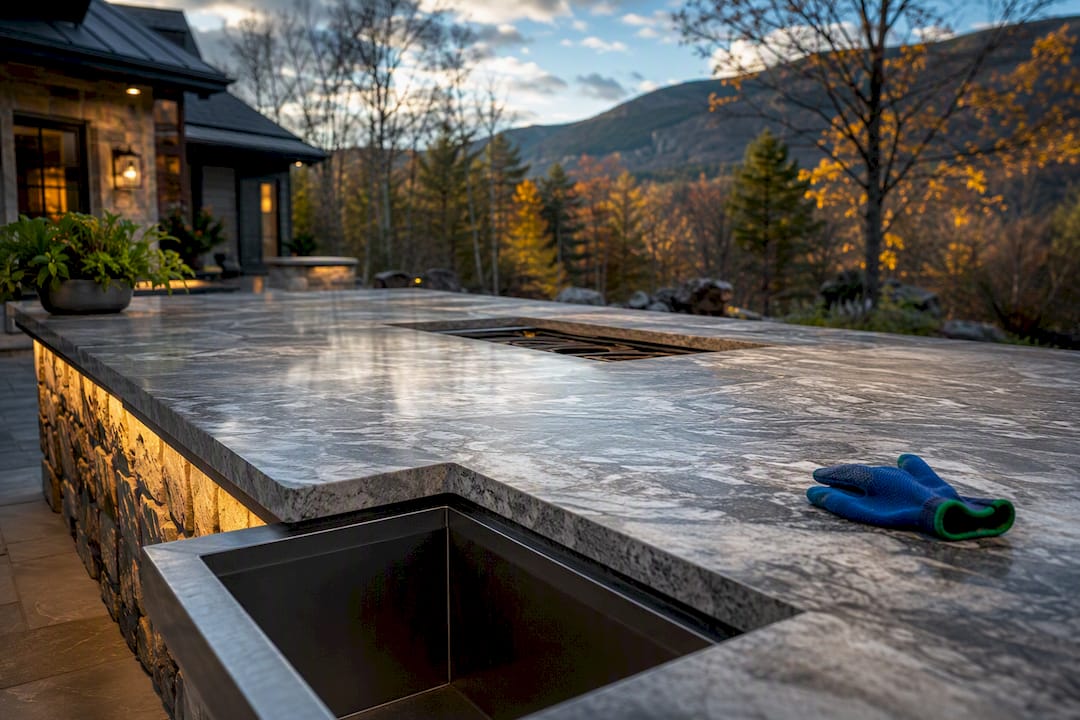
For most homeowners, the best outdoor kitchen countertops are sintered stone or large-format porcelain slabs, followed closely by honed or leathered granite. Both resist UV fading and freeze-thaw cracking far better than indoor materials, and neither demands much upkeep. Coastal properties do better with soapstone or 316 marine-grade stainless. Your climate, more than your style preference, should drive this decision.
TL;DR:
- Sintered stone and large-format porcelain are the top choices for durability and low maintenance, offering near-zero porosity and UV stability.
- Honed or leathered granite provides a natural look but requires resealing every one to three years to prevent moisture issues.
- For coastal or freeze-thaw climates, soapstone and 316 marine-grade stainless steel excel due to their non-porous, salt- and moisture-resistant qualities.
- Proper installation involves matching the material to site conditions, reinforcing heavy slabs, and planning cutouts for sinks and appliances before fabrication.
- Budget options like sealed granite and porcelain tiles perform reasonably well outdoors but demand ongoing grout maintenance and careful sealing.
Table of Contents
- Which Outdoor Countertop Material Fits Your Situation?
- How Do Porcelain, Granite, Soapstone, Stainless, and Concrete Compare?
- How Should Climate Change Your Countertop Choice?
- What Does an Outdoor Kitchen Countertop Cost to Install?
- How Do You Maintain and Seal an Outdoor Countertop?
- What Divine Landscaping LLC Has Learned From On-Site Installs
- Does Your Countertop Choice Affect the Environment?
- How Do You Match Countertops to Your Outdoor Kitchen Style?
- How Much Weight Can Your Base Structure Support?
- Will Your Countertop Work With Your Grill and Sink?
- What Actually Matters When You’re Choosing a Material
- Get a Custom Outdoor Kitchen Countertop Estimate
- Sources
- FAQ
Which Outdoor Countertop Material Fits Your Situation?
Before comparing every option in depth, most homeowners fall into one of four camps. Here’s the fast answer for each.
- Want the lowest maintenance possible? Sintered stone or large-format porcelain slabs win. They have near-zero water absorption and full UV stability, so you’re not sealing anything, ever.
- Prefer the classic outdoor kitchen look? Honed or leathered granite delivers that natural-stone warmth homeowners want, with a reseal every one to two years to keep it performing.
- Building near the coast? Skip anything porous. Soapstone and 316 marine-grade stainless steel shrug off salt air, and 316-grade fasteners keep corrosion from creeping in through the hardware.
- Working with a tighter budget? Porcelain tile or sealed granite still perform well outdoors, as long as you commit to grout maintenance and a sealing schedule.
How Do Porcelain, Granite, Soapstone, Stainless, and Concrete Compare?
Material choice for an outdoor kitchen isn’t really about looks first. It’s about which surfaces survive a New Hampshire winter, a humid Massachusetts summer, and everything sunscreen and grill grease can throw at them. Here’s how the leading options actually hold up.
-
Porcelain and sintered stone. These engineered slabs have near-zero porosity and complete UV stability, meaning no staining, no yellowing, and no sealing routine to remember. The tradeoff is cost and installation difficulty. Large-format slabs are heavy, brittle during handling, and require installers experienced with the specialized cutting and lifting equipment these panels demand. Hire the wrong crew and you risk cracked corners before the project even reaches your patio.
-
Granite, honed or leathered. Granite handles heat and freeze-thaw cycles about as well as any natural stone available, and the color range is enormous. It does need sealing roughly every one to three years to keep moisture from working into microscopic pores. Skip the high-polish finish for outdoor use. A honed or leathered surface reduces glare and improves grip when the counter is wet, which matters more than most homeowners expect once they’re standing at the grill in July.
-
Soapstone. Naturally non-porous and quietly elegant in darker gray and charcoal tones, soapstone shrugs off moisture without any sealant at all. Scratches happen, but they sand out easily. It performs especially well in freeze zones, since there’s little porosity for water to exploit during winter cycles.
-
316 marine-grade stainless steel. For coastal properties, this is close to a requirement rather than a preference. It’s fully non-porous, hygienic, and immune to the pitting that ordinary steel suffers in salt air, provided the fasteners are 316-grade too. The downsides: it gets legitimately hot in direct sun and shows scratches more visibly than stone.
-
Concrete and quartzite. Concrete offers unmatched customization in shape, color, and edge profile, but it’s porous and needs consistent sealing plus proper reinforcement to avoid cracking, especially in freeze-thaw climates. Quartzite performs closer to granite in durability, but confirm the specific slab’s absorption rate before buying, since quality varies by quarry.
One warning that applies across the board: standard interior-grade engineered quartz does not belong outdoors. The resin binders in most quartz products yellow and degrade under UV exposure, and only products specifically engineered with UV-inhibited resin formulas are rated for exterior use. If tile or porcelain is on your shortlist, remember that the grout lines, not the material itself, are usually where problems start.
How Should Climate Change Your Countertop Choice?
Your site conditions matter more than any material’s marketing copy. A few rules of thumb:
- Freeze-thaw regions: Water expands roughly 9% in volume when it freezes, and that pressure is what cracks porous stone and grout over a few winters. Stick with near-zero-absorption materials like porcelain, sintered stone, or soapstone if your kitchen sits fully exposed.
- Salt air near the coast: Specify 316-grade stainless steel and matching 316 fasteners every time. Standard stainless or carbon-steel hardware corrodes far faster than most homeowners expect once salt gets into the mix.
- Full sun exposure: Dark countertops absorb heat and can become uncomfortably hot to the touch. Lighter tones, textured finishes, or a shaded pergola over the cooking zone all help.
- Covered vs. exposed layouts: A roofed outdoor kitchen widens your material options considerably, but seams and drainage still need attention since wind-driven rain reaches covered spaces more often than people assume.
What Does an Outdoor Kitchen Countertop Cost to Install?
Budgets vary by material, slab thickness, and how much fabrication the layout demands. Ask your contractor for a per-linear-foot estimate once you’ve settled on a material, since layout complexity and seam count both affect final project costs as much as the material itself.
A few questions are worth asking any contractor before signing anything:
- Is this specific product rated for exterior use, or is it an interior line being repurposed?
- What fastener grade is specified for the substructure and any metal trim?
- What warranty terms apply specifically to outdoor installation, not just the material itself?
- What sealer do you recommend, and on what schedule?
- How visible will seams be, and what’s the process if a section needs repair later?
Large-format porcelain and sintered stone demand installers with specialized vacuum lifts and diamond-blade cutting tools, since standard tile crews often aren’t equipped for slabs this heavy or brittle. Poured concrete counters need proper rebar or mesh reinforcement before the pour, not after cracks appear.
How Do You Maintain and Seal an Outdoor Countertop?
Maintenance schedules vary enough by material that mixing them up leads to premature wear. Granite and quartzite need resealing every one to two years. Concrete needs it annually in most climates. Porcelain, sintered stone, soapstone, and stainless steel need no routine sealing at all.
- Avoid acidic cleaners like vinegar or citrus-based sprays on any natural stone. They etch the surface over time.
- Rinse stainless steel regularly in coastal zones to clear salt residue before it has a chance to sit.
- Before winter, cover appliances, drain and blow out water lines, and check grout lines for cracks that let moisture in during freeze cycles. A step-by-step cleaning routine helps homeowners stay ahead of buildup between deep cleans.
- Store removable accessories like cutting boards or trivets indoors over winter rather than leaving them exposed.
Pro Tip: Choose a honed or leathered finish over polished stone anywhere near a grill. It hides water spots and fingerprints far better, and it won’t turn into a skating rink the moment someone splashes marinade on it.
What Divine Landscaping LLC Has Learned From On-Site Installs
Framing matters as much as the slab itself. We build weatherproof frames, grade for proper drainage away from the structure, and seat slabs on a bed that avoids point-loading, which is what actually cracks stone over time, not the winter cold alone.
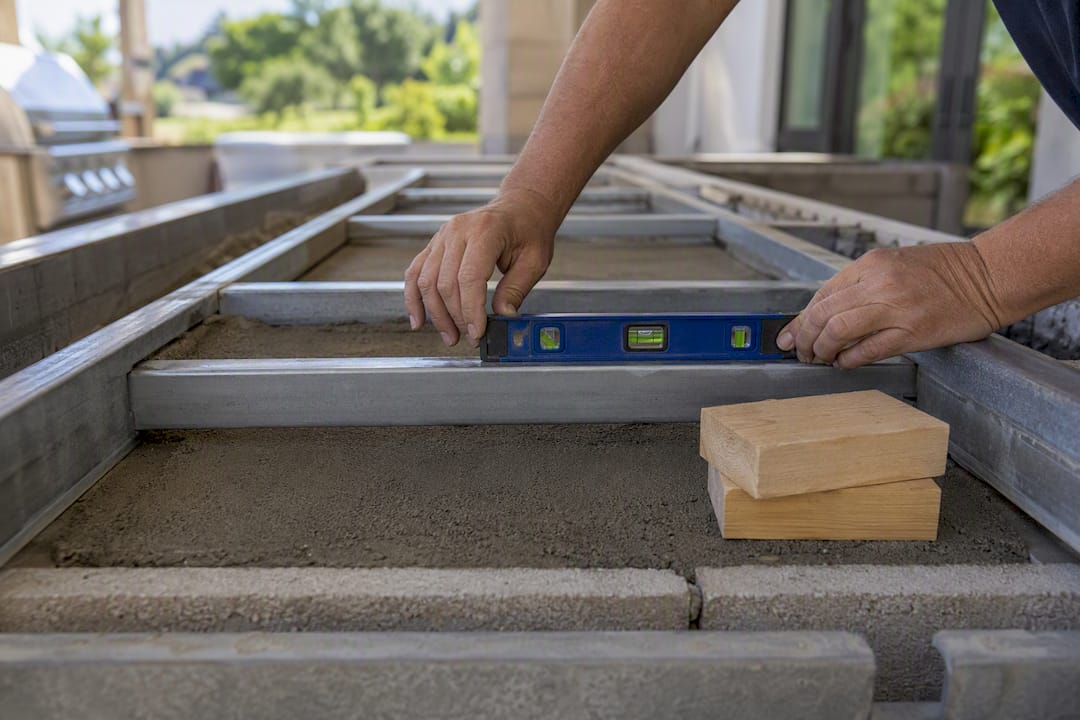
The mistakes we fix most often: sink and cooktop rough-ins measured before the final slab template, fasteners specified for indoor use, and homeowners falling for engineered quartz that was never rated for sun exposure. Our project gallery shows finished examples across several material types. If your layout is straightforward and standard-sized, a prefabricated outdoor kitchen kit can work. Custom footprints, built-in seating, or unusual site grades usually call for a contractor instead.
Does Your Countertop Choice Affect the Environment?
Material sourcing matters more here than most buying guides admit. Natural stone like granite and soapstone is quarried, which carries a real environmental footprint tied to extraction and transport, but the slabs themselves last decades without replacement, which offsets some of that upfront cost.
Sintered stone and porcelain are manufactured from natural minerals fused under extreme heat and pressure, a process that consumes significant energy but produces a surface that essentially never needs replacing due to weathering. Concrete has a mixed profile. Cement production is carbon-intensive, but a well-poured concrete counter can be formulated with recycled aggregate and still last a decade or more outdoors.
Stainless steel stands out for recyclability. Most marine-grade stainless contains substantial recycled content already, and old panels can be fully recycled at end of life rather than landfilled. If sustainability weighs heavily in your decision, ask suppliers directly about recycled content percentages and regional sourcing. Shorter shipping distances for heavy slabs reduce transport emissions meaningfully, and a quarry or fabricator within a few hundred miles beats one shipped overseas, even if the material itself is identical.
Longevity is the real sustainability lever here. A countertop that lasts 25 years without cracking, staining, or replacement almost always beats a cheaper option that needs redoing twice in that span, regardless of the manufacturing footprint of either one.
How Do You Match Countertops to Your Outdoor Kitchen Style?
Material and style aren’t separate decisions, even though buying guides often treat them that way. A rustic stone patio with a wood pergola calls for a different countertop than a clean-lined modern deck kitchen, and the finish you choose can either complete that look or fight against it.
Leathered granite in warm earth tones suits farmhouse and rustic layouts, especially paired with stacked-stone facing on the base cabinetry. Soapstone’s deep charcoal leans naturally toward modern and minimalist designs, particularly against black stainless appliances or matte metal fixtures. Large-format porcelain slabs now come in finishes that convincingly mimic marble or concrete, giving homeowners a high-end look without the maintenance burden either original material carries.
Color also does practical work beyond aesthetics. Lighter porcelain or granite tones brighten a shaded patio and reflect heat in full-sun installations, while darker soapstone or stainless hides grill grease and daily fingerprints better on a high-traffic cooking station. If your outdoor kitchen sits on a deck rather than a poured patio, lighter materials also tend to read better against wood decking tones than heavy dark stone does.
Edge profiles matter too. A bullnose or bevel edge softens a stone counter for family-friendly spaces, while a squared edge reads more contemporary and pairs naturally with stainless appliances and simple sightlines.
How Much Weight Can Your Base Structure Support?
Countertop weight is where a lot of DIY plans quietly fall apart. Granite and quartzite slabs typically run heavier per square foot than porcelain or sintered stone of comparable thickness, and that difference adds up fast across a ten-foot run. A base cabinet system built for a light material simply won’t hold a full granite slab without sagging or cracking at the seams over time.
Concrete counters, cast in place or poured off-site, tend to be the heaviest option of all once cured, which means the substructure needs real engineering, not a standard cabinet frame. This matters even more on elevated structures. An outdoor kitchen built on a deck needs the deck’s joists and support posts evaluated for the added load, since most residential decks weren’t framed with a stone countertop and grill island in mind.
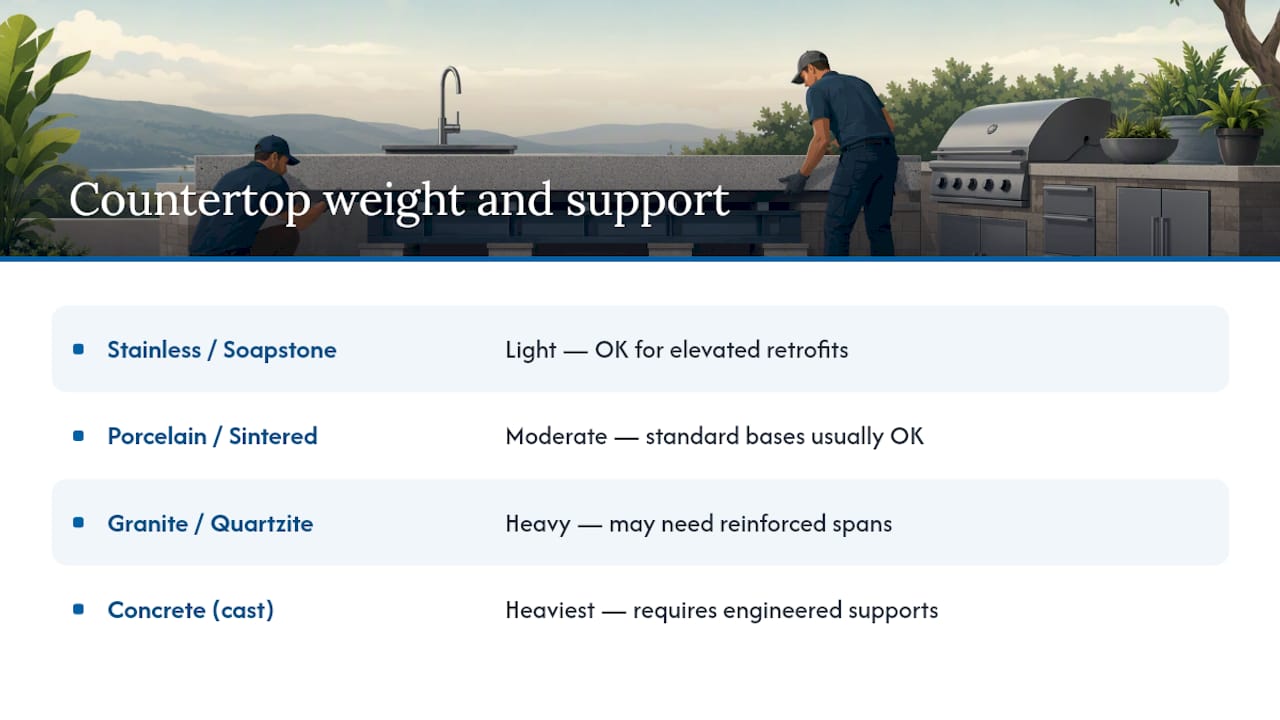
Stainless steel and soapstone sit toward the lighter end, which makes them more forgiving for elevated or retrofit installations where added structural reinforcement isn’t practical. Whatever material you choose, the base needs to be level, fully supported across its span, and free of any gaps that let the slab flex under its own weight. Unsupported overhangs are a common failure point, particularly with heavier stone, so confirm the maximum unsupported span your fabricator recommends before finalizing cabinet placement.
Will Your Countertop Work With Your Grill and Sink?
Cutouts for cooktops, sinks, and grill inserts need to be planned before the slab is fabricated, not after. Porcelain and sintered stone can be cut with precision using diamond-tooled equipment, but the cutout locations have to be finalized early since these materials don’t tolerate rework the way concrete does.
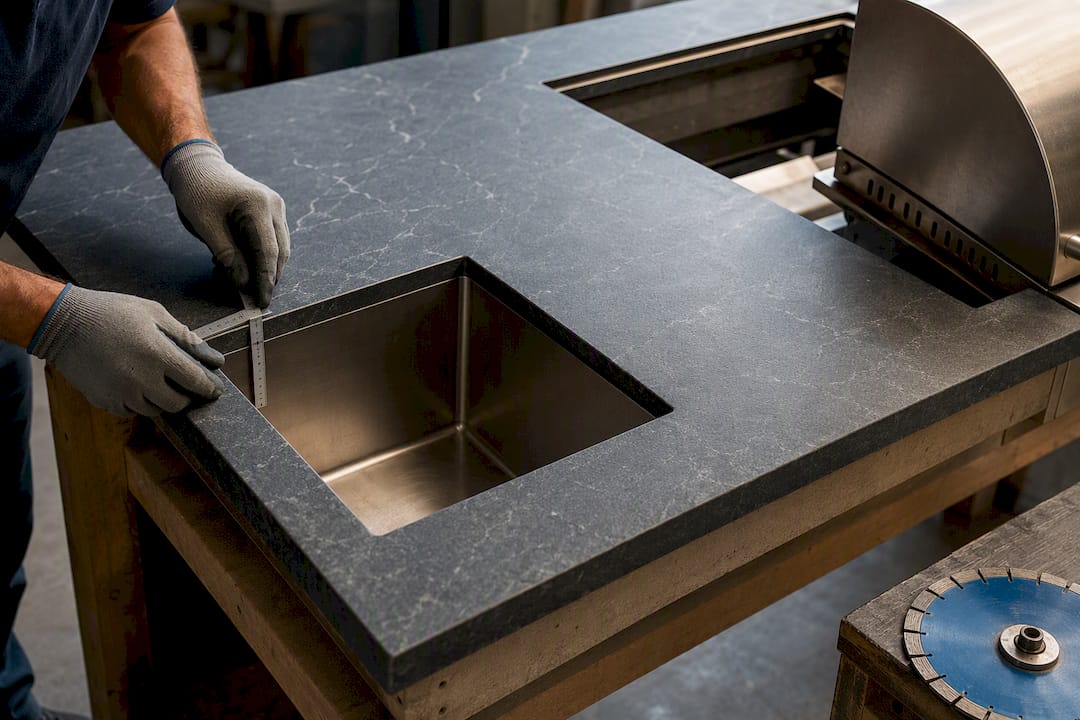
Heat is the bigger compatibility issue. Any material sitting directly adjacent to a built-in grill or side burner needs to tolerate radiant heat without discoloring or cracking, which rules out anything with lower heat tolerance regardless of how attractive it looks in a showroom. Granite, soapstone, porcelain, and stainless all handle this well. Concrete can too, provided the mix and sealant are heat-rated for the application.
Sink cutouts introduce a different concern: seam sealing around the basin edge. A poorly sealed sink cutout in a porous material becomes a moisture entry point almost immediately, undermining the rest of the counter’s durability regardless of how good the material is everywhere else. Stainless steel sinks integrate most seamlessly with stainless countertops, since both can be welded into a single continuous surface with no seam at all.
If your layout includes a side burner or built-in ice chest, confirm clearance specs with the appliance manufacturer before the slab template is cut. Retrofitting a cutout after fabrication is expensive and sometimes impossible depending on the material.
What Actually Matters When You’re Choosing a Material
Most buying guides treat outdoor countertop selection like a style decision with durability as an afterthought. That’s backwards. The climate you live in should eliminate half the options before aesthetics even enter the conversation, and homeowners who skip that step end up resealing granite they never wanted to maintain or replacing concrete that cracked its first winter.
The conventional advice, “pick what matches your kitchen,” undersells how much failure actually stems from mismatched hardware and fasteners rather than the slab itself. A gorgeous granite counter installed with standard stainless fasteners near the coast will fail at the hardware long before the stone shows any wear. That detail rarely makes it into glossy design articles, but it’s the difference between a counter that lasts fifteen years and one that needs hardware repairs within three.
If there’s one priority worth fixing first, it’s this: match the material and every fastener to your actual site conditions, not to a photo you liked online. Everything else, including finish and edge profile, is a preference. Climate compatibility is not.
— Damian
Get a Custom Outdoor Kitchen Countertop Estimate
Divine Landscaping LLC builds outdoor kitchens designed around your specific site, not a one-size-fits-all kit pulled off a shelf. Because we handle everything from grading and drainage to slab installation and masonry finishing, you get one contractor accountable for the whole structure instead of coordinating separate crews for the patio, the base, and the countertop.

Browse the project gallery to see finished countertop applications across granite, porcelain, and stainless installations throughout New Hampshire and Massachusetts. A consultation covers material selection for your climate, site constraints like drainage and structural support, and a cost-per-linear-foot estimate specific to your layout. Visit Divine Landscaping LLC’s hardscape services to request a consultation and get a real number for your project instead of a national average that doesn’t reflect New England conditions.
Sources
- HGTV — Outdoor kitchen countertop options
- BBQHost — Best countertop materials for outdoor kitchens
- Grills
- The Spruce — Outdoor kitchen countertops
FAQ
What Is the Best Countertop for an Outdoor Kitchen?
Sintered stone and large-format porcelain slabs are generally the best all-around choice thanks to their near-zero porosity and UV stability. Honed granite is a close second for homeowners who want a natural-stone look and don’t mind resealing every one to two years.
What Is the Cheapest Countertop for an Outdoor Kitchen?
Sealed granite or porcelain tile tend to be the most budget-friendly options that still hold up outdoors, though tile requires more grout maintenance over time. Concrete can also be affordable if poured on-site, but factor in the cost of proper reinforcement and annual sealing.
What Is the Best Surface for an Outdoor Kitchen in a Cold Climate?
Non-porous materials like sintered stone, porcelain, or soapstone perform best in freeze-thaw regions, since water expanding inside porous stone or grout is what causes cracking. Confirm any granite or concrete surface is properly sealed before winter if you go that route instead.
What Are Good Waterproof Outdoor Countertops?
Sintered stone, large-format porcelain, soapstone, and 316 marine-grade stainless steel are all effectively waterproof due to their extremely low porosity. Granite and concrete can perform well too, but only with a consistent sealing schedule to keep moisture from working into the surface.