
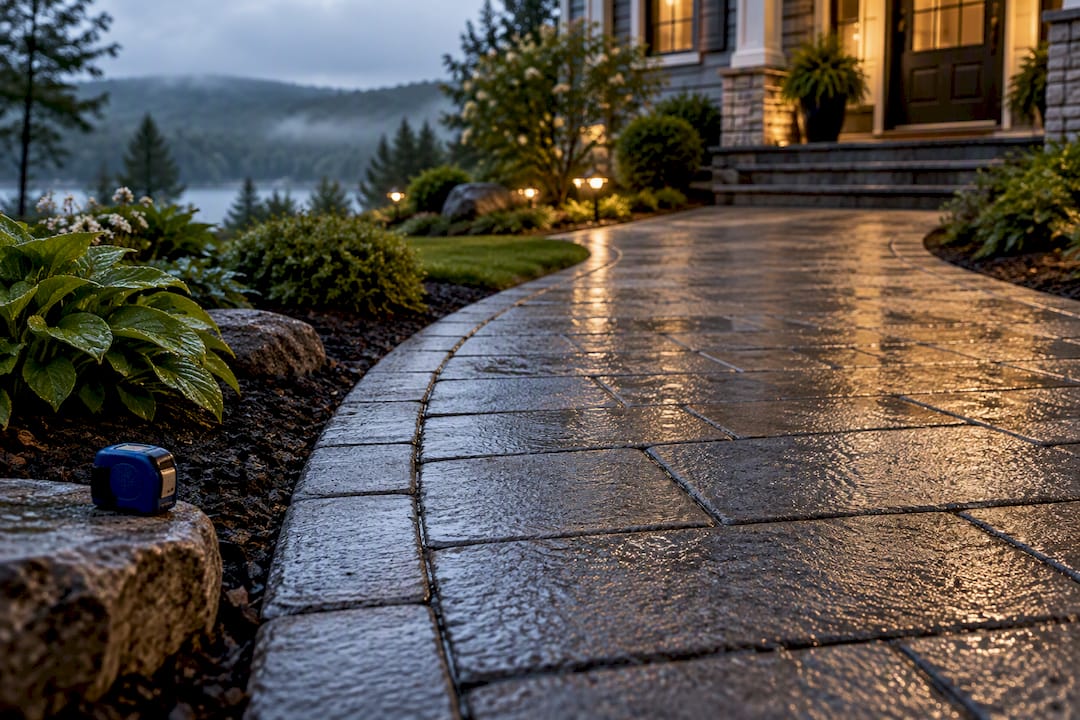
Concrete pavers with a textured or exposed-aggregate face, broom-finished or acid-etched concrete, bead-embedded epoxy coatings, and certain textured porcelain or natural stone products all reliably produce non-slip walkway materials when specified correctly. The rule that matters more than any single product choice: match surface texture and drainage to the contaminant you actually expect (water, oil, ice, or leaf litter), then commit to the maintenance that keeps that texture working.
TL;DR:
- Permeable and textured pavers with proper drainage are highly effective in maintaining traction during rain and avoiding pooling issues.
- Coarse joint aggregate and acid-etched or thermal finishes on stones and porcelain improve slip resistance in wet or splash-prone areas.
- Bead-embedded epoxy coatings provide superior slip resistance in damp conditions but require periodic recoating for sustained effectiveness.
- Proper site drainage, base compaction, and regular maintenance are critical to preserving traction over time, especially in high-contaminant zones.
- Contractors must evaluate site-specific factors such as water flow, contaminants, and slope before recommending durable, slip-resistant walkway solutions.
Table of Contents
- Non-Slip Walkway Materials: Types, Trade-Offs, and Where They Belong
- How to Choose Materials by Setting and What Contaminates the Surface
- Do Anti-Slip Coatings and Surface Treatments Actually Work?
- Installation and Maintenance Steps That Keep Traction Working
- What DCOF, PTV, and NFSI Ratings Actually Tell You
- What Contractors Check Before Recommending a Walkway Material
- Balancing Safety, Looks, and Budget on a Real Property
- Get a Walkway Assessment From Divine Landscaping
- Sources
- FAQ
Non-Slip Walkway Materials: Types, Trade-Offs, and Where They Belong
Walking into a materials showroom without a plan is how property owners end up with a beautiful walkway that turns into a skating rink every October. Every material on this list can be a slip resistant walkway option in the right setting, and a liability in the wrong one.
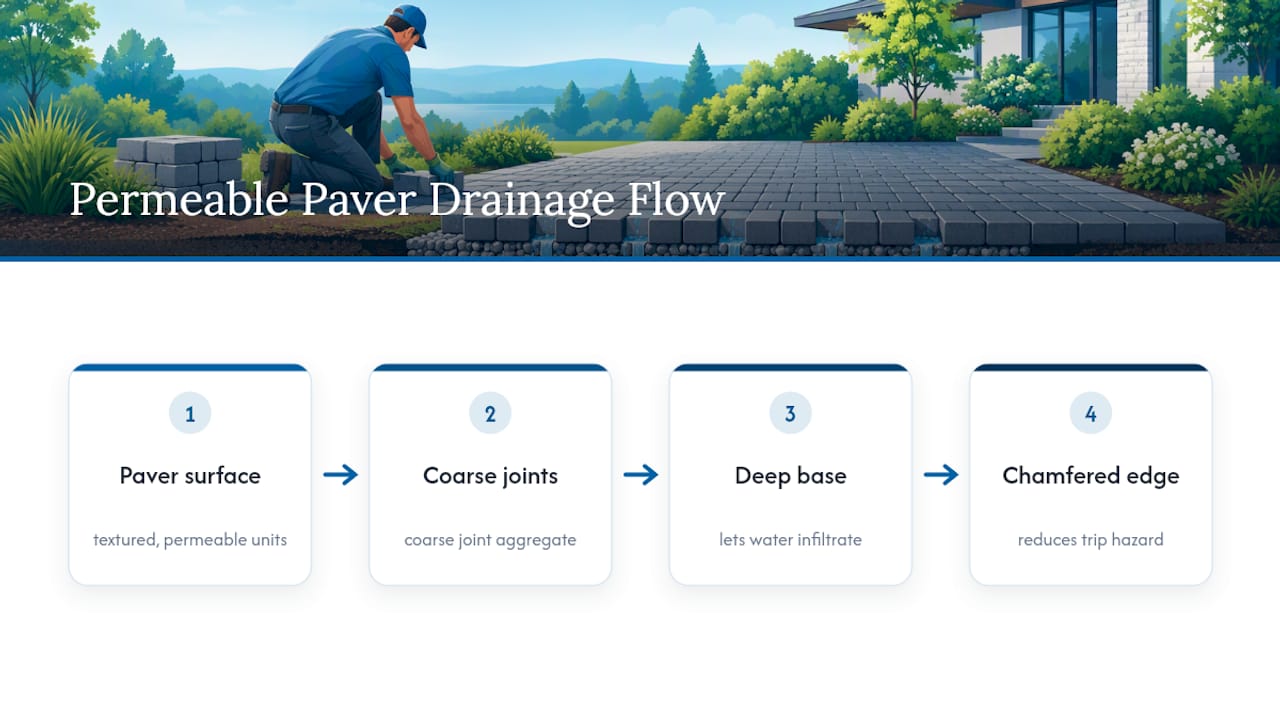
Concrete pavers, interlocking and permeable. Textured concrete pavers give you a repeatable, factory-controlled surface profile, and permeable versions add drainage that solid materials cannot match. Permeable interlocking pavers rely on coarse joint aggregate and a deeper base course to let water infiltrate rather than pool on the surface, which is exactly the combination that keeps traction consistent through a rainstorm, according to permeable paver installation specifications. A small chamfer on the paver edge softens the transition between units and cuts down on the trip hazard that comes from edges shifting over time.
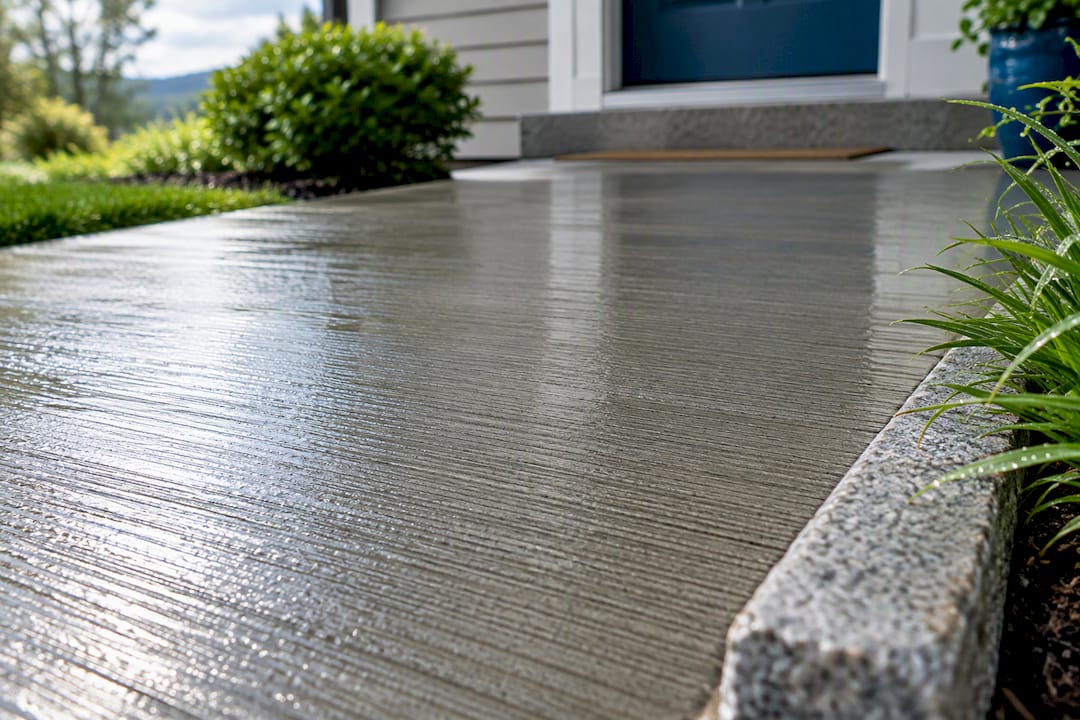
Broom-finish and exposed-aggregate concrete. Broom finishing is the cheapest way to add traction to a poured slab, and it works because the bristle pattern creates thousands of tiny channels that break water film underfoot. Exposed aggregate goes a step further by grinding away the surface paste to reveal embedded stone, which holds up longer under heavy foot traffic. Both are retrofit-friendly if you already have a smooth slab that has become dangerously slick.
Natural stone and textured porcelain. Bluestone, granite, and travertine look excellent on a front walk, but a polished or honed finish turns dangerous the moment it gets wet. Thermal or flamed finishes on stone, and textured “outdoor rated” porcelain pavers, solve most of that problem. Always ask for the wet-rated version of any stone product; the showroom sample is almost always the dry, polished version.
Epoxy and polymer topcoats with aggregate. These coatings let you retrofit traction onto an existing slab without tearing it out, and bead-embedded epoxy systems in particular hold up well in damp conditions. Wear is the trade-off: beads flatten under years of foot traffic and need periodic recoating.
Rubber and PVC matting, drainage runners. Matting is the fastest fix for a high-contaminant zone like a loading dock apron or a seasonal pool deck entry. Certified matting systems with built-in drainage channels can handle oily or industrial conditions that would defeat most hard-surface coatings, per product testing data on PVC matting systems. It is rarely the right permanent solution for a primary residential or commercial walkway, though, since it degrades under UV and heavy weather faster than masonry.
Anti-slip tapes and stair nosings. These belong on steps, thresholds, and transition points rather than open walkways. They are inexpensive and easy to install, but adhesive-backed tape has a real lifespan, typically a year or two outdoors before edges start to lift and become a hazard themselves.
How to Choose Materials by Setting and What Contaminates the Surface
The setting tells you almost everything you need to know before you look at a single product spec sheet.
- Entryways and covered walkways. These see foot traffic in all weather but limited direct rain exposure. Textured pavers or broom-finished concrete handle this well, especially paired with a walk-off mat zone just inside the door to catch tracked-in water.
- Ramps and accessible routes. Firmness and stability matter as much as texture here. Research on exterior surfaces for accessibility found that many materials lose firmness and stability once wet, which directly affects wheelchair and walker users, according to Access Board research on exterior surfaces. Choose a stable, consistently textured paver or broom-finished concrete over loose aggregate or soft-set stone on any ramp.
- Pool decks and splash zones. Constant water contact plus sunscreen residue and bare feet make this the least forgiving setting on the list. Textured concrete or coarse-aggregate pavers with generous drainage slope outperform smooth stone by a wide margin.
- Service garages and commercial entries. Oil, grease, and de-icing chemicals are the real threats here, not just water. Certified matting or a chemically resistant epoxy system built for contaminant exposure usually beats a plain masonry finish.
- Landscaped garden paths. Organic debris, leaf litter, and moss growth are the main hazards. Permeable pavers or exposed-aggregate concrete resist algae buildup better than smooth stone because water does not sit on the surface.
Budget for upkeep the same way you budget for the material itself. A high-performance surface that never gets swept, power-washed, or resealed will lose its traction advantage within a few seasons regardless of what the spec sheet promised. Readers managing routes that must meet accessibility requirements should also review ADA landscape compliance guidance before finalizing a material.
Do Anti-Slip Coatings and Surface Treatments Actually Work?
Coatings are a real fix, not a band-aid, but only when matched to the right substrate and contaminant profile.
Bead-embedded epoxy systems consistently outperform standard acrylic sealers in wet or damp conditions. A 2026 study measured dynamic friction on coated surfaces and found epoxy with embedded plastic beads reached a dynamic friction coefficient around 0.60 to 0.62 under damp testing, notably higher than comparable acrylic coatings, according to the TexCoMP coatings and slip resistance study. That is a meaningful margin when the difference shows up as someone catching themselves instead of falling.
- Epoxy and aggregate broadcast systems suit damp, shaded, or frequently hosed-down areas, as research shows coatings with embedded beads can achieve higher dynamic friction in these conditions.
- Acid-etch treatments work best on dry or arid-climate walkways where standing water is rare.
- Bead size and density affect both starting traction and how fast that traction fades, so ask the manufacturer for bead specification and an expected recoating interval rather than a one-time performance claim.
- A coating is the right retrofit when the underlying slab is structurally sound; when the concrete itself is cracked or spalling, replacement usually costs less over ten years than repeated coating failures.
For step-by-step application guidance, a homeowner’s guide to epoxy coating steps walks through surface prep and cure times that apply just as well to walkway sections as driveways.
Pro Tip: Ask any coating manufacturer for the bead density and the projected recoat interval in writing before you sign off. A traction number measured on day one tells you nothing about year three.
Installation and Maintenance Steps That Keep Traction Working
Slip resistance is not a one-time property you install and forget. It is a condition you maintain.
- Design for drainage first. Grade every walkway section away from the building with enough slope to move water off the surface, not just downward through it. Standing water defeats even the best textured finish.
- Compact the base properly. Skimping on base preparation is the single biggest reason pavers shift, settle unevenly, and create trip hazards within a few years. Deeper, well-compacted bases matter even more for permeable systems, since they double as the drainage reservoir.
- Detail the edges. Small chamfers on paver edges reduce the trip risk that comes from units settling at slightly different heights over time.
- Choose deicers carefully. Rock salt corrodes and pits many concrete and natural stone surfaces over repeated winters. Calcium magnesium acetate or other masonry-safe deicers protect the surface texture you are relying on for traction. For preparing a solid base before winter freeze cycles, the same compaction principles that protect a garage slab apply directly to walkway substrates.
- Clean textured and permeable surfaces on a schedule. Power-wash exposed aggregate and broom-finish concrete at least once or twice a year to clear algae and grime buildup. Permeable paver joints need periodic vacuuming and replenishing with fresh joint aggregate to keep infiltration working, not just to keep them looking clean.
- Use temporary fixes honestly. Rubber mats or anti-slip tape at a problem threshold are fine as a stopgap while you plan a permanent repair, but do not let a temporary fix become the permanent answer for a chronic hazard spot.
What DCOF, PTV, and NFSI Ratings Actually Tell You
Manufacturer traction labels look authoritative, but a single number rarely tells the whole story.
- Wet DCOF and ANSI A326.3. This standard sets a 0.42 wet dynamic coefficient of friction guideline for interior wet-use hard surfaces, but it explicitly contains no outdoor recommendations and cautions that DCOF alone does not predict real-world slip risk, per the ANSI A326.3 test method.
- Pendulum Test Value and ASTM E303. Pendulum testing measures friction dynamically across a textured surface and is widely considered more predictive for outdoor, contaminated, or irregular surfaces than a lab DCOF reading taken on a flat sample.
- NFSI traction categories. The National Floor Safety Institute and related ASTM/NFSI B101.x methods classify traction into ranges that installers and facility managers use for procurement, though a certified label still describes lab conditions, not your specific site.
Standards summaries note that ASTM E303, ANSI A326.3, and NFSI methods are complementary rather than interchangeable, and property owners should always ask which method produced a quoted number, according to a standards comparison summary. Industry guidance likewise warns that specifiers need to weigh traffic, contaminants, and expected maintenance rather than treating any single lab figure as the final word, per commentary on specifier responsibility. When in doubt, request the test report and consider a modest field test on the actual installed surface, wet, under real foot traffic.
What Contractors Check Before Recommending a Walkway Material
A site visit reveals more than any product catalog does. Before recommending a material, an experienced installer walks the site checking traffic patterns, likely contaminants, existing drainage, the finish on adjacent surfaces, and how much upkeep the owner realistically plans to do.
The most common mistake we see is a property owner fixating on one manufacturer’s lab-tested traction number while ignoring drainage. A textured paver installed with no slope toward a drain will pool water and lose most of its rated traction advantage within one wet season. Thin, single-coat epoxy applications without enough embedded aggregate are another repeat offender. They look fine in the showroom sample and wear smooth within a year of real foot traffic.
- Confirm slope and drainage before selecting a finish, not after.
- Match coating thickness and aggregate density to actual foot traffic, not a minimum spec.
- Budget for recoating or resealing on a known cycle rather than an “as needed” guess.
DIY installation can work for a short, low-traffic garden path, and a step-by-step guide for building a front yard walkway covers that scope well. Larger commercial entries, ramps, or anything tied to accessibility compliance usually justify a professional install, both for the base engineering and for warranty coverage. Learn more about what full hardscape services typically include before deciding which route fits your project.
Balancing Safety, Looks, and Budget on a Real Property
Every walkway material decision is really three decisions stacked together: how safe it needs to be, how it needs to look, and what the owner is willing to spend maintaining it. Safety should win that argument on any ramp, entry, or pool deck, full stop. Plan for the contaminant scenario you will actually face, not the dry, sunny day the sample looked great in.
If a walkway sees ice, heavy shade, or wheelchair traffic, get a contractor to walk the site rather than relying on a spec sheet alone. Numbers on paper do not account for your slope, your drainage, or your winter.
— Damian
Get a Walkway Assessment From Divine Landscaping
Choosing between textured pavers, exposed aggregate, and an epoxy retrofit is easier with someone standing on your actual walkway, not just reading a spec sheet. Professional landscaping companies build and repair walkways across residential and commercial properties, working through drainage, base preparation, and finish selection as one connected project rather than three separate guesses.
Our walkway installation and repair work covers everything from permeable paver replacements to full drainage remediation on existing slabs, and our patio installation services extend the same materials expertise to adjoining outdoor living spaces. A site visit typically covers traffic patterns, contaminant exposure, existing drainage, and a realistic maintenance plan before recommending a specific product. If a section of your property has become a recurring slip hazard, request a quote and we will schedule an assessment.
Sources
- Exterior surfaces research — firmness, stability and accessibility
- TexCoMP study on coatings and slip resistance
- Ideal Permeable Paver Specs (Andover Collection & 5511)
FAQ
What Is the Best Material for an Outdoor Walkway?
There is no single best material across every setting; textured concrete pavers and exposed-aggregate concrete are the most versatile choices for most residential walkways because they hold traction in wet and dry conditions alike. The right pick depends on your climate, contamination exposure, and how much maintenance you plan to keep up with.
What Are the Best Non-Slip Materials for High-Contaminant Areas?
Certified rubber or PVC matting with built-in drainage channels handles oily or industrial conditions better than most hard-surface finishes, since it is designed for chemical resistance, according to product testing on PVC matting. For permanent installations, bead-embedded epoxy coatings are the stronger long-term choice in damp, high-traffic zones.
What Is the Best Anti-Slip Coating for Outdoor Paths?
Bead-embedded epoxy coatings achieve high dynamic friction in damp conditions, outperforming standard acrylic sealers according to the 2026 coatings study. Acid-etch treatments can work as well in drier climates where standing water is rare.
What Type of Pavers Are Not Slippery When Wet?
Textured or exposed-aggregate concrete pavers and permeable interlocking pavers with coarse joint material stay grippier when wet than polished or honed stone, largely because their surface profile breaks up water film underfoot, per permeable paver specifications. Avoid polished granite, marble, or honed bluestone for any walkway exposed to rain or splash zones.
How Much Does Divine Landscaping Charge for Walkway Installation?
Pricing depends on material, square footage, and site conditions, so Divinelandscapingllc does not publish a flat rate for walkway work. Current project pricing is available by requesting a quote and site assessment.