
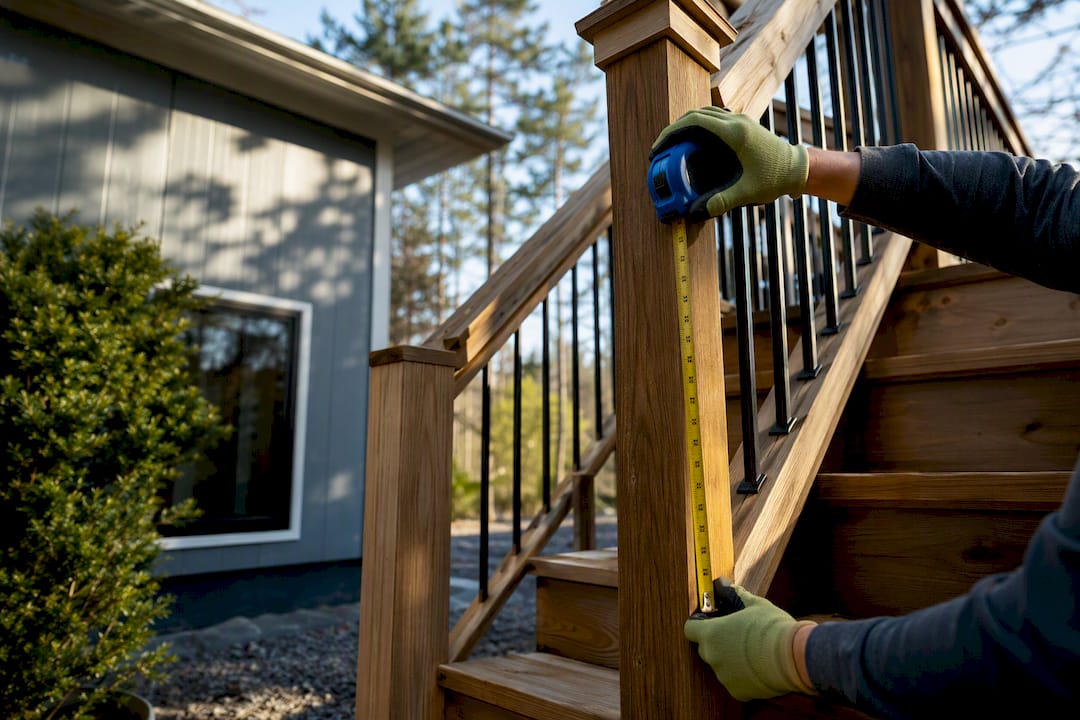
Yes, a well-built, properly sized deck usually adds resale value. National benchmarks show homeowners typically recoup roughly half to two-thirds of the build cost when they sell, with wood decks often showing a higher recoup rate on paper, with composite decks trading some recoup percentage for less maintenance risk. Condition, permits, and local market taste can move that number substantially in either direction.
TL;DR:
- Composite decks cost about $24,000 to build and typically recoup around 68%, adding approximately $16,500 at resale, while wood decks can have higher percentage recoups but similar dollar returns.
- The deck’s condition, legality, and size relative to the home are as important as material choice, with unpermitted or poorly maintained decks actively decreasing offers.
- Small fixes like cleaning, tightening fasteners, and restaining within 12 to 24 months of sale usually deliver better returns than costly replacements or elaborate upgrades.
- Proper permit pulling, correct installation, and matching the deck size to the neighborhood and home’s scale are essential to preserving resale value and avoiding inspection issues.
- A well-maintained, code-compliant deck aligned with neighborhood expectations can significantly influence days on market and overall sale price, even without high-end features.
Table of Contents
- Typical ROI numbers and what sellers should expect
- How materials, size, and features change ROI
- What actually moves a deck’s contribution to resale value
- Should you repair, refinish, or replace before listing?
- Contractor checklist for protecting deck resale value
- Tax implications or incentives related to decking improvements
- DIY versus professional installation and what it does to ROI
- What sellers get wrong about deck ROI
- How Divine Landscaping LLC helps sellers protect their deck’s value
- Where to check the numbers yourself
- Sources
- FAQ
Typical ROI numbers and what sellers should expect
Cost figures from remodeling industry benchmarks give sellers a concrete starting point. For a standard 320 square foot deck, one widely used composite benchmark puts the average build cost near $24,000, with resale value near $16,500, a recoup rate of about 68%. Wood decks tend to cost less upfront, and that lower base cost is part of why they can show a recoup rate as high as 50 to 95% depending on the market and the data source, even though the dollar amount recovered often lands close to what a composite deck returns.
That distinction matters for how you read a percentage. A high recoup rate on a cheap deck can still add fewer dollars than a lower recoup rate on a pricier one, so sellers should look at both numbers before deciding what to build or repair.
- A $24,000 composite deck project returning roughly 68% adds about $16,500 at resale.
- A less expensive wood deck can show a higher percentage on paper while adding a similar dollar amount.
- Regional climate and buyer taste shift these figures further: covered decks and heated features perform differently in short-season markets than in warmer regions.
Remodeling and real estate industry data consistently rank outdoor living projects among the stronger exterior investments, which is part of why decks show up so often in resale conversations.
How materials, size, and features change ROI
Material choice changes both the upfront number and how the deck ages, which matters if you are timing a sale.
- Pressure-treated wood costs the least to build but needs regular staining and sealing, and that recurring cost adds up over a five to seven year window.
- Cedar sits above pressure-treated wood in price and looks better longer, but it still asks for periodic maintenance to avoid graying and splitting.
- Composite decking costs more per square foot up front, yet its lower maintenance profile can become financially competitive within five to seven years once wood’s upkeep costs are counted.
- Tropical hardwoods sit at the premium end and appeal to specific buyer tastes, which can narrow your pool of interested purchasers.
Features matter almost as much as material. Built-in seating, layered lighting, and code-compliant railings tend to read as finished and safe to buyers, while elaborate pergolas or oversized built-ins rarely pay back their added cost. Match the material to your timeline: a seller moving within a year gets little benefit from paying a composite premium, while an owner planning to stay five or more years may find the lower upkeep worth the higher entry price.
What actually moves a deck’s contribution to resale value
Material is only part of the equation. Appraisers and buyers respond just as strongly to condition, legality, and proportion.
- A neglected deck with loose boards or wobbly railings can actively reduce offers, sometimes by more than the cost of fixing it.
- Unpermitted work is a known risk at closing: appraisal guidance treats decks as an amenity rather than living space, and buyers’ lenders can balk at structures without documented permits.
- Pulling permits before you build is inexpensive relative to the risk of a sale stalling over code questions later.
- A common sizing guideline keeps the deck footprint at roughly 10 to 20% of the home’s square footage, since an oversized deck on a modest home rarely earns back its extra cost.
- A well-presented deck can shorten days on market, and every week a home sits unsold adds carrying costs that eat into your net proceeds.
Neighborhood expectations shape all of this. A $40,000 deck added to a modest home rarely recovers fully if nearby comparable sales do not support that kind of upgrade.
Should you repair, refinish, or replace before listing?
Most sellers overestimate what a deck needs before a sale. The right move usually depends on your timeline and the deck’s actual condition, not its age.
- If you plan to sell within 12 to 24 months, focus on cleaning, restaining, tightening loose fasteners, and inspecting the ledger board rather than a full rebuild.
- Replace only when there is a structural problem, a missing permit that cannot be resolved, or a safety issue that would show up on a home inspection.
- Small pre-listing fixes in the $500 to $2,000 range often deliver a better net return than a $20,000 replacement, especially when the existing structure is sound.
- Factor in carrying costs: a faster sale from a well-presented deck can offset far more than the price of a weekend refinish.
Pro Tip: Walk the deck yourself and check for soft spots, rust streaks around fasteners, and any gap where the ledger meets the house. Those three spots tell an inspector, and a buyer, most of what they need to know.
Contractor checklist for protecting deck resale value
A consistent set of standards can be applied on resale-focused deck projects, whether the job is a new build or a renovation ahead of a listing.
- Pull permits before construction starts and keep documentation on hand for the eventual buyer or appraiser.
- Install proper ledger flashing and use code-approved fasteners to prevent the moisture damage that fails inspections.
- Build stairs and railings to current code height and spacing requirements, since these are common inspection flags.
- Size the deck to match the home’s scale and the neighborhood’s typical price point rather than defaulting to the largest footprint the lot allows.
- Set a maintenance schedule appropriate to the material, since a wood deck needs different upkeep than composite over its lifespan.
Tax implications or incentives related to decking improvements
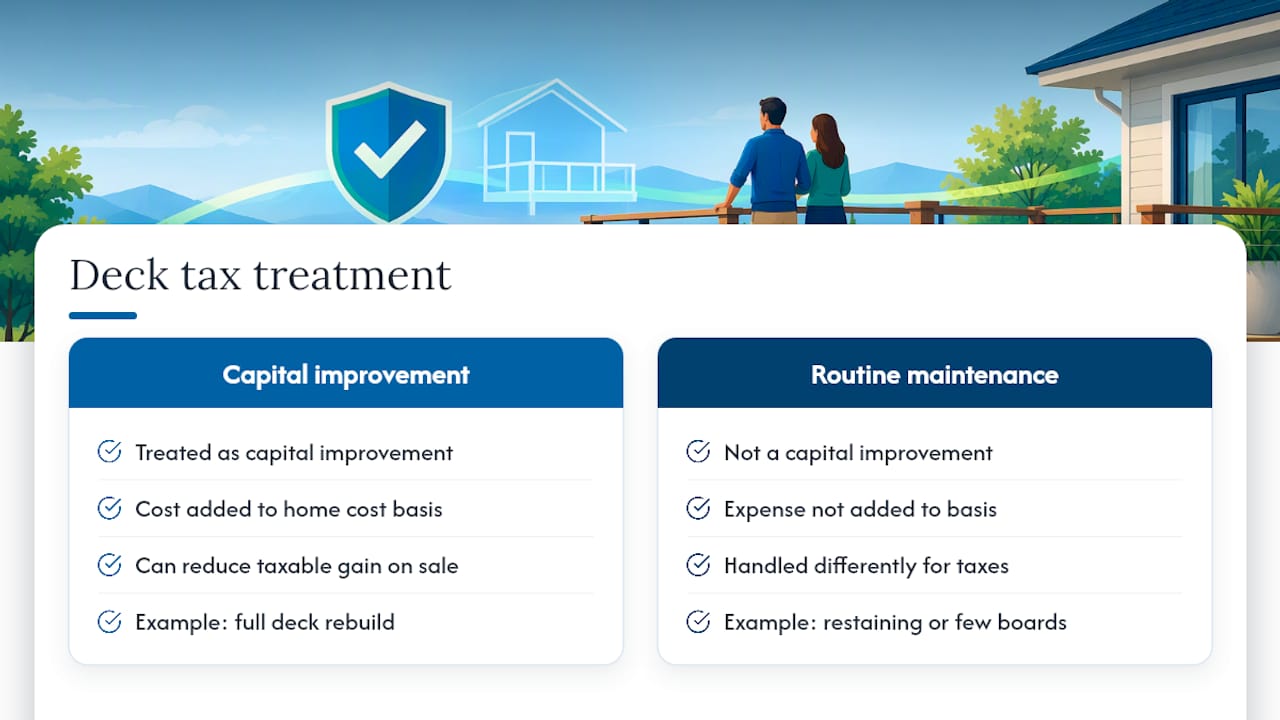
A deck addition is generally treated as a capital improvement rather than a repair for tax purposes, which means its cost typically gets added to your home’s cost basis rather than deducted in the year you pay for it. That basis adjustment can reduce your taxable gain when you eventually sell, particularly relevant if your profit is likely to exceed the standard home sale exclusion. Routine maintenance, such as restaining or replacing a few boards, does not usually qualify as a capital improvement and is handled differently than a full rebuild.
There is no broad federal incentive specifically for building or upgrading a deck. Some homeowners look into local rebates tied to energy-efficient materials or stormwater management, but those programs vary by municipality and are the exception rather than the rule. If you are unsure how a deck project affects your specific tax situation, a tax professional familiar with your state’s rules is the right resource, since capital gains treatment and basis calculations depend on your full ownership and improvement history rather than any single project.
For most sellers, the practical takeaway is simpler than the tax code: keep your receipts and permit records. Good documentation supports your cost basis claim later and doubles as proof of code compliance when a buyer’s inspector or lender asks about the deck’s history.
DIY versus professional installation and what it does to ROI
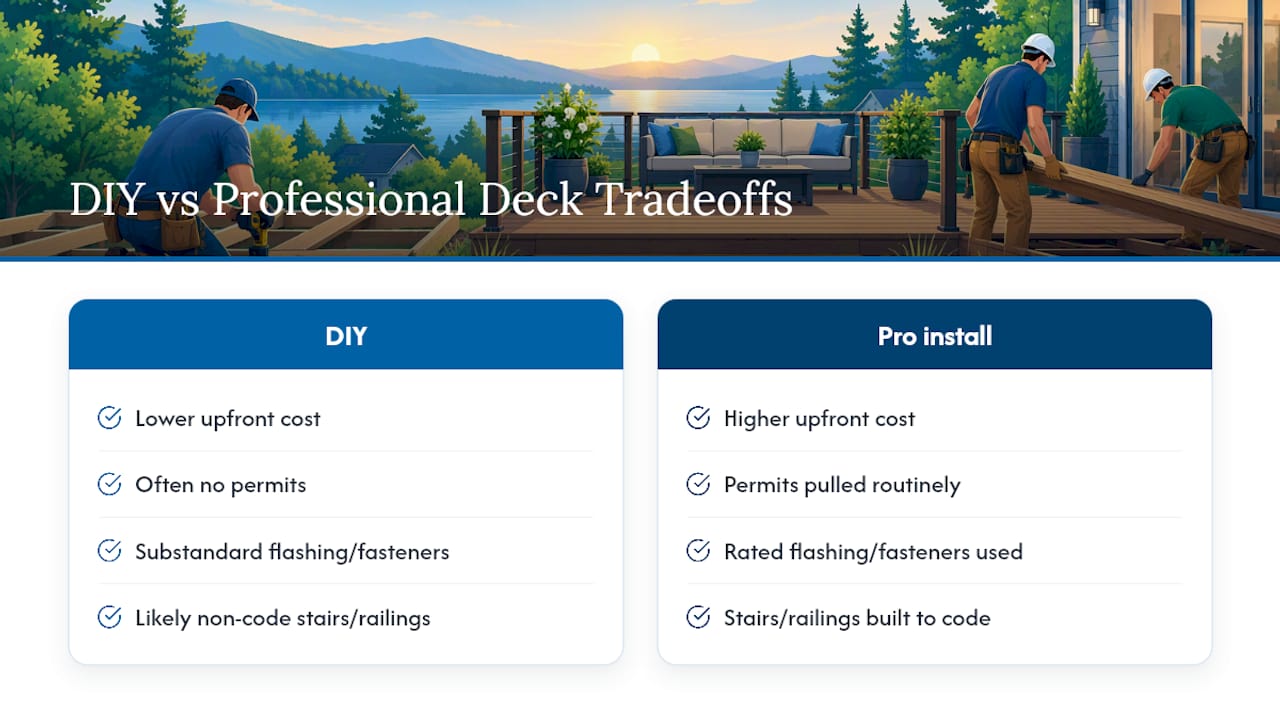
A DIY deck build can lower the upfront cost, and that is the main appeal. But the ROI math is not just about labor savings. A deck built without a permit, without proper flashing, or without code-compliant railings can create the exact problems that reduce offers or stall a sale, the issues industry data flags as risks to financing and inspection.
Professional installation costs more upfront but tends to protect the resale side of the equation in ways that are hard to see until a home inspection happens. A licensed contractor pulls permits as a matter of course, uses fasteners and flashing rated for the job, and builds stairs and railings to code the first time. That reduces the odds of a buyer’s inspector flagging something that either kills the deal or forces a price reduction.
For a seller weighing the choice, the real question is not who can build a deck cheaper. It is which approach is less likely to introduce a problem that shows up during the one inspection that actually matters, the one right before closing.
What sellers get wrong about deck ROI
The biggest mistake I see is sellers chasing the highest recoup percentage instead of asking what their specific market rewards. A deck that matches the house and the neighborhood, is structurally sound, and carries clean permit paperwork will usually outperform a flashier build with a better number on a national chart.
Right-size the footprint, fix safety and permit issues before anything cosmetic, and choose material based on how long you are actually staying, not on what looks best in a photo. Premium features rarely pay back what they cost, while a clean, code-compliant, well-maintained deck consistently helps a listing move. When you are not sure which category your deck falls into, a local contractor or your real estate agent can tell you quickly which fixes are worth the money.
— Damian
How Divine Landscaping LLC helps sellers protect their deck’s value
Selling soon puts specific pressure on a deck project: you need work that holds up to inspection without overspending on features a buyer will never notice. Divine Landscaping LLC’s deck services cover repairs, refinishing, permit handling, and right-sized rebuilds built around your actual timeline rather than a generic upgrade list.

- Deck repairs and refinishing scoped to fix the issues that actually affect an inspection or an offer.
- Permit pulling and documentation handled as part of the project, not left for you to sort out later.
- Right-sized rebuilds designed to match your home’s scale, plus lighting upgrades that help a listing show well.
A consultation can include walking through your deck’s condition, flagging any permit gaps, and prioritizing the fixes that matter most before listing. Ask for a written scope, references, and proof of permits on any deck project, and get in touch through Divine Landscaping LLC’s decks and outdoor living page to start that conversation.
Where to check the numbers yourself
The figures in this guide come from a handful of sources worth bookmarking if you want to dig into regional or lifecycle detail.
- ThePricer’s composite decking cost guide breaks down the 16 by 20 benchmark job and lifecycle maintenance costs.
- DeckMath’s deck ROI guide covers national recoup ranges, right-sizing guidelines, and the days-on-market angle.
- The NARI remodeling impact report reflects combined remodeling industry and REALTOR® perspective on which projects perform best.
- Opendoor’s home features guide is useful for checking how over-building risk plays out across different home price tiers.
- For a broader look at what buyers prioritize in renovations generally, BLDG Realty’s roundup of high-ROI renovations offers a real estate perspective beyond decks alone.
Check DeckMath or Cost vs. Value data for regional breakdowns, and use the lifecycle comparisons in the composite cost guide if you are weighing material choice over a longer ownership horizon.
Sources
- Does a Deck Add Home Value? Deck ROI 2026 | DeckMath
- How much does composite decking cost? | ThePricer
- 2025 Remodeling impact report | NARI
- Home features that add the most value | Opendoor
FAQ
What is the ROI for a deck?
Deck ROI typically falls in the range of roughly 50 to 95% for wood decks and around 68% for composite decks, depending on the market and the specific benchmark used. The exact figure shifts with build cost, condition, and how well the deck fits the neighborhood’s price point.
What is the 3/4/5 rule for decks?
There is no single, universally recognized “3/4/5 rule” tied to deck resale value in the sources behind this guide, so treat any version you see with caution. If you come across it referenced elsewhere, confirm the specific definition with a local contractor or building department before relying on it.
How much would a 20 by 20 deck cost?
Cost benchmarks in this guide are based on a 16 by 20, or 320 square foot, composite deck averaging about $24,000 to build. A 20 by 20 deck covers more square footage, so expect the total to scale up from that benchmark rather than match it exactly, and get a written estimate for your specific footprint and material choice.
How to increase home value by $50,000?
No single project, including a deck, reliably adds a fixed dollar amount on its own, since resale contribution depends heavily on your specific home, market, and existing condition. A deck can be part of a broader improvement plan, but pairing it with other updates and confirming numbers against local comparable sales gives a far more reliable answer than any generic figure.