
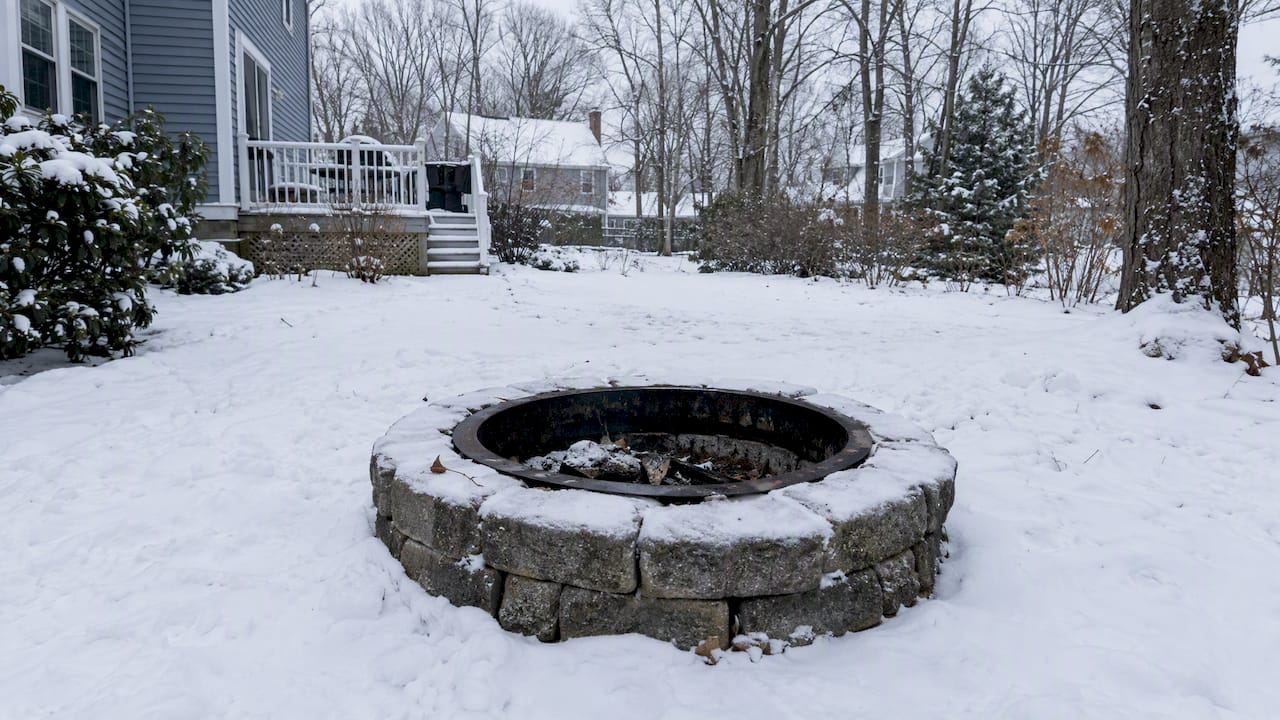
Yes, in New Hampshire, most outdoor open fires, including many backyard fire pits, require a written fire permit unless the ground is completely covered with snow within 100 feet of the fire. Beyond that baseline, three things matter most: your fire pit’s size and clearance from structures (Category I, II, or III), the hours you’re allowed to burn, and where you get your permit, whether through NHFirePermit.com or your town’s Forest Fire Warden.
TL;DR:
- Measure the interior: fires up to 32 inches need 25 feet of clearance; fires up to 48 inches need 50 feet and evening hours.
- Any bare patch, mulch bed, or exposed grass within 100 feet defeats the snow exemption, so inspect the full radius before relying on it.
- Check the local fire danger rating before each burn; an active ban overrides a valid permit, regardless of fire size or category.
- Use only untreated firewood, brush, or charcoal; trash, plastic, tires, and treated lumber are prohibited and belong in local waste services.
- Apply through NHFirePermit.com only if your town participates; otherwise contact its Forest Fire Warden, and confirm local fees and stricter rules.
Table of Contents
- When written permits are required and how the 100-foot snow exemption works
- Category I, II, and III: size limits, clearances, and burn timing
- Materials allowed and prohibited under NHDES open-burning rules
- Timing rules, the rain exception, and daily fire danger ratings
- How to get a fire permit and what towns require
- Penalties, liability, and enforcement under RSA 227-L
- A practical checklist for a compliant, safe fire pit
- Why permits matter more than most homeowners assume
- Building a fire pit that’s compliant from the ground up
- FAQ
- Sources
When written permits are required and how the 100-foot snow exemption works
New Hampshire’s open-burning framework starts with RSA 227-L, the state’s woodland fire control law. Under this statute, nearly every open-kindled fire on private land, whether it’s a cooking fire, a campfire, or a backyard fire pit, needs a written permit issued by the town’s Forest Fire Warden or an authorized agent. The requirement exists because unattended or poorly sited fires are a leading cause of wildfires in the state, and permits give local wardens a chance to flag dry conditions or high-risk locations before a match ever gets struck.
There’s one notable exception. You don’t need a permit when the ground is completely covered with snow within a 100-foot radius of the fire, according to the NH Division of Forests & Lands. That’s a specific, measurable standard, not “there’s some snow in the yard.” Before assuming you qualify, walk the full 100-foot radius around your planned fire site and check for bare patches, mulch beds, or exposed grass, any of which breaks the exemption.
A few practical points worth knowing before you plan a burn:
- Permits must be obtained from your local Forest Fire Warden, a deputy warden, or another authorized issuing agent in your town.
- Applicants must meet age or authorization requirements, such as being an adult or having the landowner’s permission.
- Portable fireplaces and store-bought fire pits are not automatically exempt. Many homeowners assume a manufactured unit sidesteps the permit system, but it doesn’t unless the snow exemption applies.
- Even a valid permit can be overridden on a given day by fire danger conditions, which we cover in detail below.
If you’re planning a permanent, masonry-built fire feature rather than a portable one, it’s worth reading our companion piece on NH fire-pit clearances and the 100-foot snow exemption for a deeper look at how these rules apply to built-in designs.
Category I, II, and III: size limits, clearances, and burn timing
New Hampshire sorts open fires into three categories based on diameter and distance from structures, and the category you fall into determines both your clearance requirements and when you’re allowed to light up. Getting this wrong is one of the most common ways homeowners end up out of compliance without realizing it.
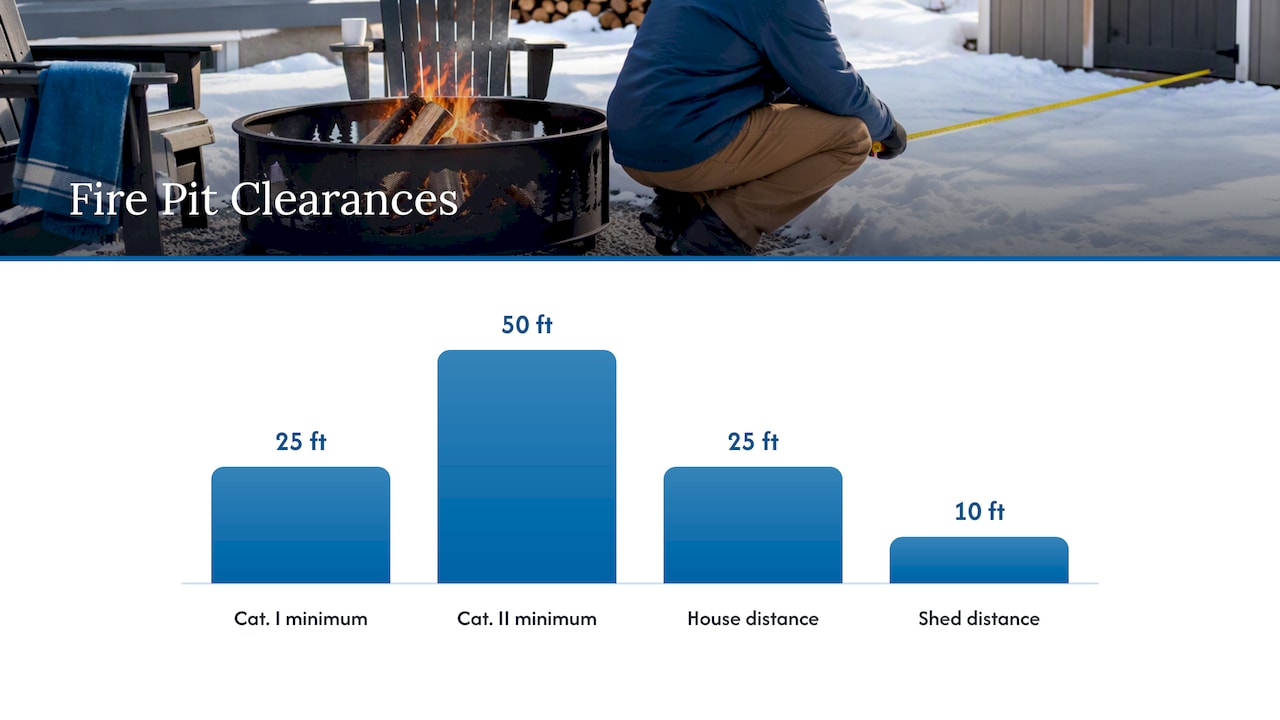
- Category I: fire pits up to 32 inches in diameter, kept at least 25 feet from any structure. These are generally permitted at any time of day, conditions allowing, according to the NH Division of Forests & Lands.
- Category II: fires up to 48 inches in diameter, requiring at least 50 feet of clearance from structures. These are typically restricted to between 5:00 p.m. and 9:00 a.m. unless it’s actively raining.
- Category III: larger or uncontained fires with the strictest clearance and timing rules, often requiring a special permit that may be valid for up to seven days depending on the issuing warden.
Most backyard fire pits homeowners install fall into Category I or II, so the diameter difference, 32 inches versus 48 inches, is the detail that decides whether you can burn in the afternoon or have to wait until evening. A tape measure settles this in thirty seconds: measure the interior diameter of the burn area itself, not the outer stone or metal rim, since that’s what the category rules actually reference.
Clearance distances are measured from the fire itself to the nearest wall, deck, fence, or overhang, not from your property line. A fire pit that’s technically 25 feet from your house but only 10 feet from a shed still violates Category I spacing. It’s also worth checking with your town separately, since municipalities are allowed to set rules stricter than the state minimums, and some do, particularly in denser neighborhoods or near conservation land.
Materials allowed and prohibited under NHDES open-burning rules
What you’re allowed to burn matters just as much as where you burn it. NHDES open-burning rules permit only clean, untreated materials for recreational fires: untreated firewood, brush, campfire wood, and charcoal. According to the NH Division of Forests & Lands fire law brochure, wood pieces should be limited in diameter to promote safe burning, which helps fires burn down fully and predictably rather than smoldering for hours.
What’s off limits is just as clear:
- Household trash and packaging materials
- Construction or demolition debris
- Painted or chemically treated lumber
- Tires and other rubber products
- Plastics of any kind
NHDES restricts these materials because burning them releases pollutants directly into the air at ground level, with no filtration or dilution, unlike emissions from a properly permitted facility. Treated lumber in particular can release concentrated chemical compounds when burned, which is a different hazard from the smoke produced by plain firewood.
In practice, this means your fire pit isn’t a substitute for a dumpster or a way to get rid of old deck boards. If you’re clearing yard debris or replacing an old structure, look into municipal brush drop-off days, yard waste pickup, or a licensed debris hauler instead of burning what doesn’t belong in a backyard pit.
Timing rules, the rain exception, and daily fire danger ratings
Even once you’ve got the right permit and the right size fire pit, the clock and the weather still have the final word. New Hampshire ties burn timing to both your fire’s category and the day’s fire danger rating, so the same backyard setup can be legal on Tuesday and off limits on Wednesday.
- Category II and III fires are generally limited to evening and nighttime hours unless it’s raining, per the NH Division of Forests & Lands. Category I fires typically have more flexibility and aren’t bound by the same evening-to-morning window, conditions permitting.
- “Raining” in this context means sustained precipitation heavy enough to meaningfully reduce fire spread risk, not a passing drizzle. If you’re unsure whether conditions qualify, treat the restricted hours as the default.
- Before lighting any fire, check the Daily Fire Danger rating for your area. The scale runs from Class 1 to Class 5, and higher classes can trigger local or statewide burn bans that apply regardless of whether you already hold a valid permit.
- If your town or the state has issued an active burn ban, your permit does not override it. Permits authorize a fire under normal conditions; they don’t guarantee you can burn on a day when fire danger is elevated.
The daily fire danger rating exists because New Hampshire’s risk conditions shift fast, sometimes day to day, depending on recent rainfall, humidity, and wind. Checking it takes less time than lighting the fire itself, and it’s the single habit that keeps a permitted, compliant fire pit from turning into a violation on a dry, windy afternoon.
How to get a fire permit and what towns require
Getting a permit in New Hampshire is usually straightforward, but the process varies slightly depending on where you live.
- Start with NHFirePermit.com. Many towns participate in the online system, which lets you check eligibility and issue a permit without a trip to the fire station. According to guidance from Epping, NH, online permits are available where towns have opted in, though not every municipality participates.
- If your town isn’t online, contact your local Forest Fire Warden or check with your town office for a list of authorized issuing agents.
- Have your information ready: proof of landowner status or written permission if you’re not the owner, your date of birth (permittees must be 18 or older), the exact burn location, intended fire type, and planned timing.
- Ask about fees before assuming your permit is free. Many New Hampshire towns issue permits at no cost, but fees and processing requirements are set locally, so it’s worth a quick call to confirm what your municipality charges.
- Expect some towns to require in-person or paper applications, especially smaller communities without an online system in place.
One detail that trips people up: a clean permit history matters. Municipalities may deny permits to residents with a history of multiple violations over recent years, according to the NHDFL fire law brochure, so staying compliant on your first fire pit makes future permits easier to get.
Penalties, liability, and enforcement under RSA 227-L
The rules carry real consequences, and they go beyond a simple warning. Under RSA 227-L, the state grants the director and authorized agents enforcement authority that includes cease-and-desist orders, administrative fines, and in more serious cases, criminal penalties for negligent or willful fires.
- If a fire escapes containment, the responsible party can be held civilly liable for suppression costs and any property damage, and towns are allowed to seek reimbursement for the resources spent putting it out.
- Administrative fines can apply for permit violations, with penalties imposed through an administrative process.
- Repeated or egregious violations can lead to permit suspension, meaning a town may refuse to issue future permits to a resident with a documented history of noncompliance.
The liability piece is often the part homeowners underestimate. A fire that spreads to a neighbor’s property or requires a fire department response isn’t just a safety problem, it’s a potential bill, and one that can run well beyond the cost of the fire pit itself.
A practical checklist for a compliant, safe fire pit
Getting the legal details right matters, but so does how the fire pit is actually built and used day to day. We approach fire pit projects with both in mind, since a compliant design on paper only works if it’s also built and operated correctly.
For site selection:
- Measure and mark your required clearance (25 feet for Category I, 50 feet for Category II) from the nearest structure before finalizing placement.
- Keep at least 10 to 20 feet of vertical clearance from low-hanging tree branches to reduce the risk of sparks catching overhead growth.
- Build on a noncombustible base such as gravel, paver stone, or compacted stone dust, and avoid siting under roof overhangs or pergola structures.
For construction, a few features consistently support compliance: masonry ring walls that contain embers, spark-arresting screens for portable units, and a stable, level, noncombustible hearth. If you’re placing a portable fire pit on a wooden deck rather than a masonry patio, additional precautions apply, since elevated wood structures need extra heat barriers and clearance from joists, a topic covered well in this guide on deck fire-pit safety.
For day-to-day operation:
- Burn only approved fuels: untreated firewood, brush, or charcoal.
- Keep a hose, bucket of water, or fire extinguisher and a shovel within reach every time you light a fire.
- Never leave a burning or smoldering fire unattended, even briefly.
- Check the daily fire danger rating before every burn, not just once per season.
Pro Tip: Keep a copy of your fire permit on-site during burning and hold onto any contractor specification sheets for your fire pit, since both can help confirm compliance quickly if a fire official or inspector stops by.
Why permits matter more than most homeowners assume
Permits aren’t paperwork for paperwork’s sake. They’re one of the few moments when a trained fire official looks at your specific setup, your clearances, your fuel load, your site conditions, before a fire is ever lit. That review catches problems early: a pit too close to a fence, a dry season that calls for extra caution, a location nobody thought to check for overhanging branches.
Communities benefit when more residents comply, since fewer avoidable fires mean fewer emergency responses and less strain on local fire departments. Compliance also works in the homeowner’s favor. We’ve found that fire features built with clearances, hearths, and materials planned around the state’s rules from the start tend to pass inspection without the back-and-forth that comes from retrofitting a noncompliant setup after the fact.
A permit, in other words, isn’t the obstacle. It’s the checkpoint that keeps a backyard fire pit from becoming a liability.
— Damian
Building a fire pit that’s compliant from the ground up
Once you know the rules, the next decision is how the fire pit actually gets built, and that’s where craftsmanship makes the difference between a feature that passes inspection easily and one that invites questions later. We design and build fire pits as part of our masonry and hardscape services, with clearances, noncombustible materials, and local ordinance variation factored into the layout from day one.

If you’re also planning the surrounding space, our patio installation and landscape design services cover the noncombustible base and overall site layout that a compliant fire pit depends on. Before a consultation, it helps to have a few photos of your yard, your desired fire pit size, and notes on existing structures nearby so we can plan clearances accurately from the start. Reach out for a site assessment and we’ll help you map out a fire feature built to meet New Hampshire’s rules the first time, not after a revision.
This article is general information, not a substitute for advice from a qualified lawyer. Consult a qualified legal professional about your own circumstances before acting on anything here.
FAQ
How much does a NH fire permit cost?
Permit fees are set locally rather than statewide, and many New Hampshire towns issue them at no cost. Check with your town office or NHFirePermit.com to confirm the fee, if any, before applying.
Can I have a fire pit in my neighborhood?
In most cases, yes, as long as you obtain a written permit, meet the diameter and clearance requirements for your fire’s category, and burn only approved materials. Some municipalities add stricter local rules, so it’s worth confirming with your town alongside the state requirements from the NH Division of Forests & Lands.
What should I check before assuming a burn ban has been lifted in NH?
Burn bans and fire danger restrictions change based on current conditions, so a ban that was active last week may not reflect today’s status. Always check the Daily Fire Danger rating for your area on the day you plan to burn, since a valid permit does not override an active ban.
Does snow cover really remove the need for a permit?
Yes, but only when the ground is completely covered with snow within a 100-foot radius of the fire, according to the NH Division of Forests & Lands. Partial snow cover or bare patches within that radius mean the exemption doesn’t apply, and a permit is still required.
What size fire pit can I have without a bigger clearance requirement?
A fire pit up to 32 inches in diameter falls under Category I and needs at least 25 feet of clearance from structures, while anything up to 48 inches moves into Category II, requiring 50 feet of clearance and added time restrictions, per the NH Division of Forests & Lands.
Sources
- Fire permits | NH Division of Forests & Lands
- Chapter 227-L Woodland Fire Control (RSA 227-L)
- NHDES — Open burning rules