
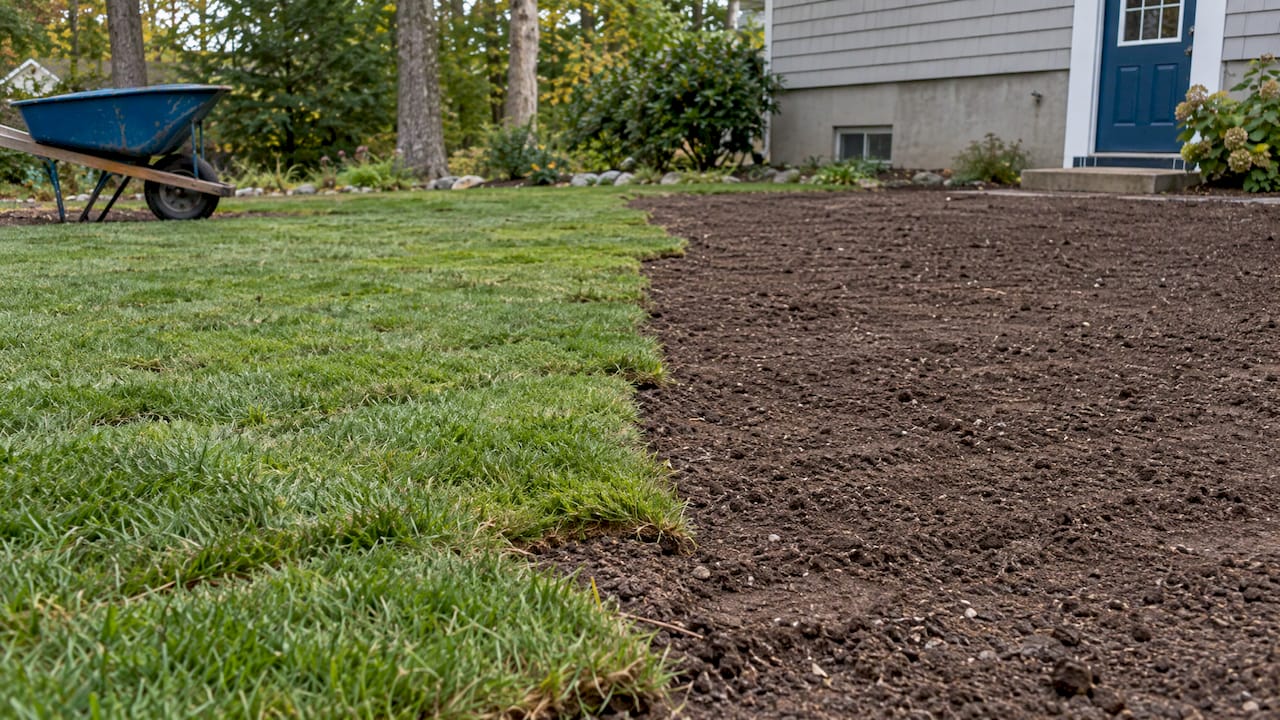
Sod gives you a green lawn in a day and can take foot traffic in a few weeks. Seed costs far less and offers more grass varieties, but it needs the right season, steady watering and patience. In New Hampshire, the best choice depends on your budget, your slope, how soon you need to use the yard and what time of year you are planting.
This guide compares sod, seed and hydroseed on the points that decide a project: cost, timing, site conditions, soil preparation and aftercare. It is written for New Hampshire homeowners and business owners who are planning a new lawn or a larger landscape project.
TL;DR
- Sod is the fastest and most expensive option. It can handle traffic within 2 to 3 weeks and suits slopes and high-visibility areas.
- Seed is the cheapest and offers the widest choice of grass types, but it can take 10 to 15 weeks before turf handles traffic.
- Hydroseed sits in the middle on cost and works well for large or sloped areas.
- In New Hampshire, the best seeding window is mid-August to early September. Sod can go down any time the ground is not frozen.
- Neither method works without soil preparation. Grading, drainage, pH and topsoil matter as much as the choice itself.
Table of Contents
- Sod, seed and hydroseed at a glance
- What each method actually involves
- What each costs
- When to plant in New Hampshire
- Match the method to your site
- Can you lay sod over dirt?
- Watering the first weeks
- Our perspective on sod vs. seed
- How to choose: a quick decision guide
- Overseeding vs. resodding an existing lawn
- Plan your lawn as part of the whole property
- Working with Divine Landscaping
- FAQ
- Sources
Sod, seed and hydroseed at a glance
| Seed | Hydroseed | Sod | |
|---|---|---|---|
| Upfront cost | Lowest | Middle | Highest |
| Time to handle traffic | 10 to 15 weeks | 10 to 15 weeks | 2 to 3 weeks |
| Grass variety choice | Widest | Wide | Limited |
| Best for | Budget projects, large open areas, shade mixes | Large lawns and slopes | Slopes, quick use, high-visibility areas |
| Weed pressure early on | Higher | Higher | Lower |
The timing and cost ranking comes from the University of California’s turf planting comparison, which also notes that seeded and hydroseeded lawns can take up to a year to reach normal use. Sod provides the best-quality turf from day one, with fewer weed invasions and less early maintenance.
What each method actually involves
Grass seed
Seed is spread over a prepared bed, raked in lightly and kept moist until seedlings anchor. It is the most flexible method because you can choose a blend for your conditions. UNH Extension notes that in sunny New Hampshire locations, Kentucky bluegrass, perennial ryegrass and tall fescues are most often used, while fine-leaf fescues do best in shade.
Hydroseed
Hydroseeding sprays a slurry of seed, mulch, fertilizer and water across the soil. The result is even coverage, and the mulch helps hold moisture and soil in place. It is best suited to large areas and slopes, and its establishment time is similar to seeding.
Sod
Sod is mature grass harvested with a thin layer of soil and rolled out like carpet. It is the most expensive option, but you get an instant lawn. The tradeoffs are cost, the labor of laying it and a narrower choice of grasses: UMN Extension notes that most sod in Minnesota is Kentucky bluegrass, and New England growers offer a similarly limited menu. It can also cause rooting problems when the soil under the sod is a different texture, so a well-prepared bed matters.
What each costs
Seed is cheaper on materials by a wide margin. One industry analysis puts seed at about $5 to $46 per 1,000 square feet for most cool-season grasses, against $283 to $523 per 1,000 square feet for sod at national average farm prices in the second quarter of 2026. Those are material prices before delivery, so installed costs run higher for both.
A few things shape the real number on your property:
- Area. A large open lawn magnifies the gap between seed and sod. A small front yard narrows it.
- Site preparation. Grading, topsoil, soil amendments and removing old turf cost the same whichever method you pick.
- Delivery and labor. Sod is heavy and perishable, so it needs a crew and a plan for same-day installation.
- Irrigation. Both methods need reliable water. If you do not have a system, adding one during the project is easier than retrofitting later.
- Reseeding risk. Washouts on a slope or a failed fall seeding can add a second round of work to a low initial price.
The cheapest method on paper is not always the cheapest outcome. A good rule: if the area is flat, large, not urgent and planted in the right season, seed saves real money. If the area is small, sloped, highly visible or needed soon, sod often earns its price.
When to plant in New Hampshire
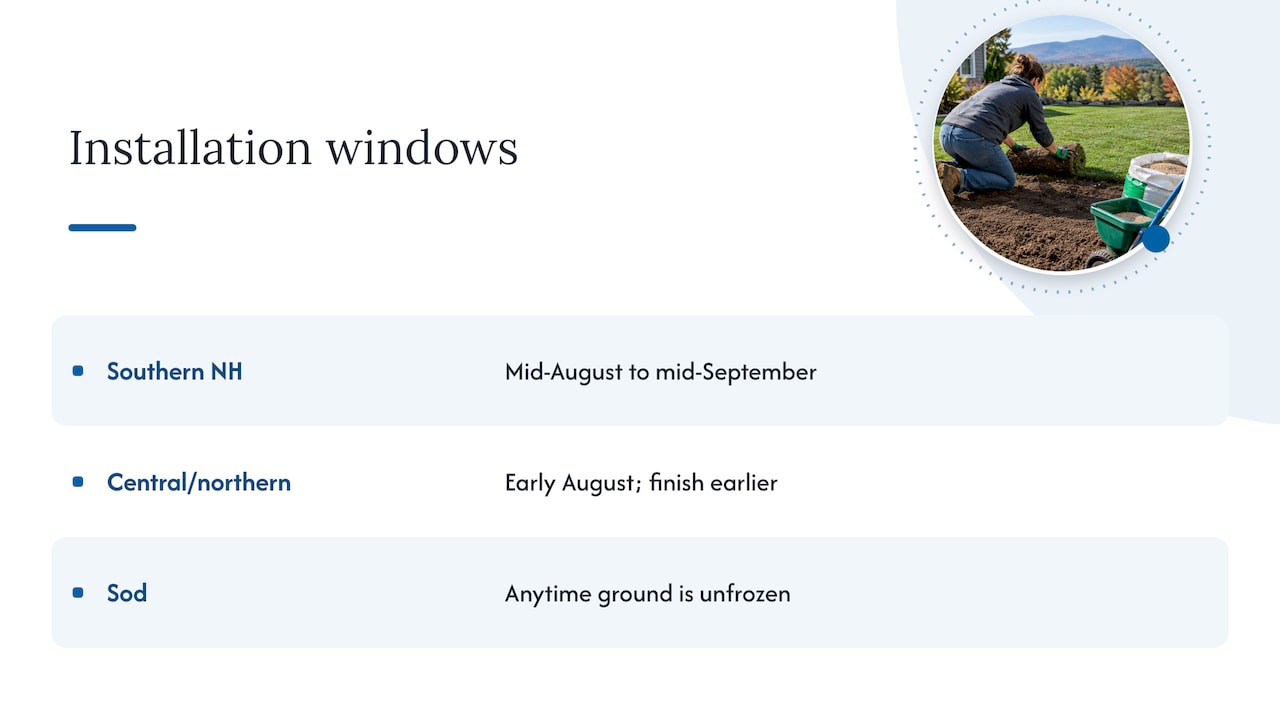
Timing is where New Hampshire differs most from national advice. UNH Extension identifies August 15 to September 10 as the best time to seed. Crabgrass competition is minimal then, and warm soil speeds germination and establishment. UMass Amherst’s turf program agrees that late summer is vastly preferable to spring for cool-season grasses in New England, with a window of roughly the third week of August to the third week of September.
The window shifts with your location. A regional guide suggests southern New Hampshire can seed from mid-August through mid-September, while central and northern areas should start in early August and finish earlier, so seedlings establish well before the first hard freeze.
Sod is far more forgiving. UNH Extension says it can be installed anytime the ground is not frozen. That makes it the practical choice when a project finishes outside the seeding window, for example a patio or retaining wall job that wraps up in October. Sod still needs soil warm enough for roots to grow and consistent moisture, so late-season installs need attention.
Spring seeding is possible but harder. Weeds compete, summer heat arrives before roots are deep and watering demands are higher. If you cannot wait until late summer and want grass quickly, sod is the safer spring choice.
Match the method to your site
Slopes and erosion
Seed on a slope can wash out in a heavy rain before it roots. Sod holds soil immediately, and hydroseed’s mulch layer gives seed some protection. For steeper grades, the right answer may be to reshape the ground first. Our guide to terracing a sloped yard explains when retaining walls and level planting areas make a lawn easier to establish and maintain.
Shade
Most sod is sold as sun-oriented grasses. Under mature trees, a fine-fescue seed blend selected for shade often performs better than sod. This is one of the cases where seed’s wider choice of varieties wins.
Soil and drainage
Most New Hampshire soils are acidic. UNH Extension notes that seedlings fail to root deeply below pH 5.0, so a soil test and lime where needed come before either method. The same source recommends a starter-type 10-20-10 fertilizer before seeding to feed the first 6 to 8 weeks.
How soon you need the space
If you are hosting an event, selling a property or finishing a commercial entrance, sod is the method that delivers a finished look right away. If the yard can rest for a season, seed is a sound plan. University of Maryland Extension frames the decision as budget, labor, materials and patience: sod for high-visibility areas needing faster results, seed where speed matters less.
Can you lay sod over dirt?
You can lay sod on soil, but not on just any dirt. It needs a prepared bed. Rutgers Cooperative Extension warns that sod placed on existing lawns, compacted infertile soil or carelessly prepared areas will not give satisfactory results, and suggests at least 4 inches of quality weed-free topsoil when the existing soil is very poor.
A solid bed has these elements:
- Clear the area. Remove existing weeds and turf. Mississippi State Extension recommends killing and tilling them under before installing new sod.
- Test the soil. Purdue Extension advises testing at least one month before sodding so you can correct pH and fertility in time.
- Loosen and amend. Illinois Extension recommends opening the soil surface and adding organic matter to heavy clay or other poor soils. Shortcuts here often lead to lawn problems later.
- Grade for drainage. Slope the ground away from the house and low spots. Standing water kills new turf and damages patios and walls.
- Firm and smooth. Sod needs firm contact with the soil so roots can grow in. Purdue notes the bed should be firm enough to walk on, with the top half inch loosened. Do not lay sod on dry soil.
The same preparation applies to seed. A well-prepared bed is the biggest factor in whether either method succeeds.
Watering the first weeks
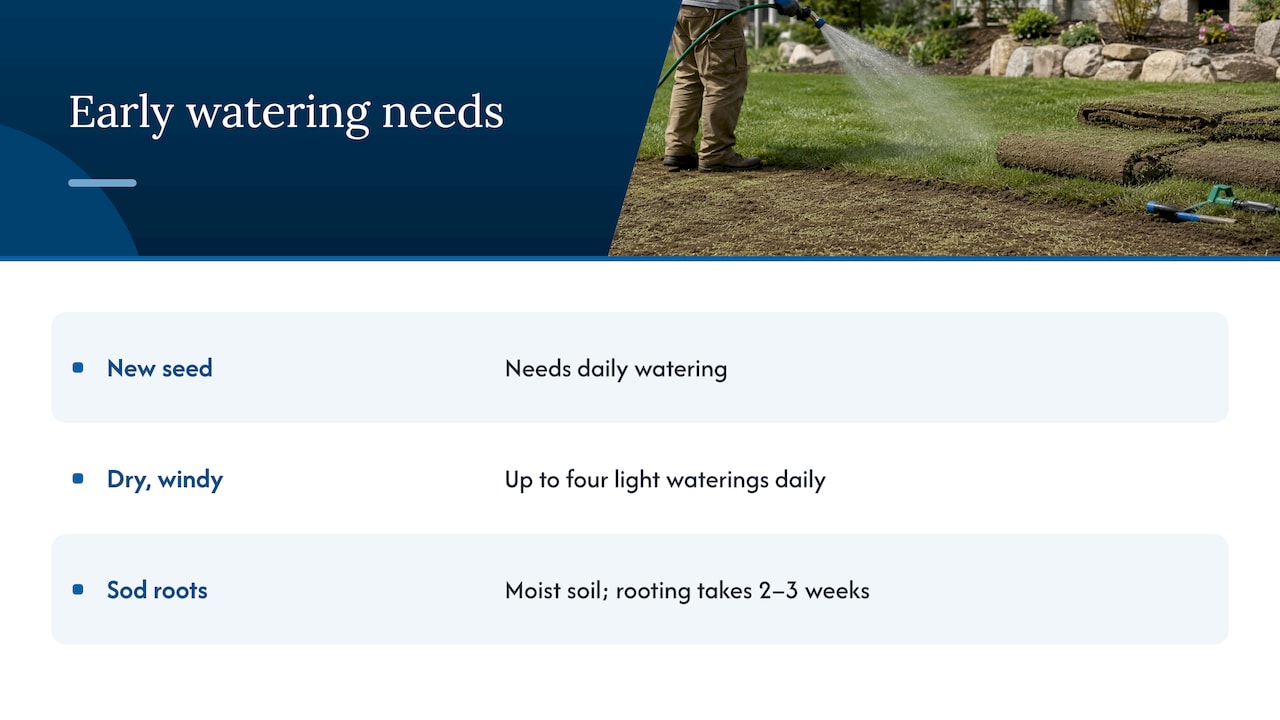
New seed needs surface moisture constantly until seedlings anchor. Washington State University Extension notes newly seeded lawns need daily watering, and in dry, windy conditions may need as many as four light waterings a day. Sod needs the soil beneath it to stay moist while roots knit in, which University of Maryland Extension says typically takes 2 to 3 weeks.
An automatic system makes this much easier, especially when you travel or work long hours. Our walkthrough on rooting new sod in 7 to 14 days covers a catch can test and a tug test to check your watering and rooting. If you are planning a system for the whole property, see how to plan a residential irrigation system step by step.
Our perspective on sod vs. seed
We usually start with the project, not the grass. A new lawn is the last layer of a bigger plan: grading, drainage, walls, patios, walkways and irrigation all come first. When those pieces are done right, either sod or seed can succeed. When they are not, neither will.
On most residential properties we work with, the yard is part of a hardscape or outdoor living project. Heavy equipment has compacted the soil, grades have changed, and the homeowner wants a finished look when the work is done. In those cases we generally steer people toward sod where it matters most, such as near the house, along walkways and on slopes, and toward seed or hydroseed for larger back areas where the budget goes further.
Our approach is a clear plan from consultation to installation, premium materials and a design tailored to the property. That means thinking about irrigation and lighting before the lawn goes in, so nobody has to dig up new grass later.
Damian
How to choose: a quick decision guide
Choose sod if:
- You need a usable lawn within a month.
- The area is sloped or prone to washouts.
- You are planting outside the August to early September seeding window.
- The area is small or highly visible, like a front yard or a business entrance.
- You want a grass variety that is not sold as seed. The Green Industry Report lists these same situations as the main reasons sod wins.
Choose seed if:
- The area is large and flat.
- You can plant between mid-August and early September.
- You want a shade blend or a specific cultivar.
- Budget matters more than speed and you can commit to daily watering.
Choose hydroseed if:
- The area is large, sloped or hard to reach with conventional seeding.
- You want even coverage and some erosion protection at a cost below sod.
A blended approach is common: sod the high-visibility and sloped areas, seed the rest.
Overseeding vs. resodding an existing lawn
If your lawn is thin rather than gone, you may not need a full rebuild. Overseeding thin turf costs a fraction of stripping and resodding, according to the Green Industry Report. Resodding makes sense when weeds have taken over, the surface is uneven or the soil underneath needs regrading. The same late-summer window applies to overseeding in New Hampshire.
Plan your lawn as part of the whole property
A lawn performs best when it is designed with the rest of the yard. Think through where water will drain, where paths and patios will sit and how you will irrigate. Our guide to landscape design for New Hampshire homeowners walks through that planning process. Business owners can find a similar framework in our guide to planning a commercial landscape renovation.
Working with Divine Landscaping
If your new lawn is part of a larger project, we can handle the design and the build together. Our services include landscape design, patios, walkways, retaining walls, decks, irrigation and lighting, plus general landscape contracting for residential and commercial properties in New Hampshire.

We focus on custom design for each property, clear project management from consultation to installation and premium materials, backed by a satisfaction guarantee. To talk through your yard, start with our landscape design service or reach us through our landscaping services page. If you want automatic watering planned in from the start, see our irrigation and lighting services.
FAQ
Is it cheaper to reseed or sod?
Reseeding is cheaper on materials. National averages put seed at roughly $5 to $46 per 1,000 square feet versus $283 to $523 for sod before delivery, according to the Green Industry Report. Overseeding a thin lawn costs far less than stripping and resodding. Sod becomes the better value when erosion, weeds or urgency make seed risky.
What month is best to lay sod in New Hampshire?
Sod can go down any time the ground is not frozen, per UNH Extension. Late summer through fall is the most comfortable window because cooler air and warm soil help roots establish. University of Maryland Extension lists September to November as the best time in its region, so New Hampshire’s colder fall means earlier is better.
What are the drawbacks of using sod?
Sod costs more, takes labor to install and offers fewer grass types than seed. UMN Extension also notes that soil layering can cause rooting issues. Proper bed preparation and watering address these, and the payoff is an instant lawn with fewer early weeds.
Can I lay sod directly over dirt?
Yes, if the dirt is prepared. The soil should be free of rocks and weeds, smooth, level and several inches deep, with the right pH and fertility, according to UGA Extension. Laying sod over an existing lawn or compacted ground usually fails.
Is hydroseed better than seed?
Hydroseed gives more even coverage and its mulch helps on slopes, but it costs more than seed and takes a similar time to establish, per the University of California. It is most useful for large or sloped areas.
Sources
- UC IPM: Healthy Lawns, comparison of planting methods
- UNH Extension: Lawns chapter
- UMN Extension: Seeding and sodding home lawns
- Green Industry Report: Sod vs seed
- UMass Amherst: Establishment, renovation and repair
- Cultivating Flora: When to install sod or seed in New Hampshire
- University of Maryland Extension: Starting a new lawn
- University of Maryland Extension: Sod
- Rutgers Cooperative Extension: Sodding
- Mississippi State Extension: Sod installation and maintenance
- Purdue Extension: Establishing a lawn from sod
- Illinois Extension: Preparing lawn soil and site
- WSU Extension: Establishing a new lawn
- UGA Extension: Soil preparation for sod