
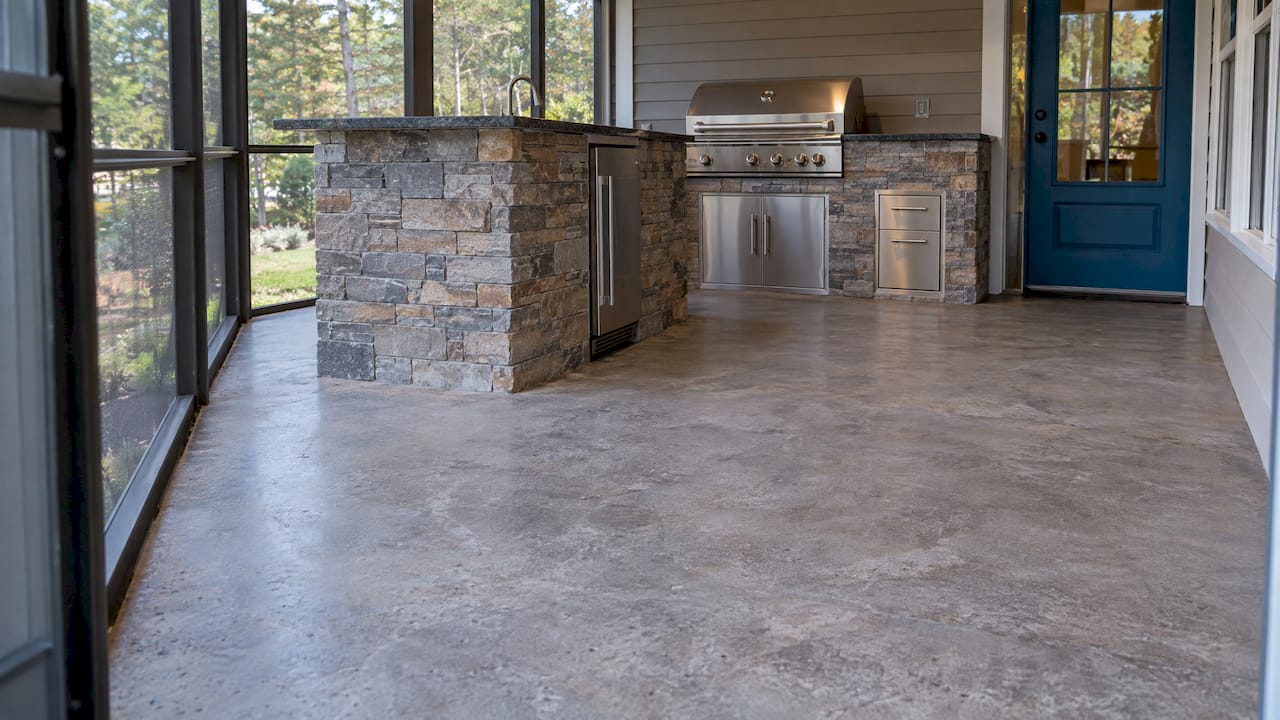
For most New Hampshire outdoor kitchens, the best floor is a low-porosity surface on an engineered base: porcelain pavers, quality concrete pavers or granite. These materials handle freeze-thaw cycles, grease and heavy appliances, and they give you a textured, wet-safe footing. Stamped or poured concrete and decking can also work, but each needs more planning around cracking, sealing or heat. Below, we compare the options, explain what to check before you buy and show how the base and drainage decide how long the floor lasts.
TL;DR
- Choose a surface rated for exterior use, with a textured or honed finish rather than a polished one, because grease, rain and spilled drinks all make a floor slick.
- In a freeze-thaw climate, low-porosity materials such as porcelain, granite and quality concrete pavers are the safer picks. Porous stone needs a sealing commitment.
- The base matters as much as the surface: compacted crushed stone, edge restraint and a slope that carries water away from the house and the cabinetry.
- Near the grill, check manufacturer clearance rules before using decking or composite, and consider epoxy grout if you choose tile.
- Budget for the whole system, not just the surface. Base preparation, site conditions and material all move the total.
Table of Contents
- What an outdoor kitchen floor has to handle
- Outdoor kitchen flooring options compared
- Choosing a floor that survives New Hampshire winters
- Slip resistance: the spec most people skip
- Base, slope and drainage
- Heat, spills and stains near the cooking line
- What outdoor kitchen flooring costs
- How to choose: three common scenarios
- Our perspective
- Plan your outdoor kitchen floor with us
- FAQ
- Sources
What an outdoor kitchen floor has to handle
An outdoor kitchen floor does more work than a typical patio. It carries heavy appliances and masonry islands, takes sun, rain and temperature swings, and absorbs grease and food spills. Guests also walk across it with plates and drinks in hand. Guidance on outdoor kitchen flooring groups these demands into durability, slip resistance, drainage, maintenance and design.
In New Hampshire, add one more factor: freezing winters. Water that gets into a surface or the base below it expands as it freezes, and that movement is what lifts, cracks and loosens outdoor floors. Covered, warm-climate kitchens can get away with choices that a New England yard cannot.
So when you compare materials, ask five questions:
- Is it rated for exterior use and for freezing temperatures?
- Does it have real traction when wet?
- Does water leave the surface, or sit on it?
- How does it handle grease and stains near the cooking line?
- What maintenance will it need each year?
Outdoor kitchen flooring options compared
Here is how the common choices stack up for a New Hampshire kitchen. The ratings reflect general material behavior and the guidance we cite below, so your own site conditions still decide the final call.
| Surface | Freeze-thaw performance | Wet traction | Grease and stains | Upkeep |
|---|---|---|---|---|
| Porcelain pavers | Very good (low porosity) | Very good with textured finish | Very good | Occasional cleaning |
| Concrete pavers | Good when quality units are used | Good | Good, seal if desired | Joint sand refresh, occasional wash |
| Granite or dense stone | Very good | Good with thermal or honed finish | Good | Light sealing may help |
| Poured or stamped concrete | Depends on base, joints and sealing | Depends on finish | Can stain without sealer | Resealing, crack monitoring |
| Porous natural stone | Needs sealing | Varies by finish | Needs sealing | Sealing every 1 to 3 years |
| Composite or wood decking | Good on a raised frame | Good when textured | Check manufacturer | Clearance rules near grills |
Porcelain pavers
Exterior-rated porcelain is low-porosity, which is why it copes well with frost and is easy to clean after a barbecue. One outdoor tile guide says outdoor tiles should have low water absorption, frost resistance and a high anti-slip rating, with R11 or R12 preferable, and that they usually come at a minimum thickness of 20 mm to carry heavy loads. Thick porcelain pavers laid on a proper base fit that description well.
If you like the clean, stone-look finish of porcelain, you can carry the theme to the table with porcelain entertaining accessories that match the surface. For a closer look at how these pavers perform and what installers check, read our guide to porcelain pavers that last.
Concrete pavers
Pavers are modular. If a section is stained or damaged, you can lift and replace individual units instead of redoing the floor. They come in many shapes, sizes and colors, so they suit both traditional and modern kitchens. The trade-off is that joints can collect debris, and the joint sand needs attention. One material guide suggests replenishing polymeric sand every 3 to 5 years and pressure washing as needed. If you are weighing pavers against stone, our comparison of pavers vs flagstone for a New Hampshire yard walks through the differences.
Poured and stamped concrete
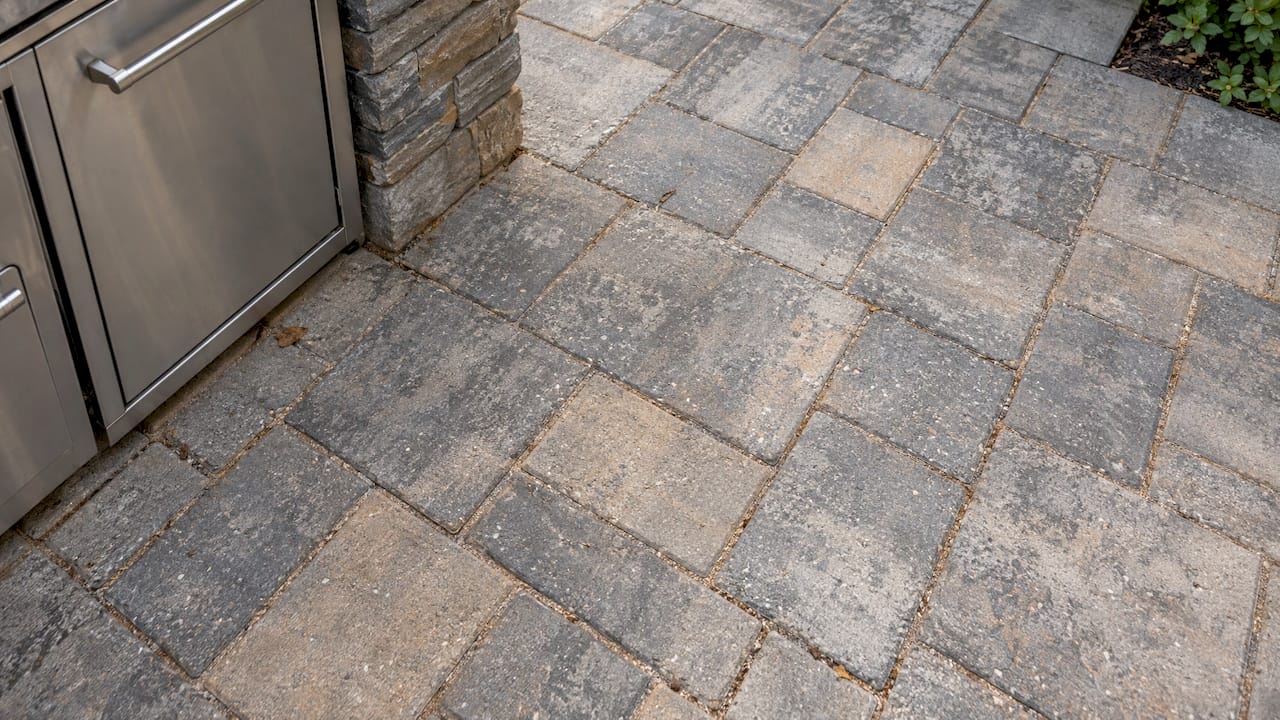
Concrete can create one continuous surface with no joints for grease to settle into, and it is a common choice for outdoor kitchens. The catch is cracking. The guidance we reviewed notes that concrete can crack, that freeze-thaw exposure can make it worse when water gets into the slab or base, and that control joints decide where cracks form but do not promise a crack-free slab. If you choose concrete, plan the joints, the base and a sealer from the start.
Natural stone
Stone gives a kitchen a high-end, natural look, and dense granite performs well in cold climates. Softer, porous stones such as limestone take in water, which expands as it freezes. If you love a porous stone, commit to sealing it on a schedule. Our overview of what a natural stone patio involves explains the choices in more detail.
Decking
A raised outdoor kitchen on a deck is a real option, and we build decks and outdoor living areas. Wood and composite both have restrictions around grills and fire features, so verify the grill manufacturer’s clearance requirements before you plan the layout. One flooring guide also cautions that a heat shield or grill mat does not make every installation safe. Our guide to an outdoor kitchen on a deck covers framing, weight and layout.
Choosing a floor that survives New Hampshire winters
Freeze-thaw and frost heave are the main reasons hardscapes fail in this region. Regional hardscape guidance points to low-porosity materials like porcelain, granite and quality concrete pavers, and suggests avoiding porous or unsealed materials unless you will seal them. The reason is simple: low-porosity materials have fewer pores for water to enter and expand inside as temperatures drop.
Installation details matter just as much as the material:
- Engineered base. A properly compacted crushed-stone base keeps the surface stable and lets water pass through instead of sitting under it.
- Positive drainage. The surface should slope away from the house, and the water needs a safe place to go.
- Edge restraint. Pavers need a firm border so they do not creep outward over time.
- Local frost guidance. Follow the frost-depth practices that apply to your site, especially for any footings or walls.
Our checklist on stopping freeze-thaw paver damage goes through the checks we run on a project. If you want a wider look at what we use here, see our guide to the best patio materials in NH.
Slip resistance: the spec most people skip
Grease, rain and spilled drinks all raise slip risk, and the answer is an exterior-rated surface with useful texture. One patio guide recommends textured or honed finishes instead of polished ones and cites a wet coefficient of friction (COF) of at least 0.60 as a benchmark. You will also see DCOF numbers. A tile standards discussion notes that the commonly cited 0.42 figure from ANSI A326.3 applies to certain interior spaces and should not be treated as a universal outdoor threshold. It suggests asking which test was run, whether the result applies to wet conditions and whether the tested finish matches the product you are buying.
A practical way to apply this:
- Ask the supplier for COF or DCOF data and the test method used.
- Choose a textured or honed finish for the cooking and serving zone.
- Remember that algae, standing water, leaves and snow reduce traction on any surface, so slope and cleaning matter as much as the label.
For walkways leading to the kitchen, see our notes on non-slip walkway materials.
Base, slope and drainage
The surface you see is only the top layer. Under it, the base decides whether the floor stays flat. A stable, compacted base with the right slope keeps water from pooling near appliances, cabinetry and the foundation. If you are asking whether the base is worth the cost, our explainer on the patio base answers it.
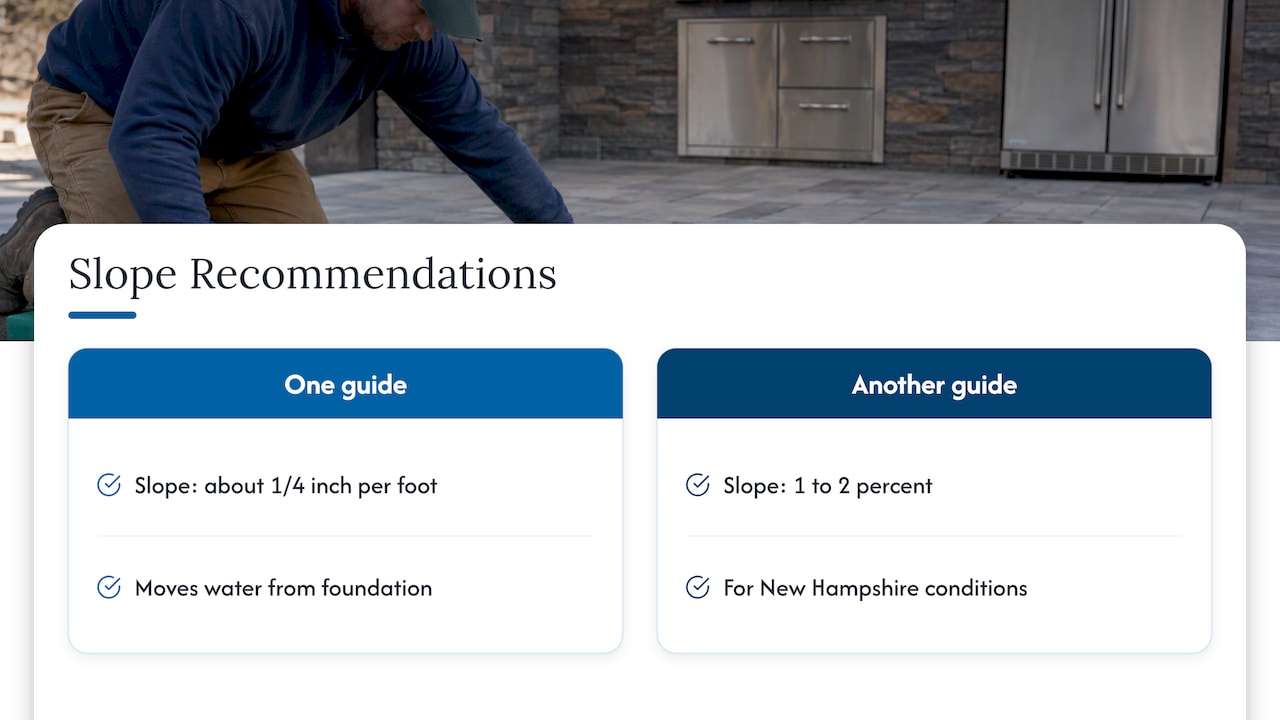
On slope, sources give slightly different figures, so your designer should set the number for your site. One guide gives about 1/4 inch per foot to move water away from the foundation. Another recommends an engineered crushed-stone base with a 1 to 2 percent slope for New Hampshire conditions. Both aim at the same result: water leaves the surface and does not settle under the kitchen.
If water already collects on your patio, our guide to patio drainage fixes covers the common solutions. Grease needs thought too: wipe cooking surfaces down before rinsing, and do not pour liquid cooking grease into a sink drain.
Heat, spills and stains near the cooking line
The area in front of the grill takes the most abuse. Here is what we plan for:
- Grout. Tile guidance says cementitious grout can stain within a season, while epoxy grout resists grease and wine. Epoxy costs more and takes more effort to install, but suits the cooking zone.
- Sealers. Natural stone and concrete tile generally need a penetrating sealer, often yearly, as the same guide notes.
- Finish. Avoid glossy or polished surfaces near the grill, where they become slick.
- Clearances. Follow the appliance manufacturer’s clearance requirements, especially over wood or composite.
The countertop is the other surface that takes spills and heat. See our guide to outdoor kitchen countertops that never need sealing so the floor and counters work together.
What outdoor kitchen flooring costs
Costs depend on region, site conditions, complexity, base preparation and material. For orientation only, one 2026 patio guide lists typical installed ranges per square foot:
| Material | Typical installed cost per sq ft |
|---|---|
| Rubber pavers | $8 to $15 |
| Concrete pavers | $10 to $20 |
| Stamped concrete | $12 to $20 |
| Brick pavers | $12 to $18 |
| Porcelain tile | $15 to $25 |
| Natural stone | $15 to $35 |
| Composite decking | $15 to $30 |
These are published industry ranges, not our prices, and local New Hampshire quotes can differ. The same guide suggests setting aside $1,500 to $4,000 for the base beneath an outdoor kitchen. A fixed price comes from a site visit, because slope, access and existing soil change the work. For the full picture of the kitchen itself, see our outdoor kitchen cost benchmarks for NH.
How to choose: three common scenarios
A kitchen at the edge of a patio, uncovered. Porcelain pavers or quality concrete pavers on an engineered base. Both tolerate frost, and pavers let you repair a section later.
A natural, traditional look. Granite or another dense stone, with a textured finish. If you prefer a softer stone, plan on regular sealing.
A raised kitchen off the house. A deck with a surface that fits the grill clearance rules, or a masonry platform with pavers if you want a heavy island. Our layout ideas for outdoor kitchens can help you plan the footprint before you choose the surface.
Our perspective
We design and build outdoor kitchens in New Hampshire, and the floor is where we see the most avoidable problems. Homeowners often start with color and style, which matter, but the winter is what tests the surface.
Our approach is to start under the surface. We look at drainage, grade and the base first, then choose a material that fits the way you cook and entertain. For many properties that means porcelain or quality pavers, because they combine a clean look with strong cold-weather performance. Our work is built around custom design for each property, premium materials and clear project management from consultation to installation.
We also believe the floor should be planned together with the counters, the grill clearances and the walkway to the house, so everything is drawn once and built once. That is how we aim to give you a space you will use for years.
Damian
Plan your outdoor kitchen floor with us
Divine Landscaping LLC designs and builds patios, walkways, retaining walls, decks and outdoor kitchens for homeowners and business owners in New Hampshire and neighboring Massachusetts. We can walk your property, discuss surface options and plan the base and drainage with you.
If you are ready to start, explore our patio installation services or our masonry and hardscape work, and contact us to schedule a consultation.
FAQ
What is the best flooring for an outdoor kitchen in New Hampshire?
For most yards, porcelain pavers or quality concrete pavers on a compacted crushed-stone base are the safest bet. Low-porosity materials handle freeze-thaw cycles better than porous stone. Choose a textured finish for traction.
Is concrete a good surface for an outdoor kitchen?
It can be, and it is a common choice because it forms a continuous surface. Concrete can crack, though, and freezing water makes that worse. Good base preparation, planned control joints and a sealer improve the result.
Can I put an outdoor kitchen on a deck?
Yes, with planning. Weight, framing and grill clearances all matter, and wood or composite can have restrictions near heat. Check the appliance manufacturer’s requirements before you finalize the layout.
How do I keep an outdoor kitchen floor from getting slippery?
Pick an exterior-rated surface with a textured or honed finish, slope it so water drains away and clean grease and algae promptly. Ask suppliers for wet-condition test data on the exact finish you are buying.
Does the floor need a drain?
It needs a way for water to leave. That can be a surface slope toward a safe discharge point, a permeable edge or a floor drain, depending on the site. Your designer should set it based on your grade.
Sources
- Outdoor Kitchen Flooring Ideas: Durable, Safe, and Stylish
- Outdoor Patio Flooring: Materials, Design and Installation
- Best Tile for an Outdoor Kitchen: A Complete Guide
- Complete guide to choosing outdoor tiles
- What To Use For Hardscaping In New Hampshire Outdoor Living
- Anti-Slip Outdoor Flooring: Safe, Durable Options