
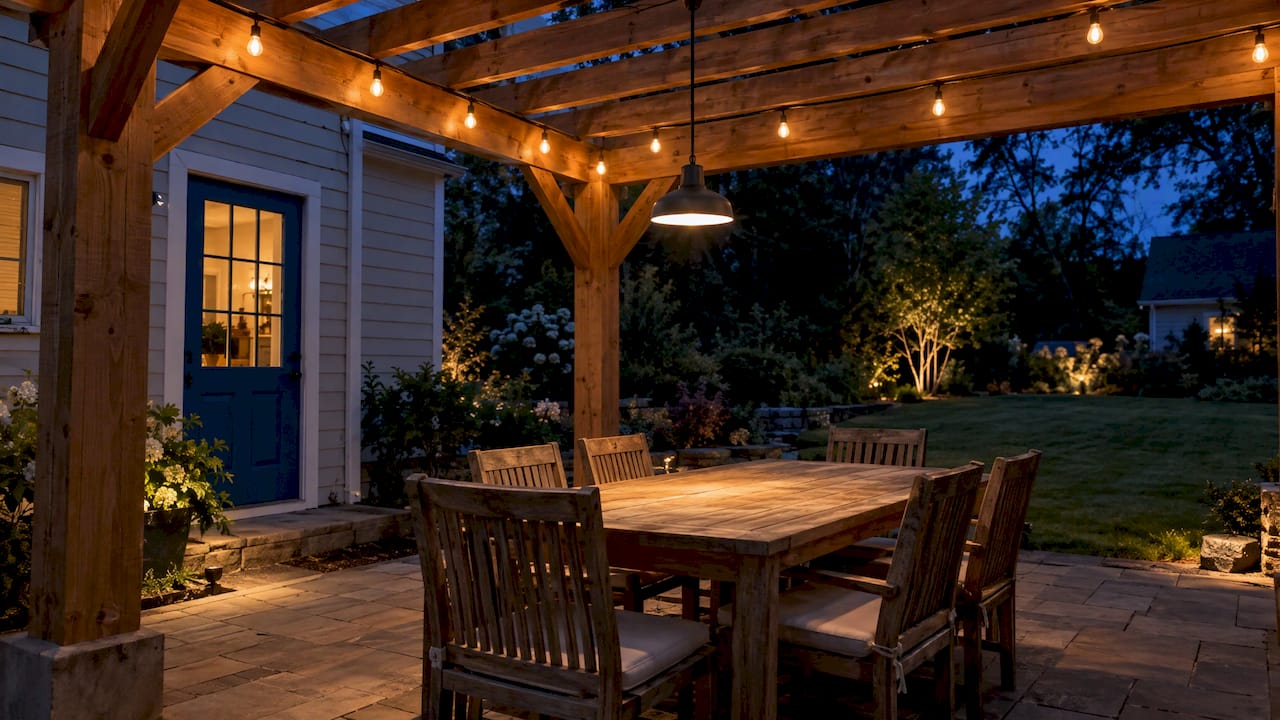
The best pergola lighting is layered: soft overhead light for mood, brighter light where you eat or work, and small low fixtures wherever people step. Combine warm string lights or a hidden LED strip with a few well-placed accent lights, put everything on a dimmer or timer, and you get a pergola that works for dinner at 7 PM and conversation at 10 PM. Our landscape lighting service covers landscape, perimeter and safety lighting, so the pergola, the path to it and the steps beside it can be planned as one system.
This guide is for New Hampshire homeowners and business owners. It walks through the ideas, the placement, the power and weather questions that matter in a New England climate, and the safety points to settle before anything is plugged in.
TL;DR
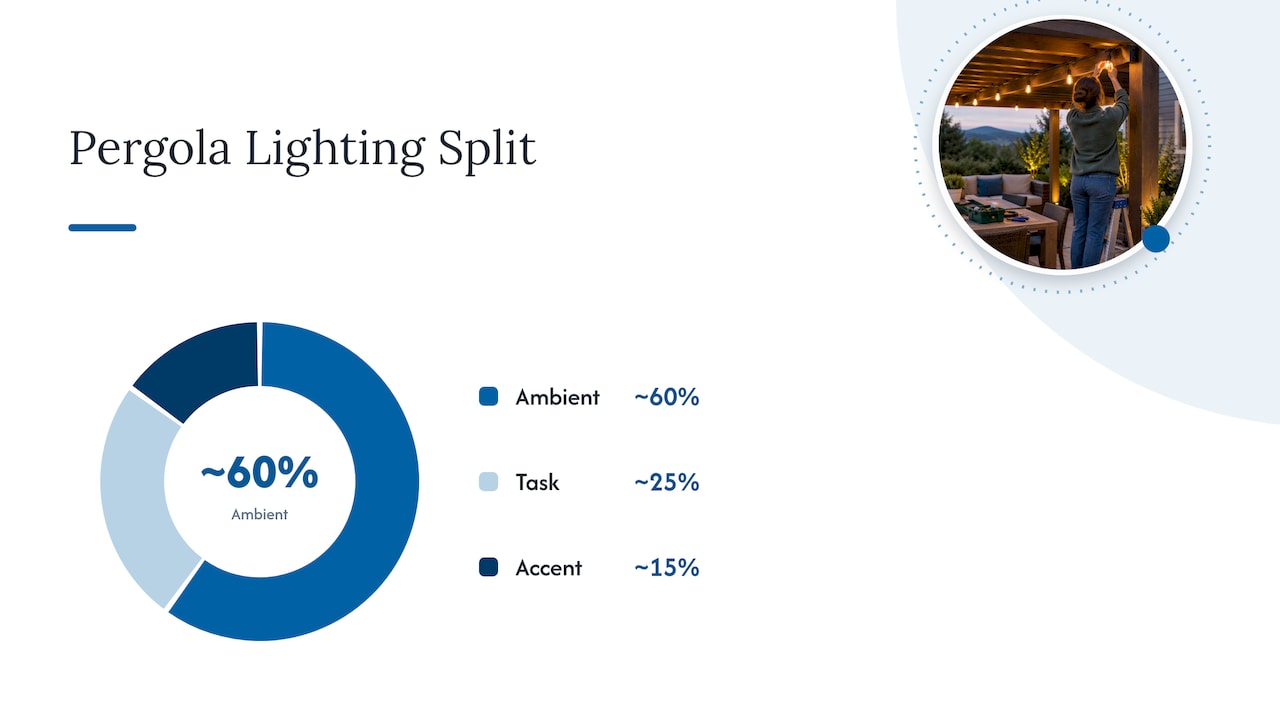
- Plan three layers: ambient (mood), task (tables, grills, counters) and accent (posts, plants, steps). A common rule of thumb is roughly 60% ambient, 25% task and 15% accent.
- On a wood pergola, LED strips under the beams and string lights at beam height are the easiest combination. Metal pergolas also take magnetic mounts and recessed fixtures.
- Choose plug-in or hardwired low-voltage power for the main lighting. Use solar for accents, because winter runtime in the Northeast drops sharply.
- Use fixtures rated for wet locations, put the 120V supply on a GFCI-protected outlet, and have a licensed electrician handle any hardwiring.
- Light every step and change of level separately. Decorative light on the roof does not make a step visible.
Table of Contents
- Start With How You Use the Pergola
- The Three-Layer Plan
- Nine Pergola Lighting Ideas
- Wood vs. Metal Pergolas: What Changes
- Choosing the Lights: Brightness, Weather and Power
- Electrical and Safety Points to Settle First
- Mistakes That Make a Pergola Look Worse at Night
- Plan Your Pergola Lighting With Divine Landscaping
- FAQ
- Sources
Start With How You Use the Pergola
Before you pick a fixture, decide what happens under the pergola after dark. A dining pergola needs light that makes food and faces look right. A lounge pergola needs low, warm light with no glare at eye level. A pergola at a restaurant patio, a small office or a multi-unit property also has to get guests safely from the parking area to the seats.
A simple way to test the plan is to set up a sample scene after dark and sit in each seat. Look for lamps reflected in glass, bright sources at eye level and dark task areas. Lighting designers suggest adjusting position and shielding before you increase output, and testing the table layer first, then the route in and out, then the decorative layer.
The Three-Layer Plan
Designers borrow a method from interior lighting. Ambient light sets the mood, task light makes the activity work, and accent light adds depth. Too much ambient light flattens the scene. Too little leaves guests squinting.
The same guide gives starting lumen ranges per fixture:
| Layer | Job | Typical fixtures | Starting brightness |
|---|---|---|---|
| Ambient | Sets the mood | Perimeter string lights, lanterns | 100–200 lumens each |
| Task | Table, grill, counter | Pendant over the table, swing-arm sconce | 300–500 lumens at the surface |
| Accent | Depth and texture | Uplights, spotlights, fairy lights | 50–150 lumens each |
The same source suggests a split of about 60% ambient, 25% task and 15% accent for most well-lit pergolas. Treat these as starting points and adjust after you see the space at night.
If you want a second explanation of how a balanced light plan makes a pergola comfortable, balancing light for a comfortable pergola covers the same layered logic.
Nine Pergola Lighting Ideas
1. String lights at beam height
Warm bistro bulbs are the classic choice. Hang them at beam level, about 8 to 10 feet up. Weave the strand through slats in an over-under pattern so the cord sits flush, and use small screw-in cup hooks on wood beams. On a metal frame, magnetic socket spools attach without drilling.
One field tester described string lights as a disconnected series of light pools because the bulbs sit 12 to 18 inches apart. That is fine for atmosphere, but not for reading a menu. Treat strings as the decorative layer, not the only one.
2. LED strips tracing the beams
A strip tucked on the underside of a rafter gives continuous, even light with no visible fixture. It is the best option when you want a clean, modern line. For wooden pergolas, strip lights are the most practical choice because recessed lighting is uncommon with the structural limits of wood. Seal strip connections with waterproof end caps, and keep strips out of direct sun where heat can build up.
3. Recessed or downlights in the beams
For an aluminum pergola or a solid-roof structure with enough depth, small recessed fixtures give a focused pool of light over a table without a visible bulb. They suit commercial patios where a clean look matters.
4. A pendant or chandelier over the dining table
A pendant hung 30 to 36 inches above the table surface makes the table the focal point. Choose a fixture listed for the exposure it will see (more on that below) and put it on a dimmer.
5. Uplights on posts and nearby trees
A ground or planter-mounted uplight washing up a post adds height and depth. Lighting a tree or tall shrub behind the pergola pushes the visual edge of the space outward, so the yard does not feel like a black wall beyond the beams.
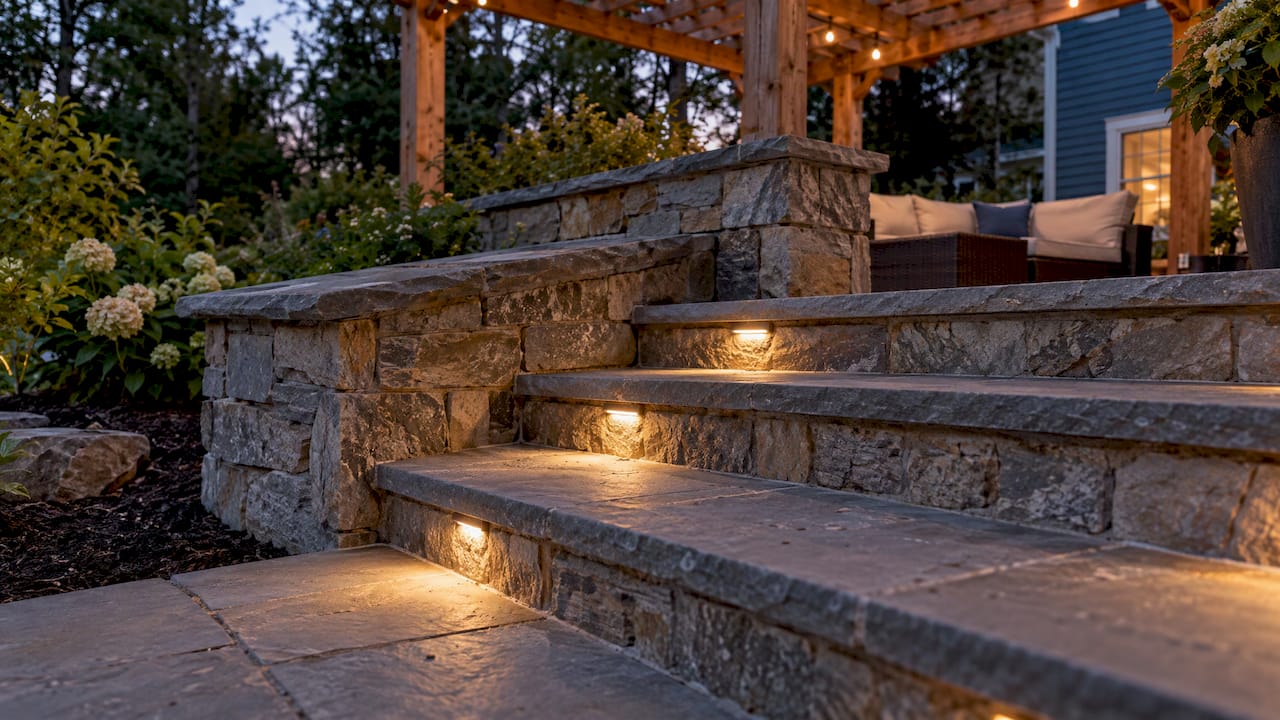
6. Step, riser and seat-wall lights
This is the safety layer. Steps, raised platforms, seat walls and planter edges need small fixtures close to the walking surface, not bright overhead light. Lighting designers also warn that decorative light around the roof does not necessarily make a step visible. Test the walking surface from both directions.
If your pergola sits on a deck, our guide to deck lighting that is beautiful and safe covers rail, post and stair options in detail.
7. Path lights to the pergola
The walk to the pergola is part of the experience. Low path lights keep the route visible without competing with the pergola itself. Our path light spacing guide gives a 6 to 8 foot starting point to test on your own walkway.
8. Scene programming
A smart controller lets one pergola change character without changing fixtures. A designer’s example: an everyday scene with warm-white strings and strips, a dinner scene with dimmed bistro lights, a party scene with color-changing accents, and a late-night scene keeping only step and landscape lights on. Even without color, dimming alone is the most useful upgrade you can make.
9. Lighting for fall, winter and shoulder seasons
New Hampshire evenings arrive early from October on. A pergola used for fire pit gatherings or holiday gatherings benefits from warm white light at low output, with the step and path layer on a timer. If you want shade and light to work together, our pergola shade options for New Hampshire homes article covers the roof side of the design.
Wood vs. Metal Pergolas: What Changes
| Wood pergola | Metal (aluminum or steel) pergola | |
|---|---|---|
| Best strip placement | Underside of beams and rafters | Inside channels or under rails |
| String light attachment | Screw-in cup hooks | Magnetic spools on ferrous frames, clips on others |
| Recessed lights | Uncommon, limited by structure | Works well |
| Wiring | Run during construction while posts are open, or surface-mount conduit painted to match | Often runs through hollow posts and channels |
The wiring point matters. Running wiring while posts are open is far cleaner than retrofitting. If you are planning a new pergola, design the lighting at the same time as the structure. Our pergola size guide is a good companion when you are still deciding how large the structure should be.
Choosing the Lights: Brightness, Weather and Power
Weather ratings
New Hampshire winters mean snow load, freeze and thaw cycles and wet springs. Look for the ratings on the box:
- At least IP44 for basic outdoor use and IP65 for year-round permanent installation, with ETL or UL listing preferred.
- In the US, open-roof pergolas need wet-location-listed fixtures; damp-rated fixtures are suited to solid roofs.
- For strip lights, IP68-rated fixtures with sealed connections hold up best.
Plug-in, low-voltage or solar
For the main lighting, choose plug-in or hardwired low-voltage power: it is brighter and more consistent. Solar suits accents and spots without an outlet. Running costs are small: a 48-foot, 15-bulb LED set drawing 30 watts costs about $0.03 to $0.05 per 8-hour night.
Solar needs honest expectations in the Northeast. Panels need six to eight hours of direct sun to charge fully, and prolonged freezing temperatures reduce battery efficiency. In one field test, solar strings ran 8 to 10 hours in summer but only 4 to 6 in winter. That suits a summer accent, not a pergola you want lit every evening from October through March.
For a low-voltage system, our homeowner’s guide to low-voltage landscape lighting explains how the transformer, cable and fixtures fit together.
Warm or color-changing
Warm white is the safe default for dining and conversation. Color-changing strips are best kept as a party scene that you can switch off. Whatever you choose, keep bulbs and strips out of direct sightlines, so the source is hidden and only the glow shows.
Electrical and Safety Points to Settle First
Pergola lighting is outdoor electrical work. These points keep it safe:
- GFCI protection. A GFCI (ground-fault circuit interrupter) cuts power fast if current leaks to ground. Outdoor receptacles must be GFCI protected. The 120V outlet or supply feeding a landscape lighting transformer is where that protection belongs; the low-voltage cable beyond it usually is not. The 2026 National Electrical Code was issued in August 2025, and states and towns adopt it on their own schedules, so ask your electrician or local building department which edition applies at your address.
- Burial and protection. Low-voltage cable that crosses walkways should be buried or run in conduit. Cable rising out of the ground needs protection from mowers and trimmers.
- Hardwiring. Anything connected to your home’s 120V wiring, including pendants and outlets mounted on the structure, belongs to a licensed electrician. Plug-in strings and low-voltage kits are the simpler route for most homeowners.
- Commercial properties. If guests or customers use the pergola, treat steps, ramps and exits as safety lighting first and decoration second.
Mistakes That Make a Pergola Look Worse at Night
- Hanging one long string and calling it done. You get bright dots and dark gaps.
- Putting bright bare bulbs at eye level. Guests squint and the space feels harsh.
- Forgetting steps. A beautiful roofline does not protect the first stair.
- Mixing color temperatures. Keep warm white consistent across strips, strings and uplights.
- Skipping dimming. A single brightness is wrong for either dinner or late conversation.
- Buying fixtures before planning the route of the wire. Decide where power, transformer and controls go first.
Our Perspective
We build pergolas, patios and decks, and we install landscape, perimeter and safety lighting. The thing we tell homeowners most is that lighting works best when it is designed with the structure, not added after it.
A pergola sits in the middle of an outdoor space: a patio underneath, a walkway leading to it, maybe steps, a retaining wall or a garden bed beside it. Light one piece and leave the rest dark and the whole space feels unfinished. Plan the whole route and the pergola becomes a place you use year-round.
New Hampshire adds its own demands. Evenings come early, winters are long, and fixtures sit through snow and freezing temperatures. That is why we favor a dependable low-voltage or plug-in main layer, with warm, dimmable light and dedicated safety lighting at every step. Our approach is built around craftsmanship, custom design for each property and clear project management from consultation to installation.
If you are planning a new pergola, bring lighting into the conversation at the design stage. Wiring routes, post locations and fixture placement are all easier to resolve before anything is built.
Damian
Plan Your Pergola Lighting With Divine Landscaping
If you want the pergola, the patio beneath it and the lighting designed as one project, our team can take it from consultation to installation. Our Irrigation & Lighting service includes landscape lighting, perimeter lighting and safety lighting, and our Decks & Outdoor Living service includes pergolas and gazebos. We work with homeowners and business owners in New Hampshire and neighboring Massachusetts.

Start with our landscape lighting and irrigation page or see pergolas and gazebos under Decks & Outdoor Living. You can also browse the outdoor living project gallery for ideas, or read about modern outdoor living space ideas for New England homes.
FAQ
What lights are best for a pergola?
For most pergolas, a combination works best: warm string lights at beam height for mood, LED strips under the beams for even working light, and small step and path lights for safety. On wood, strips are the easiest hidden option. Use fixtures rated for wet locations if the roof is open.
How can I make my pergola look better at night?
Add layers rather than brightness. Uplight a post or a nearby tree, put a pendant over the table, and put everything on a dimmer. Lighting the plants and structure behind the pergola also makes the space feel larger.
Are solar pergola lights enough?
Solar works well for accents and for spots with no outlet, especially in summer. In winter, runtime and battery performance drop in cold, low-sun conditions, so most New Hampshire homeowners prefer plug-in or low-voltage power for the main layer.
Do I need an electrician for pergola lights?
Plug-in string lights and low-voltage kits fed from a GFCI-protected outdoor outlet are straightforward. Hardwired pendants, new outlets and any connection to your home’s 120V wiring should be done by a licensed electrician, and your local building department can tell you which code edition applies.
How high should I hang pergola lights?
Place string lights at beam level, around 8 to 10 feet up, and hang a dining pendant 30 to 36 inches above the table. Put step and path lights low, close to the walking surface.
Sources
- Pergola Lighting Ideas: Fixture Types, Placement, and Layered Design
- Pergola Lighting 101
- Pergola Lighting: Solar and Battery Options
- Pergola Lighting Ideas for a Warm, Modern Outdoor Space
- Pergola Lighting Ideas: Layers, Glare, and Controls
- Best Outdoor String Lights (2026)
- Solar light guide
- 2026 NEC Code Changes
- Pergola világítás és fűtés