
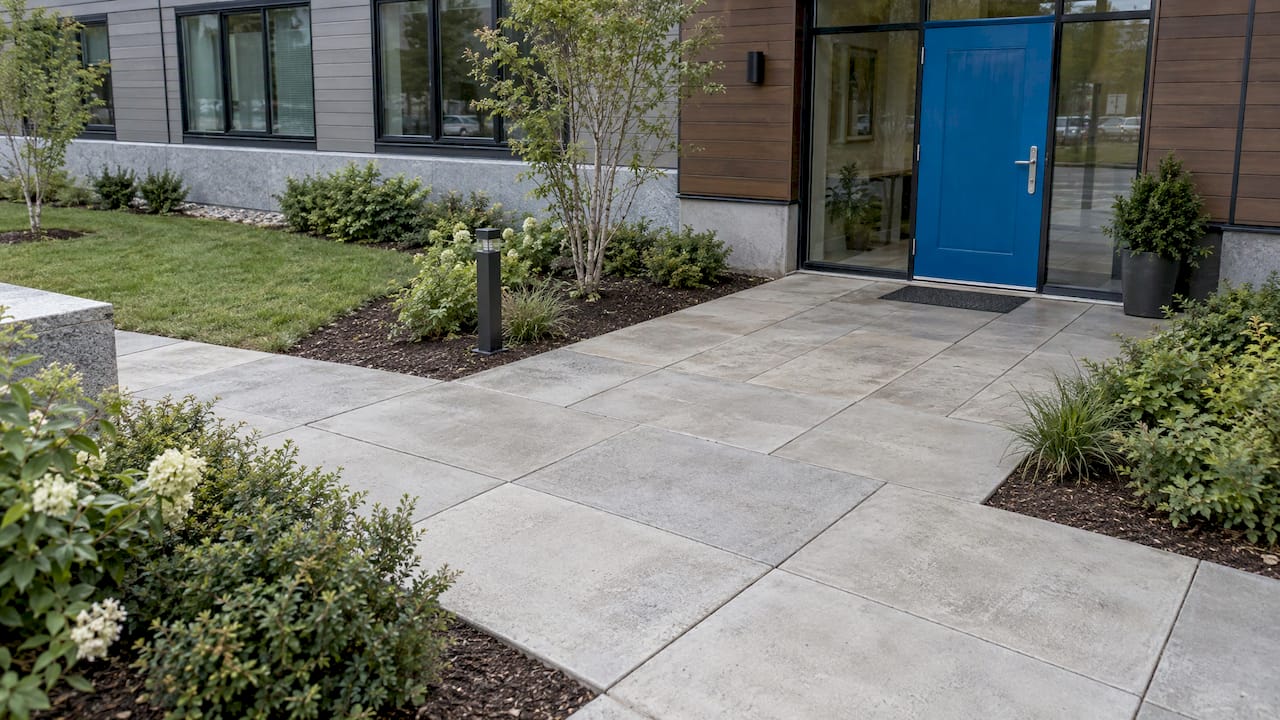
Large format pavers are oversized slabs, commonly 24×24 inches and up, with 24×48 and 36×36 inches among the most popular sizes. They give a patio or walkway a clean, modern look with fewer joints. They also demand a precise base and careful handling, and that is why they are best designed and installed as one project, with the layout, drainage and base planned before the first slab is set. For a New Hampshire yard, where frost heaves, snowmelt and de-icing salt test every surface, those details decide whether the slabs still look sharp in 15 years.
TL;DR
- Large format means slabs of roughly 24 inches or more on a side, sold in concrete, porcelain and natural stone.
- The bigger the slab, the fewer the joints, and the more any flaw in the base shows. Excavation depth, compaction and slope matter more than the paver itself.
- Porcelain suits freeze-thaw climates well, and natural stone and concrete are strong options when they are specified and sealed correctly.
- Slabs this size can overwhelm a small patio or a narrow path. Match the format to the space: rectangles for walkways, squares for seating areas.
- De-icing and spring cleaning habits affect how long the surface looks new.
Table of Contents
- What counts as a large format paver
- Concrete, porcelain or natural stone
- Where large format works, and where it does not
- The base matters more than the slab
- What affects the cost
- Caring for large format pavers through a New Hampshire year
- Is a large format paver patio right for your yard?
- Our perspective
- Plan your large format patio or walkway with us
- FAQ
- Sources
What counts as a large format paver
There is no single legal definition. In practice, a paver is “large format” when one piece is big enough that you notice the slab more than the joints. Most homeowners see sizes from 24×24 inches up to 36×36 or 24×48 inches, and some products go beyond that.
Suppliers show how wide the range is:
- One natural-stone producer offers XL granite, limestone and marble pavers in 36×36 and 24×48 inches.
- One U.S. manufacturer lists stand-alone slabs of 12×24, 24×24 and 24×36 inches, along with porcelain in 2’×2’ and 2’×4’ sizes, with larger sizes by special order, in its large-format trends guide.
- The same guide notes that large slabs take a growing share of North American paver sales as buyers move toward modern and transitional looks with cleaner lines.
The appeal is easy to understand. Fewer joints mean fewer places for weeds, ants and sand loss, and the surface reads as one calm plane. Large slabs also make a modest yard feel more orderly when the layout is planned well.
Concrete, porcelain or natural stone
Three material families dominate. Each behaves differently in a New Hampshire winter, so the choice is as much about climate as about looks.
Porcelain
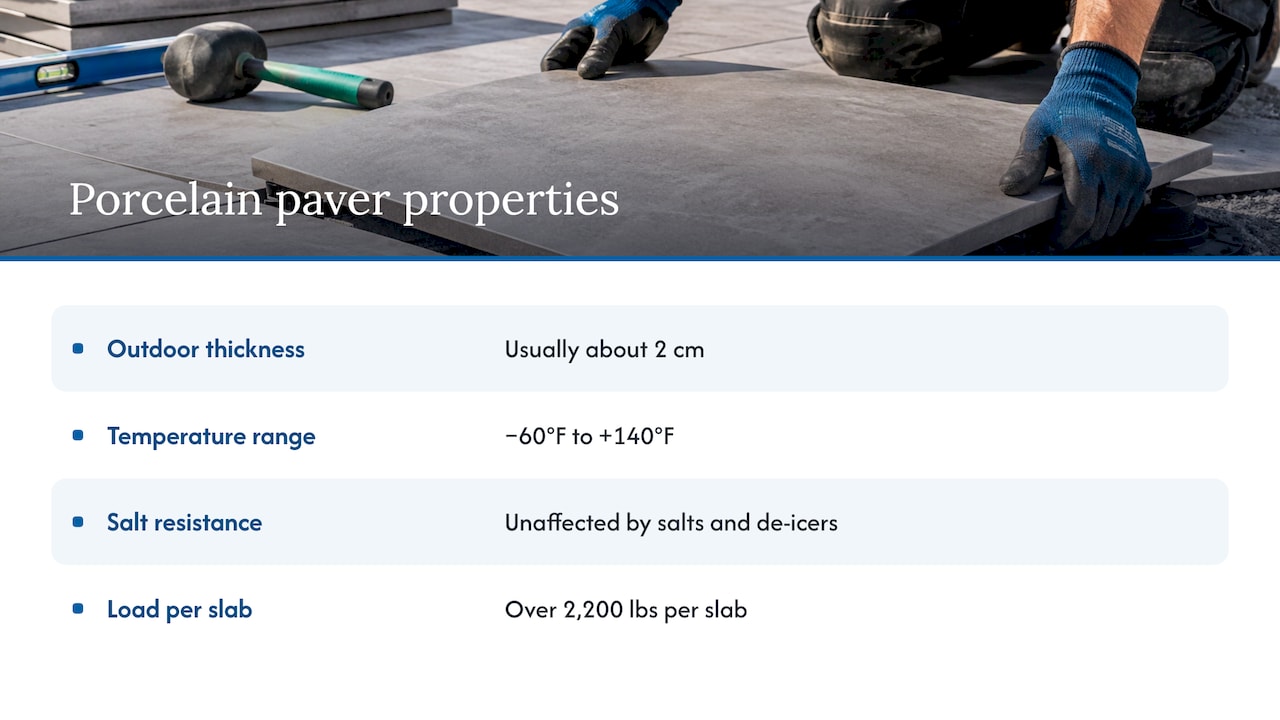
Porcelain pavers are dense fired ceramic slabs, usually about 2 cm thick for outdoor use, with a printed or textured face that can imitate stone, concrete or wood. Their density keeps water absorption very low, so there is little for frost to act on. One New England paver guide from a manufacturer states that its porcelain pavers keep their properties from −60°F to +140°F, are not affected by salt or de-icing materials, and carry loads over 2,200 lbs per slab. Our own write-up on porcelain pavers that last 15 to 20 years covers what to check before choosing a product.
Natural stone
Granite, limestone, bluestone and similar stones offer real variation in color and texture, and that variation is the reason many homeowners pick them. Stone slabs are heavy, and thicker cuts handle patio use well. The natural-stone producer mentioned above publishes XL formats in granite, limestone and marble and describes granite as durable with a wide color range. If you are weighing a slab against irregular stone, our comparison of pavers vs. flagstone for a New Hampshire yard goes through the trade-offs.
Concrete
Large concrete pavers are the most common route when the budget matters or when the surface needs to carry vehicles. Thicker slabs exist for driveways, and manufacturers now offer large formats with textured faces that resemble stone or slate. Concrete benefits from sealing, and its color can soften over the years in strong sun. For a closer look at the practical difference, see brick pavers vs. concrete for a New Hampshire patio.
Quick comparison
| Factor | Porcelain | Natural stone | Concrete |
|---|---|---|---|
| Look | Printed or textured face, consistent color | Unique variation, natural patina | Wide range of finishes, uniform color |
| Typical thickness | About 2 cm | Often 1¼ to 3 cm or more | Thicker for driveway use |
| Water absorption | Very low | Varies by stone | Higher |
| Sealing | Generally none | Often recommended | Often recommended |
| Best fit | Patios, pool decks, walkways | Patios and walkways with a natural look | Budget-conscious patios, driveways |
The right pick depends on your use. A pool patio has different needs than a front walk, and our guide to pool patio materials addresses surface temperature and traction. For a broader view, see the best types of materials for patio installation in NH.
Where large format works, and where it does not
The scale that makes large pavers dramatic also limits where they look right.
- Patios and seating areas: Square slabs such as 36×36 inches suit open patios where a table and chairs sit on a continuous surface.
- Walkways: Rectangular 24×48 inch slabs suit linear paths, because the long side follows the direction of travel.
- Small or narrow spaces: Natural-stone guidance warns that XL pavers can overwhelm smaller patios or narrow walkways. Standard-size pavers handle curves, intricate patterns and complex boundaries better.
- Driveways and commercial areas: These need products rated for the load, a deeper base and a design that matches traffic. The manufacturer’s New England guide sorts paver uses from pedestrian plazas and residential driveways up to parking lots with frequent heavy vehicles, with the site and pavement cross-section driving the choice.
If your yard has curves, steps or several level changes, a mix often works best: large slabs for the main field and smaller pavers for borders, edges and curves. The manufacturer guide mentioned earlier describes the same idea, pairing large slabs with smaller borders and accents. Our ideas for modern outdoor living in New England show how those combinations fit different homes.
Design tips that hold up
- Pick a pattern early. Running bond, stacked and grid layouts each change how the cuts fall at the edges. Plan them on paper before ordering.
- Think about the cuts. Large slabs leave fewer chances to hide a poorly planned edge. A layout that ends in thin slivers looks unfinished.
- Choose texture for traction. Wet slabs on a walkway or pool deck need a textured finish rated for outdoor use.
- Keep colors calm. A single tone for the main field, with a contrasting border, gives the clean line that makes large format worth choosing.
- Plan lighting and drainage at the same time. Conduit and drain lines are far easier to place before the slabs go down. See our notes on landscape lighting design basics.
The base matters more than the slab
A large paver spans more ground, so a soft spot beneath it shows quickly as a rocking slab, an uneven joint or a crack. Installation guidance from a natural-stone producer calls for 8 to 10 inches of excavation, a compacted base of at least 6 to 8 inches for patios and walkways, and a slope of 3/16 inch per foot away from the foundation. The same guide notes that the reduced joint count makes precise installation critical.
For a New Hampshire yard, that guidance fits the realities of local soil and frost:
- Frost depth: Water in the soil expands as it freezes. A properly built, free-draining base gives that water somewhere to go.
- Slope: A subtle pitch away from the house carries meltwater off the surface and away from the foundation.
- Edges: Edge restraints keep the field from creeping apart under foot traffic and seasonal movement.
- Heavy handling: Large slabs are heavy and often take two people or lifting equipment to set safely. Planning access to the yard matters as much as the layout.
If you are not sure what belongs under the slabs, what a patio base is and whether you need one explains it in plain terms, and patio drainage fixes cover what to do about standing water. For the winter side of the problem, our freeze-thaw paver damage checks list what shows up first.
What affects the cost
Large format pricing varies too much by product, site and design to give one number that would hold for every New Hampshire yard. The factors that move a quote are consistent, though:
- Material: Standard concrete is usually the lower-cost route, porcelain sits in the middle to upper range, and natural stone such as granite or marble is typically the highest.
- Thickness and rating: Slabs rated for vehicles cost more than pedestrian-only slabs.
- Excavation and base: Deeper excavation, more stone and more hauling add to labor.
- Access and handling: Heavy slabs on a tight or sloped lot take more time and equipment.
- Layout complexity: Curves, steps, borders and many cuts take more hours than a simple rectangle.
- Add-ons: Retaining walls, lighting, drainage, fire features and steps.
Because the base and handling are a large part of the work, compare quotes on the full scope, not on the square-foot price of the slab alone. A written scope should state excavation depth, base material, slope, edge restraint, joint treatment and cleanup.
Caring for large format pavers through a New Hampshire year
Good maintenance is simple, but the details matter.
- Spring cleaning: The manufacturer’s care guide for freezing climates recommends an annual spring cleaning and prompt treatment of stains.
- Sealer: The same guide suggests sealing concrete pavers after the first year. Natural stone often benefits from periodic sealing, and porcelain generally does not need it.
- Pressure washing: For porcelain, the manufacturer’s New England guide specifies a low-pressure washer at a maximum of 1,600 psi, and sand or polymeric-sand joints need re-sanding afterward.
- Joints: Natural-stone guidance notes that open-grade installations may need joint sand topped up from time to time, while mortared installations typically need no routine maintenance.
- Drainage: Water that sits on or under a surface in freezing weather causes the damage. Keep downspouts, drains and slopes clear.
De-icing safely
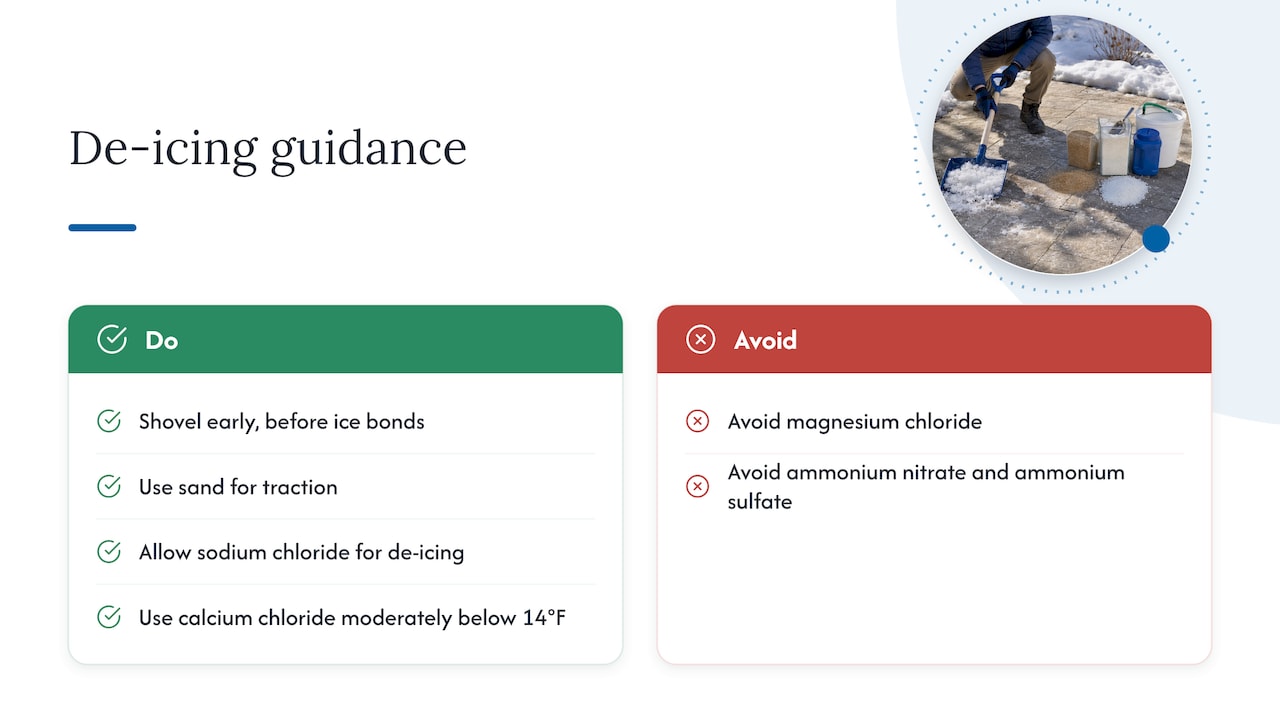
Winter products can discolor or damage some surfaces. The care guide for freezing climates lists sodium chloride (rock salt) as acceptable for de-icing. It allows calcium chloride only below 14°F and in moderation, and it says never to use magnesium chloride or products containing ammonium nitrate or ammonium sulfate. Check your product’s label against the paver manufacturer’s guidance, shovel early so ice does not bond, and use sand for traction when you can.
Is a large format paver patio right for your yard?
A short checklist helps:
- Is the space large enough? A patio of about 12×12 feet or more is usually a comfortable fit for large slabs.
- Is the layout mostly straight? Geometric shapes suit large slabs. Curves call for smaller pieces.
- Can equipment reach the area? Slab weight and access affect safe handling.
- Is the soil well drained? If water pools, fix the drainage first.
- Do you want a modern or transitional look? That is where large format shines.
For business owners, the same questions apply with an added one: what traffic will the surface carry? Entrances, plazas and courtyards that see only foot traffic are a good fit, while loading zones and parking areas call for a load-rated product and a deeper structural design. Property managers who handle several tenants may find our guide to multi-tenant property landscaping design useful for planning.
Our perspective
We design and build hardscapes across New Hampshire and neighboring Massachusetts, and large format pavers are one of the clearest cases where design and construction have to be planned as one job.
The slab gets the attention, but the base, the slope and the layout decide the result. A custom design built around your property lets us choose the format, the material and the pattern for how you will use the space, then carry that plan through to installation with one clear line of project management from consultation to finish.
With more than 20 years of combined hands-on experience and a satisfaction guarantee, we want you to be able to look at your patio a decade from now and see the same clean lines you approved on day one. Our approach is to use premium materials and to talk through each choice with you, so you know why a given slab, base or drainage detail is in the plan.
If large format is on your list, start with the space, not the catalog. Tell us how you want to use the yard, and we will show you which sizes and materials fit it.
Damian
Plan your large format patio or walkway with us
Divine Landscaping LLC designs and builds patios, walkways, retaining walls, firepits, outdoor kitchens, decks and lighting for homes and commercial properties in New Hampshire and neighboring Massachusetts. If you want large format pavers in your project, our patio installation team can walk the site with you and shape the plan around your property.
For a wider hardscape scope, such as walls, steps, firepits or an outdoor kitchen to go with the patio, see our masonry and hardscape services, or start with landscape design. You can also browse finished work in our project gallery. We serve towns including Salem and Windham.
FAQ
What size is a large format paver?
Most people use the term for slabs of about 24 inches or more on at least one side. Common sizes include 24×24, 24×36, 24×48 and 36×36 inches. Some manufacturers offer even larger slabs by special order.
Are large format pavers a good choice for New Hampshire winters?
Yes, when the product and the base are right. Porcelain is dense, with very low water absorption, and one manufacturer states its slabs keep their properties from −60°F to +140°F. Whatever the material, a compacted, free-draining base and a slight slope away from the house do the most to protect the surface from frost.
Can large format pavers be used on a driveway?
Only products rated for vehicles should be used, and the base needs to be built for that load. Manufacturers make thicker slabs for driveways, and pedestrian-only slabs are not a substitute. Tell your designer how the area will be used so the specification matches.
Do large format pavers need sealing?
It depends on the material. Concrete is usually sealed after its first year, according to one manufacturer’s care guide, and natural stone often benefits from periodic sealing. Porcelain generally does not need sealing.
Are large format pavers right for a small patio?
Often not. Guidance from a natural-stone producer notes that XL slabs can overwhelm small patios and narrow walkways. A smaller format, or a mix of large slabs with a smaller-paver border, usually looks better in a compact space.
Sources
- How To Install Large Stone Pavers (Polycor)
- Large-Format Paver Trends (Belgard, 2024)
- New England Site Solutions Guide (Belgard, 2024)
- Operation & Maintenance Guide (Belgard, 2020)