
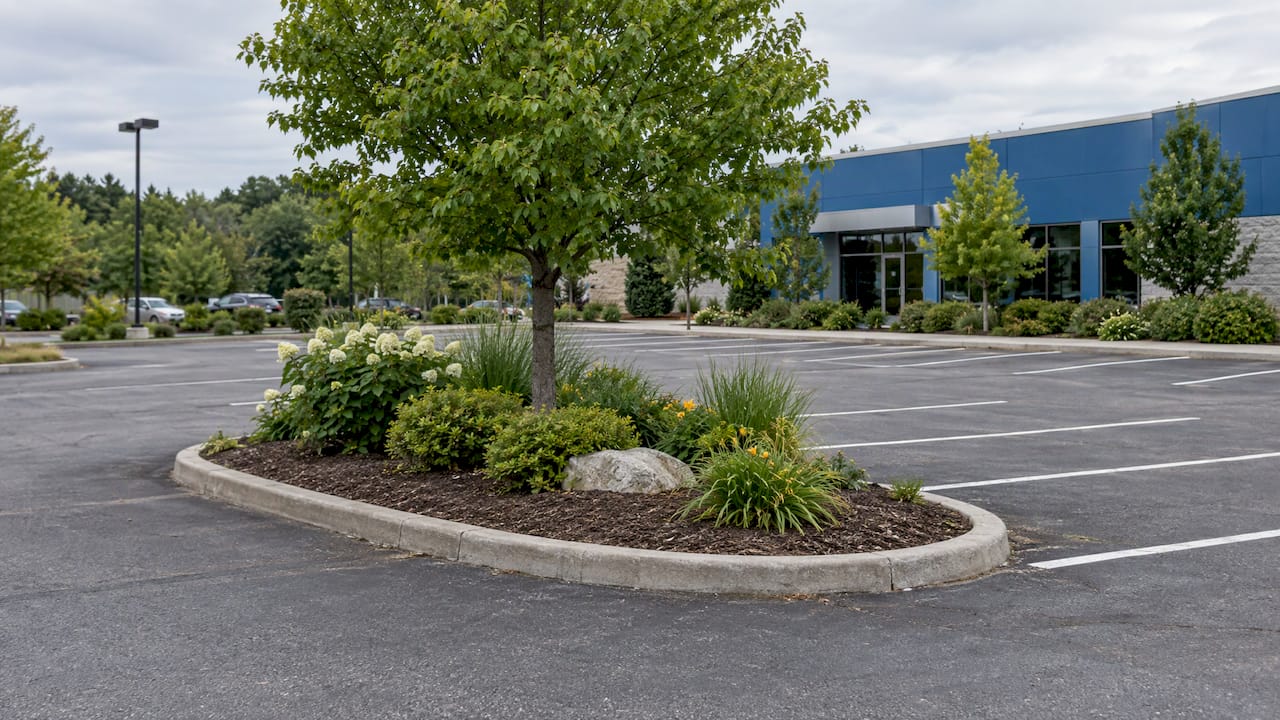
A parking lot island is a planted strip or bed inside or at the end of a row of parking spaces. In New Hampshire it has to do four jobs at once: hold a tree alive, survive plowed snow and road salt, keep drivers’ sightlines clear and handle runoff. Islands that get the dimensions, soil and plant list right at the design stage look good for years. Islands that don’t are the ones that turn into compacted dirt and broken curbs by the second winter. We design and build commercial landscapes across New Hampshire, and the sections below walk through what a property owner needs to decide before any plants go in.
TL;DR
- Islands do real work: they break up pavement, guide traffic, shade asphalt and take in stormwater, so size them for a tree’s roots, not for looks.
- Many New Hampshire towns write island rules into site plan review. Hopkinton, for example, sets a 9-foot minimum width and one shade tree per island. Check your town’s rules first.
- Choose plants for salt, snow storage, reflected heat and little care, not for what looks best in a nursery.
- Raised curbs or wheel stops, a good soil mix and irrigation decide whether an island lasts.
- Plan the island together with lighting, accessibility and snow removal so they don’t fight each other.
Table of Contents
- What a parking lot island actually does
- Check your town’s rules before you draw anything
- Size and layout: give the tree room to live
- Choosing plants for salt, snow and neglect
- Use the island to handle stormwater
- Protect the island: curbs, irrigation and lighting
- Maintenance and snow management
- Our perspective
- Ready to plan your lot?
- FAQ
- Sources
What a parking lot island actually does
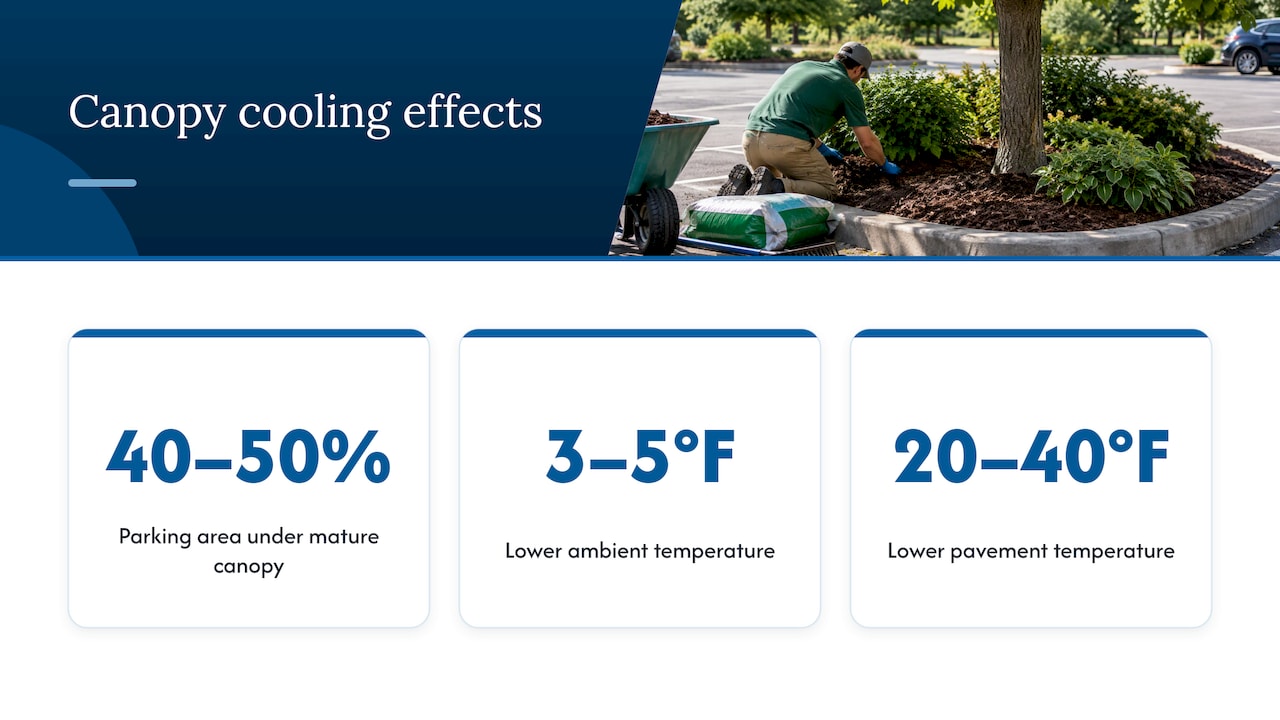
Tree islands are vegetated areas within the parking field. According to Parking Professional’s landscaping guide, they break up large expanses of asphalt, direct traffic flow, reduce stormwater runoff, provide canopy and make the lot friendlier to people on foot. The same guide reports that mature canopy over 40 to 50 percent of a parking area can lower ambient temperatures by 3 to 5°F and pavement temperatures by 20 to 40°F.
For a business owner, that translates into practical benefits: customers who find a shaded car on a July afternoon, pavement that is not baking all summer, and a lot that reads as cared for from the road. The Green Building Alliance goes further and calls natural drainage, water collection and filtration the most important function of parking lot landscaping, with looks and shade as secondary gains. That is a useful way to think about an island: it is part of the lot’s drainage system as much as its decoration.
Check your town’s rules before you draw anything
In New Hampshire, parking lot landscaping is usually controlled by the town’s site plan review regulations, which the planning board applies when you build, expand or substantially change a commercial lot. The numbers differ from town to town, so treat the examples below as a picture of what to expect, not as your requirement.
Hopkinton’s site plan review regulations, amended in 2024, require:
- Islands at least 9 feet wide and 18 feet long, measured from the face of the curb, where they run parallel to spaces on both sides.
- No more than 10 contiguous parking spaces without an island.
- At least one shade tree per island.
- Porous curbing or wheel stops to protect interior plantings.
- At least 10 percent of the lot’s interior landscaped.
- Shade trees of hardy, drought- and salt-resistant species, 2.5 to 3 inches in caliper (trunk diameter) and at least 12 feet tall at planting.
- Islands and medians designed to accept and retain stormwater and to serve as a safe haven for pedestrians.
New Castle’s regulations take a different approach. They call for a continuous landscape strip between every four rows of parking, planting islands preferably at the ends of rows, and islands at least 9 feet wide every 10 to 15 spaces, each with a shade tree that has at least 6 feet of clear trunk.
The EPA’s Region 1 review of street and parking standards for New Hampshire and Massachusetts notes the same pattern: landscape islands and borders are commonly required for traffic flow and screening, and the total landscaped area is usually calculated from the number of spaces or the amount of impervious cover.
Before you hire anyone, call your town planning office and ask for the current site plan regulations and any landscape or stormwater sections. If your lot is part of a multi-tenant property, our manager’s guide to multi-tenant landscaping design covers how to coordinate several tenants around one plan.
Size and layout: give the tree room to live
Most failed islands fail on size. A strip of soil a few feet wide, enclosed by asphalt and curb, cannot support a shade tree for long. The published standards show a clear range:
| Source | Minimum island width or area | Spacing and notes |
|---|---|---|
| Hopkinton, NH | 9 ft wide, 18 ft long | Max 10 contiguous spaces, one shade tree per island |
| New Castle, NH | 9 ft wide | Every 10 to 15 spaces, 6 ft clear trunk |
| Yale facilities standards (2025) | 10 ft wide | Green space added elsewhere if space is short |
| University of Arkansas (2023) | 8 ft wide | Curbs, irrigation or sleeves, low plants on internal islands |
| CED Engineering reference | 250 sq ft minimum area | Terminal islands with at least two trees |
The Prince George’s County landscape manual adds root-zone detail: at least 160 square feet of contiguous planting area per tree, with no dimension under 6 feet, and 12 feet of minimum branch height. It also scales interior planting to lot size, from none under 7,000 square feet up to 15 percent for lots of 150,000 square feet or more. That manual is from Maryland, so use it as a design reference, not as a New Hampshire requirement.
Keep sightlines open
The same manual recommends low shrub screens of 2 to 4 feet and warns against tall shrubs or low-branching trees where they block visibility. Plantings near entrances should keep safe sight distances. The University of Arkansas standard limits internal curbed islands to low shrubs or groundcover for the same reason. In practice: tall material goes at the end of a row or in the middle of a wide island, and low material goes anywhere a driver or pedestrian needs to see across.
How cars enter the lot matters too. Design of entry points, from open lanes to car park gate design, decides where vehicles queue and turn, and that tells you where island ends and sightlines need the most care. Our guide to entrance landscaping for a business property goes through the planting at the front door of the lot.
Plan for walkers and accessibility
Islands often sit right next to accessible routes and van-accessible stalls. Planting must not narrow a path, drop branches into the walking zone or push roots up through a walkway. Our explainer on ADA landscape compliance outlines what property owners should have in mind before the layout is final.
Choosing plants for salt, snow and neglect
The landscape manual’s authors make a point every New Hampshire owner should hear: plants in parking lots face many adverse conditions and are unlikely to get consistent care. That argues for moderate to slow growers that handle sun, wind, drought, glare, reflected heat, salt and cramped roots.
Salt needs particular attention here. Cornell’s recommended urban trees guide points out that published salt-tolerance information is largely anecdotal and often does not separate spray from soil salt. It also notes that early snowfall in late October or early November, and late salt applications in April, can injure trees because the soil is warmer and the roots are more active. Urban soils can be near-neutral to alkaline, up to pH 8.2, so soil pH belongs in your species decision.
A workable approach for a New Hampshire island:
- Start with the tree. Choose one hardy, durable shade tree suited to the island’s width, in line with your town’s caliper and height requirements.
- Add a low layer. Compact shrubs, ornamental grasses and perennials that stay under about 3 feet keep sightlines open and shade the soil. The New Orleans zoning ordinance shows the idea: shrubs for a second layer and at least 75 percent of each island in live groundcover, perennials or grasses, with mulch until the groundcover fills in.
- Plan for snow. Plowed snow gets piled onto islands. Keep fragile plants away from the plow side, and choose woody material that bends without snapping.
- Match the plant list to the soil. Ask for a soil test, and amend or replace compacted fill before planting.
Some towns publish salt-tolerant plant lists. Hampton Falls’s landscaping design guidelines mark road-salt-tolerant plants and address snow storage in parking lots, so check whether your town has something similar.
Use the island to handle stormwater
An island that sits below the surrounding pavement can take in runoff instead of shedding it. The Green Building Alliance describes bioretention islands as set below lot level, filled with a sandy, compost-rich soil mix, topped with mulch and dense vegetation, with a 6 to 8 inch ponding depth and an overflow outlet. It cites about 5 percent of the paved surface as the area to aim for. Perimeter bioswales, which are shallow planted channels, can direct runoff to a larger collection system.
The benefit is measurable. Parking Professional reports that a well-designed bioswale can remove 80 to 90 percent of total suspended solids and 30 to 50 percent of total nitrogen from parking lot runoff.
It has to be coordinated with the paving, though. CED Engineering treats water as the main cause of distress in pavement and calls for paved-surface slopes of at least 0.4 percent. A depressed island needs curb cuts or openings at the right places, and Hopkinton’s rule that islands be designed to accept and retain stormwater shows that some New Hampshire boards expect it. If standing water is already a problem next to your hardscape, our piece on patio drainage fixes shows how grading and drainage decisions play out on the ground. If you are weighing sustainability goals, what LEED landscaping means is a good primer.
Protect the island: curbs, irrigation and lighting
Curbs and wheel stops
Vehicles will drive over an unprotected island. Hopkinton calls for porous curbing or wheel stops, CED Engineering specifies raised concrete curbs to prevent vehicle intrusion, and the University of Arkansas standard requires curbs to protect trees and plants. Stone or concrete edging, set properly, is masonry work, and our masonry and hardscape services include walls, walkways and related stonework.
Irrigation
A new tree in an island has little soil volume and a lot of hot pavement around it. The Arkansas standard calls for irrigation or at least irrigation sleeves, which are buried pipes that let you add irrigation later without cutting the pavement. Installing sleeves during construction is far cheaper than retrofitting. Our guides on planning an irrigation system and irrigation zones explain how zones are laid out, and smart controllers help keep watering matched to the weather.
Lighting
Light poles typically go in islands or along the perimeter. The Arkansas standard sets a 0.5 foot-candle minimum for parking lighting. That means a pole location must be settled with the tree location, so a mature canopy does not end up blocking the light. Our article on commercial landscape lighting design checks walks through that coordination.
Maintenance and snow management
New Hampshire islands live a hard winter life. A few habits protect them:
- Mark the island edges with stakes or reflective markers before the first plowing season so operators know where beds begin.
- Pile snow where it won’t harm plants. Agree with your plow contractor on designated storage areas.
- Keep salt use down. The New Hampshire Department of Environmental Services runs a voluntary salt applicator certification program for commercial lots, aimed at keeping them safe while cutting environmental impact from salt. Less salt on the pavement means less in the island soil.
- Water through the first seasons. Young trees and groundcover need steady moisture until established.
- Mulch and prune each year. Keep mulch off trunks, and prune low branches to the clearance your town requires.
- Repair curbs and replace losses promptly. A dead tree in an island is usually a required tree under your approved site plan.
If your property is already built and tired, planning a commercial landscape renovation shows how to phase work so the lot stays open to customers.
Our perspective
Owners tend to treat islands as the last item on the plan, a place to put what is left over. We see it the other way. The island is where a commercial property shows its care first, and where shortcuts show first too.
Our approach is custom design for each property, premium materials and clear project management from the first consultation through installation. For an island, that means starting with the tree’s root space, the curb that protects it, the water that will reach it and the winter it must survive, and then choosing the plants. When that order is followed, the planting looks mature sooner and needs less rescue work later.
We bring more than 20 years of combined hands-on experience to commercial and residential landscapes in New Hampshire, and we stand behind our work with a satisfaction guarantee. Landscape design, masonry, irrigation and lighting can be planned together, which keeps one plan from undoing another.
Damian
Ready to plan your lot?
Divine Landscaping LLC designs and builds outdoor spaces for commercial and residential properties in New Hampshire, including landscape design, masonry and hardscape, irrigation and lighting. If you are creating a new lot, renovating an old one or sorting out a planning board comment, our landscape design service is the place to start, and our commercial landscaping overview for New Hampshire shows how we work with property owners.
When you are ready to talk through your property, request a quote and we will take it from there.
FAQ
How wide should a parking lot island be?
Check your town’s regulations first. Hopkinton, NH requires at least 9 feet by 18 feet for islands between parking spaces, and New Castle also uses 9 feet. Other published standards range from 8 feet to 10 feet. A wider island gives tree roots room to grow and survive winters.
How many parking spaces can go between islands?
It depends on the town. Hopkinton allows a maximum of 10 contiguous spaces, and New Castle calls for islands every 10 to 15 spaces. Longer runs are usually treated as a design problem by planning boards.
What should I plant in a parking lot island in New Hampshire?
Use a hardy shade tree that tolerates salt, drought and reflected heat, with low shrubs, grasses or perennials beneath it to keep sightlines open. Match species to your soil and to your town’s list of requirements. A designer can prepare a plant list that fits both the site and the site plan review.
Can a parking lot island help with stormwater?
Yes. Islands set below pavement level, with a sandy compost-rich soil mix and an overflow outlet, can collect and filter runoff. The Green Building Alliance suggests about 5 percent of the paved area for bioretention islands, and some New Hampshire towns, such as Hopkinton, expect islands to retain stormwater.
Sources
- Parking Lot Landscaping Guide, Parking Professional
- Runoff Landscaping for Parking Lots, Green Building Alliance
- Hopkinton, NH Site Plan Review Regulations
- New Castle, NH Site Plan Review Regulations
- EPA Region 1 street and parking design standards assessment
- Yale parking lot design standards
- University of Arkansas campus parking lot standards
- CED Engineering, Parking Lot Design
- Prince George’s County Landscape Manual
- Cornell Recommended Urban Trees
- New Orleans Comprehensive Zoning Ordinance
- NH DES voluntary salt applicator program
- Car Park Gate Design guide