
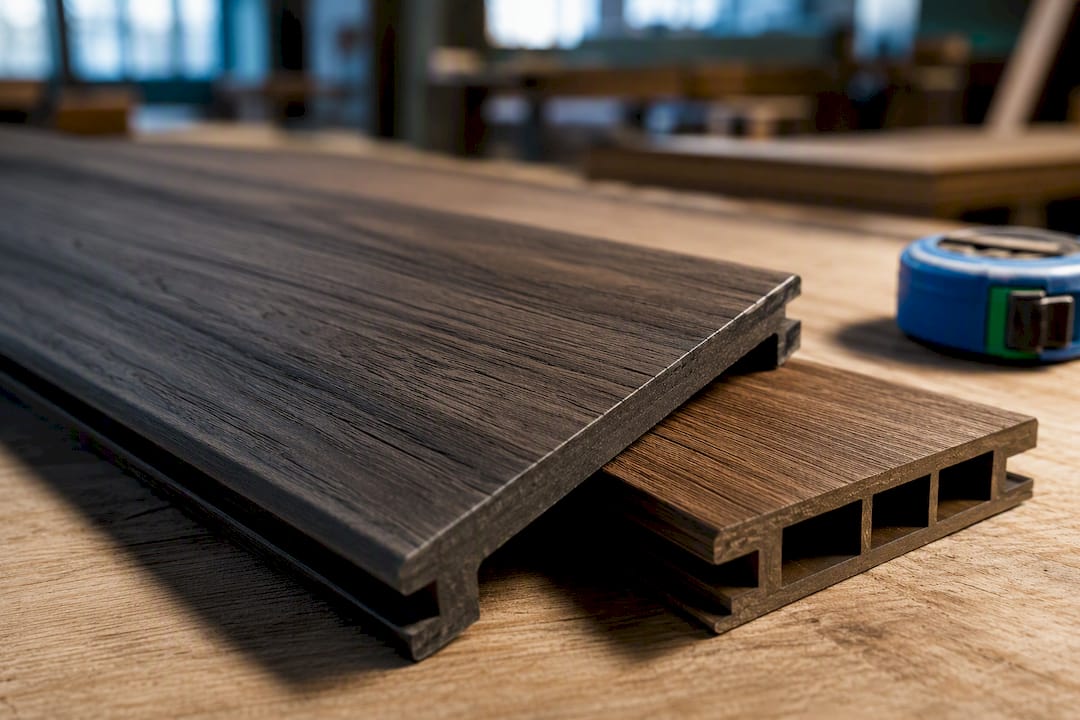
Installed composite decking typically runs $40 to $85 per square foot for a standard single-level deck, covering both materials and labor. That range usually includes railing, stairs, and basic permit handling, but your final number will shift with site prep, deck size, and where you live in the country.
TL;DR:
- Site conditions such as elevation, joist condition, and access significantly influence the final deck cost beyond the base square footage estimate.
- Regional labor rates can cause a variation of 25 to 40 percent in total price, especially for framing and installation tasks.
- Replacement is generally advisable over repairs if repair costs exceed 50 percent of the full deck replacement price, considering the remaining lifespan.
- Accurate bids require a thorough on-site inspection of existing structures and specific project details, rather than relying on online averages or preliminary estimates.
- Material choice tiers range from $40 to $85 per square foot, with higher costs reflecting better moisture resistance, scratch resistance, and longevity, especially for premium PVC options.
Table of Contents
- What Does Composite Deck Cost Per Square Foot?
- Where Does Your Money Actually Go? Materials, Labor, and Hidden Costs
- What Will a Composite Deck Cost by Size?
- What Site Conditions Push Your Deck Budget Higher?
- Should You Repair Your Deck or Replace It?
- How Do You Get an Accurate Contractor Quote?
- Is Composite Worth It Long Term Compared to Wood?
- What Do Contractors Actually Look for When Pricing a Deck?
- What Homeowners Get Wrong About Deck Pricing
- Ready to Get a Real Number for Your Deck?
- Sources
What Does Composite Deck Cost Per Square Foot?
Your material choice is the single biggest lever on price, and it splits into three clear tiers. Understanding what separates them helps you avoid paying premium prices for features you won’t use, or skimping on a board that won’t hold up to New Hampshire winters.
Entry-tier composite typically installs for $40 to $55 per square foot. These boards are often uncapped wood-plastic composite (WPC) or feature capping on only three sides, leaving the bottom exposed to moisture. They’re a real step up from pressure-treated lumber in appearance, but they’re more prone to fading and staining over time since the surface isn’t fully sealed.
Mid-tier composite lands around $55 to $70 per square foot installed. This is where fully capped boards enter the picture, either mineral-based composite (sometimes called poly composite) or fully-encapsulated WPC. You get better stain and scratch resistance, stronger warranties (often 25 to 30 years against fading and staining), and a more consistent wood-grain look across the board.
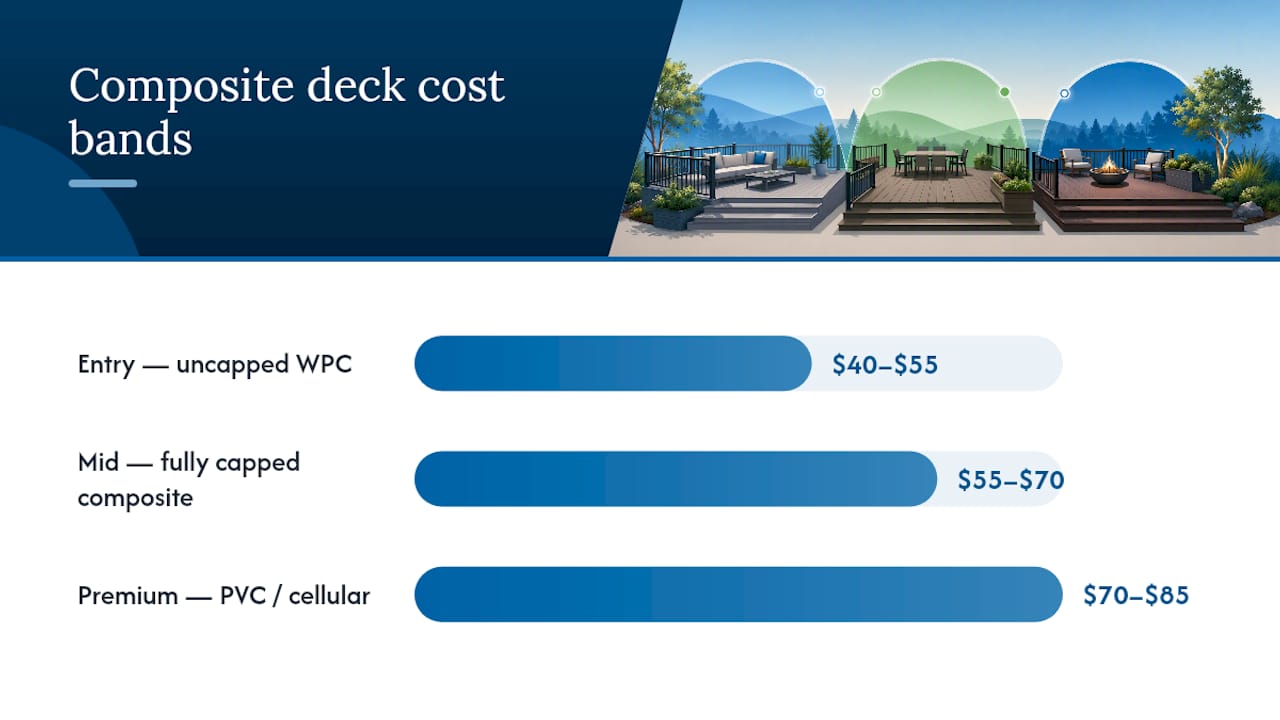
Premium PVC and cellular PVC decking pushes the range to $70 to $85 per square foot, sometimes higher with specialty finishes. These boards contain no wood fiber at all, which makes them the most resistant to moisture, mold, and insect damage. Many premium lines also incorporate “cool deck” technology that reflects heat, a genuine benefit if your deck faces full afternoon sun.
A quick glossary helps when you’re comparing spec sheets:
- WPC (wood-plastic composite): wood fiber blended with plastic resin, the original composite decking category.
- Mineral-based composite: a polymer blend using mineral fillers instead of wood fiber, often marketed as “poly” decking.
- PVC/cellular PVC: fully synthetic boards with no wood content, the most weather-resistant and typically the most expensive.
If you’ve already narrowed down a brand and product line, a brand-specific cost calculator can tighten these ranges considerably since material pricing varies by manufacturer.
Where Does Your Money Actually Go? Materials, Labor, and Hidden Costs
Composite decking price per square foot isn’t just board cost. Once you break a bid into its parts, it becomes much easier to spot where a contractor is charging fairly and where you might trim or upgrade.
According to industry cost data, labor represents roughly 25 to 40% of an installed composite deck’s total cost, and that percentage swings significantly by region. A framing crew in rural New England charges differently than one working a Boston suburb, so two identical decks can land thousands of dollars apart based on zip code alone.
Substructure and framing is where budgets often get surprised. A standard deck built on a stable, accessible site might only need modest footing work. But if your yard requires frost-line footings (common across New Hampshire and much of the Northeast) or helical piers for unstable soil, expect the substructure line item to climb substantially. Frost-line code requirements alone can add real cost to the foundation phase, since footings often need to reach 42 inches or deeper depending on local frost depth.
Railing and stairs are billed separately from the decking surface itself, usually by linear foot for railing and per stair run for steps. Composite or aluminum railing systems commonly add several hundred dollars per 8 to 10 foot section, and a custom metal railing system can push that higher depending on the design. If you’re weighing railing material options, factor in both the upfront cost and how much upkeep each style demands over the deck’s life.
Soft costs round out the bid:
- Permit fees: commonly $150 to $750 depending on your municipality and deck size.
- Demolition of an existing deck: typically $5 to $15 per square foot.
- Contingency: most experienced contractors build in 10 to 15% for unforeseen site conditions.
Homeowners often assume permit fees are optional or negotiable. Most reputable contractors handle permits and inspections as part of their bid, and if a proposal excludes them, you should expect that cost to land back on your plate later.
Optional upgrades add their own increments. Hidden-fastener systems, which hide screws beneath the board surface for a cleaner look, typically add $0.50 to $1.00 per square foot.
What Will a Composite Deck Cost by Size?
Square footage drives your total more than almost any other factor, but the relationship isn’t perfectly linear. Larger decks often benefit from slight economies of scale on labor, while very small decks can feel disproportionately expensive because fixed costs (permits, mobilization, equipment delivery) get spread across less area.
These totals assume basic railing, standard framing, and typical single-story labor rates. They exclude landscaping, elevated structures, custom features like built-in seating, and demolition of an existing structure. For context, RemodelCalculators reports a standard 320-square-foot composite deck installed nationally between roughly $13,000 and $24,000, which lines up closely with the mid-to-premium range above once regional labor is factored in. If you’re in a high-cost labor market like coastal Massachusetts or greater Boston, plan to push toward the upper end of every tier.
What Site Conditions Push Your Deck Budget Higher?
A per-square-foot estimate only tells part of the story. The site itself often decides whether you land at the low end of a range or blow past the high end entirely.
Elevation adds real cost. A second-story or elevated deck requires taller support posts, additional bracing, and often a set of stairs that a ground-level deck never needs. Labor time increases too, since crews work more slowly and carefully at height. Expect elevated decks to run 15 to 25% above a comparable ground-level build.
Joist and ledger condition matters more than most homeowners expect. If you’re replacing an old wood deck’s surface with composite but reusing the substructure, a contractor should inspect the ledger board (where the deck attaches to your house) and every joist before quoting. Rotted or undersized joists require replacement before any composite board goes down, and that inspection can add anywhere from a few hundred to a few thousand dollars depending on how much framing needs rebuilding.
Design complexity drives waste and labor time. A simple rectangular deck wastes very little board material. Curves, diagonal board patterns, and picture-frame borders all increase cutting, fitting, and scrap, which shows up as both a materials waste factor and added labor hours.
Access and logistics quietly affect labor cost. A backyard reachable by truck is a different job than one where every board has to be carried by hand around a house or through a narrow gate. Tight urban lots and steep grades slow crews down, and that time gets reflected in the labor line of your bid.
- Elevated or multi-level decks: add 15 to 25% to base cost.
- Joist/ledger replacement: adds a few hundred to several thousand dollars depending on scope.
- Curved or diagonal layouts: increase material waste and labor time noticeably.
- Difficult site access: extends labor hours even on a straightforward footprint.
Pro Tip: Ask any contractor bidding your project to physically inspect the existing substructure before finalizing a quote, not just the visible deck surface. A bid based only on square footage and photos is far more likely to grow once demolition starts.
Should You Repair Your Deck or Replace It?
The clearest rule of thumb in the industry is the 50% rule: if repairing your existing deck would cost more than half of a full replacement, replacement is usually the smarter financial move. Measuring this requires an honest look at what’s actually failing versus what’s cosmetic.
- Get a repair estimate first. Have a contractor price out fixing the specific problems, whether that’s board replacement, railing repair, or a few rotted joists.
- Get a comparable replacement estimate. Use the same square footage and a similar material tier to keep the comparison fair.
- Calculate the percentage. Divide the repair estimate by the replacement estimate. Above 50%, replacement typically wins on long-term value.
- Factor in remaining lifespan. A repaired deck with 25-year-old joists may only buy you another five years before you’re back in the same position.
Resurfacing, sometimes called re-decking, only works when your substructure is genuinely sound. It requires solid, properly-spaced joists and a ledger board free of rot. Resurfacing alone typically costs less than full replacement since it skips demolition and substructure rebuilding, but it still isn’t cheap once you account for composite board material.
Demolition and disposal of an old deck runs $5 to $15 per square foot, which factors directly into the replacement side of your calculation.
Example: For a 360-square-foot deck, full replacement often falls between $5,400 and $11,500 for mid-range materials and labor.
How Do You Get an Accurate Contractor Quote?
Comparing composite deck bids gets confusing fast when each contractor structures their proposal differently. A useful bid isn’t just a bottom-line number. It should spell out exactly what you’re paying for, item by item.
Every legitimate quote should include:
- Material line items specifying brand, board profile, and quantity, not just “composite decking.”
- Installation method, including whether fasteners are hidden or surface-screwed, since hidden-fastener systems require precise expansion-gap calculations that affect labor time.
- Substructure details, including footing depth and framing lumber grade.
- Permit handling, stated clearly as included or excluded.
- Warranty language, spelling out what’s covered and whether it transfers to a future homeowner.
Beyond the line items, ask direct questions before signing anything. What expansion gap allowance does the crew use between boards? Is joist tape being applied to protect the framing lumber from moisture, a small add-on that meaningfully extends substructure life? Does the manufacturer’s warranty transfer if you sell the house?
Watch for these red flags in any bid:
- Vague scope language like “decking and railing, per plan” with no specifics.
- No mention of permits or inspections anywhere in the proposal.
- No proof of contractor’s insurance or licensing.
- Unit prices noticeably below every other bid you’ve collected, often a sign of corners being cut on substructure or fasteners.
When you’re comparing three or four bids, line up the per-square-foot unit cost and the material allowance side by side rather than just comparing bottom-line totals. A well-planned deck addition starts with apples-to-apples comparisons, not the lowest number on the page.
That’s usually where the gap hides.*
Is Composite Worth It Long Term Compared to Wood?
Upfront price only tells half the value story. Composite decking’s real financial case shows up over the 15 to 25 years you’ll own the deck, not on installation day.
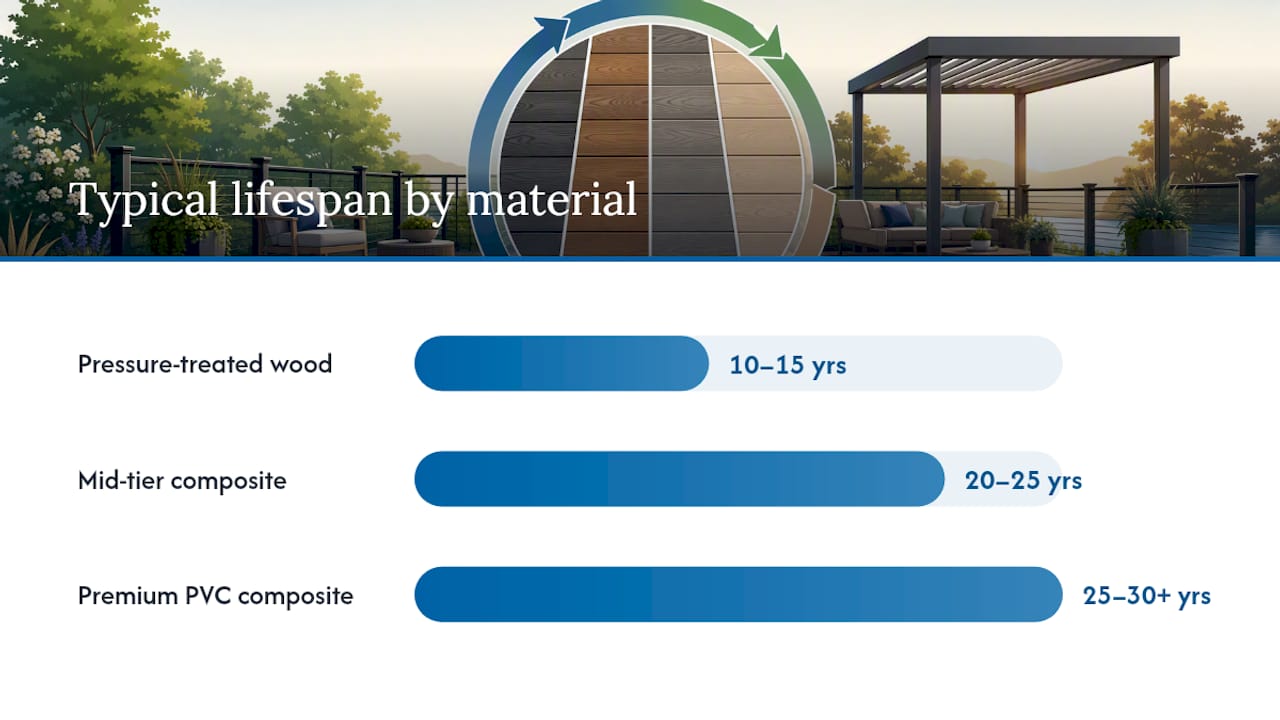
Premium PVC decking commonly carries a 25 to 30 year warranty and can last well beyond that with minimal upkeep. Mid-tier composite typically holds up for 20 to 25 years. Pressure-treated wood, by contrast, generally needs significant repair or replacement within 10 to 15 years even with regular care, and pressure-treated wood decks install for roughly $6,000 to $15,500 on a standard 320-square-foot footprint, notably less upfront than composite.
Maintenance is where the gap widens. Wood decks need annual staining or sealing, which runs a few hundred dollars a year in materials and labor if you hire it out, plus regular inspection for rot and splintering. Composite decking generally needs nothing more than periodic washing with soap and water.
- Pressure-treated wood: lower upfront cost, annual staining/sealing required, 10 to 15 year typical lifespan before major repair.
- Composite (all tiers): higher upfront cost, occasional cleaning only, 20 to 30+ year typical lifespan.
- Warranty exclusions to check: most composite warranties exclude damage from improper fastening, inadequate ventilation, or installation that ignores manufacturer expansion-gap specs.
Run the math over a 20-year window and a mid-tier composite deck frequently breaks even with wood once you account for repeated staining cycles and one likely mid-life wood deck rebuild. Premium PVC extends that advantage further since it essentially never needs refinishing.
What Do Contractors Actually Look for When Pricing a Deck?
Every accurate estimate starts on site, not on paper. When Divinelandscapingllc walks a property for a deck estimate, the inspection covers ground conditions, existing structure attachment points, drainage patterns, and access routes for equipment and material delivery. Each of these directly affects the final number, and skipping this step is the single biggest reason homeowners see quotes balloon mid-project.
Add-ons come up constantly during these visits. Integrated lighting, upgraded railing systems, and built-in features like bench seating or planters are common requests once homeowners see the space taking shape. Deck lighting alone can shift a budget by a meaningful percentage depending on fixture count and wiring complexity, and it’s far easier to price accurately upfront than to retrofit later.
The best defense against change orders is a thorough pre-bid inspection paired with clear allowances written into the contract for anything not yet finalized, whether that’s a specific railing style or a lighting package. Building in a contingency line from the start, rather than treating surprises as add-on charges after the fact, keeps the homeowner’s budget and the contractor’s scope aligned from day one. That’s the standard Divinelandscapingllc holds every deck and outdoor living project to across its New Hampshire and Massachusetts service area.
What Homeowners Get Wrong About Deck Pricing
The biggest mistake I see in how composite deck cost gets discussed online is treating the per-square-foot figure as the whole answer. It isn’t. A number without substructure condition, site access, and regional labor attached is a starting point at best, and often a misleading one.
Conventional advice tends to fixate on material brand comparisons, as if choosing between board lines is the decision that matters most. In practice, the substructure inspection and the honesty of the contractor’s bid usually swing your final cost more than whether you pick one premium PVC line over another.
If you take one thing from this guide, prioritize getting a real site walk before you commit to a budget number. A written quote with itemized allowances, built from an actual inspection, will tell you more about your true cost than any national pricing chart. Compare bids on their specifics, not their bottom line alone.
— Damian
Ready to Get a Real Number for Your Deck?
National pricing ranges give you a starting budget, but the only way to know what your composite deck actually costs is a site visit from a contractor who builds them regularly in your area. Divinelandscapingllc designs and builds custom decks and outdoor living spaces across New Hampshire and neighboring Massachusetts, alongside patios, retaining walls, and full backyard renovations, so your deck estimate accounts for the same site conditions, drainage, and access factors a crew will actually deal with on installation day.

When you request an estimate, expect a straightforward process: an on-site review of your yard, framing, and access, followed by a written quote with itemized material and labor allowances, and a realistic project timeline before any contract gets signed. Browse the project gallery to see completed deck and outdoor living work, then request your estimate to get a number built on your actual property, not a national average.
Sources
- Composite Deck Cost Calculator: $50–$110/sqft Installed | DeckMath
- How much does composite decking cost? | Angi
- Deck Cost (2026) — Build & Replace Ranges by Material | RemodelCalculators