
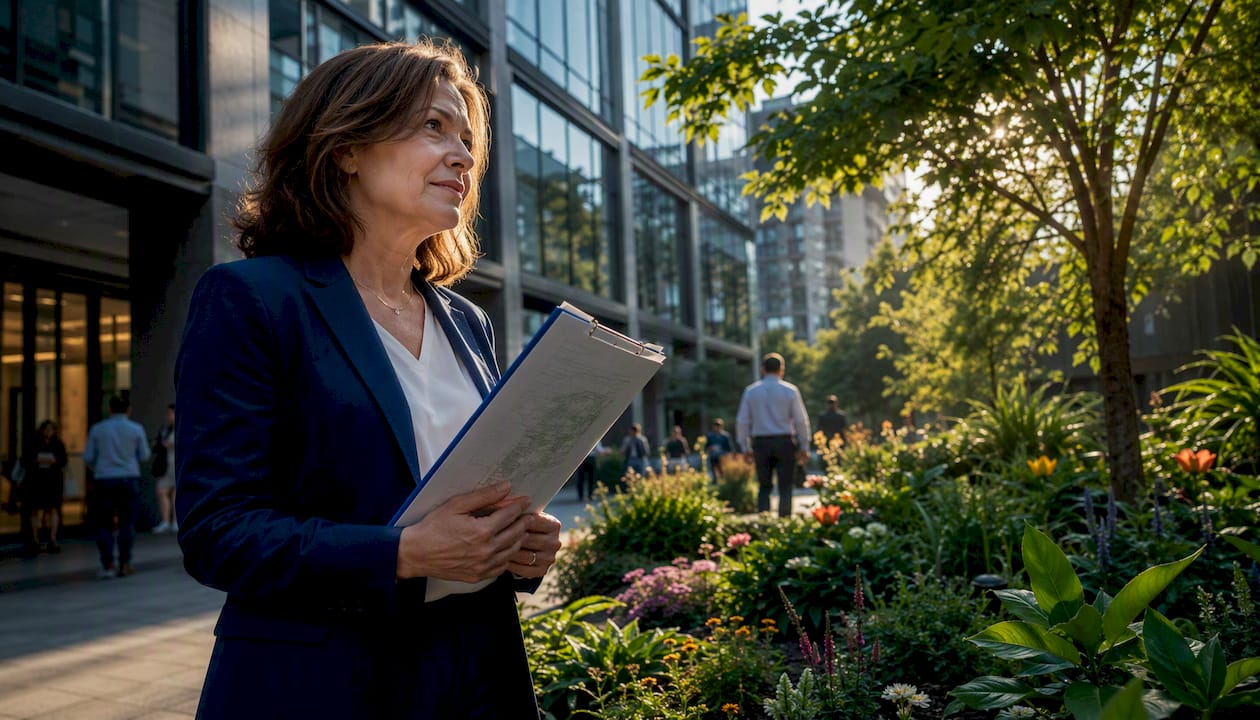
Yes, well-designed green space measurably raises commercial property value, improves tenant and employee outcomes, and reduces long-term operating costs. A New York City study using the Green View Index found offices with higher street-level greenness commanded an 8.9%–10.5% transaction premium and a 5.6%–7.8% rent premium over comparable buildings with minimal vegetation. The NRDC’s commercial green infrastructure brief documents additional owner-facing returns: higher rental rates, stormwater fee credits, and avoided roof-replacement costs over a 40-year analysis. LEED and WELL certifications, both of which reward green space integration, correlate with further occupancy and rent advantages in competitive markets.
Three reasons this matters to your bottom line right now:
- Asset value and rent: Street-level greenery and accessible outdoor amenities translate directly into higher transaction prices and lease rates.
- Tenant and employee outcomes: Green spaces reduce vacancy risk by improving workplace satisfaction, foot traffic, and retail sales.
- Operating savings: Green roofs, bioswales, and permeable paving lower energy loads, reduce stormwater fees, and extend roof lifespans.
Your practical next step: run a site feasibility checklist (structural capacity, drainage, frontage visibility) before selecting an intervention type. Divinelandscapingllc serves commercial owners across New Hampshire and parts of Massachusetts, and can help you scope that assessment.
Table of Contents
- ## 1. Green space benefits commercial properties across six measurable dimensions
- ## 2. The business case: how green investments translate into real asset value
- ## 3. Which green interventions work best for your property type?
- ## 4. Design, permitting, and stakeholder planning: a step-by-step checklist
- ## 5. What does a commercial green space project actually cost?
- ## 6. Research and case studies that quantify the impact
- ## 7. How to measure the impact of your green space investment
- Key Takeaways
- What owners often underestimate about commercial green space
- Divinelandscapingllc designs commercial green spaces built to perform
- Selected sources and further reading
## 1. Green space benefits commercial properties across six measurable dimensions
The advantages of green spaces in commercial settings go well beyond curb appeal. Each benefit category below has documented evidence behind it, which means you can build a financial model around more than one of them simultaneously.
Property value and rent premiums
The Green View Index research on New York commercial buildings documents transaction and rent premiums for offices with meaningfully higher street-level greenness. Those figures hold after controlling for building age, size, and location, so the greenery itself is doing the work.
Customer foot traffic and retail sales
A two-year longitudinal study in a London business district found that managers across retail and leisure sectors reported increased customer footfall and sales after mixed greening schemes were installed. A 2026 study across 1,090 commercial alleys in Seoul reinforced this: higher greenness was significantly associated with higher weekend sales, and the researchers identified spatial clusters where incremental greening yields the strongest sales-per-dollar return.
Employee wellbeing and productivity
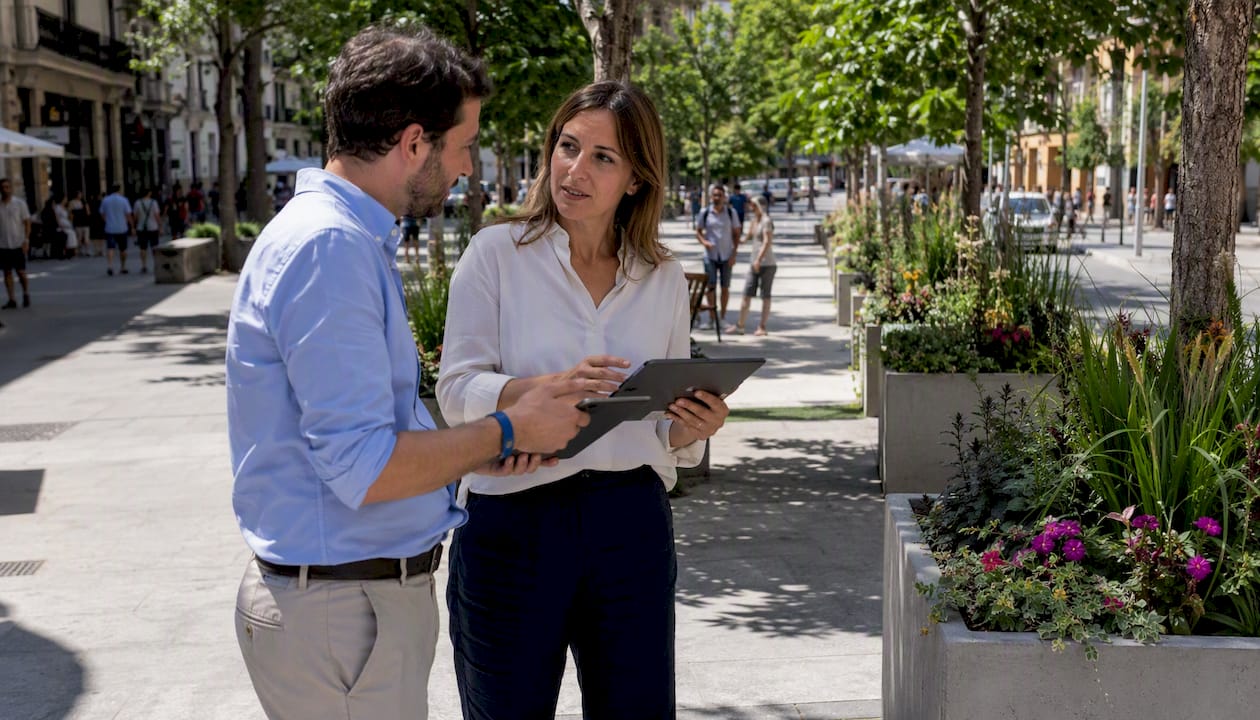
The same London study found improvements in self-reported workplace happiness and team interaction for staff with access to new green spaces. Accessible outdoor areas in office environments also align with LEED landscaping standards and WELL Building Standard criteria, both of which are increasingly used by tenants to screen properties during lease negotiations.
Energy and operational savings
Green roofs reduce surface temperatures and provide insulation, lowering year-round energy demand for heating and cooling. Shade trees and living walls on south- and west-facing facades compound that effect. For a mid-size commercial building, the reduction in HVAC load alone can offset a meaningful portion of annual maintenance costs.
Stormwater management
Green roofs and permeable paving reduce stormwater runoff volume and slow peak flows. Municipal programs in cities like Philadelphia and New York have tied stormwater fee credits directly to green infrastructure installations, sometimes amounting to tens of thousands of dollars in credits for medium-scale projects.
Safety, branding, and biodiversity
Street-level vegetation, when sited to preserve sight lines, correlates with lower rates of property crime, graffiti, and vandalism. Poorly placed dense shrubs can create concealment risks, so design matters. On the branding side, visible greenery signals environmental stewardship to tenants, customers, and investors, supporting sustainability certification narratives and ESG reporting.
Pro Tip: When evaluating which intervention to prioritize, map it against all six benefit categories above. An intervention that scores across three or more categories, such as a green roof combined with a rooftop terrace amenity, typically delivers a stronger blended ROI than a single-purpose planting bed.
## 2. The business case: how green investments translate into real asset value
The impact of greenery on businesses is clearest when you trace it through net operating income (NOI). Higher rents and lower vacancy directly increase NOI; lower energy and stormwater costs reduce operating expenses; and a longer roof lifespan defers capital expenditure. All three levers move asset value in the same direction.
Observed premiums and what drives them
The 5.6%–7.8% rent premium documented in the NYC Green View Index study reflects tenant willingness to pay for a better environment, not just aesthetics. Tenants in competitive office markets increasingly use outdoor amenity access and sustainability credentials as screening criteria. Retail tenants benefit from the foot-traffic effect documented in London and Seoul, which supports higher percentage-rent clauses in retail leases.
A simple NOI calculation
Suppose your office building currently achieves typical annual rent rates. A conservative rent uplift from a well-executed greening program adds appreciable additional gross revenue. At a 6.5% cap rate, that annual income increase translates to roughly $1.08 million in asset value. Set that against a $300,000–$500,000 green roof and terrace installation, and the payback window on value creation alone is under five years, before accounting for stormwater credits or energy savings.
Lifecycle accounting matters
The NRDC documents green roofs avoiding hundreds of thousands of dollars in roof-replacement NPV over a 40-year analysis, because the vegetative layer protects the membrane from UV degradation and thermal cycling. Treating green infrastructure as a long-term capital investment rather than a maintenance line item changes how it appears in your asset plan and how lenders and appraisers evaluate it.
Where to prioritize investment
The Seoul GIEI (Green Infrastructure Efficiency Index) research shows that incremental greening yields the highest returns in locations where current greenness is low but adjacent demand or foot traffic is strong. That finding applies directly to U.S. commercial corridors: a street-facing planting bed or entrance landscape on a high-traffic block with minimal existing vegetation will outperform the same investment on an already-green suburban campus.
Pro Tip: Capture tenant-side benefits in your lease structure. Include green amenity access as a named feature in lease marketing materials, and consider a modest amenity fee for rooftop terrace access. Both approaches let you monetize the investment directly rather than waiting for it to show up at lease renewal.
## 3. Which green interventions work best for your property type?
Matching the right intervention to your site constraints and goals is where most owners save or lose money. Here is a comparison of the six most common commercial green space types.
| Intervention | Thermal benefit | Foot traffic uplift | Stormwater benefit | Permits typically required | Maintenance intensity |
|---|---|---|---|---|---|
| Green roof (extensive) | High | Low | High | Yes (structural, building) | Low–Medium |
| Green roof (intensive/terrace) | High | High | Medium | Yes (structural, building) | Medium–High |
| Living wall (exterior) | Medium | Medium | Low | Sometimes | Medium–High |
| Pocket park / plaza | Low | High | Medium | Yes (site plan, zoning) | Medium |
| Bioswale / permeable paving | Low | Low | High | Yes (stormwater, civil) | Low |
| Interior landscaping | Low | Medium | None | Rarely | Medium |
| Planters and entrance beds | Low | Medium | Low | Rarely | Low–Medium |
Quick selection rules:
- Green roofs suit large, flat commercial rooftops with adequate structural load capacity; extensive systems (2–4 inches of growing media) are the lowest-cost entry point.
- Intensive green roofs and rooftop terraces are the right choice when you want to create a tenant amenity that commands a rent premium, not just an infrastructure benefit.
- Living walls deliver the highest economic return per square foot when street frontage and visibility are the primary goals, according to comparative research on vertical greening.
- Pocket parks and plazas work best for retail corridors and mixed-use properties where dwell time and foot traffic drive sales.
- Bioswales and permeable paving are the most efficient path to stormwater fee credits and are often the lowest-disruption retrofit for parking lots and service areas.
- Interior landscaping (interiorscaping) suits office lobbies and common areas where outdoor space is limited; it supports WELL certification points and improves perceived air quality.
For entrance landscaping on a commercial property, a combination of structured planters, defined walkways, and seasonal color beds often delivers the fastest visible ROI because it directly affects first impressions and leasing inquiries.
## 4. Design, permitting, and stakeholder planning: a step-by-step checklist
A green space project that skips pre-design due diligence almost always encounters cost overruns. Work through these steps before any design drawings are finalized.
- Conduct a site survey. Document existing drainage patterns, sun exposure, prevailing wind, utility locations, and ADA access routes. This data drives plant selection and irrigation design.
- Commission a structural engineer review for any rooftop installation. Extensive green roofs add roughly 15–25 pounds per square foot when saturated; intensive systems can exceed 80 pounds per square foot. Your building’s structural capacity determines which system is feasible.
- Identify stormwater requirements and incentives. Contact your municipality’s stormwater authority early. Many New Hampshire and Massachusetts municipalities offer fee credits or grants for green infrastructure. Philadelphia’s Green City, Clean Waters program and New York City’s green roof tax abatement are well-documented models; check your local equivalent.
- Pull the right permits. Rooftop work typically requires a building permit and structural sign-off. Pocket parks and plazas may require a site plan amendment or zoning variance. Bioswales often need civil engineering review and a stormwater management plan.
- Select plants for your climate and maintenance budget. Native New England species, such as little bluestem, native sedges, and low-growing junipers, typically outperform imported cultivars in durability and pest resistance. For rooftop systems, sedums are the standard low-maintenance choice.
- Design irrigation and drainage together. Drip irrigation with soil moisture sensors reduces water waste and prevents overwatering, which is the leading cause of plant loss in commercial installations. Drainage layers must be sized for your local 100-year storm event.
- Address safety in the planting plan. Properly sited vegetation improves natural surveillance and reduces crime risk; dense shrubs placed near building entries or parking structures can do the opposite. Keep sightlines clear at 2.5–8 feet above grade.
- Engage tenants and stakeholders before construction. A short survey asking tenants what outdoor amenities they value most takes two weeks and can redirect a $200,000 design toward features that actually drive lease renewals. Share the project timeline and construction staging plan so tenants can plan around disruption.
- Define maintenance responsibilities in the lease. Specify whether the owner or tenant is responsible for watering, pruning, and seasonal replanting in common-area green spaces. Ambiguity here is the single most common source of post-installation disputes.
- Select a contractor with documented commercial green-space experience. Ask for references on at least two comparable commercial projects, confirm licensing and insurance, and verify that the scope includes irrigation commissioning and a plant-establishment warranty.
Pro Tip: Bring your maintenance team or contracted grounds crew into the design review meeting before construction begins. They will flag irrigation head placements, access routes for equipment, and seasonal pruning requirements that a designer working from drawings alone will miss. Catching those gaps in design costs nothing; fixing them after installation can run into thousands of dollars.
For a full planning framework, Divinelandscapingllc’s guide on commercial landscape renovation projects covers scope definition, phasing, and contractor selection in detail.
## 5. What does a commercial green space project actually cost?
Budget ranges vary significantly by intervention type, site conditions, and whether the project is a retrofit or part of new construction. The table below gives realistic planning figures.
| Intervention | Typical installed cost (per sq ft) | Project timeline | Maintenance intensity |
|---|---|---|---|
| Extensive green roof | $10–$25 | 4–10 weeks | Low (1–2 visits/year) |
| Intensive green roof / terrace | $25+ | 8–20 weeks | Medium–High (monthly) |
| Living wall (exterior) | $75+ | 2–6 weeks | High (monthly irrigation checks, quarterly replanting) |
| Pocket park / plaza | $30–$80 (hardscape + planting) | 6 weeks | Medium (seasonal) |
| Bioswale / permeable paving | $15–$40 | 2–6 weeks | Low (annual inspection) |
| Interior landscaping | $20+ (installation) | 1–3 weeks | Medium (weekly watering, monthly care) |
Major cost drivers:
- Structural upgrades to support rooftop loads are often the largest single line item in a green roof retrofit and can equal or exceed the green roof system cost itself.
- Irrigation design and installation typically adds 15%–25% to planting costs but is the most important factor in long-term plant survival.
- Plant material quality and sourcing affect both upfront cost and replacement frequency; native species sourced from regional nurseries tend to establish faster and require fewer replacements.
- Hardscape integration (pavers, seating walls, pergolas, lighting) for pocket parks and terraces often doubles the base planting budget but is what converts a green space into a usable tenant amenity.
Maintenance contract clauses to include:
- Minimum irrigation system uptime SLA (e.g., 95% of growing season days with functional coverage)
- Plant replacement warranty covering the first 12 months post-installation
- Seasonal pruning schedule with defined visit frequency and scope
- Annual growing media inspection for green roofs, including drainage layer check
- Pest and disease monitoring protocol with defined response time
For seasonal tree maintenance on commercial properties, a structured annual schedule prevents the reactive, higher-cost interventions that result from deferred care.
## 6. Research and case studies that quantify the impact
The evidence base for commercial green space benefits has grown substantially over the past decade. Here are the strongest findings and what they mean for your property.
NYC Green View Index study
Researchers at MIT’s Real Estate Innovation Lab used street-level imagery and transaction data to isolate the effect of greenness on commercial building prices and rents in New York City. The result: an a notable transaction premium and rent premium for buildings with meaningfully higher street-level greenness. These are among the most rigorously controlled figures available for U.S. commercial real estate.
London business district longitudinal study
A two-year mixed-methods study tracked multiple greening schemes across a London business district. Retail and leisure managers reported increased customer footfall and sales. Office workers with access to new green spaces reported higher workplace happiness and better team interaction. The study is notable because it measured outcomes over time rather than relying on cross-sectional snapshots.
Seoul commercial alley study (2026)
Across 1,090 commercial alleys, researchers found that higher greenness was significantly associated with higher weekend sales. The study introduced the GIEI metric to identify priority locations where greening investment yields the highest sales efficiency, a tool directly applicable to U.S. retail corridor planning.
NRDC commercial green infrastructure brief
The NRDC’s issue brief documents lifecycle financial returns across multiple asset types, including green roofs adding to rental rates, stormwater fee credits from municipal programs, and avoided roof-replacement costs over 40-year analyses. It frames green infrastructure as a capital investment with a calculable NPV, not a discretionary amenity spend.
Case example: office building green roof retrofit
A mid-size office building that installs an extensive green roof gains insulation value (reducing HVAC costs), qualifies for stormwater fee credits, extends its roof membrane lifespan significantly, and can market the installation as part of a LEED or sustainability narrative to attract tenants. Each of those outcomes has a dollar value that can be modeled in a standard DCF analysis.
## 7. How to measure the impact of your green space investment
Tracking outcomes before and after installation is what separates a well-managed green space program from a sunk cost. These KPIs apply across asset types.
Priority KPIs by asset type:
- Office: rent per square foot, occupancy rate, tenant survey scores (workplace satisfaction, outdoor space usage), employee absenteeism proxy (if HR data is available), HVAC energy consumption (kWh/month)
- Retail: sales per linear foot of frontage, foot traffic counts (manual or sensor-based), dwell time, customer satisfaction scores
- Multifamily commercial: lease renewal rate, vacancy duration, amenity satisfaction scores, utility cost per unit
Measurement template:
- Baseline (pre-installation): Record all KPIs above for a minimum of 6 months before construction begins. Pull utility bills, lease roll data, and POS sales reports. Run a short tenant or employee survey.
- 6-month post-installation: Rerun the same survey. Pull utility and sales data for the same seasonal period as baseline to control for seasonality.
- 12-month post-installation: Full annual comparison. Calculate year-over-year changes in rent, occupancy, energy use, and stormwater fees. This is typically when rent premium effects begin to show in new lease negotiations.
- 36-month post-installation: Assess whether the investment has influenced lease renewal rates, attracted new tenants citing sustainability, or supported a LEED/WELL certification application.
Practical data sources: utility bills (energy and stormwater), lease roll exports from your property management system, POS sales reports from retail tenants, manual or automated foot traffic counters, and short annual tenant surveys (5–7 questions, distributed digitally).
A/B comparison in multi-building portfolios: If you own multiple comparable properties, treat one as the control and one as the pilot. Hold all other variables constant (location tier, building age, lease structure) and compare KPI trajectories over 12–24 months. This approach gives you defensible internal evidence for rolling out the program portfolio-wide.
For employee outdoor space design, connecting your KPI framework to HR metrics like absenteeism and engagement scores strengthens the business case when presenting to ownership or a board.
Key Takeaways
Green space benefits commercial properties through rent premiums, lower operating costs, and higher tenant satisfaction, all of which are measurable with the right KPI framework in place.
| Point | Details |
|---|---|
| Rent and value premiums are documented | NYC research shows an 8.9%–10.5% transaction premium and 5.6%–7.8% rent premium for greener commercial buildings. |
| Multiple ROI levers compound returns | Green roofs deliver insulation savings, stormwater credits, extended roof lifespan, and rent uplift simultaneously. |
| Prioritize by efficiency, not coverage | Seoul’s GIEI research shows highest returns where current greenness is low but demand is strong — target those locations first. |
| Measure before and after | Establish baseline KPIs (rent/sq ft, energy kWh, tenant survey scores) at least 6 months before installation to quantify real impact. |
| Divinelandscapingllc for NH/MA projects | Divinelandscapingllc designs and installs commercial green spaces across New Hampshire and parts of Massachusetts, from green roof prep to full hardscape integration. |
What owners often underestimate about commercial green space
Most owners who call us about a commercial greening project are thinking about one benefit: curb appeal. That framing undersells the investment and often leads to undersized scopes that deliver only partial returns.
The owners who get the most out of these projects are the ones who treat green infrastructure as a capital asset from day one. They run a lifecycle cost model, they identify which stormwater credits their municipality offers, and they build the amenity narrative into their leasing materials before the project is even complete. The rent premium does not appear automatically at lease renewal; it appears because the leasing team is actively marketing the outdoor space as a differentiator.
There is also a design discipline that most people skip: safety-aware planting. Dense foundation shrubs planted for aesthetics without regard for sight lines can increase crime risk rather than reduce it. The research on this is clear, and it is one of the first things we review in a commercial site assessment. A well-placed 30-inch ornamental grass does more for natural surveillance than a 6-foot arborvitae hedge that blocks the parking lot from view.
The other underestimated factor is maintenance handover. A beautiful installation that receives no irrigation system commissioning or plant-establishment care in the first 12 months will lose 20%–40% of its plant material. That replacement cost erodes your ROI and damages the tenant experience you were trying to create. Build a 12-month maintenance contract into the original project scope, not as an afterthought.
For New Hampshire and Massachusetts commercial owners, the local climate adds one more variable: freeze-thaw cycles are hard on irrigation systems and growing media. Specifying the right drainage layer depth and winterizing the irrigation system properly are not optional steps here.
Divinelandscapingllc designs commercial green spaces built to perform
Commercial property owners in New Hampshire and Massachusetts have a local design-build partner who understands both the business case and the site conditions. Divinelandscapingllc delivers full-scope commercial green space projects: landscape design, hardscape integration (pavers, seating walls, retaining walls, pergolas), irrigation system design and installation, lighting, and ongoing maintenance planning.
The difference between a green space that pays back and one that sits underused is almost always in the design and execution phase. Divinelandscapingllc’s commercial work covers the full scope, from initial site feasibility and structural coordination through plant selection, irrigation commissioning, and maintenance handover. For multi-tenant commercial properties, that means coordinating around tenant schedules, phasing construction to minimize disruption, and delivering a finished space that your leasing team can market immediately.
Service area: New Hampshire and neighboring Massachusetts. To request a commercial site assessment or get a project estimate, contact Divinelandscapingllc at divinelandscapingllc.com.
Selected sources and further reading
The studies and briefs below are the strongest sources cited in this article. Each link goes directly to the original publication.
- The financial impact of street-level greenery on New York commercial buildings — Documents the 8.9%–10.5% transaction premium and 5.6%–7.8% rent premium using the Green View Index on NYC office buildings.
- The Green Edge: How Commercial Property Investment in Green Infrastructure Creates Value (NRDC) — The most comprehensive U.S. owner-facing brief on green infrastructure financial returns, covering rent uplift, stormwater credits, and lifecycle cost avoidance.
- Do Greener Environments Support Better Business? An Empirical Study in Seoul’s Commercial Alleys — 2026 study across 1,090 alleys linking greenness to weekend sales and introducing the GIEI prioritization metric.
- Exploring the co-benefits of urban green infrastructure improvements for businesses and workers’ wellbeing — Two-year London business district study documenting footfall, sales, and workplace happiness outcomes from mixed greening schemes.
- City life: Why are green spaces important? (Natural History Museum) — Accessible overview of urban heat island reduction and energy benefits from rooftop vegetation.
- Value of urban green spaces in promoting healthy living and wellbeing (PMC/NIH) — Peer-reviewed summary of environmental, health, and social benefits of urban green space, useful for WELL and public health framing.
- Urban green space interventions and health: A review of impacts and effectiveness (WHO Europe) — WHO evidence review on maximizing health and environmental benefits from urban green space interventions.