
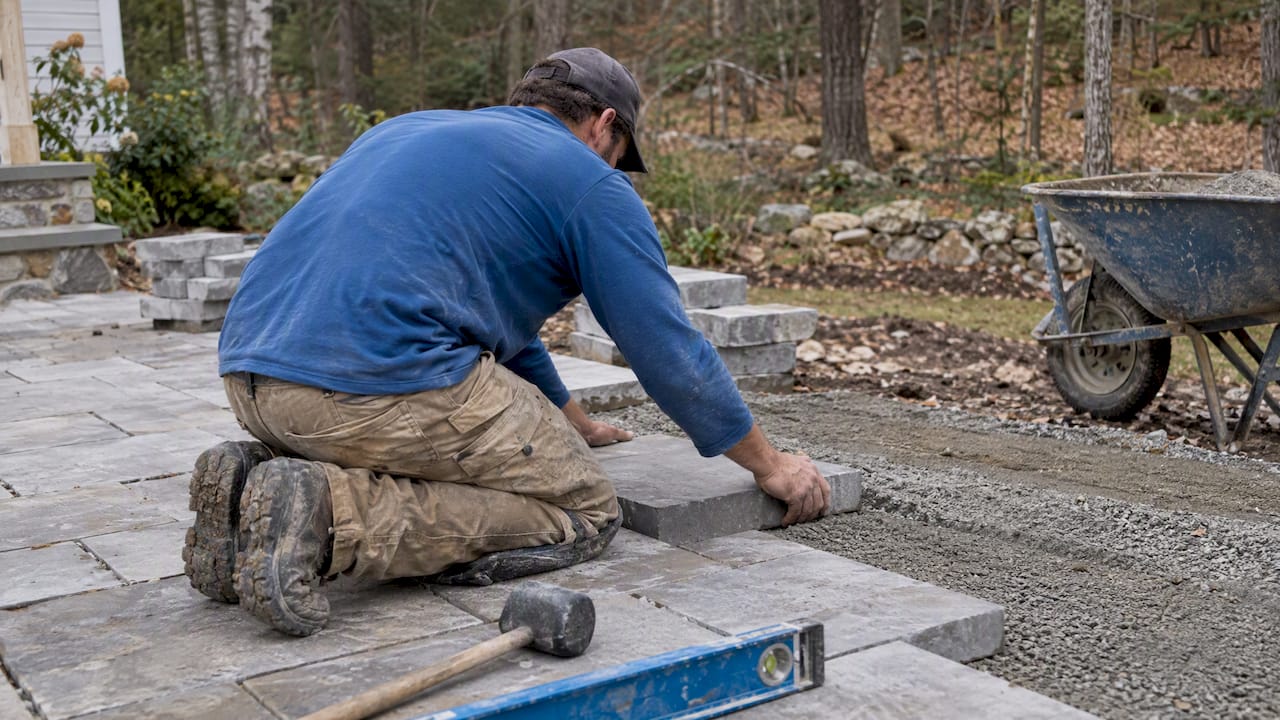
New Hampshire hardscaping costs vary widely, from simple walkways to large patios with walls or built-ins. Where yours falls depends on its size, the material you choose, and how much site preparation your yard needs. The sections below translate that into project-specific ranges.
TL;DR:
- Complex stone patios and high end projects can cost roughly $10,000 to $35,000, while built in kitchens and utility lines expand scope.
- Manchester and Nashua’s mean hourly wage reached $35.00 in May 2025, above the national $33.54 mean, contributing to higher local installation costs.
- Gravel and basic concrete pavers cost less upfront, but gravel needs regular topping and edging; natural stone costs more and can last when properly installed.
- Require written bids that specify base depth, drainage, timeline, payment schedule, and warranty, and document how unexpected rock or soil conditions trigger change orders.
Table of Contents
- What do common hardscape projects cost in New Hampshire?
- What drives the price: size, materials, site prep, and labor?
- Which materials cost more, and which last longer?
- What hidden costs do homeowners often miss?
- How do I get an accurate estimate?
- Why hire a local, experienced contractor in New Hampshire?
- What do most homeowners get wrong about budgeting?
- Get an itemized hardscape quote from our team
- FAQ
- Sources
What do common hardscape projects cost in New Hampshire?
Rather than quote one price for everything, it helps to think in project types. Here is how we frame a first budget for homeowners across the state:
- Paver patios: Size drives the bill more than anything else. Smaller patios sit at the low end, medium-sized patios in the middle, and larger patios at the top, because material and labor scale with every added square foot. Industry patio guidance uses the same size buckets for budgeting.
- Walkways: A simple path costs far less than a patio because the footprint is narrow. Width and curves matter more than length alone, since cuts and edging add labor.
- Retaining walls: A short, low wall is a modest job. A tall wall needs engineering, drainage behind it, and deeper footings, so the price climbs quickly. Our guide on retaining wall costs in NH walks through both cases.
- Firepits and outdoor kitchens: A basic firepit is a small add-on. Built-in grills, counters, and gas or electric lines turn a patio into a larger project with several trades involved.
- Complex stone work: A regional report notes that complex stone patios and high-end projects can run roughly $10,000 to $35,000.
Common add-ons such as lighting, seating walls, steps, and drainage upgrades can each raise the cost on their own. For patio-specific numbers, see our breakdown of what a new paver patio costs in NH.
What drives the price: size, materials, site prep, and labor?
Two quotes for the “same” patio can differ by thousands of dollars. The difference almost always sits in these line items:
- Square footage: Every added square foot needs more stone, more base material, and more hours on site.
- Material: Concrete pavers, natural stone, and poured concrete carry very different price tags per square foot.
- Excavation: Digging out the old surface, hauling soil, and removing rock or roots can add a lot, especially on lots with ledge or tight access.
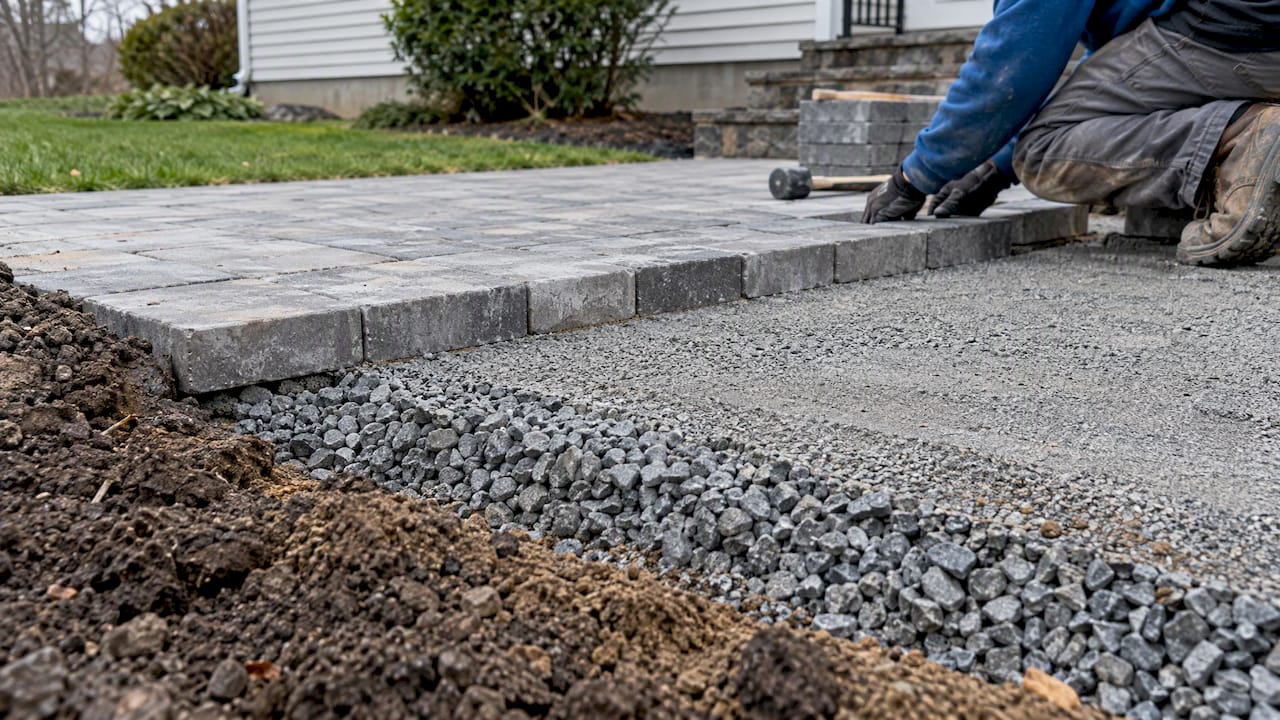
- Base and subbase: A deep, well-compacted gravel base keeps a patio flat through freeze and thaw. Skipping depth may save money initially but can lead to higher costs later.
- Drainage and grading: Water must move away from your home. Regrading or adding drain lines changes both scope and price.
- Permits: Some walls and larger structures need local approval, which affects cost and timing.
Labor is a real share of the total. The Manchester–Nashua area had a mean hourly wage of $35.00 in May 2025, above the U.S. mean of $33.54, which is one reason local installation costs run higher than national averages.
Drainage also pays off over time. The UNH Stormwater Center has published comparisons of maintenance cost, labor demands, and performance showing that low-impact drainage designs can be more cost-effective over the long run than conventional ones.
Which materials cost more, and which last longer?
Think of materials in tiers, from entry level to premium:
- Entry level: Gravel and basic concrete pavers keep upfront cost down. Gravel needs regular topping up and edging, while basic pavers need a solid base to stay level.
- Mid-range: Quality concrete pavers from manufacturers such as Techo-Bloc offer many colors and textures, and individual pavers can be replaced if one cracks or stains.
- Premium: Natural stone and bluestone cost the most per square foot, but they can hold their look for a long time when installed correctly.
Freeze-thaw cycles are the main durability test in New Hampshire. Water seeps into joints, freezes, and shifts anything sitting on a weak base. That is why the base matters as much as the surface you see. Poured concrete is often cheaper to install but can crack and is harder to repair neatly.
For a deeper comparison, read our guide to the best patio materials for NH.
Pro Tip: Compare materials by lifetime cost, not sticker price. A mid-range paver on a deep base can be a better choice than a cheaper surface that needs repairs.
What hidden costs do homeowners often miss?
Material prices are easy to compare. These items are not, and they are where final bids tend to shift:
- Excavation surprises: Boulders, thick roots, or ledge can slow digging and raise labor hours. Blasting is rare, but it changes the budget sharply when it happens.
- Drainage fixes: Poor grading can send water toward your foundation. Correcting it may call for drain lines or an engineered solution, and a drainage guide from a paving specialist explains the common options.
- Permits and approvals: Walls and larger structures may need sign-off before work starts, which can add weeks.
- Short season: Outdoor construction in New Hampshire is compressed by cold weather, so spring and summer slots book early and scheduling can affect price.
How do I get an accurate estimate?
A good quote removes guesswork. Use this checklist when comparing bids:
- Insist on a written scope that names the material, the base depth, the drainage plan, the timeline, the payment schedule, and the warranty.
- Ask about logistics during the site visit: equipment access, staging area, debris disposal, subcontractors, and references from similar jobs.
- Ask how change orders work. Unexpected rock or soil conditions can change the price, so the process should be in writing before work begins.
- Be wary of the lowest bid. A price far below the others often means a thinner base or missing drainage. A contractor checklist for paver patios covers similar questions.
- Use our patio installation tips to prepare before the first visit.
Why hire a local, experienced contractor in New Hampshire?
Local knowledge shows up years after the job is done. Frost depth, soil type, and how materials hold up through New England winters all shape the right way to build.
- Design to installation: We handle patios, masonry, retaining walls, irrigation, and lighting, so these systems are planned together instead of fighting each other.
- Complex jobs: Retaining walls, tricky grading, and integrated drainage are where professional installation earns its cost.
- Local context: Our team works with New Hampshire soil and weather.
What do most homeowners get wrong about budgeting?
The most common surprise is underbudgeting what you will never see. People fall in love with finishes early, then discover that the base, drainage, and grading ate the budget. Lock the structural number first, then choose colors and textures with what remains. A patio that drains and stays level will look better in ten years than a fancy one that heaves. If you are ready for a real number, the next section shows how to get one.
— Damian
Get an itemized hardscape quote from our team
Ready to turn these ranges into a real price? We design and build hardscapes across New Hampshire, from patios to walls and walkways. After a site visit, we discuss your project and its potential scope. Request your quote or see our patio installation services.
FAQ
How much does a 20×20 paver driveway cost?
The cost of a paver driveway depends on its size, the paver type, excavation, and drainage. Driveways may need a deeper, stronger base than patios, so a site visit is the best way to get an accurate estimate.
What is the cheapest hardscape option?
Gravel and basic concrete pavers are usually the lowest-cost surfaces. Gravel needs regular upkeep, so compare lifetime cost before choosing, especially with New Hampshire’s freeze-thaw cycles.
How much value does hardscaping add to a house?
Well-built patios, walkways, and walls improve curb appeal and expand usable living space, which many buyers value. The return depends on quality and drainage, so we cannot promise a specific figure for your property.
Does hardscaping cost more in New Hampshire than elsewhere?
Labor is part of the reason. Manchester–Nashua wages were above the U.S. mean in May 2025, and a short building season adds scheduling pressure.
Sources
- Occupational Employment and Wages in Manchester-Nashua — May 2025 : Northeast Information Office : U.S. Bureau of Labor Statistics
- Publications | UNH Stormwater Center
- Here’s how much it costs to install a deck or patio for the …
- Landscapingnetwork