
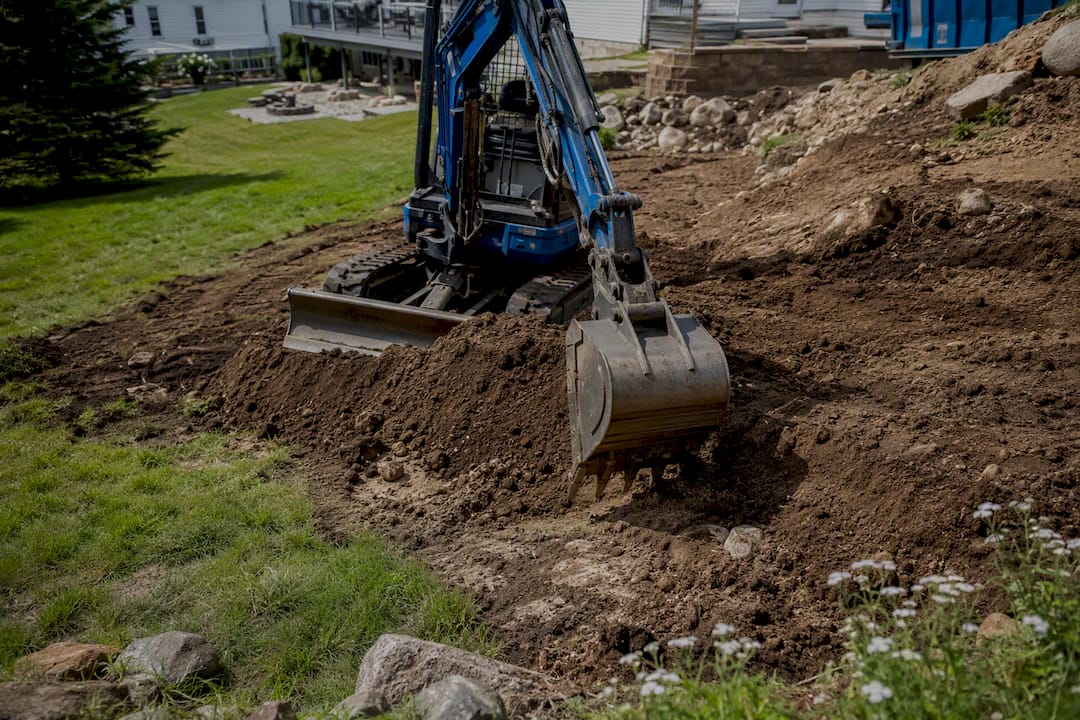
Land grading costs typically run $0.08 to $2.00 per square foot, or roughly $15,800 to $44,535 per acre, with most residential jobs between 1,000 and 2,000 square feet landing somewhere between $770 and $3,000. Your next move is simple: get three itemized local quotes and ask each contractor whether your project needs a permit before work starts.
TL;DR:
- Land grading costs range from $0.08 to $2.00 per square foot, or $15,800 to $44,535 per acre, depending on the scope and terrain complexity.
- Site-specific factors like slope, soil type, access, and clearing needs can cause quotes to vary by thousands of dollars even for the same area.
- Permits, surveys, utility locates, and environmental regulations can add several hundred dollars or more to the initial estimate.
- Fall is generally the best season for more competitive pricing due to lower demand and more favorable soil conditions in many regions.
- Properly itemized bids, site visits, and contingency planning for soil types and possible obstacles are essential for accurate budgeting.
Table of Contents
- What Does Land Grading Cost Per Square Foot and Per Acre?
- Key Factors That Affect Land Grading Cost
- How Much Does It Cost by Project Type?
- What Extras Should You Budget Into a Grading Estimate?
- Should You DIY Grading or Hire a Professional?
- How Do You Get an Accurate Land Grading Quote?
- How Can You Lower Land Grading Costs Without Cutting Corners?
- What Maintenance Costs Come After the Initial Grading Job?
- How Do Environmental Regulations Affect Grading Costs?
- Does the Season You Grade in Affect the Price?
- How Divine Landscaping LLC Approaches Grading Estimates
- Ready to Get a Grading Estimate for Your Property?
- Sources
What Does Land Grading Cost Per Square Foot and Per Acre?
Grading contractors price jobs two ways: by area for straightforward leveling, and by the hour when the terrain gets unpredictable. Fine grading, the light touch-up work that smooths a yard for sod or seeding, sits at the low end of the range. Rough grading, which involves moving significant volumes of soil to reshape a slope or prep a building pad, costs more because it eats more machine time and often needs more skilled operators.
On a per-square-foot basis, expect $0.08 to $2.00, with most homeowners paying somewhere in the middle unless their site has serious slope or access problems. Scale that up and grading a full acre commonly runs $15,800 to $44,535, depending on how much cutting and filling the job requires. Smaller residential projects, the kind most homeowners are actually pricing, tend to fall in a narrower band.
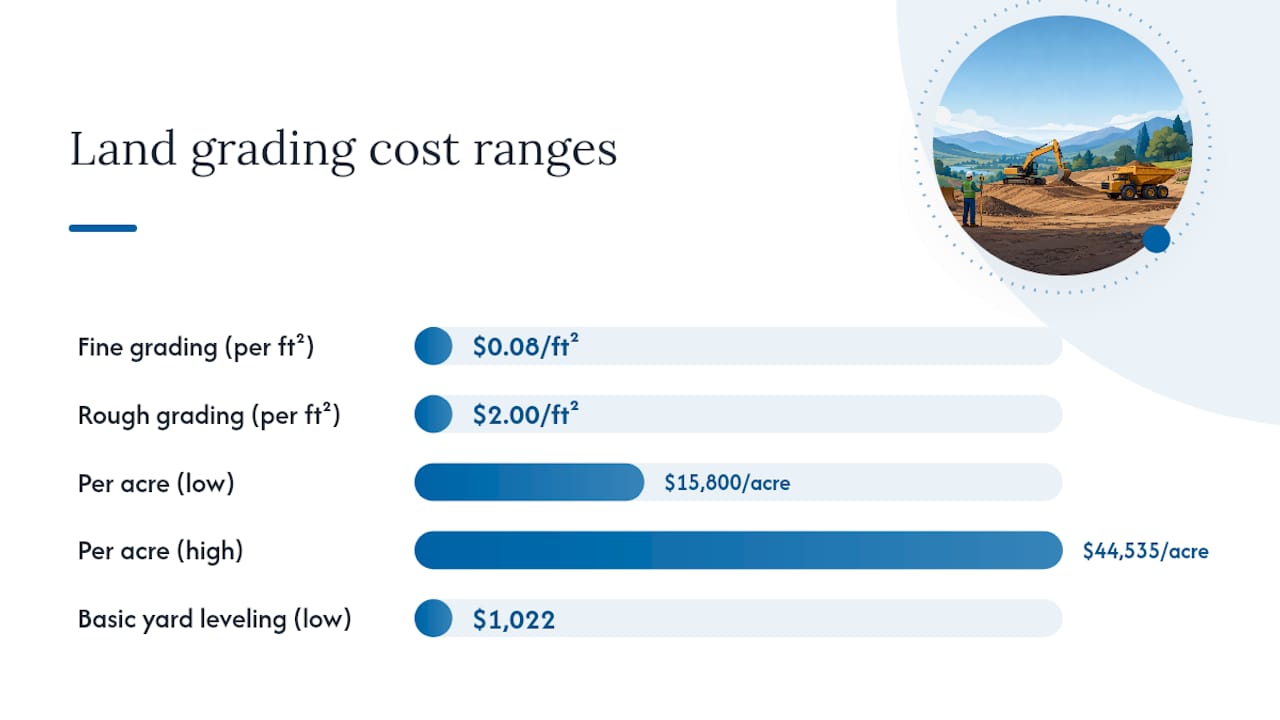
For comparison, basic yard leveling averages $1,022 to $3,334, with many jobs priced around $1 to $2 per square foot. If the lot needs clearing first, tack on another $1,300 to $5,700.
Here’s how those ranges translate into real project sizes:
Hourly pricing often applies to smaller or more complex sections, whereas area-based pricing is common for larger, straightforward jobs. If your quote mixes both models on the same invoice, ask why. That’s often a sign the site has one tricky section and one easy one, which is normal, but it should be explained line by line.
Key Factors That Affect Land Grading Cost
Two quotes for the same square footage can differ by thousands of dollars, and it almost always comes down to what’s under and around the dirt, not the dirt itself.
- Size and slope: A steep elevation change means more cut-and-fill work and more machine hours than a flat lot of the same size.
- Soil composition: Rocky, clay-heavy, or debris-filled soil slows equipment down and can require specialized attachments.
- Site access: Tight driveways, fences, or neighboring structures that block large equipment often mean smaller machines, more passes, and higher labor costs.
- Tree and stump removal: Clearing vegetation before grading starts adds a distinct cost most homeowners forget to ask about upfront.
- Material needs: Fill dirt runs $5 to $30 per cubic yard and topsoil $12 to $55 per cubic yard, and a job that needs a lot of imported fill will cost more than one that reuses on-site soil.
- Labor and equipment: Crews typically bill $35 to $100 per hour, with specialized machinery like laser-guided graders commanding a premium.
- Permits and surveys: Municipal permit fees, boundary surveys, and utility locates all show up as separate line items on a proper estimate.
Regional labor markets swing rates by 20 to 40 percent, which is why a quote in coastal New Hampshire won’t match one from rural Ohio. Seasonal demand moves the number too. A contractor booked solid in late spring has less incentive to shave a bid than one filling a slow winter calendar.
How Much Does It Cost by Project Type?
Not every grading job is built the same way, and the price band shifts a lot depending on what you’re actually trying to accomplish.
- Regrading around a foundation: This tends to run higher per square foot than open-yard work because crews must hand-dig near the structure, protect siding, and maintain roughly 4 inches of exposed foundation wall above the finished grade. Expect a premium over standard yard leveling for the same footprint.
- Lawn and yard leveling: A typical 1,000 to 2,000 square foot yard falls in the $770 to $3,000 range for straightforward regrading ahead of new sod or a seeding project.
- Driveway base prep or regrade: Driveway work often blends grading with base compaction, and pricing scales with length and the depth of base material needed for the intended surface, gravel, asphalt, or pavers.
- Pool pads and structure pads: These are small, targeted jobs, usually a few hundred to a couple thousand dollars, because the footprint is tight even though the compaction standards are strict.
- Large acreage and hillside flattening: Once you’re grading a full acre or reshaping a hillside, per-acre pricing takes over, and costs can approach the $44,535 high end when the slope is severe enough to require significant engineered fill.
If your project touches more than one of these categories, say you’re leveling a yard and prepping a patio base, ask your contractor to itemize each scope separately. Bundled estimates that lump everything into one number make it nearly impossible to tell if you’re overpaying for any single piece.
What Extras Should You Budget Into a Grading Estimate?
Permits, surveys, and site prep rarely show up in the headline number a contractor quotes over the phone, and they can add real money once the paperwork starts.
- Permits: Many municipalities require a permit for significant regrading, especially near property lines or drainage easements, typically running $100 to $500.
- Surveys and soil testing: A boundary or topographic survey costs money upfront but can prevent a costly mid-project surprise, like discovering you’re grading onto a neighbor’s lot.
- Utility locates: Calling 811 before any excavation is standard practice and usually free, but skipping it risks striking a buried line, which turns a budget job into an expensive one fast.
- Site prep overlap: Clearing, excavation, and grading together average about $3,800, with most jobs landing between $1,300 and $5,600.
Timeline follows a predictable arc: site prep and clearing first, then the actual grading and cut-and-fill work, then compaction in stages, then final dressing. Most residential jobs finish in hours to a few days; larger lots or anything requiring permits, imported fill, or demolition can stretch to weeks. Rain delays compaction more than almost anything else, since wet soil won’t pack properly.
Should You DIY Grading or Hire a Professional?
Some grading tasks are genuinely within reach for a capable homeowner with a rented compactor and a weekend. Minor surface leveling under 4 inches, filling small low spots in a lawn, or prepping the base for a small paver patio are reasonable DIY territory.
Professional grading becomes necessary once you’re dealing with steep slopes, foundation drainage, or any significant cut-and-fill that changes how water moves across your property. This isn’t a place to guess. Industry guidance calls for roughly a 5% slope, about 6 inches of drop over the first 10 feet, away from a foundation, and getting that wrong invites water into a basement instead of away from it.
- Compaction failure: Skipping proper lifts (compacting in 3-inch layers rather than dumping and grading all at once) leads to settling months later.
- Buried utilities: DIY excavation without a locate service risks striking gas, water, or electrical lines.
- Code noncompliance: Grading that violates local drainage ordinances can trigger fines or force a costly redo.
Our guide on landscape grading basics walks through how professionals think about slope and drainage before touching a shovel, which is worth a read even if you plan to DIY part of the job.
How Do You Get an Accurate Land Grading Quote?
A vague estimate is how homeowners end up with surprise charges halfway through a project. Use this checklist when comparing bids:
- Request an itemized scope with unit rates for clearing, haul-away, fill, topsoil, compaction, drainage work, and disposal.
- Ask for the equipment list and estimated machine hours, plus crew size and projected start and end dates.
- Confirm who handles permits, and whether that cost is included or billed separately.
- Verify insurance and request references from at least two recent similar jobs.
- Get the payment schedule in writing before any equipment shows up on-site.
When a contractor visits, walk the property together and point out drainage patterns you’ve noticed after heavy rain. That detail often changes the recommended grade more than the square footage does.
Pro Tip: Ask every bidder the same specific question, “What happens if you hit rock or heavy clay two feet down?” A vague answer or a shrug is a red flag. A contractor with real experience will already have a contingency rate built into the quote.
How Can You Lower Land Grading Costs Without Cutting Corners?
The cheapest grading job is one where the contractor only has to show up once. Bundle related tasks, grading plus drainage plus patio prep, into a single scope so mobilization costs get spread across more work instead of charged separately each time.
- Reuse on-site cut material for structural fill instead of buying new fill dirt, and save purchased topsoil for the final 2 to 4 inch dressing layer.
- Schedule outside peak spring and early summer demand, when crews have more flexibility on price.
- Collect at least three quotes so you have a real basis for comparison, not just one number to react to.
Pro Tip: Never let a bidder talk you out of compaction lifts or drainage slope to save money upfront. A cheaper grade that settles wrong or pools water at the foundation costs far more to fix later than it saved on day one.
What Maintenance Costs Come After the Initial Grading Job?
Grading isn’t a one-time expense that disappears the day the crew leaves. Settling is normal in the first year or two, especially over any area where fill was added, and small low spots often reappear as soil compacts naturally under gravity and rainfall.
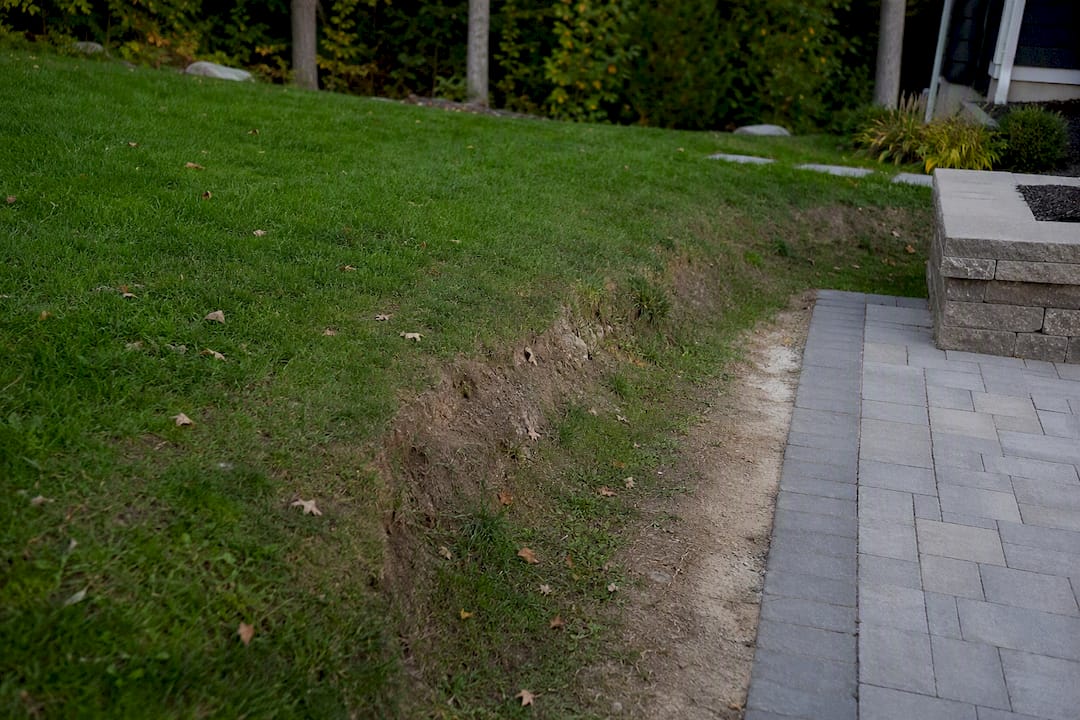
Homeowners should budget for periodic touch-up grading, particularly around downspouts, patios, and anywhere water tends to collect after storms. If you added fill near your foundation, keep an eye on window wells too. Raising the surrounding grade without extending the well can eliminate the 2 to 3 inch clearance needed to keep basement windows dry, a detail a lot of DIY regrades miss entirely.
Erosion along slopes and swales is the other recurring cost. A slope that was properly graded and seeded can still wash out if drainage patterns shift after a few seasons of heavy rain, which sometimes means adding a French drain or a small retaining wall years after the original job. Our breakdown of why retaining walls fail covers the drainage mistakes that turn a stable slope into a repeat expense. Budgeting a small annual allowance for grading touch-ups, even just $100 to $300, tends to be cheaper than waiting for a bigger problem to force a full regrade.
How Do Environmental Regulations Affect Grading Costs?
Local and state environmental rules can add real cost to a grading project, especially on lots near wetlands, floodplains, or steep slopes subject to erosion control ordinances. Many municipalities require a stormwater management plan or erosion control measures, silt fencing, temporary seeding, or sediment barriers, before a permit gets issued, and those materials and labor show up as their own line item.
Wetland setbacks are one of the most common surprises. If any portion of your property falls within a protected buffer, you may need a wetlands delineation survey before a contractor can even submit a grading plan, and that review alone can take weeks and add several hundred dollars to your upfront costs.
Compliance costs vary sharply by jurisdiction, so a job that’s simple in one town can require an engineered drainage plan in the next town over. This is precisely where the permitting process becomes more involved than most homeowners expect. Reviewing a general primer on commercial permitting workflows gives a useful sense of how review timelines and plan submissions typically unfold, even for residential-scale work.
The upside: contractors who handle permitting regularly usually know which local requirements apply before they ever break ground, which is exactly the kind of detail a good estimate should flag early rather than discovering after work has started.
Does the Season You Grade in Affect the Price?
Timing your grading project changes both cost and outcome. Spring and early summer are peak demand months in most of the U.S., which means contractors have less incentive to negotiate and scheduling windows fill up fast.
Frozen or waterlogged ground creates real problems too. Winter grading in cold climates like New Hampshire often isn’t possible once the ground freezes, and contractors who can work through it typically charge more for the added difficulty of moving frozen soil. Spring thaw brings the opposite problem: saturated ground that won’t compact properly, which can force a delay or require additional drying time before work proceeds.
Fall tends to be the sweet spot in much of the country, cooler temperatures, drier soil, and a calendar that’s typically less booked than spring. Scheduling a grading job for September or October, when feasible, can mean a more competitive quote and a crew that isn’t rushing between five other jobs. Heavy rain at any time of year can also stall a project mid-stream, since wet soil compacts poorly and erosion control measures need dry conditions to hold.
How Divine Landscaping LLC Approaches Grading Estimates
We start every grading project with an on-site visit, not a phone quote. Walking the property lets us see the slope, soil, and drainage patterns a satellite photo can’t show, and it’s the only reliable way to give you a number you can actually trust.
From there, you get an itemized estimate covering labor, materials, equipment hours, and any permit work we’ll handle on your behalf. We’re upfront about what’s included and what isn’t, and we stand behind the cleanup and final grade once the job wraps. If you’re weighing a grading project alongside a patio, retaining wall, or drainage fix, our guide to grading safely around a home foundation is a solid starting point before you call anyone for a quote. When you’re ready, have your rough square footage and any known drainage issues on hand. It speeds up the visit considerably.
— Damian
Ready to Get a Grading Estimate for Your Property?
If your yard slopes the wrong way toward your foundation, your driveway floods after every storm, or you’re prepping ground for a new patio, Divine Landscaping LLC handles the grading and the hardscape work that comes after it, so you’re not coordinating two separate contractors and hoping their timelines line up.
We serve homeowners and property managers across New Hampshire and neighboring Massachusetts, and every estimate starts with a real site visit rather than a guess based on square footage alone. You’ll get an itemized quote covering grading, compaction, drainage, and any hardscape prep your project needs, plus guidance on permits if your town requires one. If a patio, walkway, or retaining wall is part of the plan, our hardscape services page covers how we build the subgrade correctly the first time. Request your on-site estimate today and get a written scope you can actually compare against other bids.
Sources
- How Much Does It Cost to Level a Yard? 2026 Data | Angi
- How Much Does Land Grading Cost in 2026? | LawnLove
- International Residential Code (IRC) foundation guidance | ICC
- Land Grading Cost in the U.S.: Pricing, Factors, and Budget Ranges 2026 | Current Cost