
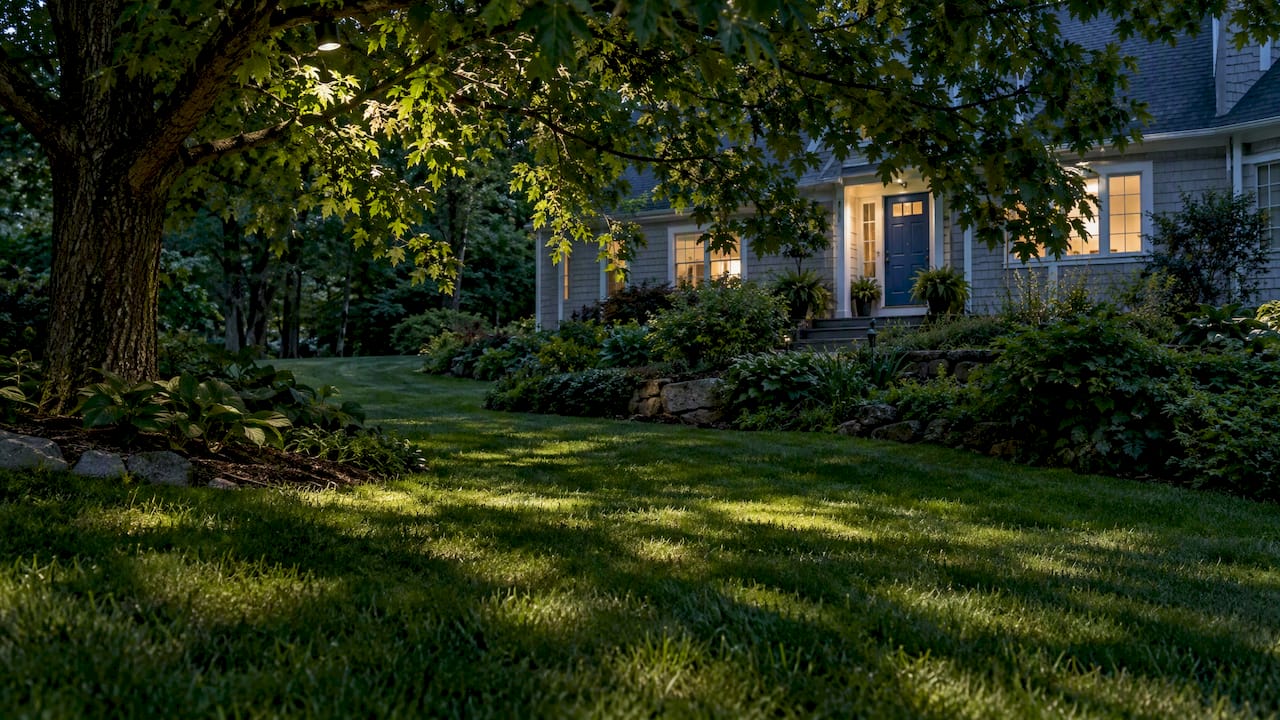
Moonlighting is a landscape lighting technique that mounts soft downlights high in a tree, or on a structure beside it, and aims them down through the branches. The leaves cast moving shadows across your lawn, patio or walkway, much like a bright night under a full moon. Done well, it makes a yard feel larger, safer and calmer after dark. Done poorly, it looks like a floodlight on a pole. This guide covers how the effect works, how to plan it, and what to settle before anyone climbs a tree.
TL;DR
- Moonlighting means downlights placed high in a mature tree (or on a pergola, eave or pole) and aimed through foliage to create natural dappled shadows.
- Start with a wide beam, a shielded fixture, and a soft white color temperature, then test at night before anything is fastened permanently.
- Keep light on your own property: fully shielded, downward-aimed fixtures reduce glare and neighbor complaints, and some New Hampshire towns require them.
- Installing at height involves ladders, lifts and tree health, so it is a job for experienced professionals.
- Plan it as part of your whole lighting layout, not as a single fixture.
Table of Contents
- What moonlighting is, and what it is not
- Where moonlighting works best
- How to plan the effect
- When the tree is too small or the wrong shape
- Keeping light where you want it
- Trees, wildlife and wiring
- Why installation at height is a professional job
- A step-by-step planning checklist
- Our perspective
- Bring moonlighting into a complete plan
- Budget and timing considerations
- Common mistakes to avoid
- FAQ
- Sources
What moonlighting is, and what it is not
Moonlighting places fixtures above the landscape and aims the light downward, imitating the soft direction of natural moonlight. The key ingredient is foliage. Light passes through leaves and branches, so it reaches the ground broken into patches of light and shade. Landscape lighting references describe the classic version as fixtures set high in a tree, with the canopy casting shadows on patios and paths.
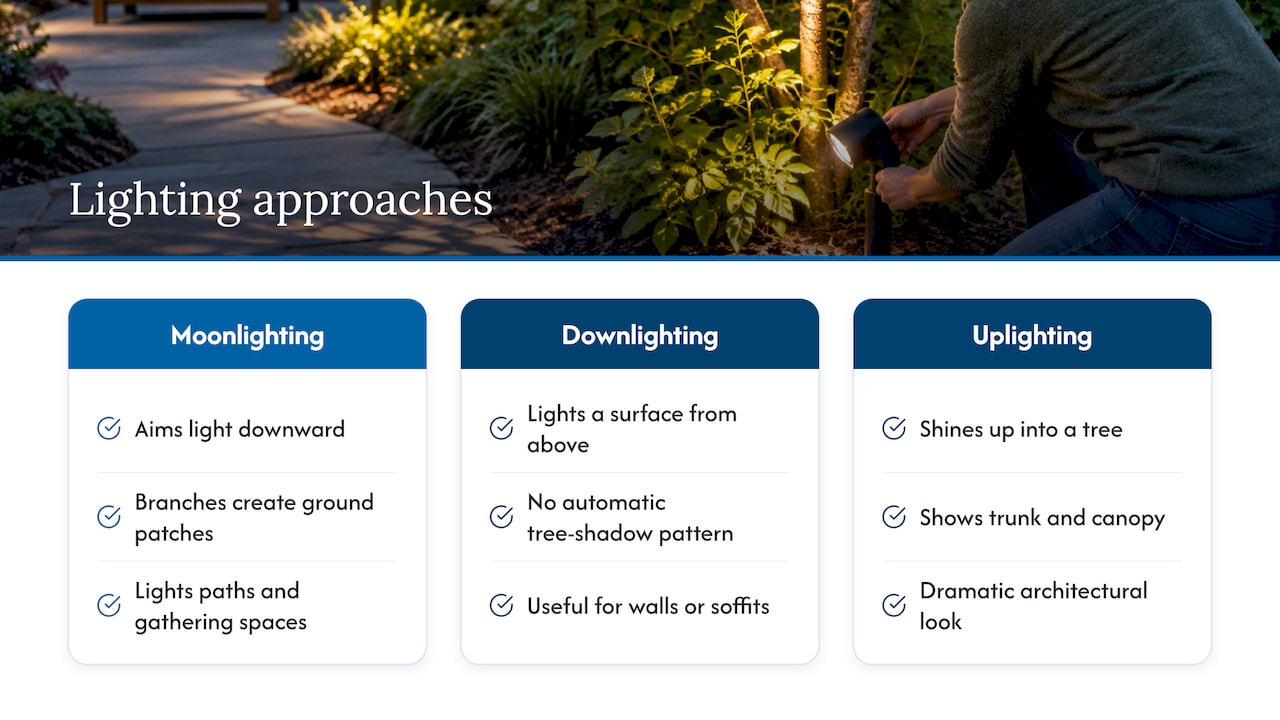
That shadow pattern is what separates moonlighting from ordinary downlighting. A downlight on a wall or soffit lights a surface from above, which is useful, but it does not automatically create the tree-shadow pattern. If the beam never crosses branches, you have a well-lit patio, not moonlight.
It also differs from uplighting. Uplighting shines up into a tree to show off its trunk and canopy, which is a dramatic, architectural look. Moonlighting lights the ground and the spaces where you walk, sit and gather. Many of the best yards use both. If you are weighing the two, our guide to tree uplighting and warm LEDs shows how that technique is planned and tested.
Where moonlighting works best
Moonlighting suits properties with at least one mature, well-shaped tree near a space people use. In New Hampshire, that often means a maple, oak or birch near a patio, a back deck, a front walk or a driveway turnaround.
Good candidates:
- A patio or deck under or beside a tree. Dappled light across the seating area makes it feel enclosed and inviting without bright glare in anyone’s eyes.
- Lawn and planting beds. Soft light across beds reveals texture and shape from the house windows in the evening.
- Walkways and entries. Moonlight-style light is gentle and wide, which helps people see steps and edges. Pair it with low path lights for definition; our path light spacing guide explains the starting spacing we test.
- Commercial entrances and courtyards. Business owners can use the same effect to make a courtyard or lot edge feel welcoming without harsh, over-lit surfaces. Our commercial landscape lighting checklist lists what to confirm before signing a design.
It works less well where trees are sparse, very small, or so dense that no light reaches the ground. In those cases, the structure-mounted approach below is usually the better path.
How to plan the effect
The difference between a convincing moonlit yard and a harsh one comes down to five choices: mounting height, beam spread, how much foliage the light crosses, where you aim, and how well the fixture controls glare.
1. Mounting height
Higher fixtures give a softer, more natural spread, because the light has farther to travel and crosses more leaves. As a starting point, we place fixtures well up the tree, roughly two-thirds of the way to the top, so the beam passes through several feet of canopy before reaching the ground. Every tree is different, so treat that as a first guess to confirm at night, not a rule.
Livingetc, quoting lighting practitioners, describes soft LED spotlights set high in mature trees or on pergola beams and angled through the branches. It also cautions that elevated tree installation should be handled by qualified professionals, which is advice we share.
2. Beam spread
A wide beam, in the neighborhood of 60 degrees, produces broad, overlapping patches of light. A narrow spot produces a hard circle, which looks like a spotlight. Aim slightly outward through the foliage rather than straight at the trunk, so the light fans through leaves instead of hitting one limb.
3. Color temperature
Moonlight reads as slightly cool, but a very blue lamp can look cold next to a warm house. A practical range:
| Color temperature | Look | Where it tends to suit |
|---|---|---|
| 2700K | Warm, welcoming | Brick, wood, warm stone, cozy patios |
| 3000K | Slightly crisper warm white | Mixed greens, stone walls, most NH homes |
| 4000K | Cool white, closest to a moon-like cast | Modern siding, cool-toned stone, evergreens |
If your house has warm brick or cedar, stay at 2700K or 3000K and let the shadows do the moonlight work. Choose cooler only when your materials are cool and you want that silvery cast. Test one fixture before buying a full set.
4. Aim and layering
Moonlighting should not be the only light. A single bright source from above flattens everything, while a few softer sources at different heights give depth. Two or three downlights from different trees, crossing one another, make the shadows overlap and look natural. Add low path lights or step lights only where you need them for safety.
5. Glare control
A bare lamp visible from the patio or from a neighbor’s window ruins the effect. Choose a purpose-built downlight with a shield or hood and an adjustable mount, and check from where people will actually sit and walk. If you can see the lamp from the seating area, adjust the fixture or add a louver.
When the tree is too small or the wrong shape
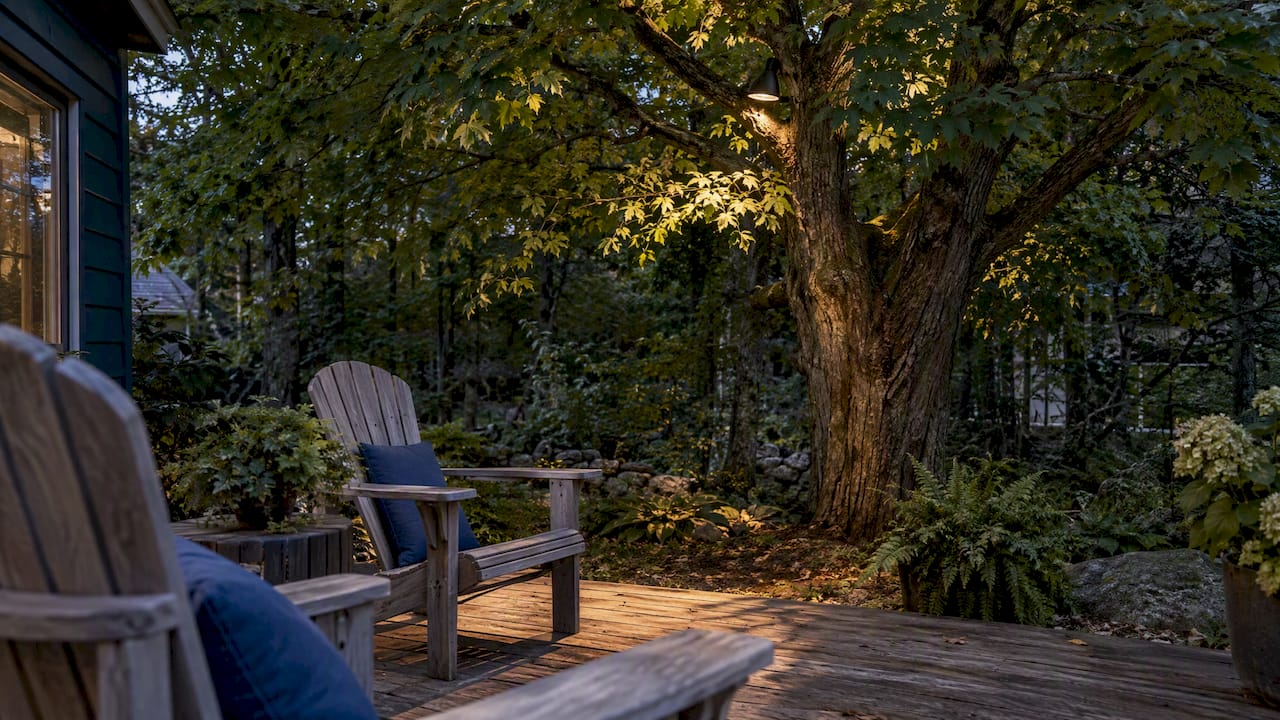
You do not need a 50-foot oak. If the tree is short, young, or a species with a thin canopy, you can mount fixtures on a nearby structure such as a second-story eave, a tall post or a pergola beam and aim them through the branches from there. A freestanding frame is often the cleanest answer, and pergola mounting options show how a solid overhead structure can carry fixtures where no tree can. Our decks and outdoor living work includes pergolas and gazebos, and planning wiring at the build stage is far easier than adding it later.
Keep expectations clear: a structure-mounted light on a patio gives you good downlighting, but you only get moonlight shadows when the beam actually crosses foliage. Aim and test accordingly.
Keeping light where you want it
American homeowners are increasingly asked, and sometimes required, to control outdoor light. The same choices that make moonlighting look natural also keep it neighborly.
- Shield and aim down. The Bureau of Land Management’s night sky best practices recommend shielding and directing lights properly to limit glare and light trespass.
- Check local rules. Some places set hard limits. Douglas County, Colorado, for example, limits driveway and entry fixtures to 900 lumens. In New Hampshire, outdoor lighting rules are set town by town, and a collection of NH town ordinances shows language requiring fully shielded luminaires and limiting light trespass at property lines. Ordinances change, so confirm your town’s current rules with the planning or building office before you finalize a plan.
- Do not over-light for security. Boulder County’s outdoor lighting requirements point out that bright, uneven light creates harsh shadows where someone could hide, while shielded, balanced lighting improves visibility for residents. Moonlighting’s soft, even spread is well suited to that goal.
If you are planning a driveway, our driveway lighting layouts explain spacing and brightness considerations that keep light on the pavement and off the road and your neighbors.
Trees, wildlife and wiring
A tree is a living thing, and fixtures go on it for years. A few points we plan around:
Tree health. Use plastic tree staples or straps that give as the trunk grows, rather than tight metal fasteners or wire wrapped around limbs. Re-check ties as the tree grows, and leave slack in the cable. Trees can compartmentalize small wounds, as arborist guidance explains for nails and fasteners, but that is no reason to be careless with where and how you attach anything. Have a certified arborist review valuable or older trees first.
Lightning. The same arborist source notes that electrical wire in a tree may tend to attract lightning, and that metal conduit should be bonded to an existing tree lightning protection system. If your tree already has lightning protection, tell your installer before any wiring is run.
Wildlife. Artificial light at night can confuse migrating birds and disrupt wildlife and keep trees from adjusting to changing seasons. The practical response is simple: use only as many fixtures as you need, keep output modest, and put them on a timer or photocell so they are off late at night.
Low voltage. Most residential moonlighting runs on a low-voltage system with a transformer and weather-rated cable. Our low-voltage landscape lighting guide covers how those systems are laid out. Any line-voltage connection should be handled by a licensed electrician in accordance with local code.
Why installation at height is a professional job
A fixture two-thirds of the way up a mature tree can sit 20 to 30 feet off the ground. Reaching that safely takes equipment such as extension ladders, lifts or bucket trucks, and experience working at height. Lighting practitioners say the same: this kind of work belongs with experienced professionals or arborists. It is not a weekend ladder task. Falls from trees and ladders are a leading cause of landscape-related injuries, so please do not attempt it alone.
A step-by-step planning checklist
- Walk the yard at dusk. Note where you sit, walk and look from inside the house.
- Pick the trees. Choose mature, healthy trees with an open enough canopy for light to pass through.
- Mark the target areas. Patio, steps, lawn, beds, driveway turnaround.
- Choose fixtures. Shielded, adjustable downlights, wide beam, warm to neutral white.
- Do a night test. Temporarily position a fixture and look from every key spot. Adjust height and angle before anything is permanent.
- Layer in other light. Add path, step or deck lights only where safety needs them. Our deck lighting ideas help here.
- Set controls. Use a timer or photocell, and consider dimming or separate zones.
- Confirm town rules. Check for shielding and trespass requirements.
- Schedule maintenance. Check tree ties, fixture aim and lens cleanliness each year, and adjust as the canopy grows.
Our perspective
Moonlighting is the technique we reach for when a client says they want the yard to feel natural at night, not lit. The fixture is the easy part. What matters is how the light meets the tree, the patio and the house.
That is why we treat it as part of landscape design rather than an add-on. We look at where you live in the space, where trees will grow, and where a wall, walkway or pergola can carry a fixture when a tree cannot. Planning lighting alongside hardscape means conduit and transformers go in once, cleanly, not as a retrofit.
We test before we commit. A night walk-through with a temporary fixture tells us more than any catalog, and it lets you see the result before the final layout is set. We aim for restraint: fewer, better-placed fixtures, shielded and properly aimed, so the yard looks good from your windows and stays considerate to the neighbors.
Our approach is built on careful craftsmanship, custom design for each property, and clear project management from consultation to installation.
Damian
Bring moonlighting into a complete plan
Moonlighting looks best when it fits the rest of your outdoor space: the patio that sits under the branches, the walkway that leads to it, the firepit and seating nearby. Divine Landscaping designs and builds custom outdoor spaces for New Hampshire homes and businesses, including irrigation and lighting, landscape design, patios, walkways, decks and pergolas.
If you want lighting planned as part of a larger project, or want a professional look at your trees before anyone climbs one, request a quote and tell us what you have in mind. You can also browse our project gallery for outdoor living ideas, or read our landscape lighting design basics before your consultation.
Budget and timing considerations
Cost depends on how many fixtures you need, how high they go, how far cable has to run, and whether trees need pruning or an arborist’s input. Work at height, long runs and new trenching add labor. We do not publish set prices, because every property is different; a site visit is the only way to give you a real number.
Timing matters in New England. Installing lighting before a hardscape project is finished is cheaper than cutting into new paving later, so share lighting plans early. Foliage also changes the look: a winter test through bare branches tells you little about summer, so judge the shadows when leaves are on, and plan to adjust as the canopy fills in. Low-voltage systems can be installed or adjusted across much of the year, but frozen ground can limit trenching, so ask your contractor how they handle winter scheduling.
Common mistakes to avoid
- Mounting too low. A fixture only a few feet up the trunk lights the trunk and creates a harsh, small pool.
- Using a narrow spot. It makes a visible circle on the ground instead of a soft wash.
- Skipping the night test. What looks right on paper often glares from the patio.
- Choosing a cold color for a warm house. The light and the materials should look like they belong together.
- Over-lighting. More fixtures do not equal more moonlight. Fewer, shielded fixtures with overlapping shadows look better.
- Forgetting growth. A tie that is snug today can girdle a branch in three years.
FAQ
What is moonlighting in landscape lighting?
Moonlighting is a technique that places downlights high in a tree or on a structure and aims them through branches. The foliage casts soft shadows on the ground, creating the look of moonlight filtering through leaves.
How high should moonlighting fixtures be mounted?
The higher the fixture, the softer the effect, because the beam crosses more foliage. We often start around two-thirds of the way up a mature tree and then adjust at night. The right height depends on the tree, so test before fixing anything in place.
What color temperature is best for moonlighting?
A warm to neutral white, roughly 2700K to 3000K, suits most New Hampshire homes with wood, brick or warm stone. A cooler white around 4000K gives a more silvery, moon-like cast and works with cool-toned materials. Test a single fixture before you buy a full set.
Can I do moonlighting without a big tree?
Yes. You can mount fixtures on a pergola beam, a second-story eave or a tall post and aim the light through nearby foliage. Keep in mind you get tree-shadow patterns only if the beam actually passes through branches.
Is it safe to install moonlighting myself?
Ground-level low-voltage work is manageable for some homeowners, but fixtures high in a tree are different. Work at 20 to 30 feet calls for lifts or bucket trucks and experience with trees, so hire experienced professionals or an arborist for that part.
Sources
- Landscape Lighting Effects & Techniques, Landscaping Network
- Why You Should Be ‘Moonlighting’ Your Garden, Livingetc
- Night Sky and Dark Environments: Best Management Practices, BLM
- Outdoor Lighting (Dark Skies), Douglas County
- Lighting Regulations in New Hampshire Communities
- Outdoor Lighting Requirements, Boulder County
- Lightning Protection FAQ, Bartlett Tree Experts
- Light Pollution, Colorado Plateau Dark Sky Cooperative, Utah State University Extension
- Guide to Outdoor Downlighting: Nature Inspired Lighting