
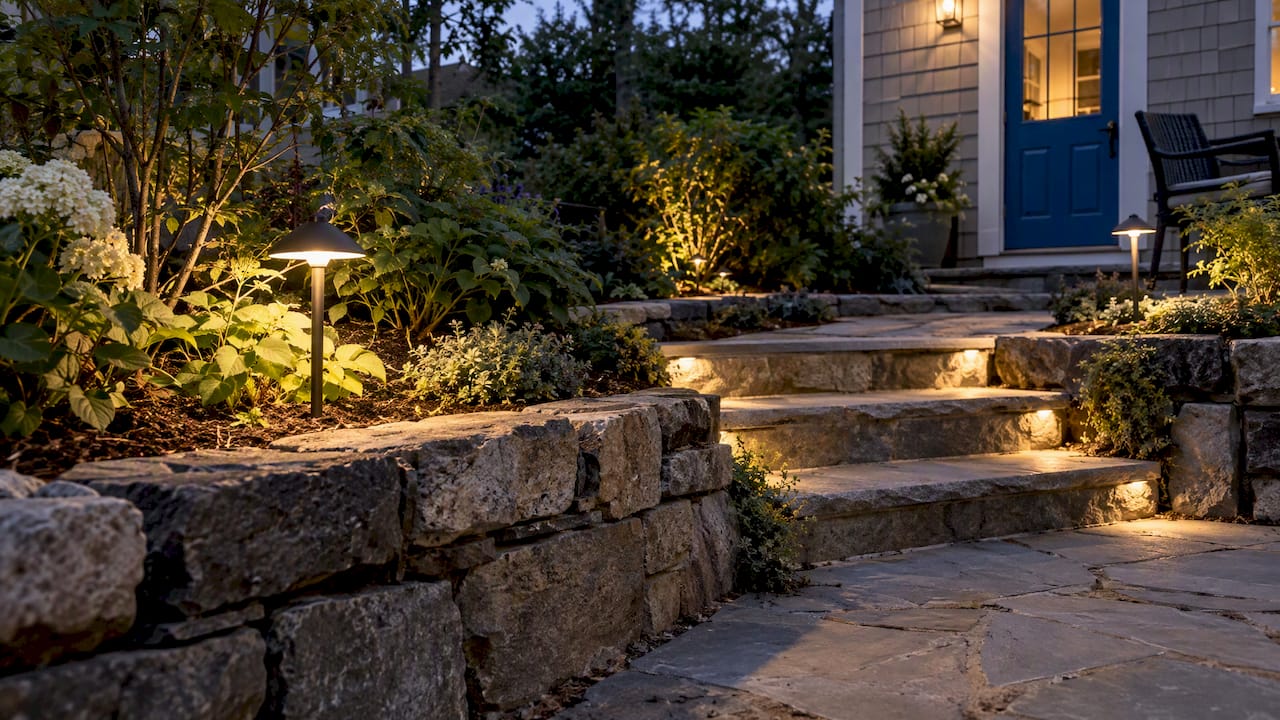
For most residential outdoor lighting, a color temperature between 2700K and 3000K gives you the warm, inviting glow that works best for pathways, patios, and landscaping, with 4000K reserved for driveways or security zones where visibility matters more than ambiance. Alongside the Kelvin number, look for a high Color Rendering Index (CRI) and be mindful of blue light content, since both affect how natural your outdoor space looks at night.
TL;DR:
- Most residential outdoor lighting should use 2700K to 3000K for warmth, while 4000K is better suited for driveways or security zones.
- Variations within the same Kelvin category, due to manufacturing binning, can affect the shade, so viewing fixtures in person before purchasing is recommended.
- Cooler 4000K lights contain more blue light, which can increase skyglow and disrupt wildlife, making 3000K a safer choice for general outdoor use.
- Mixing only two Kelvin temperatures, with 80% of fixtures in one range and a few focal points in a cooler tone, creates a cohesive scene without mismatched appearances.
- Prioritize adjustable, tunable fixtures with high CRI above 85 and use controls like timers or dimmers to optimize color consistency and energy efficiency.
Table of Contents
- What Correlated Color Temperature Actually Measures
- 2700K vs 3000K vs 4000K: What Each Looks Like
- Matching Color Temperature to Each Outdoor Area
- CRI, Blue Light, and the Trade-offs Worth Knowing
- Mixing Temperatures Without Creating a Mismatched Look
- What to Look for When Choosing Fixtures and Controls
- How We Approach Color Temperature on Every Lighting Project
- Why the “Just Pick 3000K” Advice Misses the Point
- Ready to Plan Your Outdoor Lighting?
- FAQ
- Sources
What Correlated Color Temperature Actually Measures
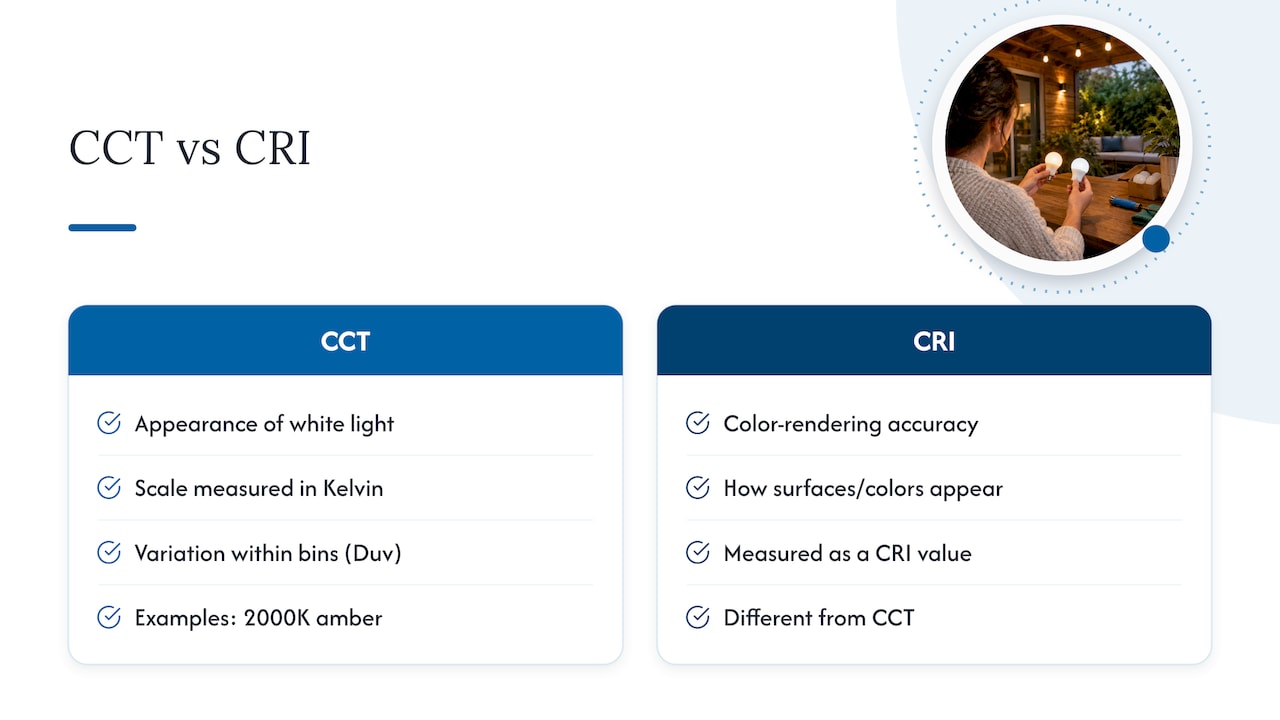
Correlated color temperature, or CCT, describes the appearance of white light on a scale measured in Kelvin, from warm amber tones around 2000K to the bluish white of daylight above 5000K. It tells you what the light itself looks like, not how it will render the colors of your siding, stonework, or plants once it hits them. That distinction matters because two fixtures labeled with the same CCT can still look slightly different on your property, according to the LED color characteristics factsheet from the U.S. Department of Energy. Manufacturers sort LEDs into “bins” based on a chromaticity measurement called Duv, and variation within those bins is normal. A single Kelvin number is a helpful shorthand, but it is not a guarantee of an exact shade, which is one reason we always recommend viewing a fixture in person before committing to dozens of them.
2700K vs 3000K vs 4000K: What Each Looks Like
Here’s how the three most common outdoor Kelvin values actually read once they’re installed:
- 2700K looks like warm candlelight or an old incandescent bulb, soft and golden, and flatters brick, wood, and warm-toned stone.
- 3000K reads as a balanced white glow, still warm but with slightly more clarity, popular for modern facades and hardscaping.
- 4000K looks crisp and cool, closer to daylight, and is typically reserved for driveways, garages, and security zones.
Cooler light at 4000K often feels “brighter” than warmer light even when the lumen output is identical, because the human eye is more sensitive to blue-rich wavelengths in low-light conditions. That perception is useful to know when you’re comparing fixtures on a spec sheet rather than side by side in your own yard.
Matching Color Temperature to Each Outdoor Area
Different zones around your property call for different Kelvin choices depending on how the space is used:
- Pathways and steps: Stick to 2700K to 3000K for a welcoming glow that still provides enough contrast for safe footing.
- Trees and garden beds: Choose 2700K for natural-looking foliage, or bump up to 3000K when you want more definition on bark texture or stonework.
- Patios and outdoor living areas: A 2700K to 3000K range balances ambiance with enough clarity for reading menus or hosting guests after dark.
- Driveways and security lighting: Lean toward 3000K to 4000K depending on how much visibility you need and how much glare your neighbors can tolerate.
- Aging eyes and accessibility: Slightly cooler light with strong, even coverage helps older adults judge depth and contrast on steps or uneven walkways.
CRI, Blue Light, and the Trade-offs Worth Knowing
Color temperature only tells half the story. CRI measures how accurately a light source renders colors compared to natural daylight, on a scale up to 100, and we recommend a CRI of 85 to 90 or higher for any fixture illuminating plants, stonework, or architectural details where color fidelity matters, a benchmark Lights & Things also uses when explaining CRI to homeowners shopping for fixtures.
At equal lumen output, warmer LEDs emit far less blue light than cooler ones: 2700K fixtures contain a lower proportion of blue radiant power compared to 3000K and 4000K fixtures, with increasing blue content at higher Kelvin values, according to the Energy Department’s blue light comparison. That added blue content increases skyglow and can disrupt nocturnal wildlife, which is why DarkSky guidance caps many approved luminaires at a nominal 3000K. Dimming, shielding fixtures downward, and adding timers all reduce unnecessary blue-light spill without sacrificing the look you want.
Mixing Temperatures Without Creating a Mismatched Look
Most well-designed properties settle on one dominant color temperature and use a second one sparingly as an accent. A warm 2700K path paired with slightly cooler 3000K uplighting on a tree canopy can create depth without looking disjointed, and a warm facade with a cooler security light tucked under the soffit keeps the overall scene cohesive while still meeting safety needs.
- Pick a dominant temperature for 80% or more of your fixtures before adding any contrast.
- Reserve a second, cooler temperature for one or two focal points, such as a specimen tree or an entry feature.
- Avoid scattering three or more different Kelvin values across a single sightline.
Pro Tip: Borrow a few tunable or adjustable-CCT fixtures and test them on-site after dark before finalizing your order, since lighting always looks different outdoors than it does under a showroom bulb.
What to Look for When Choosing Fixtures and Controls
A few practical checks make the difference between lighting that looks professional and lighting that looks improvised:
- Read the Lighting Facts label on any fixture for lumen output, wattage, efficacy, CRI, and CCT in one place.
- Favor field-selectable or tunable fixtures and dimmable drivers so you can adjust color and brightness after installation rather than guessing upfront.
- Ask manufacturers about Duv and binning if matching color consistency across many fixtures is a priority, since two “3000K” products can still look slightly different.
- Use timers, motion sensors, and dimming schedules to cut down on unnecessary blue-light exposure and trim energy costs over time.
These same principles apply whether you’re lighting a single tree or an entire low-voltage landscape lighting system across your property.
How We Approach Color Temperature on Every Lighting Project
Choosing the right Kelvin value is only useful if the installation backs it up, which is where our outdoor lighting design and installation work comes in. We handle fixture selection, placement, and control programming as one connected process, so the color temperature you choose for a stone patio actually matches the tone we use on nearby tree uplighting or a deck lighting feature a few feet away. We pair that with on-site tuning once fixtures are installed, checking how everything reads together after dark rather than relying on spec sheets alone. We focus on consistent color across every fixture on a property, correct pairing with your materials, and controls set up the way you’ll actually use them.
Why the “Just Pick 3000K” Advice Misses the Point
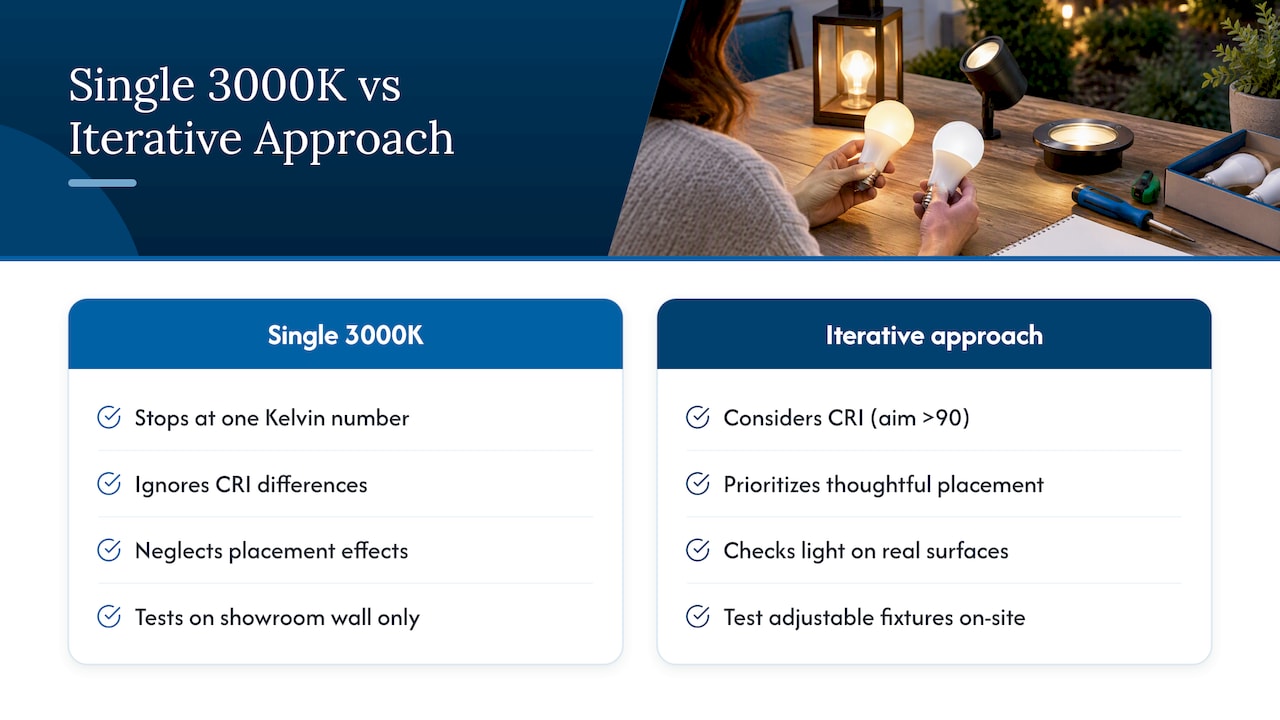
Most guides stop at a single recommended Kelvin number and call it done, and that advice isn’t wrong so much as incomplete. The bigger factor we see homeowners overlook isn’t the Kelvin value at all, it’s CRI and placement. A 3000K fixture with a CRI in the 70s will still make warm brick look slightly washed out, while a thoughtfully placed 2700K fixture with a CRI above 90 can make that same brick glow.
The conventional advice also treats color temperature as a one-time decision, when it’s really an iterative one. Light behaves differently against wet pavement, dry mulch, or painted siding, and the only reliable way to know how a fixture will look on your property is to test it there after dark, not on a showroom wall. If we had to prioritize one thing for homeowners starting this process, it would be this: buy or borrow a few adjustable fixtures before locking in an entire property’s worth of lighting. The Kelvin number gets you in the right neighborhood. Testing on-site is what gets it right.
— Damian
Ready to Plan Your Outdoor Lighting?
We design and install outdoor lighting that’s tuned to your property, not just a catalog spec sheet, pairing the right color temperature with the right fixture placement so your patios, walkways, and landscaping look the way you pictured them.

If you’re ready to talk through a project, visit our outdoor lighting page or reach out through our landscape design services to start planning a lighting layout built around your home.
FAQ
Is 3000K or 4000K better for outdoor lighting?
For most residential landscaping, walkways, and patios, 3000K gives a warmer, more inviting look while still offering enough clarity for everyday use. 4000K works better for driveways, garages, or security areas where visibility and contrast matter more than ambiance.
How do I adjust the color temperature of my LED light?
Some LED fixtures offer a built-in switch or dial that lets you select between a few preset Kelvin values, often 2700K, 3000K, and 4000K, without replacing the bulb. For fixtures without that feature, you’ll need to swap in a different CCT bulb or module, which is why tunable fixtures are worth the extra cost if you expect to fine-tune your setup.
What is the recommended color temperature range for outdoor lighting?
Practitioners routinely recommend 2700K–3000K for residential outdoor and landscape lighting, a standard noted in guidance from professional lighting integrators. Cooler temperatures such as 4000K are generally chosen for areas like driveways or security zones where visibility is a priority.
Which is better for outdoor lighting, 2700K or 3000K?
Both sit within the recommended warm range, so the choice comes down to the look you want: 2700K reads warmer and closer to candlelight, while 3000K is slightly crisper and often preferred for modern architecture. Many properties use 2700K for pathways and gardens and 3000K near hardscaping or entryways for a touch more definition.
Sources
- LED color characteristics factsheet
- Selected blue light characteristics of various outdoor lighting sources at equivalent lumen output
- DarkSky Approved luminaires guidelines
- How to find the right color temperature for landscape lighting