
The best patio plantings start with three decisions: how much sun the patio gets, what container or bed each plant will live in, and how the plants will look in October as well as July. Get those right and the rest is choosing colors you enjoy. This guide gives you layouts, plant groupings, privacy and shade ideas, and soil and winter advice that fit New Hampshire’s long, cold winters.
TL;DR
- Count your direct-sun hours first. Full sun is 6 or more hours, and a concrete patio can run hotter than the rest of the yard.
- Build each container with a tall center plant, rounded fillers and trailing edges, and keep to two or three container styles per grouping.
- Pick pots with drainage holes and use container potting mix, not garden soil.
- For privacy and shade, use grouped shrubs, a fence or a deciduous tree, and leave room so the planting does not crowd the patio.
- Plan for winter: evergreens and structure for permanent plantings, and a protected spot for tender potted plants.
Table of Contents
- Start with sun, heat and exposure
- Container ideas that make a patio feel finished
- Pots, soil and watering
- Edible patio containers
- Privacy and shade with plantings
- Planting for four seasons
- Planting ideas by patio type
- Our perspective
- Bring plants and patio together
- FAQ
- Sources
Start with sun, heat and exposure
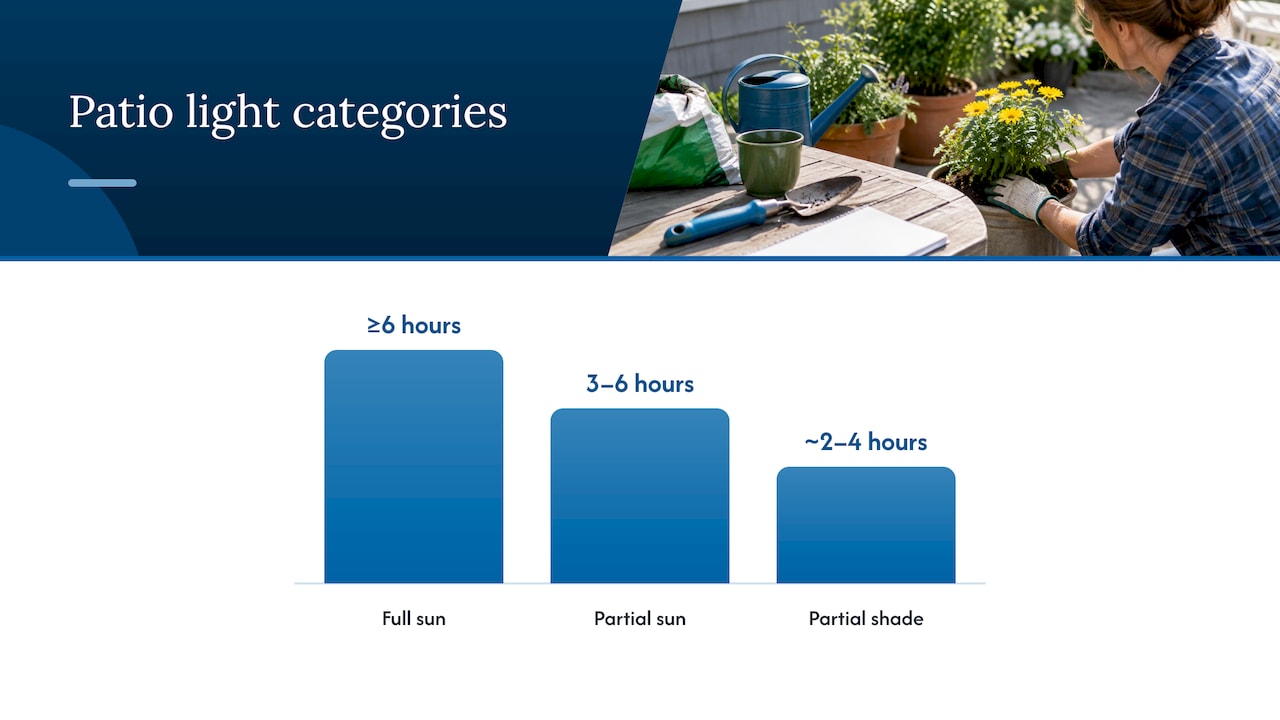
Before you buy a single plant, spend a sunny day noting when light reaches the patio. Rutgers Cooperative Extension defines full sun as at least 6 hours of direct light, partial sun as 3 to 6 hours, and partial shade as about 2 to 4 hours with relief from intense afternoon sun. Those three categories are the ones plant tags use, so a quick sun log makes every label useful.
Material matters too. Oklahoma State University Extension notes that a concrete patio can expose containers to about 8 hours of direct sun and reflected heat, which favors sun-loving or drought-tolerant plants and can increase how often you water. Pavers and stone hold heat in a similar way, so a south-facing patio often behaves like a hot spot even in a cool New England summer.
A shaded patio is not a problem, only a different plant list. For eastern or dappled exposures, Rutgers’ light definitions support choosing shade or partial-shade plants rather than full-sun species that will stretch and bloom poorly.
If a new structure will change the light, place it before you plant. Ideas like these garden studio ideas show how a backyard building can reshape the sun and shade around a patio, which is worth settling before you commit to a planting plan.
Match plants to the zone, not just the look
UNH Extension tells New Hampshire gardeners to prioritize winter hardiness, moisture and drainage, sun or shade, maintenance, and resistance to pollution or salt when choosing landscape plants. It also states that survival through long, cold winters is generally the hardiness concern here. For anything planted in the ground beside the patio, that means choosing plants rated for our winters. Near a driveway or walkway that is salted, salt tolerance matters as well.
Container ideas that make a patio feel finished
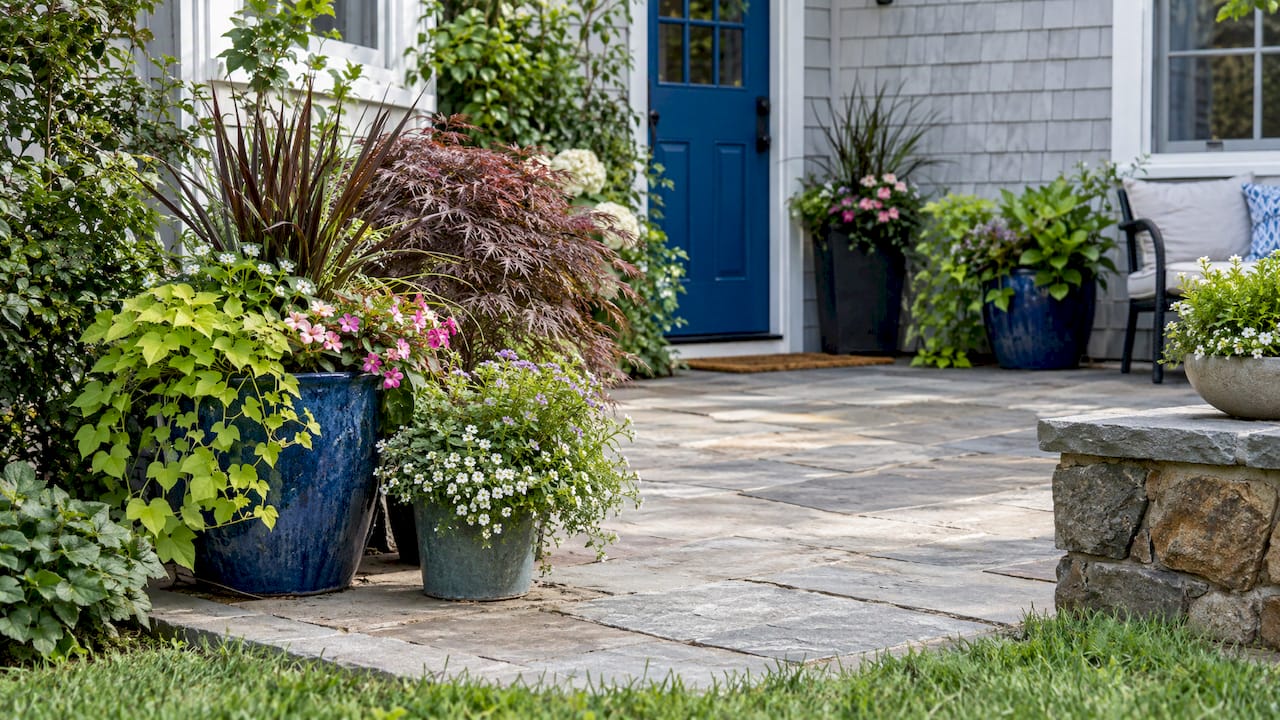
Containers are the fastest way to add color to a patio, and you can rearrange them as the season changes. UNH Cooperative Extension says containers can add color, create an atmosphere, spotlight plants or provide focal points, and that when you group them you should choose just two or three types of container. A matching set in two sizes looks calm. Six different pots look busy.
The thriller, filler and spiller formula
A reliable recipe for a single pot comes from Penn State Extension: a tall plant at the center or back, rounded fillers around it, and trailing plants near the edges. Here is how that can look on a New Hampshire patio:
| Role | Sun example | Shade example |
|---|---|---|
| Tall center | Ornamental grass | Upright foliage plant such as a fern |
| Filler | Geranium | Begonia |
| Spiller | Trailing annual | Trailing ivy or similar vine |
The plant names are examples of the type of plant, so check each tag for its light needs. One good option for a sunny pot is the dwarf fountain grass ‘Hameln’. The North Carolina Extension Plant Toolbox lists it as suitable for containers and patios, best in full sun but tolerant of part shade, though it may flower less in shade.
Build in texture and contrast
Color gets attention, but form and texture keep a planting interesting. The Chicago Botanic Garden suggests combining contrasting forms, such as spiky with cascading, feathery with solid, and mounding with upright. UNH Extension adds that successful plantings combine height and depth and use varied colors, forms and textures for balance, and that you should choose plants and containers together rather than one after the other.
Keep plants with matching needs together
The most common reason a mixed pot fails is that its plants want different things. Oklahoma State University Extension says plants sharing a container should have similar light and moisture requirements. A full-sun plant should not share a pot with a shade plant, and a succulent should not share one with a moisture-loving plant.
Also leave room to grow. Penn State Extension warns that overcrowding reduces root space and airflow, and that vigorous plants may later need division, removal or a larger pot. A pot that looks a little sparse in June is usually right by August.
Pots, soil and watering
A handsome pot with poor drainage is a short-term investment. UNH Cooperative Extension says a successful container needs enough root room and excellent drainage, and that porous pots can dry quickly while nonporous pots hold moisture and need especially good drainage.
Use this short checklist when you set up each container:
- Size: UC Cooperative Extension recommends containers at least 10 inches in diameter and depth for most plantings.
- Drainage holes: Every pot needs them. Skip decorative pots without holes, or use them only as a cover for a plain pot inside.
- Mix: Use a container potting mix, not garden soil. UC advises against putting rocks in the bottom. UNH describes a good mix as one with organic material plus perlite or vermiculite.
- Watering: Water until excess runs freely from the drainage holes. UNH’s container fig guidance suggests watering when the top 1 to 2 inches of mix are dry, a handy test for most pots.
Pots on a hot patio dry faster than those in a garden bed, so check them more often in July and August. Water pooling under pots or running toward your house is a different issue, and it usually points to the patio itself. Our guide to patio drainage fixes explains the options.
Edible patio containers
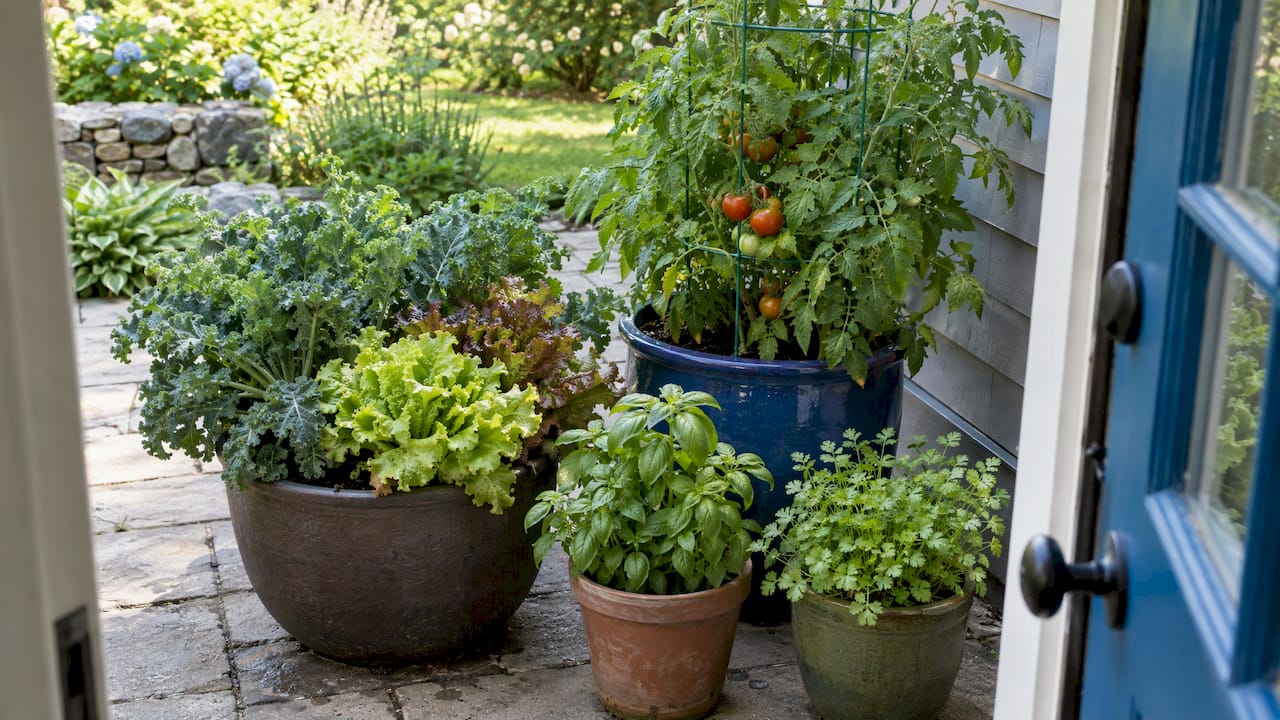
A small herb and vegetable collection by the back door earns its space. UC Cooperative Extension says most vegetables need 6 to 8 hours of sun, while leafy crops such as lettuce, spinach, kale, chard, basil and cilantro can tolerate partial shade with as little as 3 hours. That makes a part-shade patio a good home for salad greens and herbs, and a full-sun patio better for tomatoes and peppers.
If you like the idea of a fig, know the limits. UNH Extension reports that edible figs are not reliably winter-hardy outdoors anywhere in New Hampshire but can be grown in containers if moved to a protected location before winter. A fig in a large pot can be a conversation piece on the patio all summer, as long as you have a sheltered place for it later.
For garden beds, raised beds beside a patio make edibles easier to reach and tend. We build raised garden beds as part of our masonry and hardscape work.
Privacy and shade with plantings
Plants can make a patio feel like a room. UNH Extension’s landscape planning guide says privacy can be created with grouped shrub borders and trees, while a fence saves space in a small area. It also recommends screening work areas and unattractive views. In a tight yard, that often means a fence or trellis with plants in front of it, rather than a wide hedge that takes up patio space.
Shade works the same way. The same guide notes that deciduous trees shade in summer and admit winter sun, and that overplanting trees can shut out sun and air. One well-placed tree or a pergola beats several crowded ones.
Some ways to put this together:
- Shrub screen: Plant a grouped border of mixed shrubs on the side facing the neighbor, with evergreens for year-round cover.
- Fence plus planters: Use tall planters along a fence line where there is no room for a bed.
- Overhead structure: A pergola with a climbing vine gives dappled shade without the footprint of a tree. We design and build pergolas and gazebos for outdoor living areas.
- Layered heights: Place the tallest plants at the back or edge and lower plants close to seating, so views stay open.
For a deeper look at screening, see our patio privacy ideas for New Hampshire. If your yard is compact, our small yard landscaping ideas cover how to use every inch.
Planting for four seasons
New Hampshire patios are used from May through October, and a patio that looks bare after the first frost feels unfinished. UNH Extension recommends evergreens, varied shrub and tree forms, colorful bark and fruit for winter interest around outdoor living areas, supplemented by flowers and foliage during the rest of the year.
A simple seasonal rhythm:
- Spring: Bulbs and early perennials in beds, pansies and cool-season greens in pots.
- Summer: Heat-tolerant annuals and grasses in the pots that get the most sun.
- Fall: Mums, ornamental grasses and kale or similar cool-weather foliage.
- Winter: Evergreens in beds or large pots, and structure such as stone, wood and lighting.
On fall mums, UNH Extension says late-season florist mums are generally best treated as annuals in New Hampshire. Some garden mums are Zone 5 hardy but do better when planted in spring, in well-drained soil, with 2 to 4 inches of protective mulch. Treat the pot of mums by your door as a seasonal accent and you will never be disappointed.
Getting plants through winter
Tender plants such as figs need a protected spot before freezing weather, as UNH’s guidance above describes. Hardy perennials in the ground benefit from mulch and good drainage, since freeze-thaw cycles are hard on roots sitting in wet soil. Moving pots against the house or into a sheltered area, and keeping them from sitting in standing water, are practical first steps.
Planting ideas by patio type
The same plant list does not suit every patio. Use these starting points:
- Small sunny patio: A cluster of three pots in two matching styles. One tall grass pot, one geranium or similar bloomer, and one herb pot.
- Shaded or north-facing patio: Ferns, begonias and foliage plants with varied leaf shapes, and a trellis for height.
- Raised patio: Use planters built into the edges so greenery softens the elevation change. See our raised patio ideas.
- Patio with a lawn edge: A curved planting bed that frames the paving, with shrubs at the corners.
- Patio on a slope: Plantings along retaining walls, which also help the wall blend into the yard. See how to build a patio on a slope.
If you are still deciding the layout, our guide to planning a backyard patio layout helps you set space for seating, paths and plants together, and our patio design styles page helps you choose a look the plants should match.
Our perspective
Plants work best on a patio when they are planned with the patio, not added afterward. We see the strongest results when the planting areas, drainage, lighting and irrigation are part of the same design as the pavers and walls.
That means deciding early where beds and planters go, how water leaves the surface, and where the sun falls. We design each property individually, with premium materials and clear project management from consultation to installation, so the planting has a place to succeed from the first season.
Our team brings 20+ years of combined hands-on experience to outdoor spaces, and we aim for patios that feel like a natural extension of the home, with greenery that fits the way you use the space.
Damian
Bring plants and patio together
If you want planting beds, built-in planters, irrigation and lighting designed alongside a new patio, our team can plan it as one project. We offer patio installation services and landscape design for homeowners in New Hampshire and neighboring Massachusetts, and our irrigation and lighting services can keep plant beds watered and your patio lit after dark.

Browse our outdoor living project gallery for ideas, then contact us to talk through your yard.
FAQ
What are the best plants for a sunny patio in New Hampshire?
Choose plants that tolerate heat and reflected light, since a hard surface can intensify both. Ornamental grasses, geraniums and herbs suit full sun, which means at least 6 hours of direct light. Check each tag for hardiness if the plant will stay outdoors through winter.
How many plants should I put in one container?
Use enough to look full, but leave room to mature. Overcrowding limits root space and airflow. A common layout is one tall plant, a few fillers and a trailing plant near the edge, all with similar light and water needs.
What can I plant on a shaded patio?
Choose plants labeled for shade or partial shade, which Rutgers describes as about 2 to 4 hours of sun. Foliage plants with different leaf shapes add interest. Leafy edibles such as lettuce, kale and basil can manage with as little as 3 hours of sun.
How do I add privacy to my patio with plants?
Grouped shrubs and small trees create screening, and a fence saves space where yards are tight. Planters along a fence or a pergola with a climbing vine are other options. Avoid planting so many trees that they block sun and airflow.
Can I leave my patio pots outside in winter?
It depends on the plant. Tender plants such as figs should move to a protected location before winter. Hardy perennials do better with mulch and good drainage, and florist mums are best treated as annuals in New Hampshire.
Sources
- Container Garden, UNH Cooperative Extension
- The Art of Container Gardening, Penn State Extension
- Container Gardening, Chicago Botanic Garden
- Outdoor Container Gardening with Flowering and Foliage Plants, Rutgers Cooperative Extension
- Container Gardening, Oklahoma State University Extension
- Container Gardening handout, UC Cooperative Extension
- Landscape planning chapter, UNH Extension
- Growing an edible fig in a container, UNH Extension
- Can fall mums be planted in the garden, UNH Extension
- Hameln Dwarf Fountain Grass, NC State Extension Plant Toolbox