
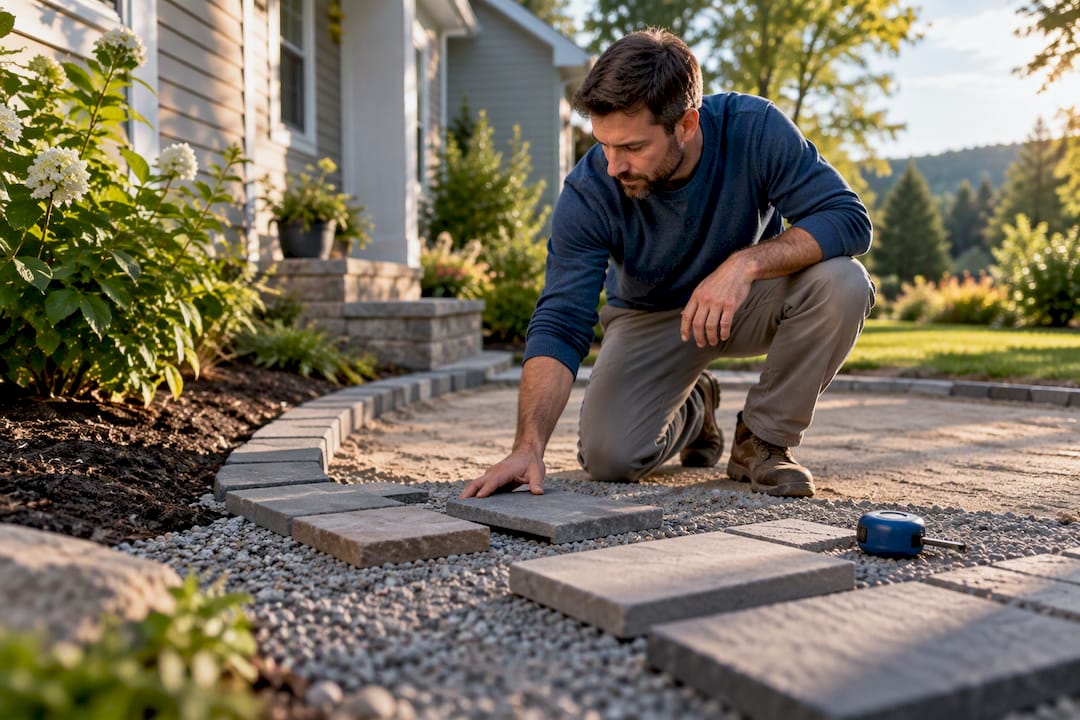
A well-built patio typically increases resale value and often recovers most, sometimes nearly all, of its cost at sale. According to the 2023 Remodeling Impact Report from the National Association of REALTORS®, an 18-by-16-foot concrete paver patio shows a very high cost recovery rate among common home projects. The exact number for your home depends on materials, design, and your local market.
TL;DR:
- A well-designed and properly installed patio can recover nearly all its cost at resale, with natural stone patios reaching up to 90% ROI in some cases.
- The value added depends more on how well the patio fits the neighborhood and design cohesion than on the upfront spending or material quality.
- Site preparation, drainage, and base stability are critical to long-term durability and resale value, often accounting for over half of the initial project cost.
- Paver patios offer a strong balance of appeal and cost efficiency, with a typical project costing $7 to $10 per square foot and a 60-80% ROI.
- Overbuilding with high-end natural stone or elaborate features in modest neighborhoods can lead to lower returns and should be balanced with neighborhood standards.
Table of Contents
- Average cost and ROI benchmarks for patio types
- What actually drives how much value a patio adds
- Material and feature choices: pros, cons, and resale signals
- Example budgets and return scenarios
- How to maximize resale impact without over-investing
- Maintenance, longevity, and realistic timelines
- Contractor perspective and client project proof points
- Think like a buyer when you plan a patio
- How Divine Landscaping LLC helps homeowners build patios that protect resale value
- Authoritative reports and resources cited in this article
- Sources
- FAQ
Average cost and ROI benchmarks for patio types
Patio costs and returns vary by material, and the numbers matter when you’re setting a budget. According to the NAR report, a representative 18-by-16-foot concrete paver patio carries a project cost estimate of $10,000 and an estimated recovered value of $10,500 at resale, a cost-recovery rate near 95%. Installed material costs for paver patios often run in the $7 to $10 per square foot range for the paving material alone, with total project costs, including labor and base preparation, climbing into the several thousand to low ten-thousand-dollar range depending on size, according to cost guidance compiled by Angi.
Reported ROI ranges vary by material across market guides and practitioner writeups:
- Concrete patios tend to land on the lower end of the ROI spectrum, often cited around 50% to 70%, since buyers perceive them as a budget material.
- Paver patios frequently outperform concrete, with reported ranges near 60% to 80%, reflecting stronger buyer appeal for the same footprint.
- Natural stone patios can reach 70% to 90% in some reports, though the higher upfront cost raises the stakes if the neighborhood doesn’t support it.
- Covered patios, which add shade and weather protection, are often cited in the 65% to 85% range.
Most REALTORS® recommend professional installation and proper staging before listing, since a patio with high cost recovery is one of the more persuasive selling points a backyard can offer.
What actually drives how much value a patio adds
A patio’s resale value depends less on how much you spend and more on how well it fits the house and the neighborhood. An overbuilt patio in a modest subdivision rarely returns its full cost, while a modest patio in a comparable neighborhood can outperform expectations.
- Comparable homes nearby set the ceiling. Buyers compare your patio to what’s typical in the area, not to what you personally wanted.
- Design cohesion with the house matters. A patio that echoes the home’s siding, trim, or roofline reads as intentional rather than bolted on.
- Functionality wins over novelty. Space for dining, seating, or a small workspace tends to appeal to more buyers than a single-purpose feature.
- Site preparation determines longevity. Grading, drainage, and base compaction affect whether the patio still looks good in five years.
- Timing and staging shape perception. A patio finished and photographed well right before listing often reads as newer and better maintained than it is.
Pro Tip: Before finalizing a design, walk the comparable listings in your area and note whether their outdoor spaces are simple or elaborate. Match that baseline, then add one distinguishing feature.
Material and feature choices: pros, cons, and resale signals
Material choice sends a signal to buyers before they even step outside. Concrete is the most affordable option and, when properly finished with a stamped or stained surface, can look far more expensive than it is, though a plain gray slab rarely impresses. Pavers strike a strong balance: Homelight’s reporting on patio value notes that well-designed patios are highly marketable to buyers, and pavers consistently show strong cost recovery in cost-vs-value style reports. Natural stone delivers the most premium look but carries real risk of overbuilding, since a stacked-stone patio in a starter-home neighborhood may not return its cost even if it looks great.
- Concrete: lowest upfront cost, best when stamped, stained, or scored rather than left plain.
- Pavers: strong balance of appeal and price, widely cited as a top performer for cost recovery.
- Natural stone: highest visual impact, but a poor fit for modest neighborhoods where comps won’t support the premium.
- Covered patios, built-in lighting, and fire features add value when they extend usable months in the year, but can tip into overkill when stacked together on a small lot.
Example budgets and return scenarios
Running the numbers on a hypothetical project helps translate ROI percentages into real dollars. These are illustrative examples, not quotes for a specific property.
- A basic 12-by-12-foot paver or concrete patio might cost $4,000 to $6,000 installed; at a 60% to 70% recovery rate, that translates to roughly $2,400 to $4,200 in added value.
- A mid-range patio with built-in lighting and simple seating might run $8,000 to $12,000; at 65% to 80% recovery, that could mean $5,200 to $9,600 recovered at sale.
- A high-end natural stone patio with a fire feature and covered structure could cost $20,000 or more; recovery percentages often drop when the design exceeds neighborhood norms, so the dollar return may lag the percentage seen in smaller projects.
Payback math is simple: multiply your project cost by the reported ROI percentage for your material to estimate the value an appraiser or buyer might credit. Keep in mind that buyer perception and appraised value aren’t always the same number. Homelight notes that buyers may value outdoor living space more than an appraiser’s strict calculation reflects, which is where staging and strong comps help close the gap.
How to maximize resale impact without over-investing
The projects that protect ROI best are rarely the flashiest ones. Neutral finishes, flexible layouts, and solid fundamentals tend to outperform elaborate one-off designs when it’s time to sell.
- Choose neutral colors and simple shapes so the patio appeals to the widest range of buyer tastes.
- Spend on drainage, grading, and base compaction before considering decorative upgrades. These budget-friendly renovation ideas show how small, well-chosen upgrades often outperform costly additions.
- Add lighting, a simple built-in bench, or a fire pit where the climate supports outdoor evenings, since these low-cost features consistently show up in buyer wish lists.
- When listing, stage the space with clean furniture, good photos, and a clear sightline from indoor living areas to reinforce indoor-outdoor flow. Homelight’s staging guidance points to professional photos and listing copy as key tools for helping buyers see the space as usable living area.
Pro Tip: If your budget is tight, prioritize refinishing an existing patio over building a new feature. Resealing pavers or resurfacing concrete often returns a higher percentage than a brand-new luxury addition.
Maintenance, longevity, and realistic timelines
Upkeep costs and habits vary by material. Concrete needs occasional resealing and crack repair, pavers benefit from periodic resanding and a fresh coat of sealer every few years, and natural stone generally needs the least frequent attention but costs more to repair if a piece cracks.
- Concrete: inspect for cracking annually and reseal every few years.
- Pavers: resand joints and reseal every two to three years to prevent shifting.
- Natural stone: check for settling and reseal as needed, typically less often than pavers.
According to Angi’s cost breakdown, 50% to 70% of a patio’s total cost can be tied up in hidden site preparation, excavation, grading, base compaction, and drainage, and skimping here is the leading cause of long-term failure. A patio typically becomes a genuine selling point once it’s had a season to settle and any minor issues have been addressed.
Contractor perspective and client project proof points
Getting the site prep right is where most patio projects succeed or fail long before the surface material goes down. Our approach starts with the fundamentals that protect a patio’s appearance and resale value for years, not just for the listing photos.
- Excavate to proper depth and grade the sub-base so water moves away from the house.
- Compact the base material in layers rather than all at once, which prevents future settling.
- Install drainage solutions before the surface goes down, not as an afterthought.
- Use edge restraints and polymeric sand or sealer on pavers to keep joints stable over time.
Readers can review completed projects in an outdoor living gallery to see how these fundamentals translate into finished spaces.
Think like a buyer when you plan a patio
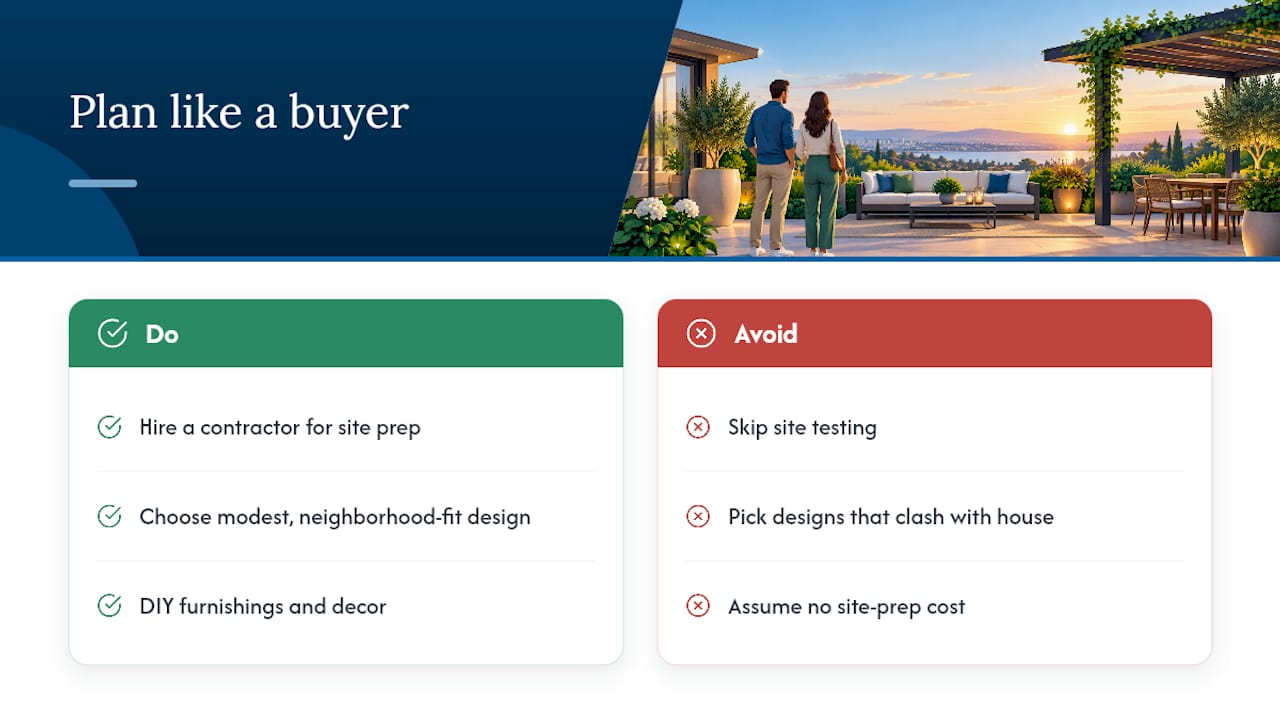
If ROI is your priority, resist the urge to build the most elaborate patio your yard can hold. A modest, well-built patio that fits the neighborhood almost always outperforms an extravagant one that doesn’t. Hire a contractor for grading, drainage, and base work, the parts that determine whether the patio lasts, and save DIY effort for furnishing and decor.
Watch for a few red flags before you commit to a design: a contractor who skips site testing, a design that clashes with your home’s style, or a budget that assumes no cost for site prep at all.
— Damian
How Divine Landscaping LLC helps homeowners build patios that protect resale value
If you want a patio designed with resale in mind rather than guesswork, that’s the project we build every day. Our patio installation services cover the full process from grading and drainage through paver or stone placement, and our landscape design work focuses on cohesion with your home’s existing style rather than a one-size-fits-all layout.
- Patio installation with proper site prep, drainage, and base compaction built into every project.
- Hardscape and masonry work for pavers, natural stone, walkways, and retaining walls.
- Lighting and irrigation additions that extend usable patio time without overbuilding the space.
Browse our project gallery or request a consultation through our patio installation page to get a realistic estimate for your property.
Authoritative reports and resources cited in this article
- NAR’s 2023 Remodeling Impact Report: cost-recovery benchmarks for outdoor projects.
- Homelight’s patio value analysis: buyer demand and staging insight.
- Angi’s patio cost breakdown: site-prep cost and failure-risk guidance.
- BLDG Realty’s renovation ROI guide: real-estate perspective on high-ROI upgrades.
Sources
- 2023 Remodeling Impact Report: Outdoor Features (NAR)
- Does a Patio Increase Home Value? Tips for Maximum ROI (Homelight)
- How much does it cost to install a patio? (Angi)
FAQ
What is the ROI on a paver patio?
Paver patios commonly show reported ROI in the 60% to 80% range across market guides, and NAR’s Remodeling Impact Report found a representative 18-by-16-foot concrete paver patio recovering close to 95% of its $10,000 project cost. Actual recovery depends on your neighborhood, design quality, and how well the patio fits the home.
How much would a 20×20 paver patio cost?
Installed paver material costs often fall in the $7 to $10 per square foot range, according to cost data from Angi. Total installed cost including base work and labor typically runs higher, so getting a project-specific quote is the most reliable way to budget.
How to increase home value by $50,000?
No single project reliably adds a fixed dollar amount since value gains depend on your home’s size, location, and existing condition. Combining several targeted improvements, such as a high-recovery patio, updated landscaping, and interior updates that match neighborhood comps, is a more realistic path than relying on one project alone.
What devalues a house the most?
Deferred maintenance and outdated or poorly executed renovations tend to hurt resale value more than any single missing feature. In outdoor projects specifically, skimping on site preparation, like drainage and base compaction, according to Angi’s guidance, causes failures that can make a patio a liability rather than an asset at sale.