
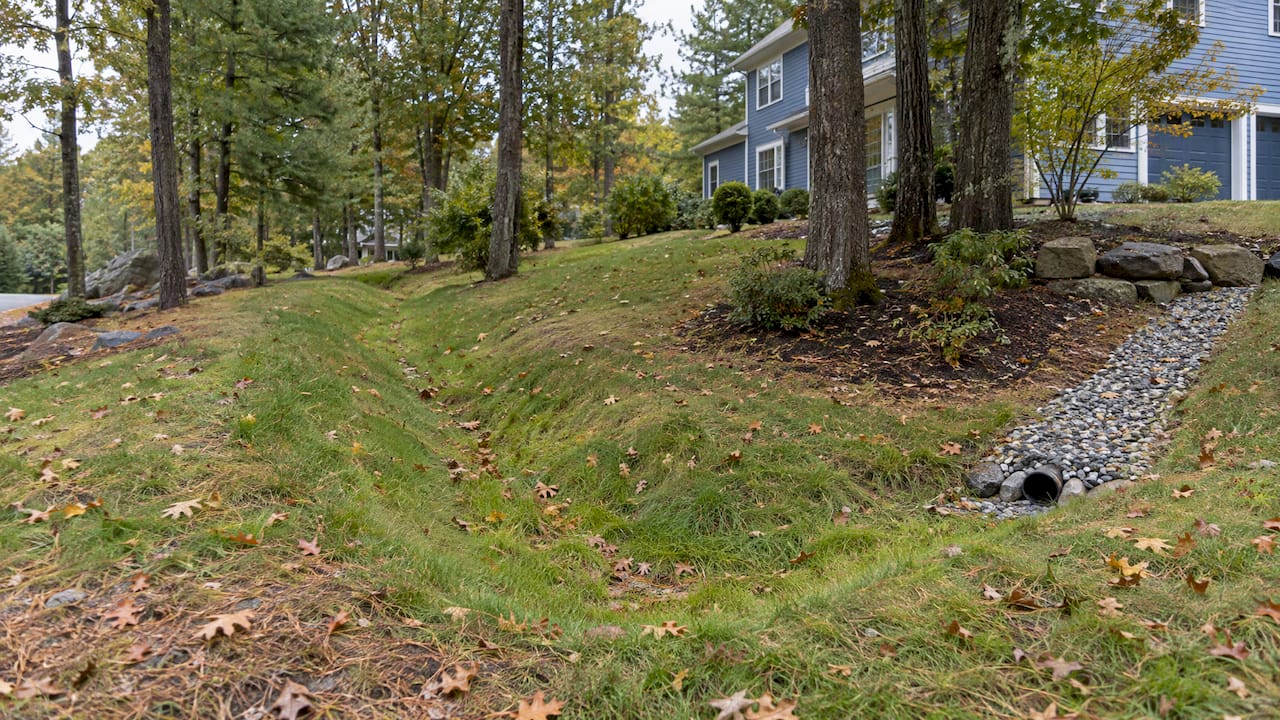
A swale is a shallow, graded channel that carries water you can see across the surface of your yard. A French drain is a buried, gravel-filled trench with a perforated pipe that collects water moving through saturated soil. If water runs across your lawn after a storm and you have room and slope, a swale is usually the fit. If the ground stays soggy, or there is no space or fall for a surface channel, a French drain is usually the fit. Many New Hampshire yards need both.
This guide explains how each one works, where each one fails, how they work together, and what to check in New Hampshire before anyone starts digging.
TL;DR
- A swale handles surface runoff. A French drain handles water below the surface. Matching the system to the water type matters more than which one costs less.
- Swales need room, gentle slopes and soil that drains. Steep slopes, compacted clay and high water tables work against them.
- French drains need a real outlet and enough fall. Without a place to discharge, the pipe only moves the puddle somewhere else.
- The two can be combined: a French drain can run at the base of a swale to speed up drainage.
- In New Hampshire, check shoreland rules and local runoff requirements before you dig, especially near water or on commercial sites.
Table of Contents
- How a swale and a French drain move water differently
- Start by identifying the water you have
- When a swale is the better choice
- When a French drain is the better choice
- Using both together
- What each option costs
- New Hampshire checks before you dig
- Let us plan drainage into your project
- FAQ
- Sources
How a swale and a French drain move water differently
The core difference is where the water travels. A swale is a shallow, usually vegetated channel built to convey, slow or soak in stormwater runoff. It works with the grade of your property: water flows across the lawn into the channel, then along it to a safe destination.
A French drain works under the surface. The same federal guidance describes it as a gravel trench with perforated pipe that intercepts subsurface water and carries it through the pipe toward an outlet. Water enters from the surrounding soil, not from the top of the yard. The NDS drainage primer describes the buried perforated pipe, gravel and filter fabric that let that happen.
| Swale | French drain | |
|---|---|---|
| Water it handles | Visible surface runoff | Water in saturated soil |
| Where it sits | At the surface, shallow and wide | Below ground, in a gravel trench |
| Look | Landscaped, often grassed or planted | Invisible once covered |
| Needs | Room, gentle slope, soil that drains | A discharge point and enough fall |
| Upkeep | Mowing, clearing debris, watching for erosion | Keeping the outlet clear, protecting the pipe from sediment |
| Typical fit | Larger, open yards | Tight sites, soggy ground, areas along foundations or walls |
Where surface drains fit in
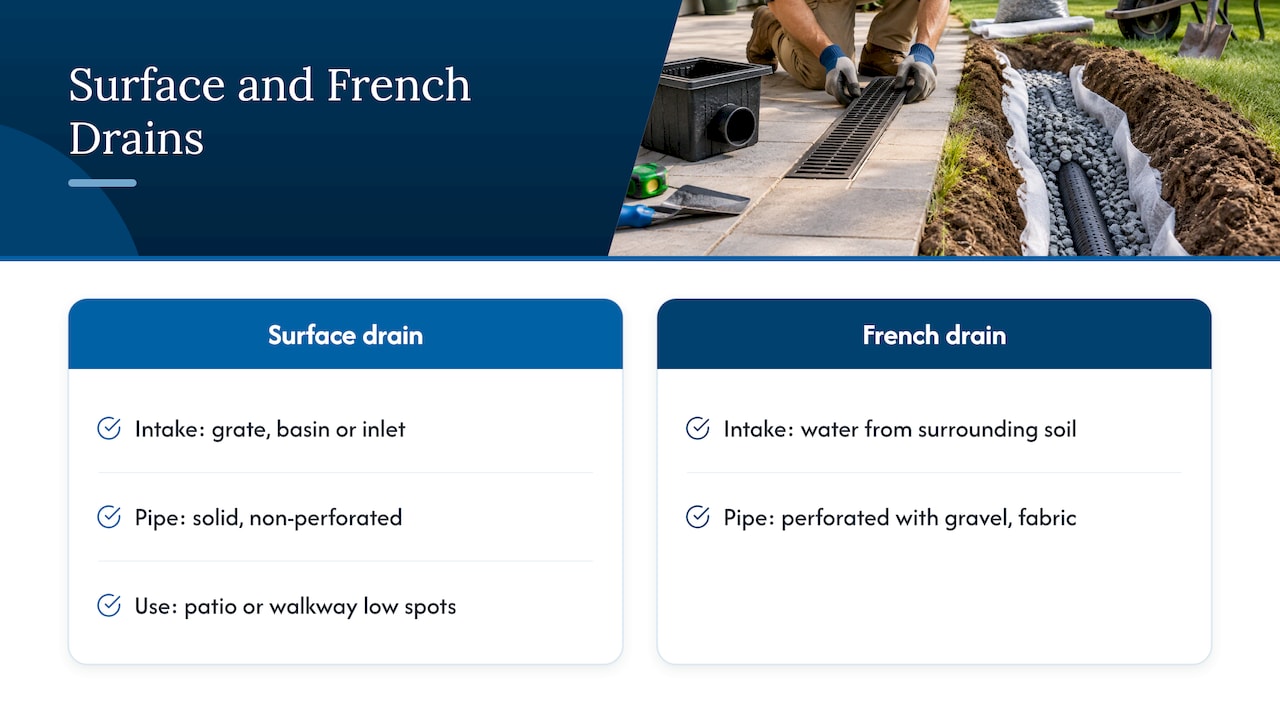
If you searched for a surface drain versus a French drain, the distinction is simple. A surface drain collects water at the top of the ground through a grate, basin or inlet, then sends it away through solid, non-perforated pipe. The NDS primer lists catch basins, drain inlets and area drains as the usual yard versions. Linear channel drains handle sheet flow across driveways, patios and other hard surfaces.
A French drain is the opposite in how it takes water in: perforated pipe, gravel and fabric let water in from the soil around it. For a patio or walkway that sheds water into a low spot, a surface drain is often the right tool. The Building America guidance mentions metal grated drains at the bottom of sloped driveways or walkways for exactly this reason. For more on patios, see our guide to patio drainage fixes that stop standing water.
Start by identifying the water you have
Most wrong installs come from skipping this step. Watch your yard during and after a heavy rain, then ask two questions.
- Is the water moving across the surface? If you see sheets or rivulets running downhill, pooling at a low corner, or washing mulch away, you have a surface water problem. A swale or surface drain is the starting point.
- Is the ground wet when it has not just rained? If your lawn squishes underfoot days later, or water seeps up near a foundation or retaining wall, you likely have a subsurface problem. A French drain is the starting point.
Most properties show a bit of both. Spring snowmelt on a saturated, still-thawing slope is a common New Hampshire example. If you want a structured way to work through this, our yard drainage diagnosis guide walks through it in under an hour.
When a swale is the better choice
Choose a swale when you have the space and the site cooperates.
- You have room. The federal guidance says to use swales where space is available to capture, control and filter runoff.
- The slope is gentle. Virginia Cooperative Extension advises against swales on slopes steeper than 4 percent, because fast water erodes the channel.
- The soil drains. The same extension fact sheet cautions against swales in compacted or high-clay soils, and where standing water tends to persist. It also recommends keeping the swale bottom at least 2 feet above the seasonal high water table.
- The drainage area is modest. EPA says grassed swales generally should treat areas smaller than 1 acre.
- You like a natural look. A swale can be shaped, seeded or planted so it reads as part of the landscape.
New Hampshire’s environmental agency also promotes this approach. Its homeowner stormwater guide encourages “Soak Up the Rain” strategies, including swales and dry wells, to manage stormwater on your own property.
Common swale problems
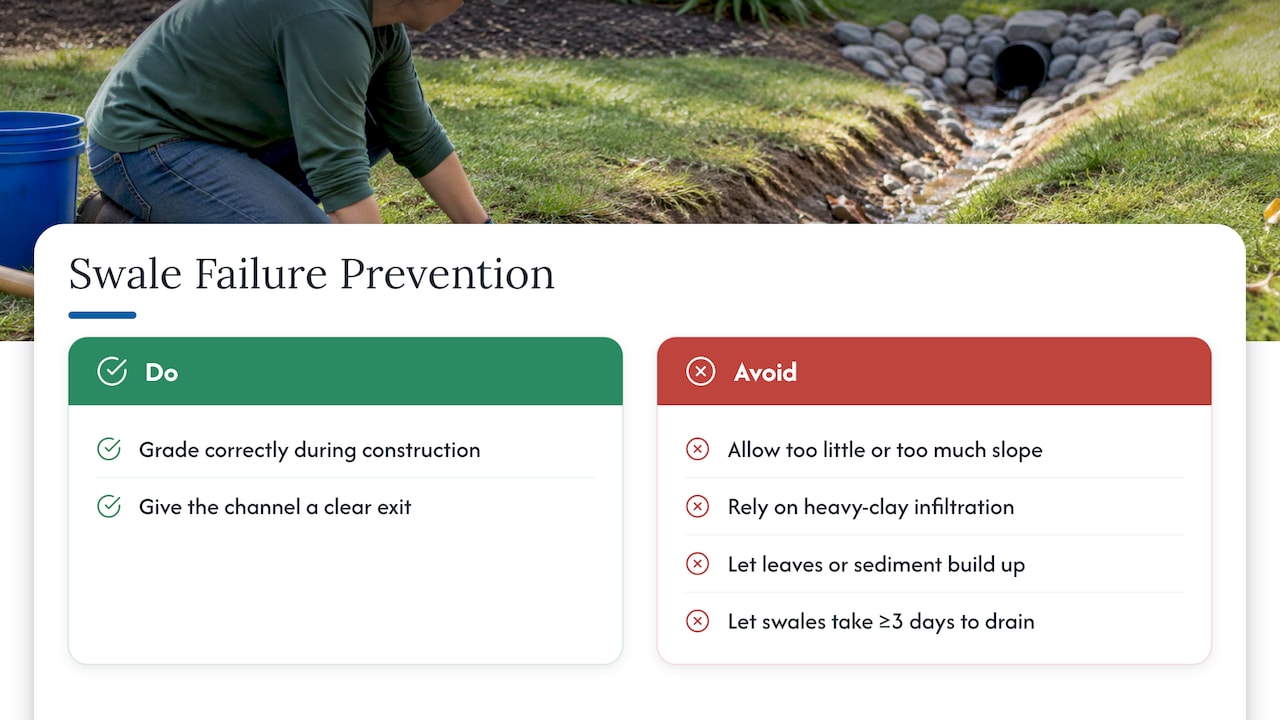
Swales fail in predictable ways. Too little slope and water sits. Too much and it erodes. Heavy clay stops infiltration. Leaves and sediment build up. EPA also notes that wet swales that take three or more days to drain can become mosquito nuisances. Getting the grade right during construction, and giving the channel a clear exit, prevents most of this.
When a French drain is the better choice
Choose a French drain when the water is underground or when a surface channel simply will not fit.
- The soil stays saturated. Professional inspector guidance says French drains suit waterlogged soil or sites without enough natural surface slope.
- Space is tight. The federal guidance notes that where room is limited, underground French drains can send water to drywells, sewers, community swales or retention ponds.
- Water collects behind a wall or along a foundation. A buried drain intercepts water before it builds up against the structure. Our retaining wall drainage checklist covers what to look for here.
- You want a clean surface. Once the trench is covered, nothing shows on the lawn.
Common French drain problems
The Stormwater Solutions article by landscape architect Russ Adsit is blunt about the limits. French drains are inefficient at dewatering poorly drained soils without adequate fall, and silt and clay can blind the fabric. Above all, a French drain does not fix a missing outlet. Every system needs somewhere for the water to go: daylight at a lower point, a drywell, a sump or an approved storm connection.
Pipe choice matters too. The Building America guidance notes that corrugated pipe tends to collect sediment and clog, which is why smooth PVC is the more durable preference for underground runs.
The lesson is not that French drains are a poor option. It is that they work best when designed with grade, fabric, pipe and discharge planned together.
Using both together
You do not have to pick one. The Building America guidance says a French drain can be installed at the base of a swale for faster drainage, sending water to a drywell, a retention area or a lower part of the site.
A typical combined layout on a sloping New Hampshire lot looks like this:
- A swale catches runoff from uphill and routes it around the house.
- A buried perforated pipe under the swale bottom helps water that would otherwise sit there soak away faster.
- The pipe or swale ends at a safe outlet, such as a lower area of the lot, a drywell or a stone-lined discharge.
- A grated surface drain handles the patio or walkway that sheds water toward the house.
If water is also reaching your foundation or basement, it helps to understand what interior fixes involve. This overview of basement waterproofing cost shows why diverting water outside first is usually the smarter order of work.
What each option costs
Cost depends on length, depth, soil, access, ledge and rock, pipe and stone, and where the water ends up. Rocky New Hampshire lots can add excavation time, which is why we have written about how rocky lots raise your bid. Swales are mostly grading and planting, so they tend to cost less per foot on open ground. French drains involve trenching, stone, pipe and fabric, so labor and materials add up faster. A drain run that must cross a driveway or be tied into other systems costs more again.
We do not publish set prices, because every property is different. A site visit is the only reliable way to price the work. Ask any contractor to itemize grading, excavation, materials, outlet work and restoration, so you can compare bids on the same scope.
New Hampshire checks before you dig
- Shoreland. If your property is near a lake, river or pond, speak with the NHDES Shoreland Program and your town planning department first. The state homeowner guide says a state or local permit may be needed in protected shoreland.
- Earth moving near water. NHDES describes certain protected-shoreland activities by size and slope, including 2,500 square feet or more, partly within 50 feet of surface water. A large regrade could cross that line.
- Town runoff rules. Some municipalities require that runoff after development not exceed pre-development rates. New Castle’s site plan regulations are one example, and the planning board there may require an engineering study for nonresidential projects. Commercial owners should ask their town early.
- Neighbors. Never send water onto a neighboring lot. Choose an outlet on your own property.
Your town’s planning or conservation office can tell you what applies to your address.
Our perspective on swales and French drains
We see drainage as part of the design, not a repair added at the end. The most common mistake we meet is choosing a fix by name before anyone has traced where the water comes from and where it can safely go. A swale, a French drain and a grated surface drain each solve a different problem.
That is why we start with grade. When we plan a patio, wall or walkway, we think about how water leaves the space before we choose the materials. A well-graded surface, a clear outlet and a drain placed where water actually collects protect the investment you are making in the outdoor space.
On many properties the best answer is a combination: shaping the land to guide surface water and adding buried drainage only where the soil needs it. Our goal is a solution that looks like part of the landscape and keeps working for years.
Damian
Let us plan drainage into your project
Divine Landscaping LLC designs and builds outdoor spaces for homeowners and business owners in New Hampshire and neighboring Massachusetts. We combine custom design with clear project management from consultation to installation, so drainage is planned alongside your patio, walkway, retaining wall or irrigation system rather than after it.

If standing water is affecting your yard, start with our landscape design service. If the problem sits around a patio or wall, see our masonry and hardscape work or patio installation. You can also contact us through our site to schedule a consultation.
FAQ
Is a swale better than a French drain?
Neither is better in general. A swale suits surface runoff on open, gently sloped ground with soil that drains. A French drain suits saturated soil or tight spaces where a surface channel will not fit. The better choice is the one that matches your water source and your site.
What are common problems with swale drains?
The usual causes are slopes that are too steep or too flat, compacted or clay soil, and a high water table. Extension guidance warns against swales in those conditions. Debris, erosion and slow-draining wet swales that attract mosquitoes are the main upkeep issues.
When should you not use a French drain?
Avoid one where there is no outlet or not enough fall for water to travel through the pipe. Silt and clay can also clog the fabric in poorly drained soils. In those cases, a surface solution, a drywell or a regraded yard may be a better plan.
Can I use a swale and a French drain together?
Yes. Federal building guidance describes installing a French drain at the base of a swale to speed up drainage, then sending the water to a drywell, retention area or lower part of the site. This works well on sloped lots with both surface runoff and wet soil.
Do I need a permit for yard drainage in New Hampshire?
Often not for small residential work, but it depends on location. Near lakes, rivers or ponds, shoreland rules may apply, and some towns set runoff requirements. Check with your town planning department and the NHDES Shoreland Program before you dig.
Sources
- Swales, Drains, and Site Grading for Stormwater Control (Building America Solution Center)
- French Drain vs. Swale (Drainage Helper)
- Principles of Exterior Drainage (NDS)
- French Drain Inspection (InterNACHI)
- Grassed Swales stormwater best management practice (EPA)
- Stormwater Management for Homeowners, Fact Sheet 4 (Virginia Cooperative Extension)
- French Drains and Their Downfall (Stormwater Solutions)
- New Hampshire Homeowner’s Guide to Stormwater Management (NHDES)
- Rules updates in the Land Resources Management Program (NHDES)
- Site Plan Review Regulations (Town of New Castle, NH)
- Basement Waterproofing Cost (USA Spray Me)