
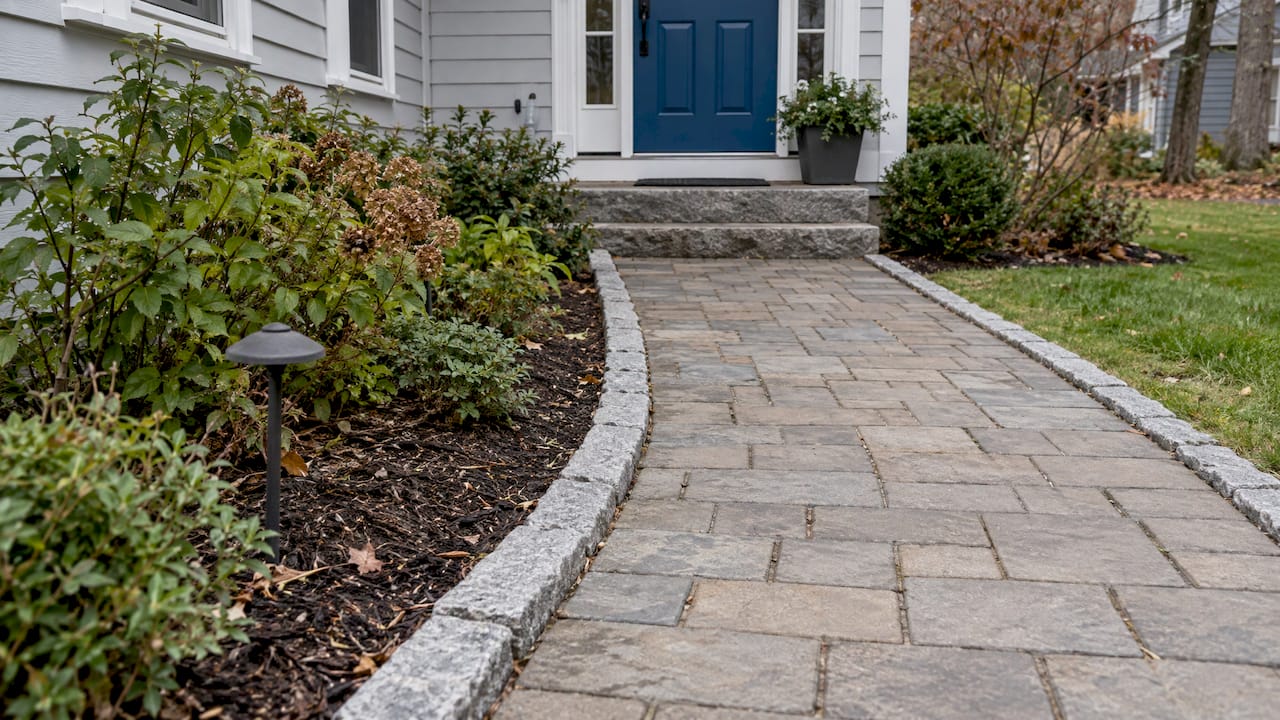
The best walkway edging for a New Hampshire property is the one that matches your walkway’s style and is built on a solid base. Paver or stone edging gives the most finished look. Thin metal edging disappears into the landscape and holds curves. In both cases, how deep and how firmly the edge is set decides whether it still looks right after a few freeze-thaw winters. We design and build walkways with the edge planned as part of the walkway, not added afterward.
Below you will find the main edging ideas, what each does well, how to match them to your home, and what to check for in a New Hampshire winter.
TL;DR
- Paver and stone edging give the most polished, permanent border and double as a mowing strip. Natural stone suits rustic paths and cut stone suits formal ones.
- Steel or aluminum edging is nearly invisible, holds gentle and tight curves, and works well with gravel and mulch.
- Plastic edging is the one most likely to lift in cold climates, so avoid it for paver walkways.
- Pavers need an edge restraint even on a walkway. It sits hidden underground, and the base and anchoring matter more than the visible material.
- Frost is the real test. A deep base, proper anchoring and drainage matter more than the product you pick.
Table of Contents
- What walkway edging actually does
- Paver edging ideas
- Stone edging for paths
- Metal edging for walkways
- Other classic ideas
- Which edging fits which walkway
- What New Hampshire winters do to an edge
- What the 3-inch edging rule means
- Checks before you choose
- Our perspective
- Have your walkway and edge built together
- FAQ
- Sources
What walkway edging actually does
Edging has three jobs. It contains the path material (pavers, gravel or stone dust), it keeps lawn and mulch from creeping onto the walking surface, and it gives the walkway a clean line. The Spruce describes edging as containing the path, adding decoration and transitioning between hardscape and garden.
On a front walk, that clean line is a large part of your curb appeal. On a commercial property it also affects safety, because an edge that sits proud of the walking surface can catch a shoe or a cane. Plan the edge when you plan the walkway. If you are still choosing the walkway surface, our guide to front walkway materials is a good first step.
Paver edging ideas
Paver edging is the most popular choice when the walkway itself is made of pavers. There are really two different things people mean by the term, and it helps to separate them.
The visible border: a soldier course or contrasting band
A row of pavers set in a contrasting color or a different pattern frames the walkway like a picture frame. Common designs include:
- Soldier course: pavers set on end, side by side, running along both edges of the walk.
- Sailor course: pavers set on their long side, giving a wider, bolder band.
- Contrasting color border: a charcoal band around a lighter field, or the reverse, to echo your siding or roof.
- Curved border: a band that follows a gently sweeping path, which suits a front entry that meets a garden bed.
This is a design decision, and it is easier to get right in the layout stage. Our landscape design service is where we work out border widths and patterns against your house and plantings.
The hidden part: the edge restraint
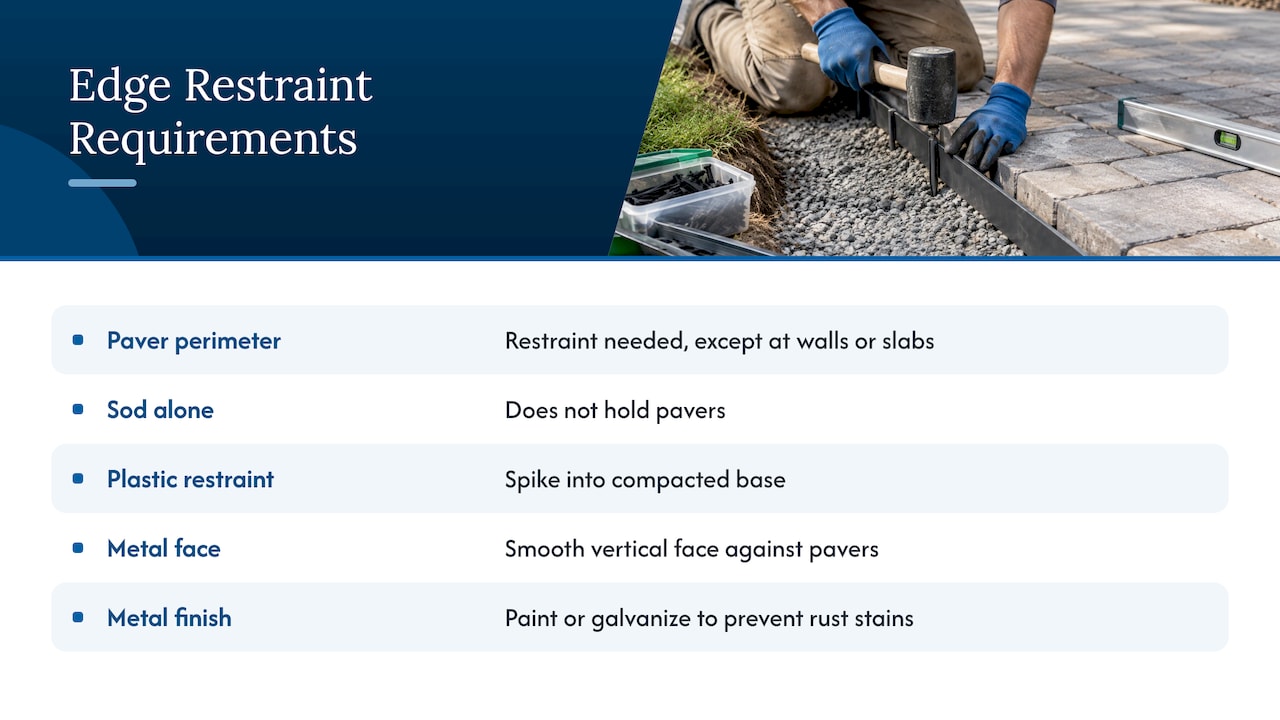
Every paver walkway also needs a restraint, the buried strip that stops the pavers from spreading. Belgard explains that the paver field should be secured with paver edge restraints, hidden underground once sand and sod are added, and that they are not needed where pavers meet a wall or concrete slab.
The contractor guide from Ideal Concrete Block, written for New England work, goes further: pavers need to be restrained around the perimeter even for walkways, and sod alone does not hold them. The same guide warns that troweled concrete edging may crack in New England freeze-thaw cycles. It adds that pavers take their heaviest loads when the compactor runs along the edge during installation, so a weak edge that shifts at that moment leads to spreading and settling later.
The Concrete Masonry & Hardscapes Association says plastic restraints should be designed for pavers and anchored with spikes into the compacted base, not into the soil. For metal, it calls for a smooth vertical face against the pavers, with steel painted or galvanized so rust does not stain the stone.
For you as an owner, the takeaway is simple: the restraint is the part nobody sees and the part that decides whether the walkway stays flat.
Stone edging for paths
Natural stone gives a path a permanent, grounded look, and it suits New England architecture well. The main options:
- Granite: crisp, dense and long-lived. Cut granite curbing suits a formal brick or paver walk.
- Bluestone: a flat, refined look that pairs well with traditional homes.
- Fieldstone: rounded, weathered stones that fit a rustic walk or a stone wall nearby.
- Flagstone and cut stone: Better Homes & Gardens notes these make attractive edging, especially along wide paths, and that pieces of the same width give the most uniform look.
Size and setting matter
Garden Gate magazine quotes a pro who recommends natural stones 6 to 8 inches tall and wide so grass roots cannot grow under or over them. The stones sit on a 2-inch base of 3/8-inch aggregate rather than sand alone, which avoids settling, and are set just above ground level so a mower can run over the top.
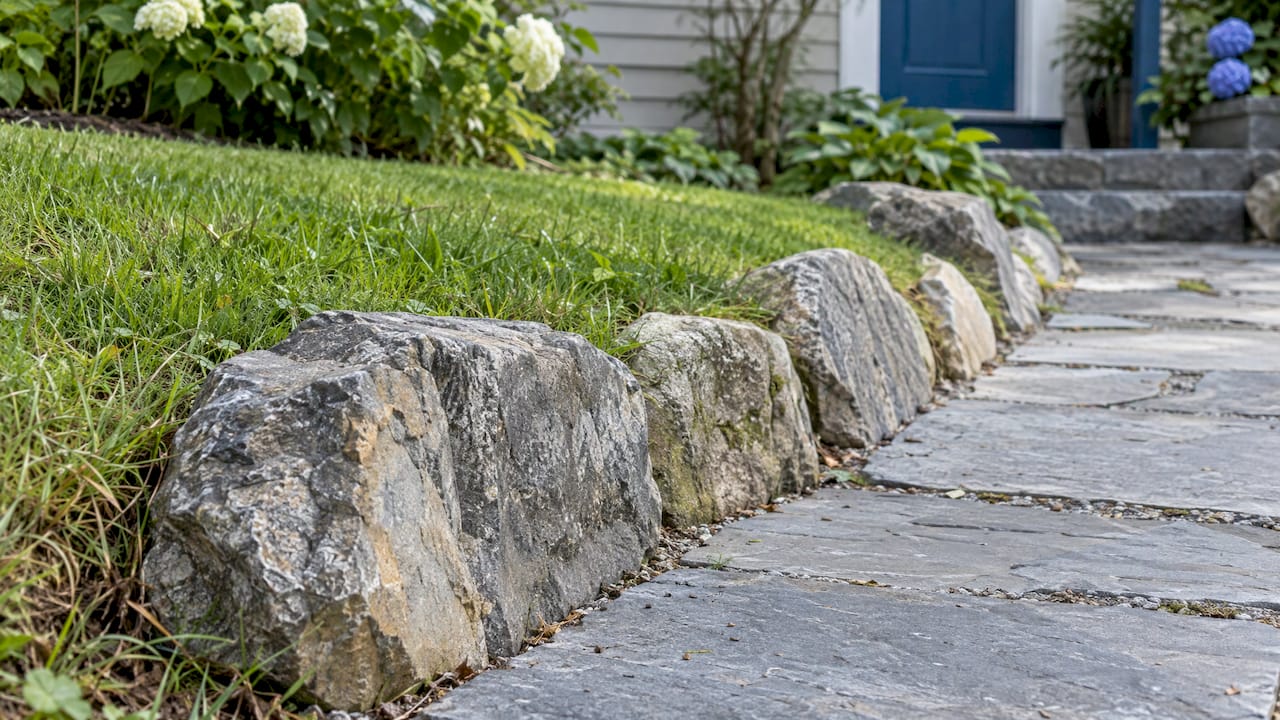
In a frost climate, bigger is better. Total Landscape Care reports that large fieldstones stay in place better than small ones that freeze-thaw undermines. Heavy, deeply set stone is a good match for New Hampshire.
Match the stone to the walkway
Keep the style consistent. Cut granite or bluestone looks right beside a formal paver or brick walkway. Weathered fieldstone or limestone belongs with a natural flagstone path. A mismatch is the most common reason an edge looks like an afterthought.
Metal edging for walkways
Metal edging is the quiet option. A thin steel or aluminum strip is set on edge, held with stakes, and sits nearly flush with the ground. It works best where you want the path or bed to read cleanly without a visible border.
- Steel: very durable and holds a crisp line. The CMHA guidance above calls for painted or galvanized steel against pavers so rust does not stain them. Landscape Management notes that raw steel may rust faster outside dry, noncoastal areas.
- Aluminum: will not rust, is lightweight and flexible, and, per the same article, does not expand or contract with temperature or moisture. That is a real advantage with freeze-thaw swings.
- Best uses: curved walkways, gravel and stone-dust paths, and the line between a path and a planting bed.
One safety point for any property with public foot traffic: a metal edge must be set low enough that it never stands above the walking surface. Cut ends should be buried or rounded. This is a detail we plan for on commercial walks.
Plastic edging is cheaper and flexible, but in cold climates it is the weakest link. Total Landscape Care advises avoiding plastic edging to hold pavers because it heaves in cold weather. For a walkway you plan to keep for years in New Hampshire, we would choose paver, stone or aluminum and steel instead.
Other classic ideas
- Brick: a traditional border that suits older New England homes. Set on end as a soldier course, it frames a gravel or paver walk well.
- Poured concrete curbing: gives a firm, continuous mowing strip. In freezing climates, the Ideal Concrete Block guide cautions that concrete edging may crack, so reinforcement and base preparation matter.
- Gravel or pea stone path with a hard edge: loose material needs a border deep enough that stone cannot escape underneath. This is where a steel or aluminum edge earns its place.
- Wood: cedar or other rot-resistant lumber and bender board suit a cottage-style path. The Spruce lists wood borders among the standard options, but wood is the shortest-lived choice in a wet, freezing climate.
- Plant edging: a low border of perennials set back from the path softens any hard edge. Keep the plants off the walking surface so the path stays usable and dry.
Which edging fits which walkway
| Walkway type | Edging that fits | Why |
|---|---|---|
| Paver front walk | Paver border plus a hidden restraint | Clean, permanent, matches the surface |
| Natural flagstone path | Fieldstone or weathered limestone | Same character as the path |
| Gravel or stone dust path | Steel or aluminum, set deep | Holds loose material and the line |
| Curved garden path | Aluminum or steel | Bends smoothly and stays discreet |
| Formal entry | Cut granite or bluestone | Crisp line, long life |
| Commercial walkway | Flush, low-profile edge | Safe for foot traffic and mobility aids |
If your walk will also carry wheelchairs, strollers or deliveries, check the width too. Our guide to walkway width for accessibility covers it. For slick surfaces in winter, see our notes on non-slip walkway materials.
What New Hampshire winters do to an edge
Frost heave is the main enemy. Water in the soil freezes, expands and pushes light or poorly anchored edging upward. Total Landscape Care explains that heave is reduced by cutting off one of its conditions: limiting frost penetration, keeping water out of the freezing zone, or making sure the soil in that zone is not frost-susceptible. Clay-like soils call for a deeper base.
That is why the same edging product can look perfect on one walkway and wavy on another. The difference is almost always below the surface:
- Base depth: a compacted crushed-stone base that extends past the edge gives it something solid to bear on.
- Anchoring: spikes that reach into the base, not just the topsoil.
- Drainage: water that cannot leave the area will freeze there. Slope the surface away from the walkway, and fix standing water first. Our patio drainage fixes apply to walks as well.
- Backfill: compacted stone behind the edge rather than loose soil.
- Salt and plows: keep de-icing salt and snow-pile pressure in mind when you choose the material and set its height.
For a deeper look at how winter moves hardscape, read our freeze-thaw paver damage checks.
What the 3-inch edging rule means
People use “the 3-inch rule” loosely, and it usually points to trench depth. Lowe’s guidance for setting edging stones is to dig a trench about 2 to 3 inches deep, depending on the stones. That is a minimum for light garden stones, not a standard for a walkway in a frost zone. Heavier stone and paver restraints need a deeper, properly compacted base, and the right depth depends on your soil and the material.
Checks before you choose
Before you commit to an edge, run through these:
- Call 811 first. Utilities must be marked before anyone digs a trench.
- Look at drainage. If water stands after rain, solve that before you build.
- Think about the mower. An edge set level with the lawn lets the mower run along it and cuts trimming time.
- Think about the plow and the shovel. A low, flush edge suffers less from winter snow removal.
- Check the height. Nothing along a walking route should stand above the surface.
- Match the house. The edge should echo your home’s materials, from the foundation stone to the walkway.
If you are comparing options for a driveway as well, our driveway edging guide covers the heavier loads. For the basics of the term, see what edging is in landscaping.
Our perspective
We build the edge first in our heads, before the walkway goes in. A path is only as good as what holds it, and in New Hampshire that means a base that is deep enough, material that is heavy enough and a layout that drains.
Our team brings more than 20 years of combined hands-on experience to custom design that is tailored to each property. We use premium materials and manage the project clearly from the first consultation to installation, so the border, the walkway and the plantings arrive as one design.
When owners ask us which edging is best, we start with their house and yard rather than a product. A formal entry gets one answer, a curved garden path another, and a commercial walk another still. Our work is backed by a satisfaction guarantee.
Damian
Have your walkway and edge built together
We design and install walkways, patios, retaining walls and other hardscape for homes and businesses in New Hampshire and neighboring Massachusetts. Walkway installation and repair is part of our masonry and hardscape work, and edging is planned in from the start.

See our masonry and hardscape services or browse the project gallery for walkway ideas. When you are ready to talk about your property, start with the consultation through our website.
FAQ
What is the best material for a walkway edge?
For a paver walkway, a paver border with a hidden restraint is the most finished and permanent. For natural paths, heavy stone such as granite or fieldstone suits New Hampshire. For curves and gravel, aluminum or steel gives a clean, low-profile line.
Which landscape edging is best for freeze-thaw winters?
Heavy stone and properly anchored metal perform best, as long as they sit on a compacted stone base with good drainage. Plastic is the most likely to lift, so we avoid it for walkways meant to last.
Is concrete landscape curbing worth it?
It gives a firm, continuous line and works well as a mowing strip. In freeze-thaw climates, concrete edging can crack if the base and reinforcement are not right, so the installation quality matters as much as the material.
Do paver walkways really need edging?
Yes. Pavers need a perimeter restraint even on a walkway, because sod does not hold them in place. The restraint is buried, so you do not see it, but it keeps the surface from spreading and settling. The exception is where the pavers meet a wall or a concrete slab.
Sources
- Materials for Landscape Edging, Patios, and Paths, The Spruce
- Explore Paver Border and Edging Options, Belgard
- A Contractor’s Guide to Paver Installation, Ideal Concrete Block
- Edge Restraints for Interlocking Concrete Pavements, CMHA
- How to Install Edging, Better Homes & Gardens
- Garden Edging Techniques: Tips From the Pros, Garden Gate
- Hardscaping: how to deal with frost heave damage, Total Landscape Care
- Leading edge(ing), Landscape Management
- Create a Border Using Edging Stones, Lowe’s