
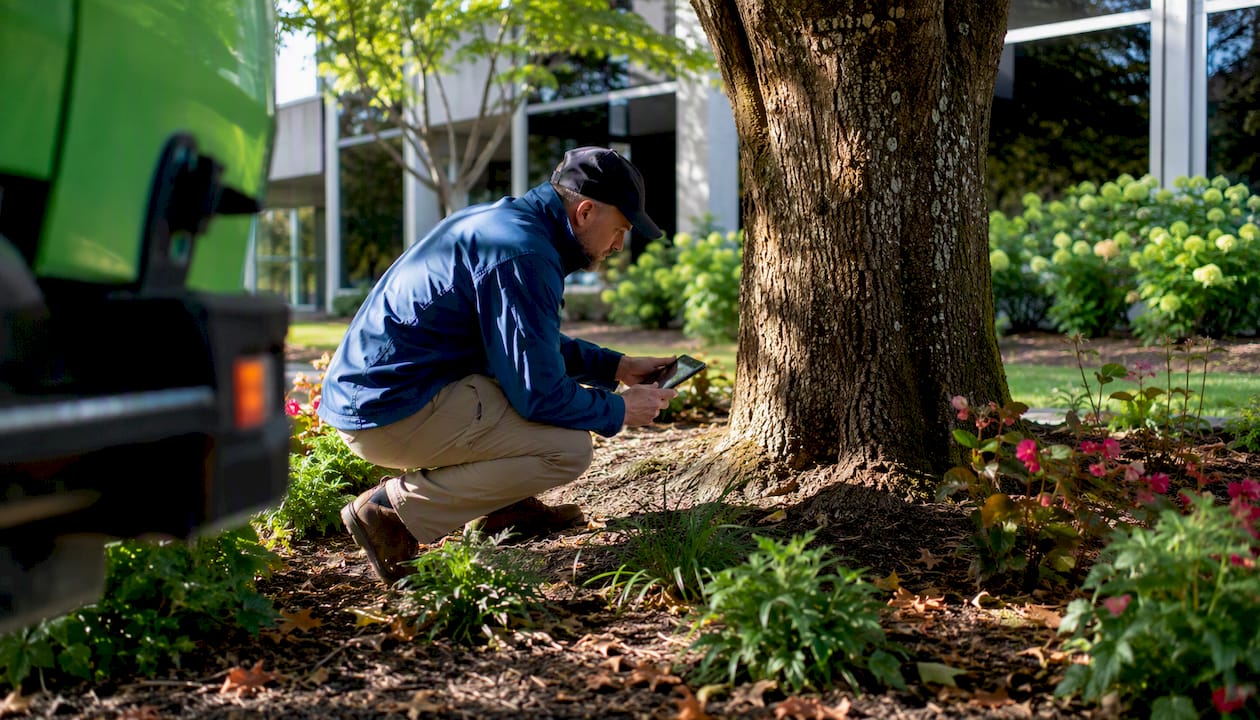
Commercial property tree care is the planned, professionally managed program of tree services applied to non-residential properties, including office parks, retail centers, industrial campuses, HOA common areas, and multi-tenant buildings. As part of commercial property maintenance, it covers everything from routine pruning and health assessments to emergency storm response and full tree removal. Think of it less as a landscaping add-on and more as a risk-management and asset-preservation program that should be scheduled, documented, and budgeted on a recurring cycle.
If you manage a commercial property, an HOA, or a business campus, here is what a complete program includes:
- A full tree inventory with species, size, condition ratings, and location data
- Scheduled pruning, structural work, and plant health care (PHC)
- ISA-based risk assessments with written reports and photos
- Emergency response capacity with documented response times
- Species-appropriate planting and long-term site planning
The International Society of Arboriculture (ISA) sets the professional standards that credentialed providers follow. GIS-based tree mapping ties your inventory to site plans and utility layouts, making it a practical tool for budgeting and permit support. Divinelandscapingllc works with New Hampshire commercial properties on exactly this kind of structured and documented program.
Key Takeaways
A documented, ISA-based commercial tree care program is the most reliable way to reduce premises liability, protect asset value, and control long-term maintenance costs on commercial properties.
| Point | Details |
|---|---|
| Start with a full inventory | Commission an ISA Certified Arborist to assess every tree before scheduling any work. |
| Require written risk assessments | Dated reports with photos are your primary defense in liability and insurance claims. |
| Budget across multiple years | Separate annual maintenance from capital removals and amortize large removals over three to five years. |
| Include emergency SLAs in contracts | Require a stated response time and documented cleanup standard before signing. |
| Choose non-invasive species when planting | Species selection at planting prevents costly sidewalk, curb, and utility repairs later. |
| Divinelandscapingllc for NH properties | Coordinates assessments, maintenance programs, and planting for commercial sites in New Hampshire. |
Table of Contents
- What does commercial tree care actually include?
- Why does commercial tree care matter for your property?
- Who should perform commercial tree work, and what credentials matter?
- Why does a tree inventory matter for your commercial site?
- How does commercial tree care differ from residential work?
- How do you build a commercial tree care program from scratch?
- What should you look for when evaluating tree care providers?
- What drives cost in commercial tree care?
- How do you manage hazard trees and storm response?
- What a commercial tree care engagement looks like step by step
- What most commercial tree programs get wrong
- Divinelandscapingllc supports your commercial tree care program in New Hampshire
- Useful resources for commercial tree care programs
- Sources
What does commercial tree care actually include?
The scope of commercial tree care services goes well beyond trimming branches. A qualified provider delivers a full menu of services that certified arborists coordinate from roots to canopy:
- Inspection and risk assessment: ISA-based visual assessments that rate each tree for structural defects, disease, root problems, and proximity hazards. These produce written reports used for insurance and liability defense.
- Structural pruning and crown management: Crown thinning, clearance pruning (for signage, lighting, and pedestrian paths), and deadwood removal on a scheduled cycle.
- Tree removal and stump grinding: Includes crane and rigging work for large or constrained removals near buildings, utilities, or parking structures.
- Plant health care: Fertilization, soil aeration, pest and disease diagnosis, and targeted treatments. Urban compaction and root-space constraints make PHC especially important on commercial sites.
- Planting and species selection: Choosing site-appropriate, non-invasive species that won’t damage sidewalks, curbs, or underground utilities. Selecting non-invasive species upfront is consistently more cost-effective than repairing infrastructure after root damage appears.
- Emergency response and storm cleanup: 24/7 triage, debris removal, and traffic control after severe weather events.
- Ongoing monitoring and reporting: Scheduled re-inspections, updated condition ratings, and documentation delivered to the property manager.
Commercial arboriculture programs typically formalize these into multi-year site plans that cover structural support, soil programs, and storm response protocols in a single contracted scope.
Why does commercial tree care matter for your property?
Safety is the most direct argument. A structurally compromised tree near a parking lot, building entrance, or pedestrian path is a premises-liability exposure. Documented, scheduled inspections create a paper trail that demonstrates due diligence, which is your first line of defense if a tree-related incident leads to a claim.
Beyond liability, trees are a measurable part of your property’s asset value. Mature, well-maintained trees contribute to curb appeal, tenant satisfaction, and lease renewal rates. Neglected or hazardous trees do the opposite: they signal deferred maintenance and can trigger lease renegotiations or insurance premium adjustments.
Programmed commercial tree maintenance reduces reactive costs, supports consistent standards across multiple sites, and improves scheduling and reporting for facility managers. The math is straightforward: a scheduled pruning cycle costs a fraction of what an emergency removal after storm damage costs, and it avoids the operational disruption of an unplanned closure.
Shade trees also reduce cooling loads on adjacent buildings during summer months, which translates to measurable energy savings. Biodiversity benefits, including pollinator habitat and stormwater absorption, are increasingly relevant for properties pursuing sustainability certifications.
Pro Tip: When presenting a tree care budget to a board or ownership group, break it into two line items: scheduled maintenance (predictable, annual) and capital removals/replacements (amortized over three to five years). This framing makes approval easier and prevents sticker shock from large one-time removals.
For a broader look at how tree care fits into your overall grounds program, landscape maintenance basics provide useful context on scheduling and documentation practices.
Who should perform commercial tree work, and what credentials matter?
Not every tree service company is qualified for commercial work. The credential that matters most is the ISA Certified Arborist designation. An ISA Certified Arborist has passed a comprehensive exam covering tree biology, diagnosis, pruning standards, risk assessment, and safety practices, and must maintain continuing education to keep the credential active. For commercial properties, you want at least one ISA Certified Arborist directing the work and signing off on written risk assessments.
Beyond the arborist credential, require the following from any provider before signing a contract:
- Proof of general liability insurance with limits appropriate for commercial work (typically $1 million per occurrence minimum, often higher for large sites)
- Workers’ compensation coverage for all crew members, including subcontractors
- State contractor licensing where required in your jurisdiction
- EEOC and OSHA compliance documentation: contractors working on your site should be able to demonstrate federal workplace compliance, including required postings and safety protocols
- Sample arborist reports and tree risk assessments from comparable commercial projects
- References from property managers or HOA boards, not just residential clients
Written risk assessments with photographic documentation are particularly important. Detailed tree risk reports are a practical requirement for defending liability claims and satisfying many insurance carriers. Ask to see a sample report before you hire.
Why does a tree inventory matter for your commercial site?
A tree inventory is the foundation of every well-run commercial tree program. Without one, you are managing reactively, responding to visible problems rather than tracking the full population of trees on your property and their condition trends over time.
A complete inventory captures the following for each tree:
| Data Field | What It Records | How It’s Used |
|---|---|---|
| Species | Common and scientific name | Species-specific maintenance needs, invasive risk |
| DBH (diameter at breast height) | Trunk diameter in inches | Size-based cost estimation, permit thresholds |
| Condition rating | Structural integrity, canopy health, root zone | Priority ranking for pruning or removal |
| Location | GPS coordinates or site-plan reference | GIS mapping, utility conflict identification |
| Priority rating | Immediate, near-term, or long-term action | Budget allocation and scheduling |
| Photos | Dated images of defects or conditions | Insurance defense, progress tracking |
GIS mapping integrates this data with your site plan, utility layouts, and maintenance schedules. The result is a living document you can use to generate multi-year management plans, support permit applications, and respond to insurance inquiries with dated, georeferenced evidence.
Insist on data portability when you commission an inventory. Formats to request include CSV exports, shapefiles for GIS platforms, and PDF summary reports. Plan for updates every two to three years, or after any significant storm event.
How does commercial tree care differ from residential work?
The differences are significant enough that a residential tree service is often the wrong choice for a commercial property, even a small one.
- Scale and scope: A commercial site may have hundreds of trees across multiple acres or multiple locations. Managing that population requires systematic inventory, scheduling software, and crew coordination that residential contractors rarely maintain.
- Equipment: Large commercial removals near buildings, utilities, or occupied parking areas often require cranes, rigging systems, and staged traffic controls. Complex removals demand specialized equipment and planning that goes well beyond a residential bucket truck.
- Documentation and compliance: Commercial clients need written reports, dated photos, risk-assessment sign-offs, and insurance certificates. Residential contractors typically don’t produce this level of documentation.
- Scheduling constraints: Commercial work must often happen outside business hours, on weekends, or in coordinated phases to avoid disrupting tenants, customers, or traffic. That requires a provider with the crew size and flexibility to work within those windows.
- Emergency capacity: A residential contractor may not have 24/7 availability or the crew size to respond to a multi-tree storm event across a large property.
For property managers overseeing multi-tenant properties, a single commercial provider managing the full tree population is almost always more efficient than coordinating multiple residential contractors.
How do you build a commercial tree care program from scratch?
A structured program follows five steps. Each one builds on the previous, so skipping the inventory phase, for example, makes budgeting and scheduling guesswork.
- Commission a full site assessment and tree inventory. An ISA Certified Arborist walks the property, records every tree, assigns condition ratings and priority scores, and delivers a written report. This is your baseline.
- Prioritize by risk, then by preservation value. Address immediate hazards first: dead trees over occupied areas, structurally compromised trees near buildings or utilities. Then schedule preservation work for high-value mature trees.
- Design a recurring maintenance schedule. Most commercial properties need a regular pruning cycle every few years per tree, annual PHC applications, and re-inspection after each major storm. Document the schedule in the contract.
- Convert inventory priorities into a three-year budget. Separate annual maintenance costs from capital removals and replacements. Spreading the cost of large removals over multiple years makes the budget predictable and defensible to ownership.
- Structure the contract with clear deliverables. The scope of work should specify service frequencies, SLA response times for emergencies, documentation deliverables (reports, photos, updated inventory), and scheduling windows.
When writing an RFP, include these requirements:
- Proof of ISA Certified Arborist on staff
- General liability and workers’ comp certificates
- Sample arborist report from a comparable commercial project
- Emergency response protocol and guaranteed response time
- Subcontracting policy and how subcontractors are credentialed
Landscape planning on a regular annual basis that incorporates tree care into the broader grounds budget helps property managers avoid year-end surprises and keeps capital planning on track.
What should you look for when evaluating tree care providers?
Vendor selection for commercial tree work comes down to credentials, documentation practices, and emergency capacity. Here is a practical checklist:
- ISA Certified Arborist on staff (verify the credential at the ISA website)
- General liability insurance with commercial-grade limits
- Workers’ compensation covering all crew members and subcontractors
- Equipment inventory that includes cranes or rigging for large removals
- References from property managers, HOAs, or commercial facility teams
- Sample written risk-assessment report from a comparable site
- Documented emergency response protocol with a stated response time
- Clear subcontracting policy with credential requirements for subs
Red flags to watch for:
- No ISA credential or inability to name the credentialed arborist on the team
- Verbal-only risk assessments with no written report or photos
- Insurance certificates that don’t cover subcontractors
- Vague SLA language (“we respond as soon as possible” without a time commitment)
- No references from commercial clients
Validate references by asking specifically about documentation quality, scheduling reliability, and how the provider handled an emergency or unexpected situation. A provider who performed well under pressure is worth more than one with a polished proposal.
Commercial lawn care programs often run alongside tree care under the same contract, so ask whether the provider can coordinate both services to reduce vendor management overhead.
What drives cost in commercial tree care?
Pricing for commercial tree work varies widely based on several factors. Understanding them helps you evaluate bids and build a realistic budget.
- Tree size (DBH): Larger-diameter trees require more time, larger equipment, and more crew. Trees of different sizes vary significantly in cost, with larger-diameter trees requiring more time, equipment, and crew.
- Access and site constraints: Trees near buildings, power lines, or occupied parking areas require rigging, cranes, or phased work, all of which add cost and time.
- Hazardous removals: Trees with significant structural defects or in confined spaces require additional safety planning and specialized equipment.
- Stump grinding: Usually priced separately from removal; depth and root spread affect the time required.
- Permits: Some municipalities require permits for removing trees above a certain DBH. Permit fees and the time to obtain them add to the project cost.
- Program vs. one-off pricing: Providers typically offer lower per-unit rates for contracted annual programs than for one-off calls. Scheduled programs can reduce per-site costs and give you priority scheduling over reactive clients.
For timelines: a full inventory of a mid-size commercial property typically takes several days. A pruning cycle for a large property may be scheduled across multiple visits over several weeks. Single-tree removals are usually completed in one day; complex multi-tree removals near structures can run two to three days.
Pro Tip: Budget large removals as capital expenditures, not operating expenses. Spreading the cost of three to five major removals across a three-year capital plan avoids budget spikes and gives you time to plan replacements with appropriate species.
How do you manage hazard trees and storm response?
Storm preparedness is where the difference between a documented program and an ad hoc approach becomes most visible. A property with a current tree inventory and a contracted emergency response protocol recovers faster and with less liability exposure than one that calls around for help after the storm.
Your emergency response plan should include:
- A contracted 24/7 response commitment with a stated arrival window
- A triage protocol: identify and address trees blocking access, utilities, or occupied areas first
- Traffic and tenant communication procedures for active removal zones
- A cleanup standard defined in the contract (chip and haul vs. log-length removal)
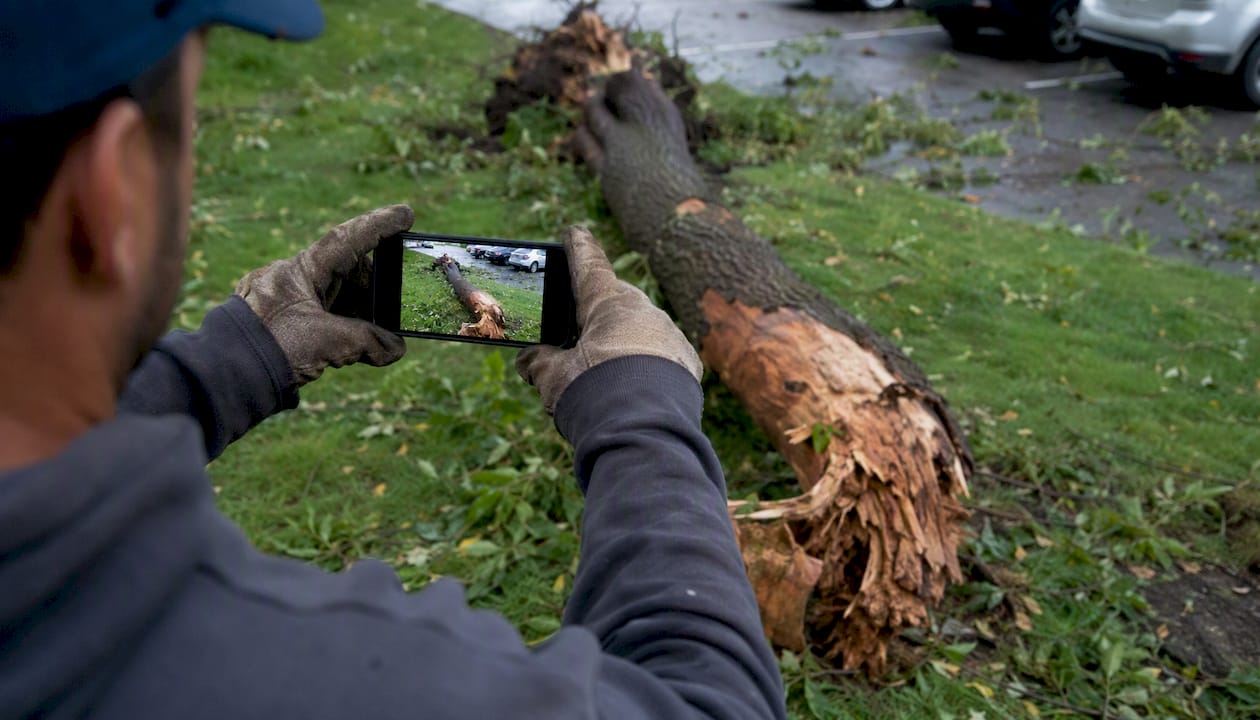
- Post-storm documentation: dated photos, work orders, and a written summary for insurance
For ongoing risk mitigation between storms, structural pruning reduces wind resistance and removes failure points before they become emergencies. Cabling and bracing can extend the life of high-value trees with structural defects. Root support measures, including soil aeration and root-zone protection during construction, prevent the slow decline that makes trees hazardous years later.
All post-storm work should be documented with photos, dated work orders, and a written report. This documentation is your primary defense if a tenant or visitor files a claim related to storm damage.
What a commercial tree care engagement looks like step by step
Here is how a well-run commercial tree care job progresses from first contact to hand-off, based on standard industry practice:
- Initial site assessment: An ISA Certified Arborist walks the full property, records each tree’s species, DBH, condition, and location, and assigns a risk priority score. The output is a written inventory report with photos.
- Proposal with prioritized scope: The provider delivers a written proposal that separates immediate hazards from scheduled maintenance work, includes a safety plan for each phase, and specifies scheduling windows that minimize tenant disruption.
- Execution: Crew stages equipment, establishes traffic controls, and works through the scope in priority order. Pruning, removals, stump grinding, and PHC applications happen in coordinated phases.
- Site cleanup: All debris is chipped or hauled, work zones are restored, and the site is left in better condition than found.
- Post-work deliverables: The arborist delivers a final written report with dated photos, updated inventory records, treatment recommendations, and a proposed re-inspection schedule.
For New Hampshire commercial properties, Divinelandscapingllc can coordinate the assessment, scheduling, and documentation steps as part of a commercial landscaping program tailored to your site’s needs.
What most commercial tree programs get wrong
The most common failure in commercial tree care programs is not neglect. It is documentation gaps. Property managers who commission regular pruning but never require written risk assessments are building a liability exposure they don’t know exists. When a tree fails and causes injury or property damage, the question an insurance adjuster or attorney asks first is: “What did you know, and when did you know it?” A verbal conversation with a tree crew does not answer that question. A dated, signed arborist report does.
The second most common mistake is treating species selection as an afterthought at planting time. Choosing the wrong tree for a site because it was available or inexpensive creates a maintenance problem that compounds for decades. Root systems that conflict with sidewalks, utilities, or building foundations generate repair costs that dwarf the original planting budget. The ISA and municipal forestry programs publish species-selection guides for exactly this reason.
The third issue is underestimating the difference between residential and commercial contractor capacity. A crew that handles residential work competently may not have the equipment, insurance limits, or documentation practices that a commercial property requires. Requiring a sample arborist report before hiring is the fastest way to separate qualified commercial providers from residential contractors who have expanded their marketing.
Divinelandscapingllc supports your commercial tree care program in New Hampshire
Property managers in New Hampshire who need a structured, documented approach to tree care have a direct path forward with Divinelandscapingllc. The team coordinates site assessments, ongoing maintenance scheduling, species-appropriate planting, and grounds programs that integrate tree care with the broader landscape plan for your property.
Whether you are starting from scratch with a first-ever tree inventory or adding emergency response protocols to an existing program, Divinelandscapingllc brings the local knowledge and commercial experience to build a program that holds up under scrutiny. For multi-tenant properties, the manager’s guide to multi-tenant landscaping outlines how a coordinated grounds program reduces vendor overhead and keeps documentation consistent across your portfolio. Contact Divinelandscapingllc at Divinelandscapingllc to schedule a site consultation.
Useful resources for commercial tree care programs
The sources below are the standard references for procurement language, species selection, and professional standards in commercial arboriculture.
- International Society of Arboriculture (ISA): The ISA publishes pruning standards, risk-assessment protocols, and the credential directory for ISA Certified Arborists. Verify any provider’s credential status directly at Isa-arbor before signing a contract.
- ISA Tree Risk Assessment Qualification (TRAQ): A specialized ISA credential for formal risk assessments. For high-liability sites, require a TRAQ-qualified arborist to conduct and sign written assessments.
- Municipal forestry and permit offices: Most New Hampshire municipalities publish tree permit requirements and, in some cases, approved species lists for commercial plantings. Check with your local planning or public works department before any removal or planting project.
- ANSI A300 Standards: The American National Standards Institute publishes the A300 series, which covers pruning, fertilization, support systems, and risk assessment for trees. Including established pruning and maintenance standards in your RFP sets a clear quality benchmark.
- OSHA and EEOC compliance resources: Contractors working on your site should maintain required safety postings and documentation. The EEOC poster requirements are a baseline compliance check worth including in your vendor onboarding checklist.
- Divinelandscapingllc commercial landscaping resources: The commercial landscaping guide for New Hampshire and the commercial landscape inspection overview provide locally relevant context for building and reviewing a tree care program.
Sources
- EEOC poster
- Your Guide to Commercial Property Maintenance Basics – Visitt
- Securing urban infrastructure: selecting trees with noninvasive roots for landscaping – Tallahassee Journal
- Commercial Tree Maintenance Programs Sydney | Plateau Trees
- Tree, Shrub & Lawn Care Services | SavATree Certified Arborists