
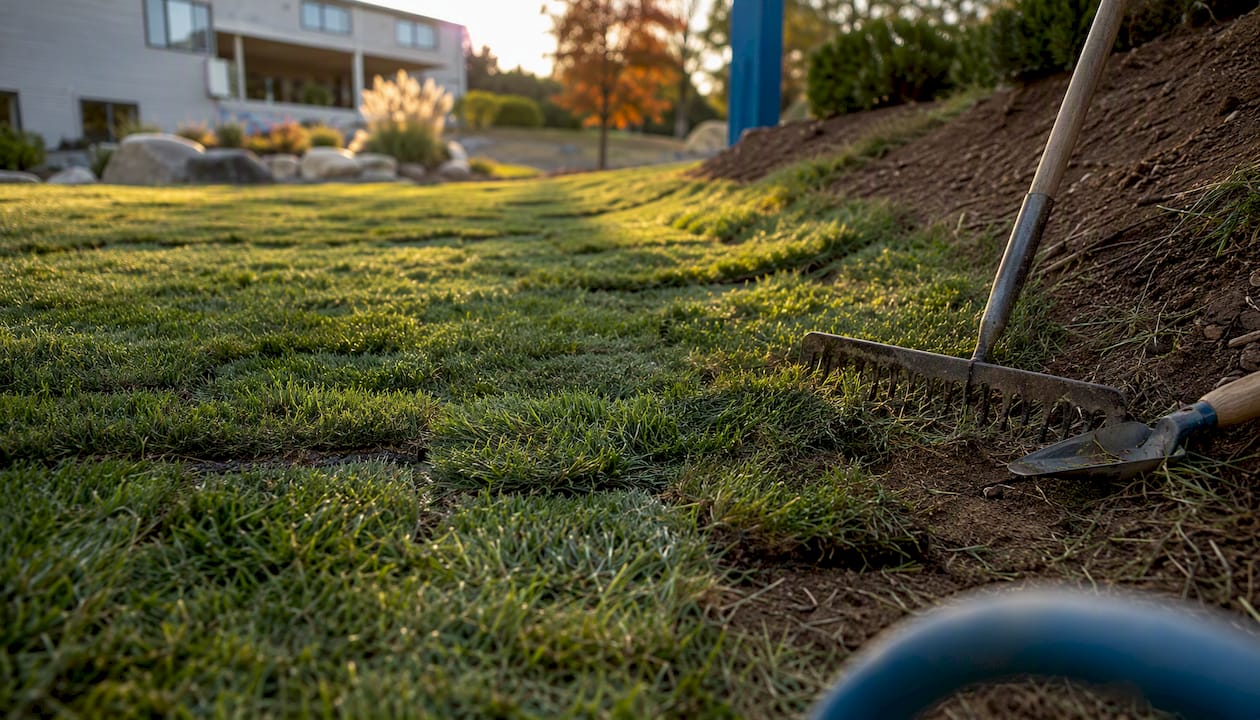
Commercial turf management is the professional contractor service of installing and maintaining turf on commercial properties, covering everything from sod and seed installation to mowing, fertilization, aeration, pest control, and irrigation and drainage management. If you manage a commercial site in New Hampshire, your first move is to request a written maintenance schedule, proof of contractor insurance, a licensed pesticide applicator credential, and a sample monthly inspection report before signing anything. Divinelandscapingllc serves NH commercial properties with exactly this documentation in hand. Two regulatory frameworks shape every compliant program here: EPA NPDES stormwater rules under 40 CFR Part 122 and ADA Standards for Accessible Design Section 402, both of which directly affect how turf is installed, graded, and maintained on your site.
Table of Contents
- What does commercial turf management actually cover?
- Why commercial turf management matters for New Hampshire sites
- What goes on a monthly commercial grounds inspection checklist?
- How do you choose the right commercial turf contractor?
- Divinelandscapingllc brings NH-ready turf management to your site
- Key Takeaways
- A contractor’s perspective on what NH managers actually face
- Useful sources and Divinelandscapingllc resources
What does commercial turf management actually cover?
Commercial turf management splits into two distinct phases: installation and ongoing maintenance. Conflating them in a bid is how scope gaps happen.
Installation includes site preparation, soil testing and pH correction, grading for positive drainage, and the choice between seed and sod. Sod delivers immediate coverage and erosion control, which matters on high-traffic commercial sites. Seed costs less but requires a longer establishment window and more intensive watering. Either way, a proper installation starts with a soil test, not a shovel.
Ongoing maintenance is where commercial turf management differs sharply from residential work: it demands commercial-grade equipment, larger crews, irrigation coordination, and technical services like targeted fertility programs and integrated pest scouting. A residential mow-and-blow crew is not equipped for a multi-acre office park.
Contract deliverables you should specify in writing:
- Mowing height range (3–4 inches for cool-season grasses)
- Fertilization schedule with product and rate documentation
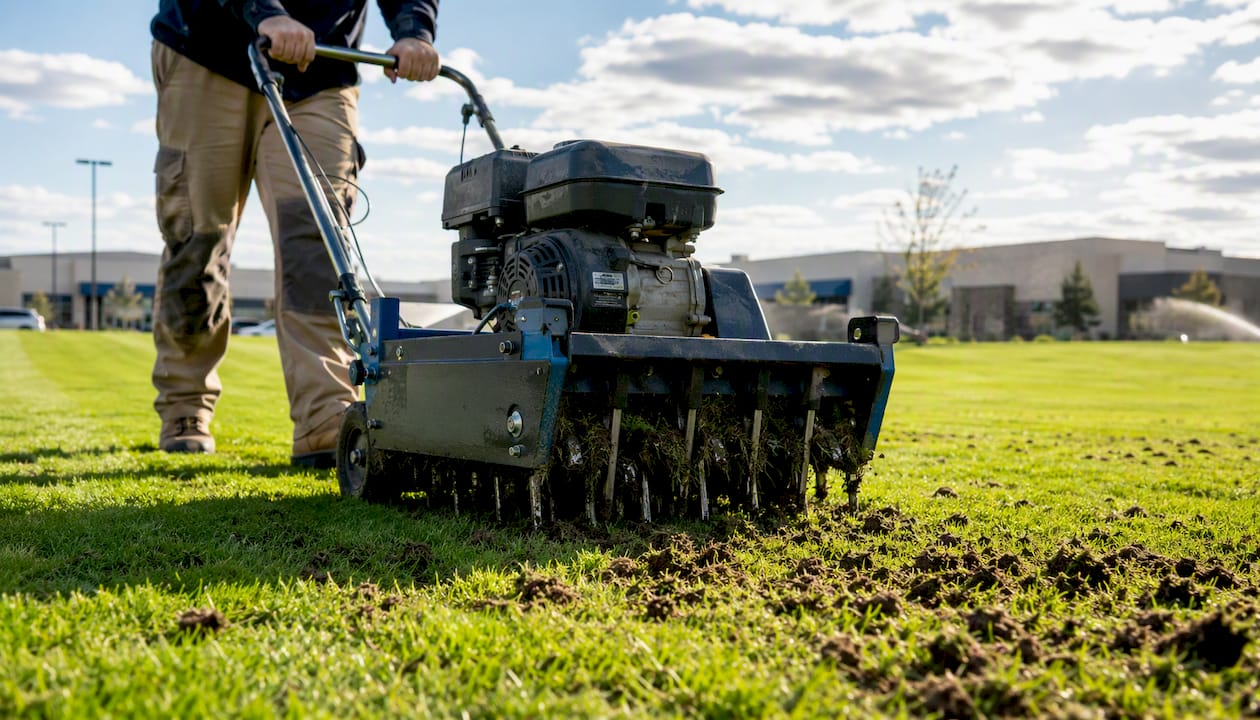
- Core aeration frequency (at minimum once annually, ideally twice for high-traffic turf)
- Irrigation inspection cadence (monthly during the growing season)
- Overseeding windows tied to soil temperature, not calendar date
| Task | Typical Provider | Frequency | Performance Metric |
|---|---|---|---|
| Mowing | Maintenance crew | Weekly (growing season) | Cut height 3–4 inches |
| Fertilization | Licensed applicator | 4–6 applications/year | Soil test-based N-P-K rate |
| Core aeration | Specialty crew | 1–2 times/year | Plug depth 2–3 inches |
| Overseeding | Maintenance crew | Late August–September | Germination rate, coverage |
| Irrigation inspection | Irrigation tech | Monthly (April–October) | Head coverage, leak-free |
| Pest/disease scouting | Licensed applicator | Monthly or as triggered | Threshold-based treatment |
Why commercial turf management matters for New Hampshire sites
The financial case for professional turf care is straightforward. Well-maintained landscaping can increase commercial property value by up to 15% and signals overall building stewardship to prospective tenants. Poor maintenance creates what property managers call a “discount mentality” among tenants, which affects lease negotiations before anyone walks through the door.
Treating turf care as a discretionary line item is the fastest way to turn a preventable $800 aeration into a $12,000 turf replacement. The math on preventative maintenance always wins over corrective spending.
The compliance side is where NH property managers often underestimate their exposure. EPA 40 CFR Part 122 (NPDES) governs stormwater runoff from commercial sites, meaning improperly graded turf or bare soil can trigger permit violations. ADA Standards Section 402 requires accessible routes to remain firm, stable, and slip-resistant, which means turf encroachment onto walkways is a liability, not just an aesthetic issue. IBC 2021 Section 1804 addresses drainage and exterior surface management. OSHA walking-working surface standards apply to any area where employees or contractors traverse the grounds. Pesticide application must be performed by or under the direct supervision of a licensed applicator under New Hampshire state law.
Documentation is your mitigation. Timestamped inspection reports, pesticide application records, and before/after photos create the audit trail that protects you in a slip-and-fall claim or a regulatory inquiry.
What goes on a monthly commercial grounds inspection checklist?
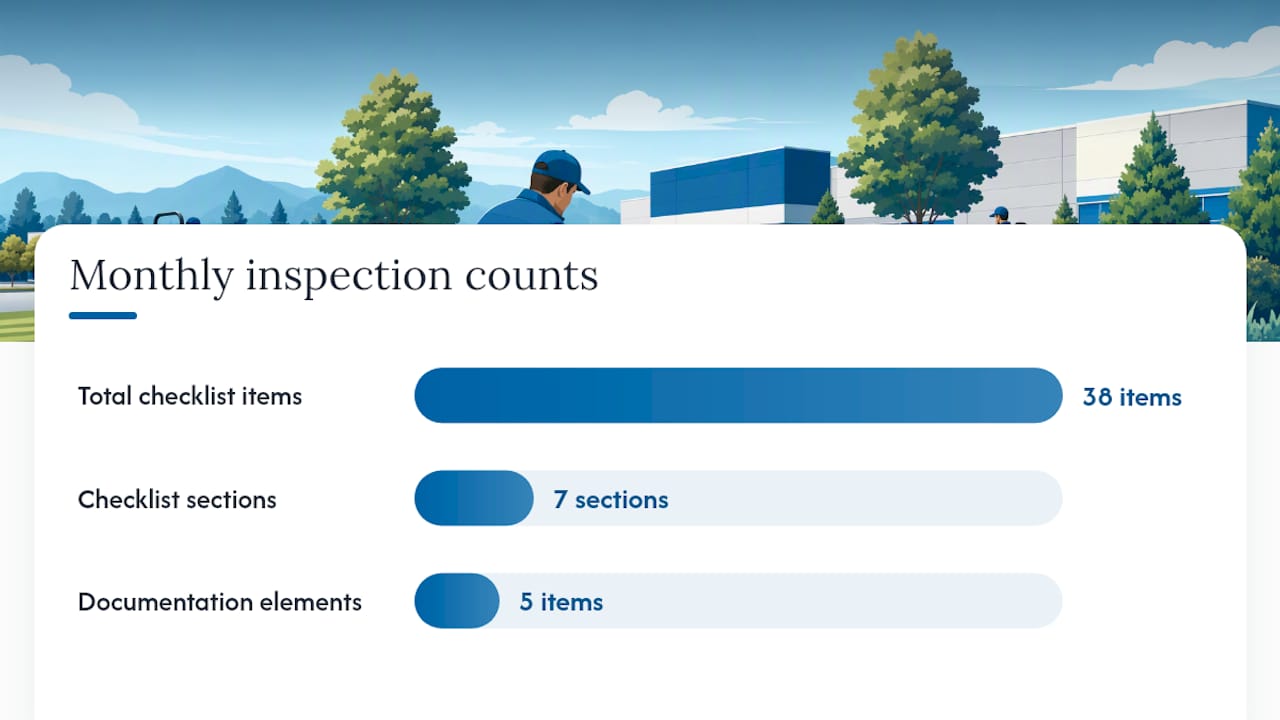
A monthly inspection is your primary tool for vendor accountability and compliance documentation. The commercial grounds maintenance inspection checklist from PopProbe covers 38 items across 7 sections, with explicit callouts for EPA NPDES, ADA Section 402, IBC 2021, OSHA, and EPA worker protection standards for pesticides.
Your monthly inspection should cover:
- Turf condition: color, density, weed pressure, bare spots, and disease symptoms
- Irrigation performance: head coverage, leaks, controller settings, and zone timing
- Drainage and pooling: standing water locations, inlet blockages, and grading issues
- Accessible routes: turf encroachment, surface stability, and ADA compliance
- Mulch depths: 2–3 inches in planting beds, pulled back from tree bases
- Tree and shrub hazards: dead limbs, root heave near walkways, and pest damage
- Pesticide application records: product, rate, applicator license number, and date
A checklist without a timestamp and a photo is just a list. The documentation that protects you in a dispute is the one with GPS-tagged images, a crew signature, and a PDF delivered within 24 hours of the inspection.
Use completed checklists as vendor scorecards: score each section, track trends over time, and tie payment to documented completion. Before awarding a contract, ask to see three months of sample inspection reports from a comparable NH property. If a bidder cannot produce them, that tells you everything about their documentation discipline.
Pro Tip: Download a commercial landscape inspection guide and adapt it as your internal audit form. Cross-reference it against your contractor’s submitted reports monthly to catch gaps before they become liabilities.
How do you choose the right commercial turf contractor?
- Ask for their crew supervision model. Who is on-site daily, and who reviews the work?
- Request sample inspection reports from a current NH commercial client.
- Confirm they have a licensed pesticide applicator on staff, not just on call.
- Ask whether they have access to certified irrigation technicians for mid-season repairs.
- Request references from properties with similar acreage and use type in New Hampshire.
Red flags that should disqualify a bidder:
- No certificate of insurance with commercial general liability and hired/non-owned auto coverage
- Scope described as “mow and blow” with no written task list or frequencies
- No licensed pesticide applicator on file
- No before/after documentation from previous clients
- No written SLA for deficiency response times
Pro Tip: The lowest bid almost always omits corrective maintenance and capital renewal. Ask every bidder to price a “base program only” and a “full program including corrective work” so you can compare apples to apples. The gap between those two numbers tells you how much deferred risk the low bidder is handing back to you.
Contractor documents to collect before signing: certificate of insurance, pesticide applicator license numbers, a sample 12-month maintenance schedule, and a local project portfolio with before/after photos. For multi-tenant property planning, also ask for service tier maps showing how the contractor prioritizes entrances versus perimeters.
Divinelandscapingllc brings NH-ready turf management to your site

Divinelandscapingllc is the NH-based alternative to a national maintenance contract for commercial property owners who need inspection-ready documentation, seasonal expertise, and a contractor who already knows what freeze-thaw cycles do to a New England site. The team provides soil testing, irrigation troubleshooting, seasonal turf programs, and monthly inspection reports delivered as PDFs, with licensed applicator credentials and insurance certificates available on request.
For managers of office parks, retail centers, or multi-tenant properties, Divinelandscapingllc’s familiarity with EPA NPDES, ADA Section 402, and IBC drainage considerations means your grounds program is built for audit readiness, not just aesthetics. Explore sustainable turf and low-impact landscaping options or request an on-site evaluation and sample maintenance schedule at divinelandscapingllc.com.
Key Takeaways
Commercial turf management is a compliance-driven operating discipline: NH property managers who require written schedules, licensed applicators, and monthly inspection reports before awarding a contract protect both their asset value and their regulatory standing.
| Point | Details |
|---|---|
| Define scope before bidding | Separate installation from ongoing maintenance in every RFP to prevent scope gaps and change orders. |
| Compliance documentation is non-negotiable | Require EPA NPDES, ADA, and OSHA-aligned inspection records, pesticide logs, and insurance certificates from every bidder. |
| Seasonal timing drives turf health | The late August–September overseeding window is the most critical annual task for cool-season NH turf. |
| Budget in four lines | Split base service, variable costs, corrective maintenance, and capital renewal to compare bids accurately. |
| Divinelandscapingllc | Provides NH commercial turf programs with inspection-ready documentation, licensed applicators, and seasonal expertise. |
A contractor’s perspective on what NH managers actually face
Most commercial turf programs in New Hampshire fail not because of bad grass, but because of bad documentation. A property manager inherits a site with no soil test history, no irrigation map, and a vendor who describes their service as “regular maintenance.” That is not a program. It is a liability waiting for a wet October.
What I see consistently on NH commercial sites is deferred aeration. Managers skip it to save a line item, and two seasons later they are looking at compacted, thin turf that holds water and invites disease. The commercial landscape inspection process exists precisely to catch these patterns before they become capital expenses.
Realistic timeline: a newly installed turf area on a commercial NH site takes one full growing season to establish and a second season to reach the density and root depth that handles foot traffic and mowing stress without thinning. Year one is establishment and monitoring. Year two is when you start seeing the return on a properly specified program.
[Author credentials placeholder — e.g., licensed NH contractor, years of commercial turf experience]
[Client testimonial placeholder — e.g., brief note from a local NH property manager on inspection documentation and seasonal results]
Useful sources and Divinelandscapingllc resources
Key references used in this guide:
- [Commercial Landscaping & Grounds Maintenance Inspection Checklist [FREE PDF] — PopProbe](https://www.popprobe.com/checklist-library/facility-maintenance/building-exterior/b27-fac-landscaping-grounds-checklist)
- Landscaping Management: A Facility Manager’s Guide – Facility Management Insights
- Seasonal Landscape Maintenance Guide for Property Managers — Delk Management
- Commercial Turf Management ROI | Weed Pro
- Commercial Asset Value Protection: Elevating Property Aesthetics & Curb Appeal – Weed Pro
- What makes commercial turf management protect property value across a multi-acre Lenexa, KS site — Hermes Landscaping
- What Is a Commercial Landscape Inspection? — Divine Landscaping LLC
Divinelandscapingllc resources for NH commercial property managers:
- What Is a Commercial Landscape Inspection? — inspection procedures and checklist guidance
- Multi-Tenant Property Landscaping Design — service tier planning and visibility zone strategy
- Commercial Landscaping in New Hampshire — localized seasonal guidance for NH property owners
- Irrigation and Lighting Services — smart controller upgrades, winterization, and system audits