
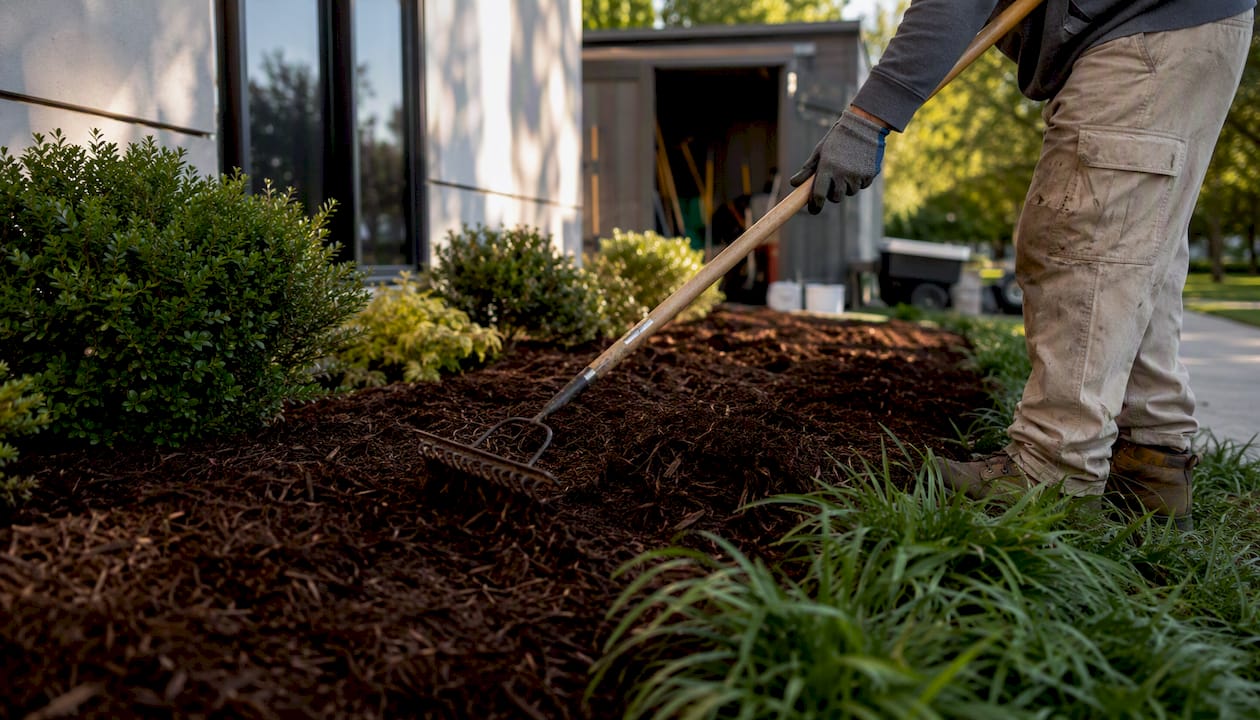
Mulch is one of the highest-return line items in a commercial landscape budget. A properly specified mulch program reduces irrigation demand, suppresses weeds, protects plant health, and signals to tenants and visitors that the property is well managed. According to The Role of Mulch in Landscaping, treating mulch as a programmatic investment rather than an occasional upgrade is what separates properties that hold their curb appeal year-round from those that look tired by midsummer.
Three things to do right now:
- Walk your beds and probe the mulch depth. Anything below 2 inches needs a topdress before the next growing season.
- Schedule an annual refresh in your maintenance contract as a named line item, not a discretionary add-on.
- Standardize one material and color across all high-visibility beds. Visual consistency matters as much as depth.
Acceptance standard for crews: require depth photos at install and a signed checklist confirming no mulch contact with trunks or foundations.
Key Takeaways
A properly specified and consistently maintained mulch program reduces weed-control labor, lowers irrigation demand, protects plant health, and strengthens tenant and customer impressions across every commercial property type.
| Point | Details |
|---|---|
| Specify depth precisely | Target 2–4 inches for new installs; 1–2 inches for annual topdress; verify with a probe at three or more points per bed. |
| Schedule annual refresh | Build a spring topdress into your maintenance contract as a named line item, timed before your peak leasing or business season. |
| Choose material by use case | Use dark-brown hardwood for high-visibility beds; specify inorganic materials only for parking islands or high-traffic zones where soil benefit is not needed. |
| Protect plants and structures | Maintain 3–4 inches of clearance from all trunks and stems; keep mulch 6 inches from foundations to prevent rot and pest harborage. |
| Divinelandscapingllc | Provides structured commercial mulching programs with line-item pricing, depth documentation, and seasonal follow-up for NH and MA properties. |
Table of Contents
- Why mulch matters on commercial properties: the operational case
- Which mulch types should you specify for commercial sites?
- How to apply mulch correctly: depths, clearances, and crew specs
- When to mulch and how often to refresh on a commercial schedule
- How mulch lowers your total groundskeeping spend
- What mulch does to your soil and plants over time
- Pest and disease risks from mulch and how to prevent them
- How mulch improves property value and the ROI case for managers
- Your RFP-ready mulch checklist for contractor bids
- How Divinelandscapingllc handles commercial mulching programs
- Divinelandscapingllc: commercial mulching and landscape programs for NH and MA properties
- The part most managers get wrong about mulch
- Sources
Why mulch matters on commercial properties: the operational case
The business case for commercial landscaping mulch comes down to five measurable benefits, each with a direct line to operating costs or tenant perception.
Moisture retention is the most quantifiable. A consistent mulch layer slows surface evaporation, which means your irrigation system runs less frequently to maintain the same soil moisture. Pairing mulch with a calibrated irrigation system compounds those savings further, as Divinelandscapingllc’s irrigation services team regularly documents on commercial installs.
Weed suppression cuts labor hours. Weeds that never germinate never need pulling. On a large commercial site with dozens of planting beds, that translates to fewer crew visits and lower herbicide spend across the season.
Temperature moderation protects root zones. Mulch insulates soil against both summer heat spikes and early fall freezes, extending the viable growing season and reducing plant stress. Stressed plants are more susceptible to disease and pest pressure, which drives up replacement costs.
Erosion control matters most on sloped beds, parking islands, and areas near stormwater features. Without a mulch layer, rain events wash soil into hardscape and drainage systems, creating both maintenance and liability issues.
Soil improvement is the long-game benefit. Organic mulches decompose slowly, feeding microbial activity and improving soil structure over multiple seasons. That means healthier plants with lower fertilizer requirements over time.
For tenant-facing properties, the qualitative benefit is just as real. Fresh, uniform mulch signals attentive management. Properties with well-maintained beds lease faster and retain tenants longer, according to multi-tenant property landscaping guidance that tracks the connection between landscape condition and tenant confidence during lease-up windows.
Which mulch types should you specify for commercial sites?
Choosing the right material depends on the use case, not just price per yard. The primary split is organic versus inorganic, and each has a distinct cost shape and maintenance profile.
| Material | Type | Best Use Case | Replenishment Frequency | Soil Benefit |
|---|---|---|---|---|
| Shredded hardwood bark | Organic | High-visibility beds, entrances | Annual | Yes, moderate |
| Double-ground hardwood | Organic | Tree rings, mixed beds | Annual | Yes, moderate |
| Engineered wood blend | Organic | Large commercial installs | Annual to 18 months | Yes, lower |
| Pine bark nuggets | Organic | Slopes, accent beds | Annual | Yes, lower |
| River rock / gravel | Inorganic | Parking islands, arid zones | Rarely | None |
| Rubber mulch | Inorganic | High-traffic play or walk areas | Rarely | None |
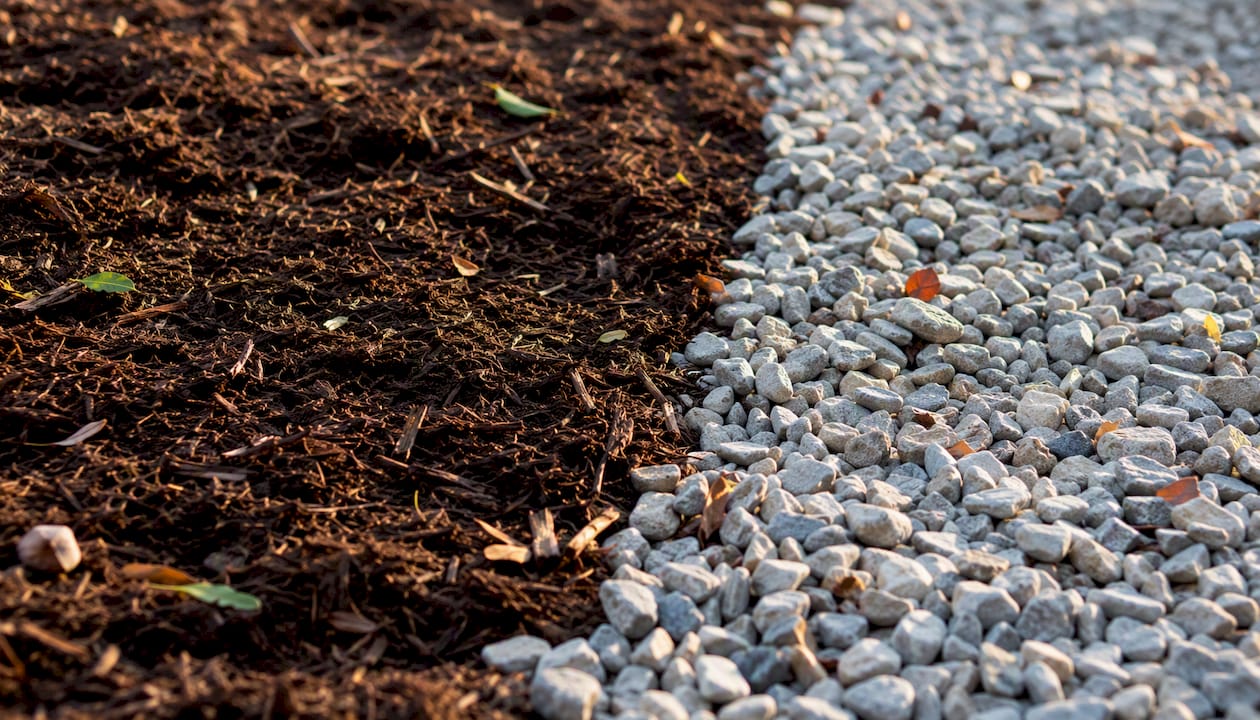
Organic mulches are the standard choice for most commercial beds. Shredded hardwood and double-ground bark provide a clean, uniform appearance, break down gradually to feed the soil, and are available in bulk quantities suited to large properties. Dark brown hardwood is the most common specification for high-visibility areas because it photographs well, holds color longer than lighter materials, and reads as “maintained” to visitors. The trade-off is annual replenishment, which is a recurring cost you need to budget for.
Inorganic options like river rock and gravel eliminate the replenishment cycle but add upfront cost and offer no soil benefit. They work well in parking islands, low-water zones, or areas where organic material would wash out repeatedly. Rubber mulch is durable and appropriate for specific high-traffic applications, though it carries a higher unit cost and does not contribute to soil health.
For large commercial properties, visual uniformity across all beds is worth specifying explicitly. Selecting one material and one color for the entire site reduces the “patchwork” appearance that signals deferred maintenance to prospective tenants.
How to apply mulch correctly: depths, clearances, and crew specs
Getting the depth right is the single most important installation variable. Too little and the weed-suppression and moisture benefits disappear. Too much and you create conditions for stem rot, pest harborage, and oxygen deprivation at the root zone.
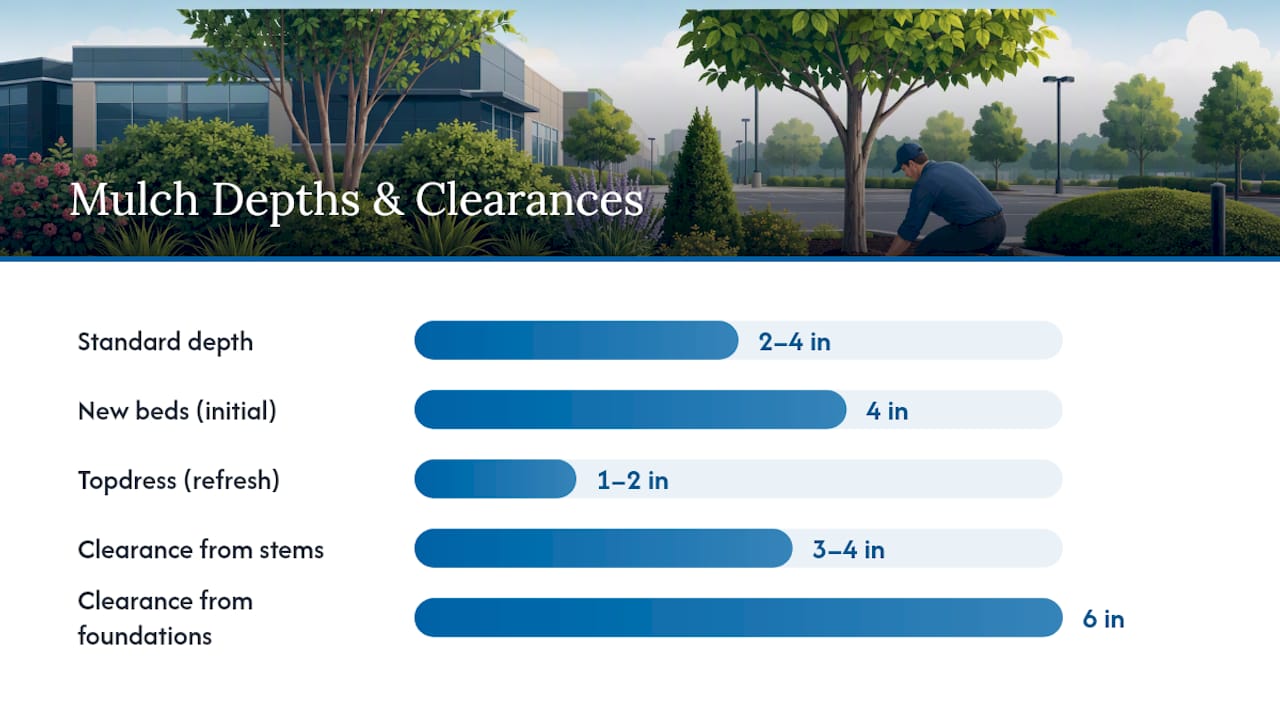
Standard depth guidance for most commercial organic mulch applications is 2–4 inches, as referenced in commercial lawn care best practices. New beds with bare soil can go to 4 inches. Established beds being refreshed typically need 1–2 inches of topdress to bring the layer back to spec.
Application steps for crews:
- Remove visible weeds and debris from all beds before laying material.
- Edge all bed borders cleanly to define the mulch zone and prevent migration onto hardscape.
- Check soil moisture. Do not mulch over bone-dry soil; water first so the mulch traps existing moisture.
- Adjust irrigation heads as needed so spray patterns clear the new mulch surface.
- Spread material evenly using rakes or blowers, working from the bed interior outward.
- Pull mulch back from all plant stems, trunks, and woody bases by a minimum of 3–4 inches.
- Pull mulch back from building foundations, walls, and fences by at least 6 inches.
- Confirm depth with a probe or ruler at three or more points per bed before signing off.
Dos and don’ts:
- Do maintain a flat, even surface. Mounded or ridged mulch sheds water rather than retaining it.
- Do use bulk delivery for large sites. Large-scale mulch staging with equipment like skid steers reduces labor hours significantly on properties with many beds.
- Don’t volcano-mulch trees. Piling mulch against a trunk traps moisture against the bark, invites fungal disease, and can girdle the tree over time.
- Don’t exceed 4 inches in any bed. Deeper layers restrict oxygen to roots and create anaerobic conditions that harm soil biology.
- Don’t skip prep. Mulching over existing weeds accelerates their growth by retaining moisture around them.
Pro Tip: Carry a 6-inch spike or a sharpened dowel rod on every inspection. Push it into the mulch layer at five random points per bed. If it stops at 2–4 inches, the install is in spec. If it bottoms out at 1 inch or less, the bed needs topdress. This takes under two minutes per bed and gives you photo-ready documentation for contractor acceptance.
When to mulch and how often to refresh on a commercial schedule
Timing your mulch program around the property’s visibility calendar is as important as the material choice itself.
Spring is the primary application window for most commercial properties in New Hampshire and the broader Northeast. A spring topdress refreshes color after winter, covers any frost heave damage, and positions beds for the growing season before peak tenant and customer traffic. Target late April through May, after the last hard frost but before summer heat sets in.
Fall mulching serves a different purpose. A light application in October or early November insulates root zones against freeze-thaw cycles, which is especially valuable for newly planted specimens or properties with shallow-rooted ornamentals. Fall mulch does not need to be as deep as a spring application; 1–1.5 inches of topdress is usually sufficient for insulation.
Refresh frequency by material type:
- Shredded hardwood and double-ground bark: annual topdress, typically spring
- Engineered wood blends: annual to 18 months depending on decomposition rate and site exposure
- Pine bark nuggets: annual, with spot-replacement after storm events on slopes
- Rock and gravel: inspect annually, add material only where coverage has thinned or shifted
For budget planning, tie your spring refresh to the property’s lease-up calendar. If your peak leasing window is April through June, your mulch install should be complete by the first week of April. Properties that refresh mulch just before high-traffic periods consistently present better than those that schedule it reactively.
How mulch lowers your total groundskeeping spend
The cost of a mulch program is visible on an invoice. The savings it generates are distributed across several other line items, which is why managers who evaluate mulch in isolation often underestimate its value.
Cost drivers to understand:
- Material type and volume (bulk pricing per cubic yard vs. bagged retail)
- Delivery method and site access (bulk truck vs. small-load delivery for tight sites)
- Crew labor for prep, installation, and cleanup
- Disposal of old or overly decomposed material
- Frequency of replenishment based on material choice
Where mulch reduces recurring spend:
- Fewer weeding visits per season, since a 3-inch layer blocks most annual weed germination
- Lower irrigation runtime, because mulch holds soil moisture longer between watering cycles, as documented in Divinelandscapingllc’s irrigation services program
- Reduced plant replacement costs, because temperature-moderated and moisture-stable root zones produce healthier, longer-lived plants
- Lower herbicide application frequency on beds that are consistently mulched
Procurement tip: When soliciting bids, require contractors to break out unit pricing for material delivery, installation labor, and annual topdress separately. A single lump-sum bid makes year-over-year cost comparisons impossible and obscures where price increases are coming from. Line-item pricing also lets you adjust scope cleanly, for example, deferring a low-visibility area while prioritizing entrance beds.
For larger properties, pairing a mulch refresh with an irrigation audit in the same contract scope documents the combined water savings and makes the ROI case easier to present to ownership.
What mulch does to your soil and plants over time
Organic mulch is not just a surface treatment. As it decomposes, it actively changes the soil beneath it, mostly for the better, with one important caveat managers need to understand.
Decomposition and nitrogen tie-up: Fresh, high-carbon wood mulches (particularly raw wood chips or sawdust-heavy blends) can temporarily immobilize nitrogen in the top layer of soil as soil microbes consume the carbon-rich material. This is called nitrogen immobilization, and it is most pronounced in the first few months after a heavy application of fresh material. The practical risk is yellowing or slow growth in shallow-rooted annuals planted directly into freshly mulched beds. The fix is straightforward: use aged or double-ground hardwood rather than raw chips, and apply a light nitrogen fertilizer to beds with high annual-plant turnover.
Long-term soil benefits: Once organic mulch has partially decomposed, it contributes organic matter to the soil, improves drainage in clay-heavy soils, and supports microbial populations that make nutrients more available to plant roots. Properties that have maintained consistent organic mulch programs for three or more years typically show measurably better soil structure and lower fertilizer requirements than comparable sites without mulch.
If your property is shifting from inorganic to organic mulch, or significantly increasing mulch depth across a large site, a basic soil test before and after the first full season gives you a baseline. Testing pH, nitrogen, and organic matter content lets you adjust fertilization accordingly and document the soil improvement over time.
Pest and disease risks from mulch and how to prevent them
Mulch creates the conditions plants need to thrive. It can also create conditions that pests and pathogens exploit if the application is not managed correctly.
Common risks:
- Stem and crown rot: Mulch piled against trunks or woody stems traps moisture against bark, creating entry points for fungal pathogens. This is the most common mulch-related plant health problem on commercial sites.
- Rodent harborage: Deep mulch layers near building foundations provide nesting cover for voles, mice, and other small rodents. Properties with persistent rodent complaints often have mulch piled against the building perimeter.
- Fungal artillery fungus: Certain wood mulches, particularly those with high bark content, can harbor artillery fungus (Sphaerobolus stellatus), which ejects spores onto nearby surfaces including vehicles and building siding. Switching to aged hardwood or pine bark reduces the risk.
- Soggy mulch and anaerobic conditions: Overly thick layers in low-drainage areas stay saturated after rain, creating anaerobic conditions that harm roots and encourage mold growth on the mulch surface.
Mitigation steps:
- Maintain a 3–4 inch clearance from all plant stems and a 6-inch clearance from foundations at every install and inspection.
- Use well-draining materials (coarser grades, pine bark) in areas with known drainage issues.
- Schedule a post-storm inspection after any rain event exceeding 2 inches to check for washout, compaction, or saturation.
- Replace mulch that has fully decomposed into a dense, matted layer. Matted mulch repels water rather than absorbing it and can harbor disease.
- If mature trees show unexplained decline on a mulched site, involve a certified arborist before assuming the cause is unrelated to mulch management.
For persistent rodent issues near foundations, a pest-control contractor should assess the site before you simply pull back the mulch. The mulch is usually a contributing factor, not the sole cause.
How mulch improves property value and the ROI case for managers
Fresh, uniform mulch is one of the fastest visual signals of a well-managed property. For commercial sites, that signal has direct financial consequences.
Tenants and prospective buyers form impressions of a property within seconds of arriving. Beds with consistent, dark-colored mulch read as maintained and professional. Beds with bare soil, visible weeds, or faded, decomposed material read as neglected, regardless of the building’s condition. For properties in active lease-up, that first impression affects both the speed of lease signing and the rent level tenants are willing to accept.
The ROI framing for mulch works on three levels:
Reduced operating costs are the most direct return. Lower weed-control labor, reduced irrigation runtime, and fewer plant replacements each reduce the annual groundskeeping budget. These savings are measurable if you track them by line item.
Protection of capital assets is the less obvious but equally important return. Mature trees and specimen plantings represent significant replacement costs if they fail. A consistent mulch program that moderates root-zone temperature and moisture is one of the most cost-effective ways to protect those assets. Treating mulch as a recurring operating expense that protects higher-cost capital assets is the framing that resonates with ownership groups and asset managers.
Tenant retention and leasing speed are harder to quantify but well-supported by property management experience. Properties with consistently maintained landscapes, including fresh mulch, experience stronger tenant retention. For a multi-tenant commercial property, even a modest improvement in retention rate has a significant impact on net operating income.
For curb appeal strategies that extend beyond mulch, Divinelandscapingllc’s curb appeal landscaping guide covers the full range of visual improvements that support leasing and property value. You can also review landscaping ideas that boost curb appeal for additional visual strategies used on commercial and residential sites.
Your RFP-ready mulch checklist for contractor bids
Use this checklist as a starting point for contractor scopes or bid documents. Adjust depth tolerances and material specs to match your property’s specific conditions.
- Material specification: State the exact material (e.g., double-ground hardwood, dark brown), source type (bulk or bagged), and color standard. Require a sample for approval before delivery.
- Depth requirement: Specify 2–4 inches for new installs and 1–2 inches for annual topdress. State tolerance as ±0.5 inches.
- Prep work: Require removal of all visible weeds, debris, and overly decomposed existing mulch before new material is laid.
- Edging standard: Require clean bed edges at all hardscape borders before mulch is spread.
- Clearances: State minimum 3–4 inches from all plant stems and trunks; minimum 6 inches from building foundations, walls, and fences.
- Slope and erosion control: For beds on grades steeper than 15%, require biodegradable erosion-control netting or a coarser mulch grade to prevent washout.
- Cleanup and disposal: Require removal of all excess material from hardscape, walkways, and drainage areas. Site must be broom-clean at completion.
- Safety and staging: Specify staging areas for bulk delivery equipment and require contractor to protect hardscape from equipment damage.
- Acceptance criteria: Uniform depth within ±0.5 inches confirmed by probe at a minimum of three points per bed; no mulch contact with trunks or foundations; no visible weeds above soil level; site broom-clean.
- Documentation: Require depth photos at a minimum of five locations per property zone, submitted within 24 hours of completion.
- Callback terms: Include a 30-day callback clause for washout, significant settling, or depth failure after a rain event exceeding 2 inches.
For larger renovation scopes that include bed redesign alongside mulching, Divinelandscapingllc’s commercial landscape renovation planning guide walks through how to sequence prep, planting, and mulching within a phased project.
How Divinelandscapingllc handles commercial mulching programs
Divinelandscapingllc follows a structured workflow on every commercial mulching project, from initial site audit through seasonal follow-up.
Typical project workflow:
- Site audit: walk all beds, document existing depth, material condition, and any plant health concerns
- Soil and irrigation check: confirm soil moisture and adjust irrigation schedules before install
- Material selection: recommend material type and color based on site visibility, drainage, and budget
- Crew staging and prep: coordinate bulk delivery logistics, protect hardscape, complete weed removal and edging
- Installation: spread to specified depth, maintain all clearances, confirm with probe measurements
- Acceptance inspection: depth photos, signed checklist, site cleanup
- Seasonal follow-up: schedule spring topdress and fall inspection as recurring contract line items
Managers who want to see finished project results can review Divinelandscapingllc’s project gallery for examples of commercial and residential landscape work across New Hampshire and Massachusetts.
Divinelandscapingllc: commercial mulching and landscape programs for NH and MA properties
Property managers in New Hampshire and Massachusetts who want a mulching program that is specified, documented, and repeatable have a direct path with Divinelandscapingllc. Rather than a one-time install with no follow-through, Divinelandscapingllc structures commercial mulching as part of a broader landscape maintenance program, with line-item pricing for material, labor, and annual refresh built into the contract from the start.
The team handles site audits, material selection, crew staging, and acceptance documentation, so you get a signed-off install with depth photos, not just a truck of mulch and a bill. For multi-tenant properties, office parks, and retail sites, Divinelandscapingllc’s multi-tenant landscaping program is the right starting point. Request a commercial mulching proposal directly through that page to get a scope and line-item estimate for your property.
The part most managers get wrong about mulch
Most commercial mulching programs fail not because of bad material or poor installation, but because they are treated as a one-time event rather than a recurring program. A property gets mulched in spring, looks great for two months, and then the beds fade, thin out, and fill with weeds by August. The manager concludes mulch “doesn’t last” and cuts it from next year’s budget. That cycle is the problem.
The conventional advice, “just mulch your beds,” misses the operational reality. Mulch is a consumable. Organic material decomposes. Depth drops. Weed pressure returns. The properties that consistently look well-maintained are the ones where mulch refresh is a scheduled, budgeted line item, not a reactive response to complaints.
What managers should prioritize first is not the material choice or the application depth, though both matter. It is the contract structure. If your maintenance agreement does not include a named annual topdress with specified depth and acceptance criteria, you do not have a mulch program. You have a one-time install that will need to be re-sold to ownership every spring.
The second thing most managers underestimate is the compounding value. A property that has been consistently mulched for three or more seasons has better soil, healthier plants, and lower weed pressure than one that gets mulched sporadically. The savings in plant replacement and weed-control labor grow each year the program runs. That is the argument to make to ownership when the line item comes up for review.
Sources
- John Deere moving mulch (Wikimedia Commons image)