
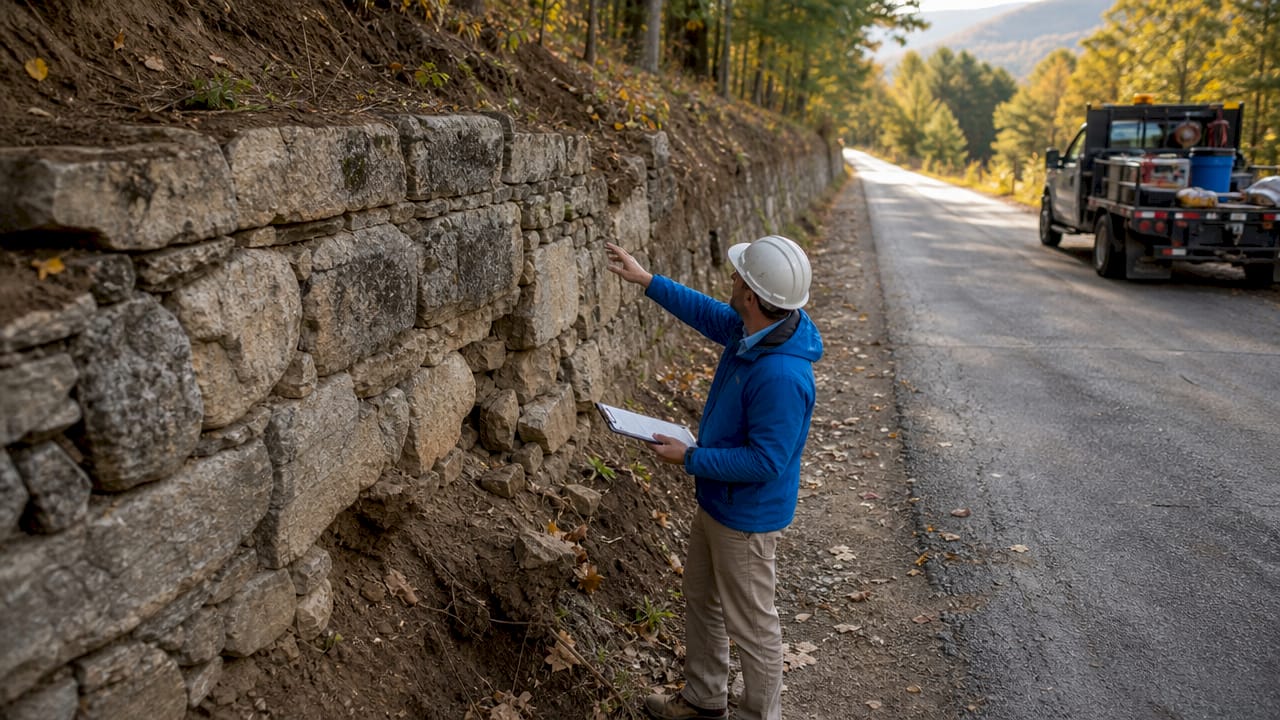
Retaining wall failure is defined as the loss of structural stability caused by forces the wall was not designed or maintained to resist. The leading cause is hydrostatic pressure, which builds when water saturates the soil behind the wall and has nowhere to drain. Saturated soil exerts 2 to 3 times the lateral pressure of properly drained soil. That single fact explains most of the collapsed and leaning walls Divinelandscapingllc sees across New Hampshire every season. Understanding why retaining walls fail gives you the power to catch problems early, maintain what you have, and build smarter from the start.
Why do retaining walls fail from poor drainage?
Poor drainage is the root cause of most retaining wall failures, and New Hampshire’s wet springs and heavy fall rains make the risk especially high. When water cannot escape from behind the wall, it saturates the backfill and creates hydrostatic pressure. A 2-meter wall with saturated soil experiences roughly double the lateral force compared to a wall with proper drainage in place. That extra force pushes outward on the wall face, and if the wall was not designed for that load, failure follows quickly.
Drainage systems fail in several predictable ways:
- Clogged weep holes. Weep holes are small openings at the base of the wall that let water escape. Soil and debris block them over time, trapping water behind the wall.
- No geotextile filter fabric. Without filter fabric separating the backfill from the drainage aggregate, fine soil particles migrate into and clog the drainage layer.
- Wrong backfill material. Native clay traps water and creates what engineers describe as a liquid reservoir behind the wall. Granular stone or gravel drains freely; clay does not.
- No perforated pipe. A perforated drainage pipe at the base of the wall collects water and directs it away. Walls built without one rely entirely on weep holes, which is rarely enough.
Drainage is not optional in retaining wall design. Engineers classify it as a mandatory structural component, not an upgrade. Adding heavy rock or concrete fill behind a wall without adequate drainage actually worsens the problem by increasing the weight pressing down on saturated soil.
Pro Tip: Inspect your weep holes every spring and fall. If they are dry after a heavy rain, they are clogged. Clear them immediately before hydrostatic pressure builds to a damaging level.

What design and construction errors lead to wall collapse?
Design and construction errors are the second major category of reasons for retaining wall failure. Many walls are built to hold back a garden bed but later face loads they were never engineered to handle.
Industry standards require specific safety margins for retaining wall design:
- Factor of safety against sliding: 1.5. The wall must resist sliding along its base with 50% more capacity than the expected load.
- Factor of safety against overturning: 2.0. The wall must resist tipping forward with twice the capacity of the overturning force.
- Factor of safety against bearing failure: 3.0. The soil beneath the footing must support the wall with three times the load it will actually carry.
Walls fail when surcharge loads are not accounted for in the original design. A surcharge load is any weight added near the top of the wall, such as a parked car, a driveway, or a new shed. Driveways alone can double the earth pressure the wall must resist compared to a simple garden-level design. If your wall was designed for a lawn and you later paved a driveway nearby, the wall is now overloaded.
The table below shows how common design choices affect wall stability:
| Design factor | Lower-risk approach | Higher-risk approach |
|---|---|---|
| Backfill material | Crushed stone or gravel | Native clay or organic soil |
| Drainage provision | Perforated pipe plus weep holes | No drainage system |
| Footing depth | Below frost line | Shallow or surface-set |
| Surcharge consideration | Engineered for driveway loads | Designed for garden loads only |
| Reinforcement | Geogrid or rebar per engineer spec | No reinforcement |
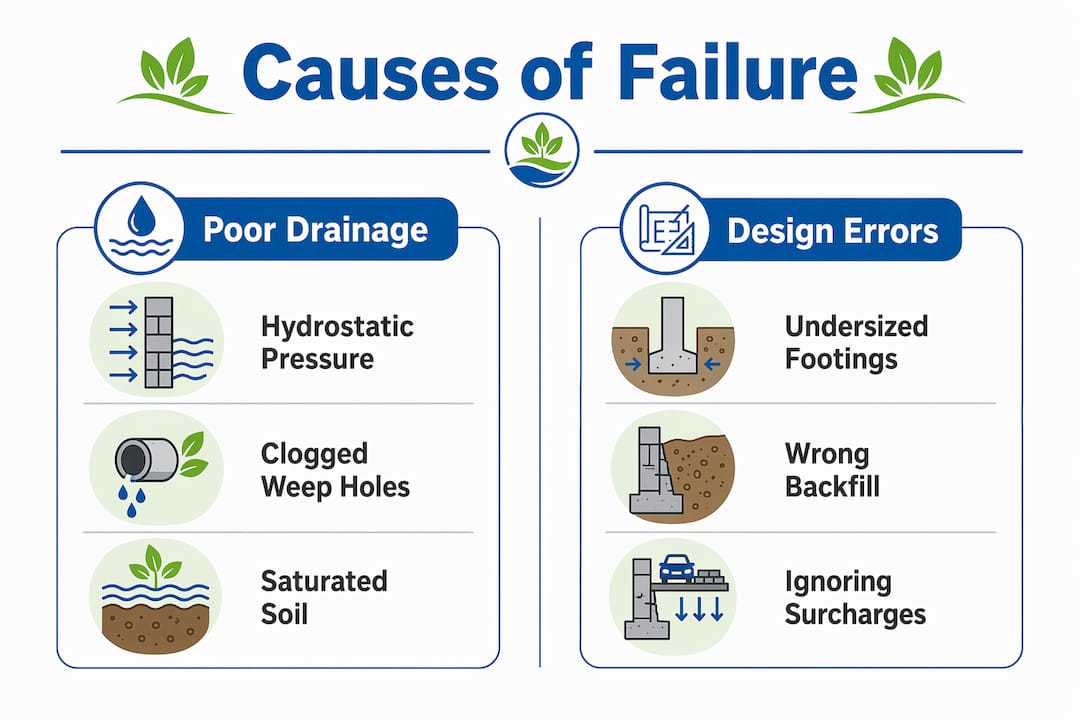
Undersized footings and poor soil compaction create weak zones that shift under load. Clay backfill compounds the problem because it holds water, swells when wet, and shrinks when dry, cycling stress into the wall with every season. New Hampshire’s freeze-thaw cycle amplifies this effect significantly.
What are the warning signs of a failing retaining wall?
Catching the signs of a failing retaining wall early prevents a minor repair from becoming a full rebuild. Most walls give clear physical warnings before they collapse.
- Horizontal cracks at mid-wall height. A horizontal crack running across the face of the wall is a serious structural signal. It indicates the wall is bending under lateral earth pressure and the reinforcement, if any, is being stressed beyond its limit.
- Outward bowing or tilting. Any visible forward lean or bulge in the wall face means the wall is moving. Movement that continues over weeks or months will not stop on its own.
- Dry weep holes after rain. Dry weep holes despite recent rainfall confirm that drainage is blocked. Water is accumulating behind the wall instead of escaping through the drainage system.
- Efflorescence on the wall face. Efflorescence is the white, chalky deposit that appears when water migrates through the wall and carries dissolved minerals to the surface. Efflorescence signals active water migration and a drainage system that is failing or bypassed. Many homeowners dismiss it as a cosmetic issue, but it is a direct warning of internal moisture damage.
- Sinkholes or depressions behind the wall. Soil migrating through or under the wall leaves voids behind it. Those voids appear as sinkholes or settling in the ground above and behind the wall.
Heavy storms can trigger failure within a single rain cycle when soil is already near saturation. New Hampshire’s spring snowmelt combined with rain creates exactly that condition. If you notice two or more of these warning signs together, treat it as urgent and get a professional assessment before the next major storm.
How can you prevent retaining wall failure in New Hampshire?
Prevention starts at the design stage and continues through the life of the wall. The good news is that most common retaining wall issues are avoidable with the right materials, drainage, and routine care.
Essential drainage components every wall needs
- A perforated drainage pipe at the base of the wall, sloped to daylight or a catch basin
- Weep holes spaced no more than 6 feet apart along the base course
- A geotextile filter fabric wrapped around the drainage aggregate to prevent soil migration
- Granular backfill, such as crushed stone, placed directly behind the wall
Backfill and material selection
Walls under 4 feet tall frequently fail because they are built as DIY projects without proper drainage or engineered backfill. In New Hampshire, walls under 4 feet in height are often exempt from building permits, but that exemption does not exempt them from physics. A wall that lacks granular backfill and a drainage pipe will fail regardless of its height or the quality of its face material. Learn more about material choices for NH walls before you build or rebuild.
Routine maintenance tasks
- Clear weep holes every spring and fall
- Remove soil and plant growth from the base of the wall that could block drainage outlets
- Check for new cracks, bowing, or efflorescence after every major storm
- Unverified surcharge loads like new parking areas or sheds added near the wall crest must be reviewed by an engineer before construction
Pro Tip: If you are planning any new construction within 10 feet of an existing retaining wall, have an engineer review the original design first. Adding load without re-engineering the wall is one of the most common causes of premature failure.
What I have learned about retaining wall failure in New Hampshire
After years of assessing and rebuilding retaining walls across New Hampshire, the pattern is consistent. The walls that fail are almost never the ones built with the best-looking stone or the most expensive block. They are the walls where someone skipped the drainage pipe, used the native soil as backfill, or added a driveway without thinking about what it would do to the wall below.
The most counterintuitive lesson is that over-designing a wall initially is almost always cheaper than rebuilding it. A drainage pipe and a yard of crushed stone cost a fraction of what it takes to tear out a failed wall, regrade the slope, and start over. Homeowners often focus on the visible face of the wall and underestimate what happens behind it.
I also see a lot of walls that were fine for years until someone added a patio or parking pad near the top. That added surcharge load is invisible to the homeowner but immediately felt by the wall. If your property has changed since the wall was built, get it looked at. Do not wait for the wall to tell you there is a problem by leaning into your yard.
Drainage is not a detail. It is the wall. Everything else is secondary.
— Damian
Divinelandscapingllc can help protect your wall
Retaining wall problems rarely fix themselves, and New Hampshire’s climate gives failing walls very little time before a wet spring or hard freeze makes things worse. Divinelandscapingllc designs and builds retaining walls with proper drainage systems, engineered backfill, and materials suited to NH soil conditions from the ground up.

Whether you need a new wall designed correctly from the start or an existing wall assessed for drainage and structural issues, Divinelandscapingllc brings the experience to get it right. Our hardscape services cover everything from initial design through construction and long-term maintenance. You can also review our retaining wall contractor services or request a quote to schedule a site visit with our team.
Key takeaways
Retaining wall failure is caused primarily by hydrostatic pressure from blocked drainage, compounded by design errors, wrong backfill, and unaccounted surcharge loads.
| Point | Details |
|---|---|
| Drainage is the top cause | Saturated soil exerts 2 to 3 times the lateral pressure of drained soil, making drainage a structural requirement. |
| Design safety margins matter | Standards require factors of safety of 1.5 against sliding, 2.0 against overturning, and 3.0 against bearing failure. |
| Clay backfill accelerates failure | Native clay traps water and cycles stress into the wall with every wet and dry season. |
| Warning signs are visible early | Horizontal cracks, bowing, efflorescence, and dry weep holes after rain all signal active failure. |
| Prevention costs far less than repair | Proper drainage and granular backfill at construction time prevent the most expensive failures. |
FAQ
What is the most common reason retaining walls fail?
The most common reason is hydrostatic pressure from poor drainage. Saturated soil behind the wall exerts 2 to 3 times the lateral force of drained soil, which overwhelms walls not designed for that load.
Do small retaining walls under 4 feet need drainage?
Yes. Walls under 4 feet often fall outside permit requirements in New Hampshire, but they still require granular backfill and drainage provisions. Without them, hydrostatic pressure will cause failure regardless of wall height.
What does efflorescence on a retaining wall mean?
Efflorescence, the white chalky deposit on the wall face, indicates that water is migrating through the wall and carrying dissolved minerals to the surface. It signals a drainage system that is failing or bypassed and should be addressed promptly.
Can adding a driveway cause a retaining wall to fail?
Yes. Driveways add surcharge loads that can double the earth pressure the wall must resist. If the original wall was not engineered for that load, the added weight can push the wall past its safety margins and cause failure.
How often should you inspect a retaining wall in New Hampshire?
Inspect your wall at least twice a year, in spring after snowmelt and in fall before freeze-up. Also check after any major storm, since heavy rain can saturate soil rapidly and accelerate failure in walls with compromised drainage.