
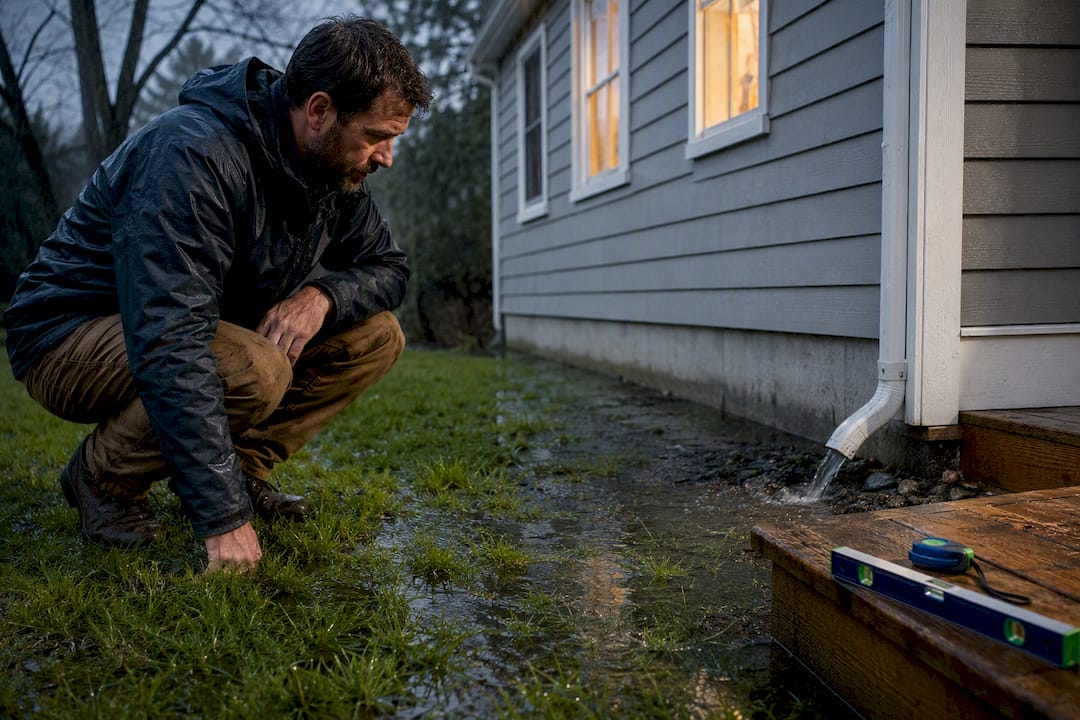
Start with two cheap tests before you spend a dollar on equipment: check your slope and test how fast your soil drains. Most yard drainage problems are solved with a low-cost fix like a downspout extension, lawn aeration, or a small regrade. Bigger issues need a French drain, catch basin, dry well, or sump pump, and if water is reaching your foundation or basement, call a professional before the problem gets more expensive.
TL;DR:
- Simple tests like slope measurement and percolation can help identify whether surface or subsurface fixes are necessary before investing in major drainage work.
- Most yard drainage issues caused by pooling near downspouts or compacted soil can often be addressed with inexpensive solutions such as extensions, gutter cleaning, regrading, or aeration.
- French drains, catch basins, dry wells, and sump pumps are suitable for serious subsurface water problems or high water tables, but require proper outlet placement to avoid failure.
- Landscape solutions like rain gardens, swales, and permeable pavers offer long-term, aesthetic options for managing moderate water runoff without extensive excavation.
- Professional intervention is advisable for persistent water seepage into basements, large grading changes, or when excavation risks hitting utilities, with thorough vetting of contractors to avoid costly mistakes.
Table of Contents
- How to Diagnose Your Yard Drainage Problem in Under an Hour
- 15 Yard Drainage Solutions at a Glance
- Try These Simple, Low-Cost Fixes First
- French Drains, Catch Basins, Dry Wells, and Sump Pumps Explained
- Rain Gardens, Swales, and Other Landscape-Based Fixes
- When to Hire a Pro and How to Vet a Quote
- Keeping Your Drainage Fix Working Long Term
- Field Notes From Damian at Divine Landscaping LLC
- Permits and Environmental Rules for Drainage Work
- Why Testing Comes Before Spending
- Get a Site Visit From Divine Landscaping LLC
- Sources
How to Diagnose Your Yard Drainage Problem in Under an Hour
You can’t fix what you haven’t measured, and guessing at the cause is how homeowners end up buying a drainage system they didn’t need. Give yourself an hour during or right after a rainstorm, and you’ll walk away with the information a contractor would normally charge you for.
Start by watching the water itself. Grab a raincoat and walk the yard while it’s actively raining, or within thirty minutes after a storm lets up. Note exactly where water sheets across the surface, where it pools and sits, and where it disappears (or doesn’t). This single observation often tells you more than any tool.
Next, run two quick physical tests:
- Screwdriver test: push a standard screwdriver into damp soil in several spots. If it slides in easily, your soil is loose. If it barely goes in an inch or two, you’re dealing with compaction, which blocks water from soaking in.
- Percolation test: dig a hole about a foot deep and a foot wide, fill it with water, and time how long it takes to drain. A hole-fill drainage test that takes more than a few hours to empty signals poor infiltration, which rules out dry wells and points you toward surface solutions instead.
Then measure your slope. Lay a straight board with a level across the first 10 feet of ground from your foundation. Anything flatter than that, or worse, sloping back toward the house, is a red flag.
Once you have this data, the mapping is simple. Standing water near downspouts usually means undersized or misdirected gutters. Slow-draining soil away from the house points to compaction or clay. A flat or negative slope near the foundation means regrading or a French drain is likely in your future. Water gone within an hour or two after a percolation test means infiltration-based fixes like dry wells or rain gardens are viable options.
15 Yard Drainage Solutions at a Glance
Once you know your problem type, matching it to the right fix gets a lot easier. The table below organizes the most common backyard drainage options by what they solve, what they cost, and how much labor they demand, based on typical DIY and professional cost ranges reported across residential drainage projects.
| Solution | Best For | DIY Cost | Pro Cost | Effort | Foundation Risk Fixed? |
|---|---|---|---|---|---|
| Downspout extension | Roof runoff pooling near house | $10 | $75 | Low | Yes |
| Pop-up emitter | Hiding underground downspout outlets | $15–$40 | $150 | Low | Yes |
| Gutter cleaning/upgrade | Overflowing gutters, water sheeting down walls | $100 | $150 | Low | Yes |
| Small regrading | Minor low spots near the house | $150 | $2,000 | Medium | Yes |
| Core aeration | Compacted lawn soil, slow absorption | $30 (rental) | $75 | Low | No |
| Compost topdressing | Clay soil, poor infiltration | $150 | $500 | Medium | No |
| French drain | Subsurface water moving toward the house | $1,500 | $1,500 | High | Yes |
| Catch basin + pipe | Concentrated surface flow at a low point | $300 | $3,000 | High | Yes |
| Dry well | Isolated wet spot with good percolation | $200 | $1,500 | High | Partial |
| Trench drain | Driveways, patios, hardscape edges | $300 | $1,200 | High | Partial |
| Sump pump | High groundwater, basement seepage | $150 | $3,000 | High | Yes |
| Rain garden | Moderate runoff with room for a planting bed | $200 | $1,500 | Medium | No |
| Swale/bioswale | Directing sheet flow across a slope | $150 | $3,000 | Medium | Partial |
| Dry creek bed | Concentrated flow with a decorative finish | $300 | $2,000 | Medium | No |
| Permeable pavers | Driveways/patios that shed too much water | $5,000 | $8,000 | High | No |
Pick one or two candidates from this list based on your diagnosis, not the whole menu. A yard with undersized gutters and a flat first 10 feet rarely needs a sump pump. A yard with a genuine high water table near the foundation rarely gets fixed by a downspout extension alone.
Try These Simple, Low-Cost Fixes First
Before you rent a trencher or call a contractor, run through the cheap fixes. Many yards that look like they need major surgery just need better roof water management and looser soil.
- Extend your downspouts. Water dumped right at the foundation is the single most common cause of wet basements and soggy beds. Route it a few feet away from the house to divert water away from the foundation using a rigid extension or a pop-up emitter that stays hidden until it’s discharging.
- Clean and size your gutters. If water overshoots the gutter during moderate rain, or you see staining below the seams, the gutters are likely undersized or clogged with debris. Clean them twice a year at minimum, more often under pine trees or maples.
- Regrade small low spots. For dips under a few inches deep, add and compact clean fill soil in thin layers, then reseed. Anything deeper than 6 inches or spanning a large area usually calls for a skid steer or a contractor with grading equipment.
- Aerate compacted lawns. Iowa State University Extension recommends pulling 20 to 40 cores per square foot to restore the soil’s ability to absorb water, a step worth taking before any excavation.
- Top-dress with compost. A half-inch layer worked into aerated clay soil improves structure over one to two growing seasons, gradually increasing how much rain the ground can hold instead of shedding.
Most of these take a weekend, a rented aerator, and less than $150 in materials. Retest with the percolation and slope checks after the next real rainstorm, not just a light sprinkle, since light rain won’t reveal whether the fix actually worked.
Pro Tip: Run your downspout test during an actual storm, not with a garden hose. Hose water flows at a fraction of the rate a heavy downpour delivers, so a fix that looks fine under a hose can still overflow during a real event.
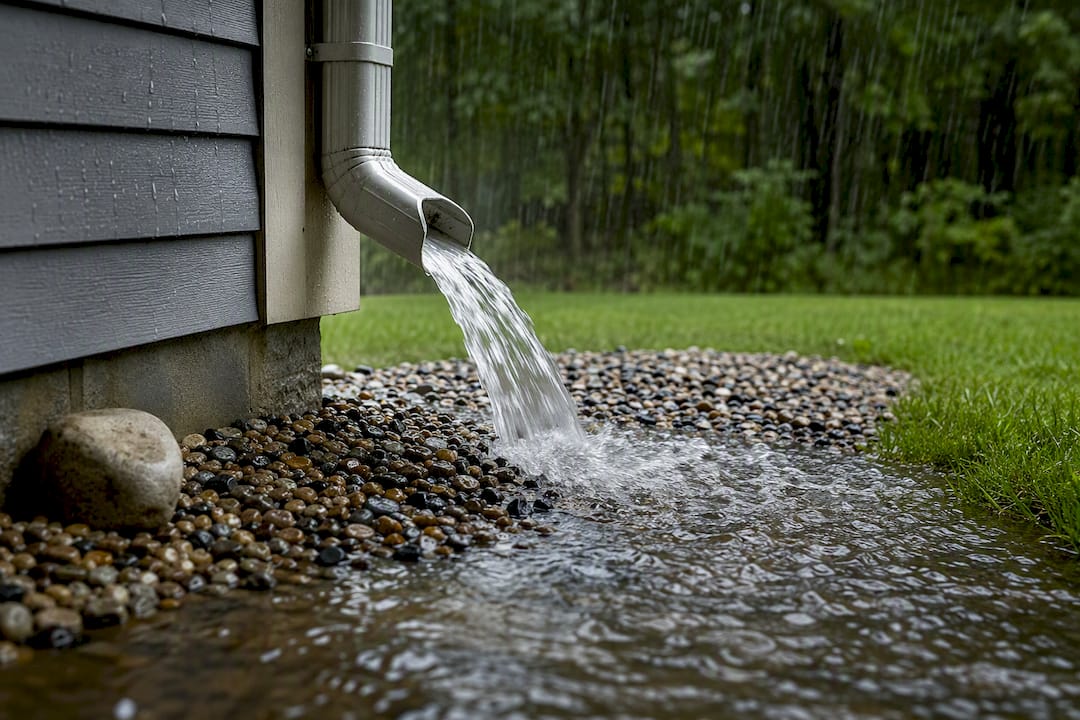
If your gutters themselves are the weak link, upgrading to larger downspouts or added capacity is sometimes the fastest fix. Local gutter and downspout upgrade projects show how straightforward that swap can be for houses with consistently overwhelmed roof drainage.
French Drains, Catch Basins, Dry Wells, and Sump Pumps Explained
When the cheap fixes don’t solve it, you’re likely dealing with subsurface water, a low point that collects flow from multiple directions, or a water table that’s simply too high for surface tricks to handle.
French drains intercept water underground and carry it away before it surfaces. Dig a trench at least 18 to 24 inches deep, lay perforated pipe wrapped in filter fabric, and surround it with clean gravel. Building America Solution Center guidance recommends smooth PVC over corrugated pipe, since corrugated pipe’s ridges trap silt and clog faster over time. The trench needs a consistent downhill slope of at least 1% (roughly 1/8 inch per foot) toward a real outlet, whether that’s daylighting on a slope, a dry well, or a storm drain connection.
Catch basins paired with solid drainpipe work better than French drains when you have one specific low point collecting runoff from a patio, driveway, or downspout, rather than a broad wet area. The basin catches the water at the surface; the pipe moves it somewhere useful.
Dry wells hold water underground and let it slowly infiltrate into surrounding soil, which only works where percolation is decent. In heavy clay, a dry well just becomes an underground bathtub with nowhere for the water to go. Size them based on your percolation test results and the roof or paved area feeding them, not a generic size off a shelf.
Sump pumps handle situations the other four can’t: basement seepage, high groundwater, or a yard that simply sits below the water table for part of the year. Sizing depends on gallons per minute needed and the vertical lift to the discharge point, both of which a groundwater situation makes hard to eyeball without testing.
A French drain with a poor or undersized outlet is one of the most common failure points seen on residential projects. Water needs somewhere to actually go once it’s collected. A trench that dead-ends into ground that’s just as saturated as the problem spot will back up and fail within a season or two, regardless of how well the trench itself was dug.
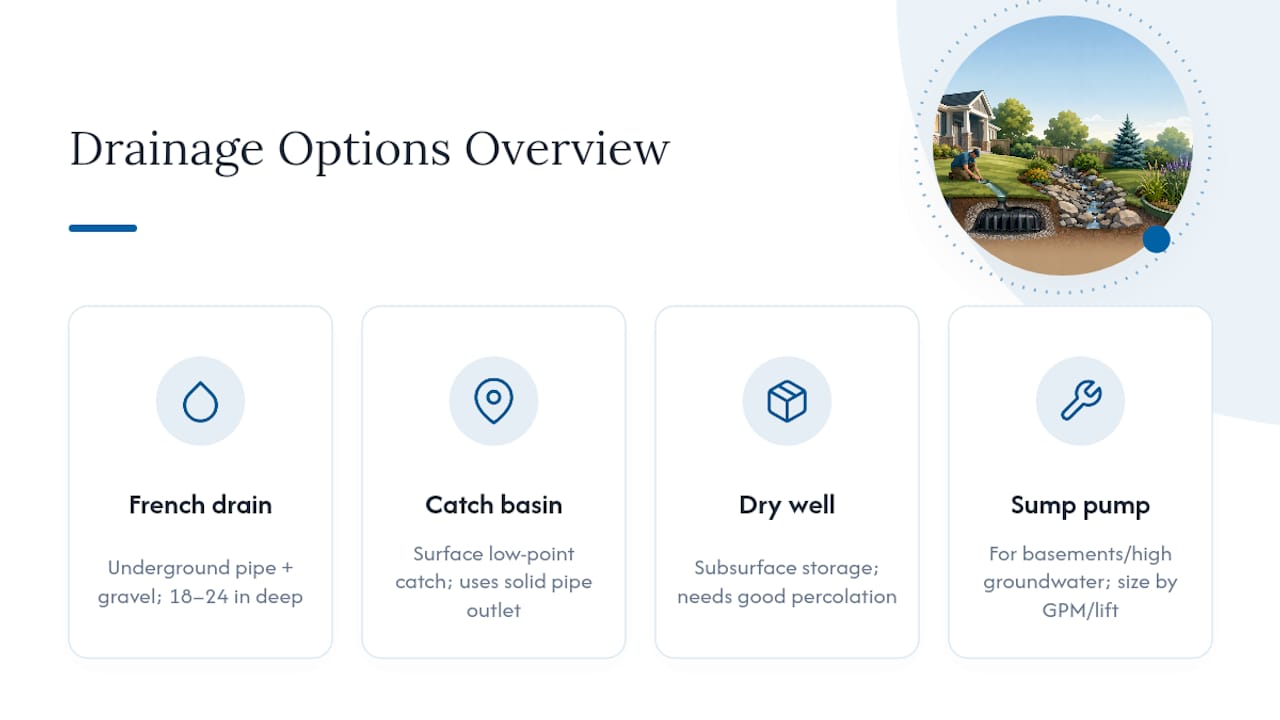
Digging near property lines, utility lines, or septic systems is where DIY projects most often run into trouble, and it’s a leading reason homeowners bring in a professional for anything beyond a shallow trench. For step-by-step guidance on catch basins, outlet selection, and trench slope, Lowe’s how-to resource recommends a minimum 2% slope for reliable water flow through any buried drain line.
Rain Gardens, Swales, and Other Landscape-Based Fixes
Not every drainage fix has to look like a construction project. Landscape-based solutions manage water while adding something you’ll actually enjoy looking at.
- Rain gardens are shallow depressions, typically 4 to 8 inches deep, planted with species that tolerate both flooding and drought. They can absorb noticeably more runoff than a stretch of turfgrass covering the same footprint. Heavy clay sites often need an underdrain beneath the garden, plus an overflow path for storms that exceed its capacity.
- Swales and bioswales channel sheet flow across a slope instead of letting it cut its own path. A workable swale runs a gentle longitudinal slope with side walls at a width-to-height ratio providing stable, effective flow, then gets stabilized with deep-rooted grasses or groundcover to resist erosion.
- Dry creek beds handle concentrated flow with a decorative finish of stone and boulders, often paired with an armored outlet where water discharges to prevent scouring at the end point.
- Permeable pavers let water infiltrate through a patio or walkway surface instead of running off it, though they need a load-bearing base engineered for both foot or vehicle traffic and drainage, which is why installed cost runs well above standard pavers.
- Native plant beds build soil structure over years through deep root systems, gradually improving infiltration in areas that don’t need an immediate structural fix.
These options work best as long-term, moderate-volume solutions. They’re a poor substitute for a French drain when you’re dealing with water actively threatening a foundation, but they’re often the better choice for a soggy back corner of the yard that just needs somewhere better to send its water. Homeowners layering drainage improvements into a larger yard plan often coordinate with foundation-safe landscaping choices at the same time, since plant selection near the house affects both moisture and root intrusion risk.
When to Hire a Pro and How to Vet a Quote
Some situations aren’t DIY territory, no matter how capable you are with a shovel. Call a professional when you see water actively seeping into a basement or crawl space, when the yard sits on a high water table, when grading needs to change across a large or sloped area, or when digging risks hitting utility lines or a septic field.
When you’re vetting a contractor, ask these questions before signing anything:
- Have you completed drainage-specific projects before, not just general landscaping, and can you show examples?
- Can you provide references from similar drainage jobs, ideally in a comparable soil type or slope condition?
- Are you insured, and can you provide proof before work starts?
- Who handles permitting if the project requires it, and is that included in the quote?
- What warranty applies to the finished system, and for how long?
A legitimate quote should break out line items clearly: excavation, pipe and fittings, gravel or fabric, outlet work, and labor, rather than one lump number. Regrading typically runs from a few hundred dollars for a small area to a couple of thousand for a larger yard requiring equipment. French drains and catch basins scale with trench length and depth, which is why two quotes for the “same” job can differ by thousands if one contractor is digging deeper or routing a longer outlet run.
Red flags include a quote with no mention of outlet location, pressure to sign same day, or a price dramatically lower than every other bid, which usually means shallower trenching or lower-grade pipe. If you’re getting a grading quote specifically, a itemized cost checklist helps you compare bids on equal footing before you commit.
Keeping Your Drainage Fix Working Long Term
A fix that works during the next storm doesn’t mean the problem is gone for good. Retest after the next few real rain events, not just a light drizzle, and repeat your percolation and screwdriver checks in the same spots you tested originally.
- Clean gutters at least twice a year, more if you have overhanging trees.
- Check catch basins for debris buildup every few months, especially in fall.
- Clear pop-up emitters of mulch or soil that can bury them over a season.
- Winterize sump pumps and check float switches before the first freeze.
- Give soil amendments like aeration and compost one to two full growing seasons before judging results.
If a fixed area starts pooling again after a year or two, it’s usually settling, a clogged outlet, or a new obstruction rather than a failed original design. For a broader maintenance rhythm across your whole yard, this homeowner’s landscape maintenance guide covers the seasonal tasks that keep drainage systems from quietly failing between checkups.
Field Notes From Damian at Divine Landscaping LLC
On a site visit, the sequence rarely changes: measure the slope first, locate every existing outlet (downspouts, drain pipes, sump discharges), check soil by hand in a few spots, then note anything blocking flow, fences, sheds, retaining walls, before touching a shovel.
The most common mistake on quotes is a missing outlet plan. A beautifully dug trench that empties into another wet patch of yard hasn’t solved anything, it’s just relocated the puddle. Watch for that gap in any bid you’re comparing.
Case examples and client testimonials from past Divine Landscaping LLC drainage projects can be added here.
Permits and Environmental Rules for Drainage Work
Most simple fixes, downspout extensions, gutter cleaning, small regrades, and aeration, don’t require a permit anywhere in the country. Once a project involves directing water onto a neighboring property, altering a floodplain, or discharging into a municipal storm system, local rules generally apply.
Many towns and cities regulate where stormwater can legally be discharged, particularly toward wetlands, streams, or shared drainage easements between properties. Some municipalities also cap how much impervious surface (pavers, patios, driveways) a property can add without a stormwater management plan, since more hardscape usually means faster runoff and a bigger burden on public drainage infrastructure.
Grading changes that shift water flow toward a neighbor’s yard can also create liability, separate from any permit requirement, since most jurisdictions hold property owners responsible for water they redirect onto adjacent land. Before excavating for a French drain, catch basin, or dry well, it’s worth a quick call to your local building or public works department to confirm depth limits, setback requirements from property lines, and whether your specific project needs a permit at all.
None of this should stop a homeowner from fixing a soggy yard. It just means a five-minute phone call before a big install can save a costly redo, or a fine, down the line.
Why Testing Comes Before Spending
The biggest waste of money in yard drainage isn’t skipping a fix, it’s skipping the diagnosis and jumping straight to the most expensive option. A homeowner who runs a percolation test and measures slope before buying anything usually spends a fraction of what someone guessing their way through a French drain install spends, and often solves the problem with a downspout extension instead.
That said, testing has limits. If water is reaching a foundation or basement repeatedly, don’t keep experimenting with cheap fixes hoping one eventually sticks. That’s the point where a professional site visit earns its cost many times over.
— Damian
Get a Site Visit From Divine Landscaping LLC
If your yard needs more than a weekend project, Divine Landscaping LLC handles the drainage work that goes beyond DIY, regrading, French drains, dry wells, catch basins, rain gardens, and the hardscape outlet work that ties a drainage system into a finished patio or walkway, all under one contract instead of juggling separate trades.

A site visit starts with the same diagnosis covered in this guide: slope measurement, a soil check, and a look at where your water actually wants to go, so the estimate you receive reflects your yard’s real problem instead of a generic package price. From there, you get a written scope covering excavation, materials, outlet routing, and warranty terms before any work begins. If your project also touches hardscaping, retaining walls, or an outdoor living space built around the fix, that gets scoped in the same visit rather than as a separate headache later.
Ready to get a real number instead of a guess? Request an estimate and get a site visit scheduled for your property.
Sources
- Swales, Drains, and Site Grading for Stormwater Control – Building America Solution Center
- Core Aeration – Iowa State University Extension
- How to solve yard drainage problems – Lowe’s