
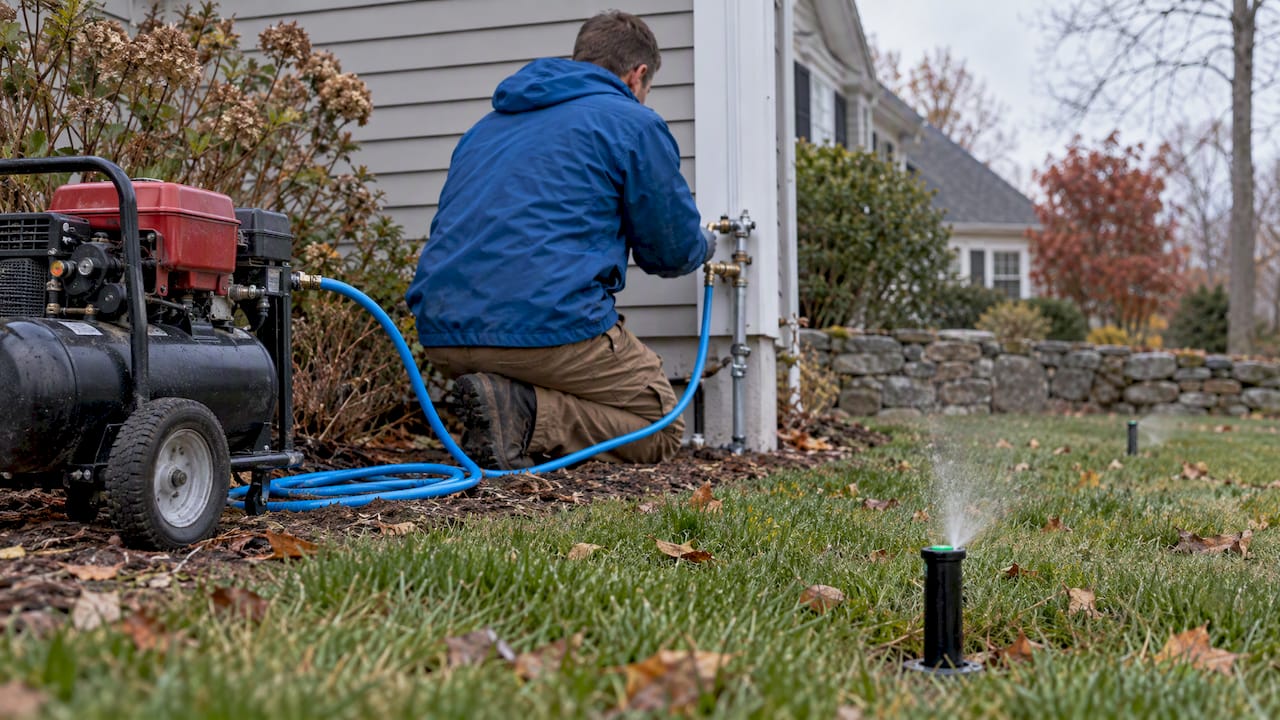
Most New Hampshire homeowners should plan on roughly $60 to $150 for a professional irrigation winterization, with small systems at the low end and larger or more complicated systems above it. That range comes from national pricing data, not from a single NH contractor, so the final number depends on your zone count, your backflow device and how easy your system is to reach. This guide explains what shapes the price, when to book, and how to tell a real blowout from a quick shutoff.
TL;DR
- Expect about $59 to $144 for a typical residential winterization, according to national cost data. Pumps, wells, crawl-space access and hard-to-reach valves can add to that.
- Price follows zone count first. Larger systems cost more in total, but less per zone.
- In New Hampshire, schedule the blowout from late September through October, before a sustained hard freeze.
- Turning off the water or the controller is not winterizing. Water must be forced out of every zone with compressed air.
- Skipping it risks cracked pipes, valves and heads. Repairs usually cost many times more than the service.
Table of Contents
- What irrigation winterization costs in New Hampshire
- What changes the price
- When to winterize in New Hampshire
- What a proper winterization includes
- Can you winterize it yourself?
- The cost of skipping it
- Our perspective: winterization starts when the system is built
- How to get an accurate quote
- Smart controllers and your winter routine
- Irrigation help from Divine Landscaping
- Why agricultural pricing does not apply
- FAQ
- Sources
What irrigation winterization costs in New Hampshire
New Hampshire does not have a state price schedule for this work, and prices vary by town and provider. The most useful benchmark is national pricing, which LawnStarter’s 2026 cost guide puts at $59 to $144 for most homeowners. Its Northeast figures, such as $64 to $155 for Providence, Rhode Island, sit in the same band, which is a reasonable guide for southern New Hampshire and the Seacoast.
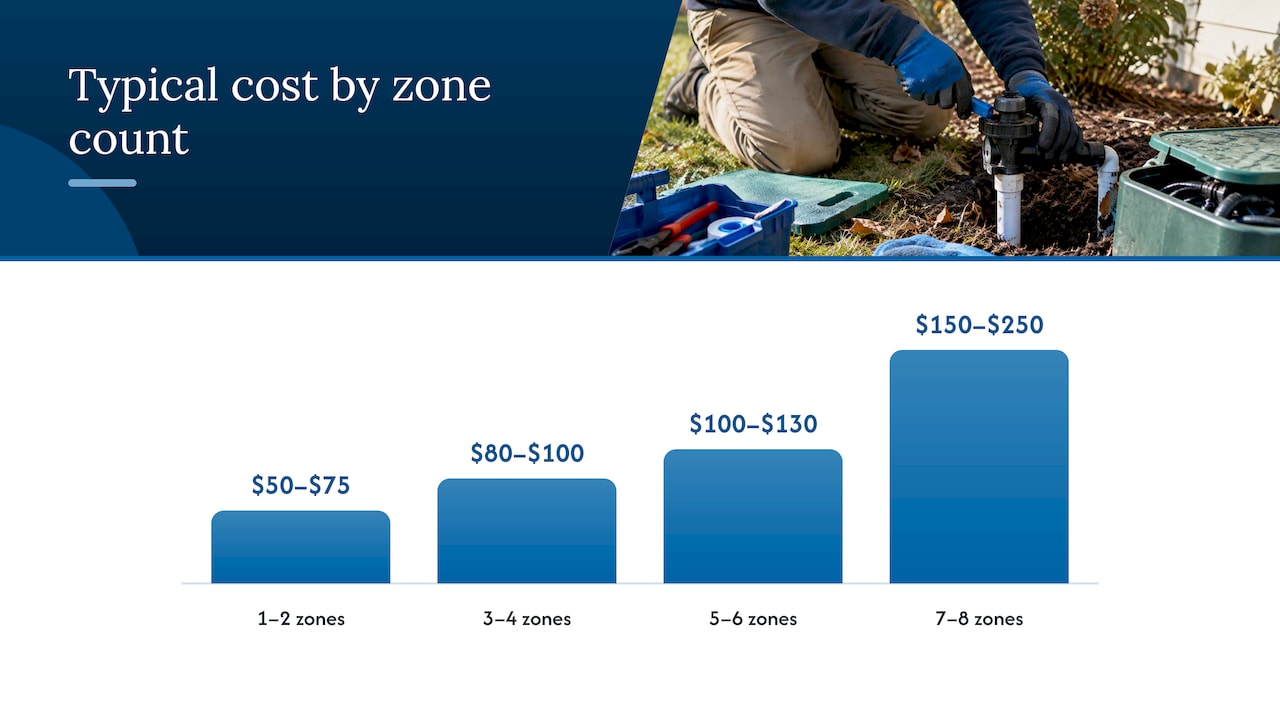
That guide also breaks cost down by zone count:
| Number of zones | Typical cost |
|---|---|
| 1 to 2 zones | $50 to $75 |
| 3 to 4 zones | $80 to $100 |
| 5 to 6 zones | $100 to $130 |
| 7 to 8 zones | $150 to $250 |
Treat these as ballpark figures. A flat-rate offer for a small yard and a quote for a large property with a well pump are different jobs, and the second one should not be priced like the first.
We don’t publish a fixed price for seasonal irrigation work, because the right number depends on what is in the ground. If you want an exact figure for your property, we would rather look at your system than guess.
What changes the price
Two homes with the same number of zones can still get different quotes. These are the factors that move the number.
Zone count and system size
A technician opens each zone one at a time and runs air through it until the lines clear. More zones mean more time and more air. That is why the per-zone cost falls as systems get bigger: the setup (connecting the compressor, shutting off the supply) is a fixed effort.
Backflow device type
This is the detail most homeowners miss. Colorado State University Extension warns that pressure vacuum breakers and reduced-pressure backflow devices must never be blown out with compressed air, because their internal seals can be damaged. The device has to be drained according to its type. A technician who identifies the device and handles it correctly is doing more work than one who simply connects air and runs through the zones.
Pumps, wells and non-standard features
Systems fed by a private well or a booster pump have extra components that hold water. Pumps need their own draining. Expect a higher quote, and tell the contractor up front.
Access
Valves in a crawl space, a basement shutoff that needs an appointment inside your home, or a manifold buried under shrubs all add time. Clear the area before the visit and note where your irrigation shutoff is.
Timing
Booking late costs more in some markets. As one example, one out-of-state provider’s 2026 schedule adds a late-season surcharge once certain November dates pass. Those are that provider’s own terms, but the pattern is common: the earlier you book, the less likely you are to pay a rush fee or end up scheduled after the ground freezes.
When to winterize in New Hampshire
Plan for the fall, commonly late September through November, with the work finished before a sustained hard freeze. October is the key month for most of the state. The New Hampshire Insurance Department advises homeowners to winterize irrigation systems before freezing weather arrives.
Elevation matters. Southern and Seacoast properties often get a little more time than homes in the North Country or the hills. Even so, booking early is safer than waiting for the first frost warning, when every contractor’s calendar fills at once.
A simple schedule:
- Late September: Stop scheduled watering as the lawn slows down and call for an appointment.
- Early to mid-October: Have the blowout done in most of southern New Hampshire.
- Before the first hard freeze: Confirm it is finished. If a freeze is forecast and you have not been serviced, call right away rather than hoping the cold passes.
What a proper winterization includes
A professional blowout follows a sequence. A typical visit covers these steps, as described by extension and municipal guidance:
- Shut off the water supply to the irrigation system.
- Drain the backflow plumbing according to the device type.
- Connect an air compressor downstream of the backflow device.
- Open zones one at a time and run air until only mist comes out of the heads.
- Purge the lateral lines and valves.
- Shut down the controller.
- Leave appropriate drains or ports open for the winter.
The pressure and volume of the compressor matter. The City of Greeley’s water department specifies a compressor of no more than 70 psi and at least 100 CFM for its described residential procedure. Volume is the point: a small homeowner compressor can make the heads sputter and look clear while water stays in low spots and lines. Always follow the limits of your own pipe and manufacturer.
The main takeaway is that “water off” is not the same as “system winterized.” Shutting the supply and switching off the controller can leave water trapped in valves, heads and piping. Colorado State also says not to trust manual or automatic drain valves alone; blow the system out with pressurized air.
Can you winterize it yourself?
Sometimes. It is realistic only when all of these are true:
- Your system has a suitable blowout connection.
- You can identify your shutoff and your backflow device type.
- You have a compressor with enough volume and a regulator to control pressure.
Excess pressure can split fittings and crack heads, and forcing air through certain backflow devices damages them. Hire a professional if your system has a pump, complex backflow equipment, buried or hard-to-reach components, or any plumbing you are unsure about. If your first blowout attempt leaves you guessing, the $60 to $150 service fee is the cheaper mistake to avoid.
The cost of skipping it
Water expands as it freezes, and that can crack pipes, valves and heads. Repairs are not cheap. Single components often run tens of dollars to a few hundred, while broken mainlines, valves and manifolds can climb much higher. And the damage is invisible until spring, when you turn the system on and find a flooded bed or a geyser.
There is an insurance angle too. The New Hampshire Insurance Department notes that a policy may cover burst-pipe damage, but only if you took reasonable precautions to prevent freezing and the discharge was sudden and accidental. Talk to your own insurer about how your policy treats frozen lines. Prevention beats relying on a claim.
Our perspective: winterization starts when the system is built
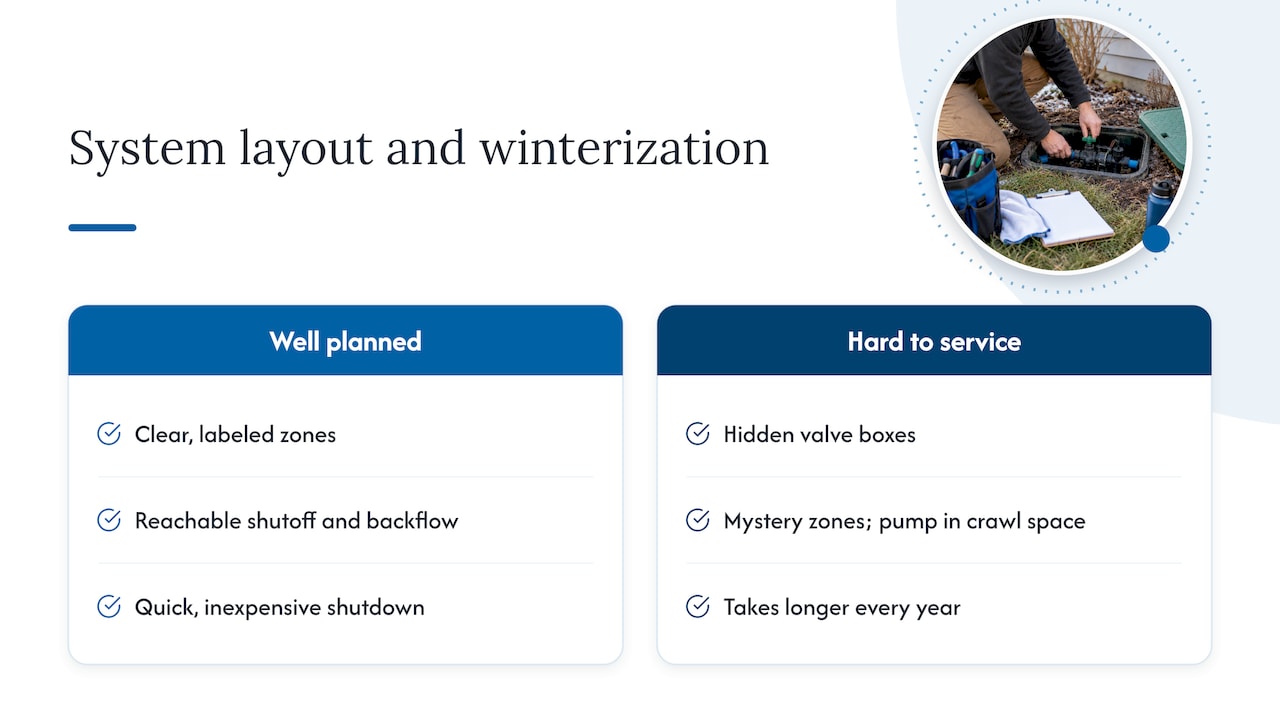
We design and install irrigation for homes and businesses in New Hampshire, and what we notice is that winterization cost is largely decided long before the first fall. A system laid out in clear, well-labeled zones, with an accessible shutoff and a backflow device placed where a technician can reach it, is quick and inexpensive to shut down. A system with hidden valve boxes, mystery zones and a pump in a crawl space takes longer every year.
That is why we push for clear planning at the start. Our guides on irrigation zones and on planning a residential irrigation system step by step cover the choices that affect long-term upkeep. If you want to see what mistakes cost people later, common irrigation system mistakes is worth ten minutes.
Our advice is simple: know your system. Write down your zone count, where the shutoff is, whether you are on town water or a well, and what kind of backflow device you have. Take a photo of the controller and the valve box. Whoever services it, whether us or someone else, will give you a more accurate quote and a better job.
— Damian
How to get an accurate quote
Before you call anyone, collect this:
- Number of zones, including any drip zones for plant beds
- Water source: municipal or private well
- Pump or booster, if any
- Backflow device type and location
- Where the irrigation shutoff is, and whether it is inside the house
- Access limits: crawl spaces, locked gates, dogs, buried valve boxes
Then ask the contractor:
- Is the price flat or per zone?
- Is there a trip fee or an extra charge for pumps and hard access?
- What compressor volume do you use, and how do you handle my backflow device?
- Is spring startup included, or separate?
- What happens if a head or valve is found damaged during the blowout?
A clear answer to all five is a better sign than the lowest price.
Smart controllers and your winter routine
Smart irrigation controllers adjust watering to weather and soil conditions, and they can help reduce overwatering through the season. They do not remove the need for a fall blowout. Whatever controller you have, it still needs to be put into its off or rain mode after the lines are cleared, and a smart controller on an outdoor wall is still exposed to freezing temperatures if it is not rated for them. Check your manufacturer’s instructions about whether to leave it powered or remove it for winter.
If you are planning an upgrade, winter is a good time to think about it. Our sprinkler system cost guide covers what a new or replacement system runs, including controllers.
Irrigation help from Divine Landscaping
If your system is old, hard to reach, or keeps needing repairs, it may be worth fixing the cause. We install, replace and repair full lawn irrigation and plant bed irrigation across New Hampshire, along with landscape lighting. You can see everything on our irrigation and lighting page, read about our irrigation services, or find local pages for Derry and Salem. If you are budgeting a larger outdoor project, our look at landscaping costs in New Hampshire explains why rocky lots change a bid.
Why agricultural pricing does not apply
Searches for irrigation costs sometimes surface farm numbers, such as the center-pivot budgets from Michigan State University, which describe a 160-acre-class system installed at $62,000 plus equipment for power and water connections. Those are agricultural figures from other states and years. They have nothing to do with winterizing a residential New Hampshire lawn system, and they should not be used to judge a quote for your yard.
FAQ
How much does it cost to winterize a sprinkler system in NH?
Most homeowners should expect about $60 to $150, based on national 2026 pricing. Small systems cost less, and systems with many zones, pumps or poor access cost more. Get a quote that spells out any extra fees.
When should I blow out my sprinklers in New Hampshire?
Book for late September through October, and have it finished before a sustained hard freeze. The state insurance department advises winterizing before freezing weather. Northern and higher-elevation properties should go earlier.
Can I winterize my sprinklers myself?
You can if your system has a blowout connection and you have a compressor with enough volume and a pressure regulator. Do not blow air through pressure vacuum breakers or reduced-pressure devices, which can be damaged. If you have a pump or are unsure of your plumbing, hire a professional.
Does turning off the water and controller winterize my system?
No. Water left in valves, heads and lines can still freeze and crack them. Each zone needs to be cleared with compressed air, and the backflow assembly drained correctly.
Sources
- How Much Does it Cost to Winterize a Sprinkler System in 2026? (LawnStarter)
- Home Sprinkler Systems: Preparing Your Sprinkler System for Winter (Colorado State University Extension)
- Time to Winterize: 4 Things to Add to Your To-Do List (City of Greeley)
- Does Homeowners Insurance Cover Water Damage from a Burst or Frozen Pipe? (New Hampshire Insurance Department)
- 160 Acre Center Pivot (Michigan State University)
- Winterize Me