
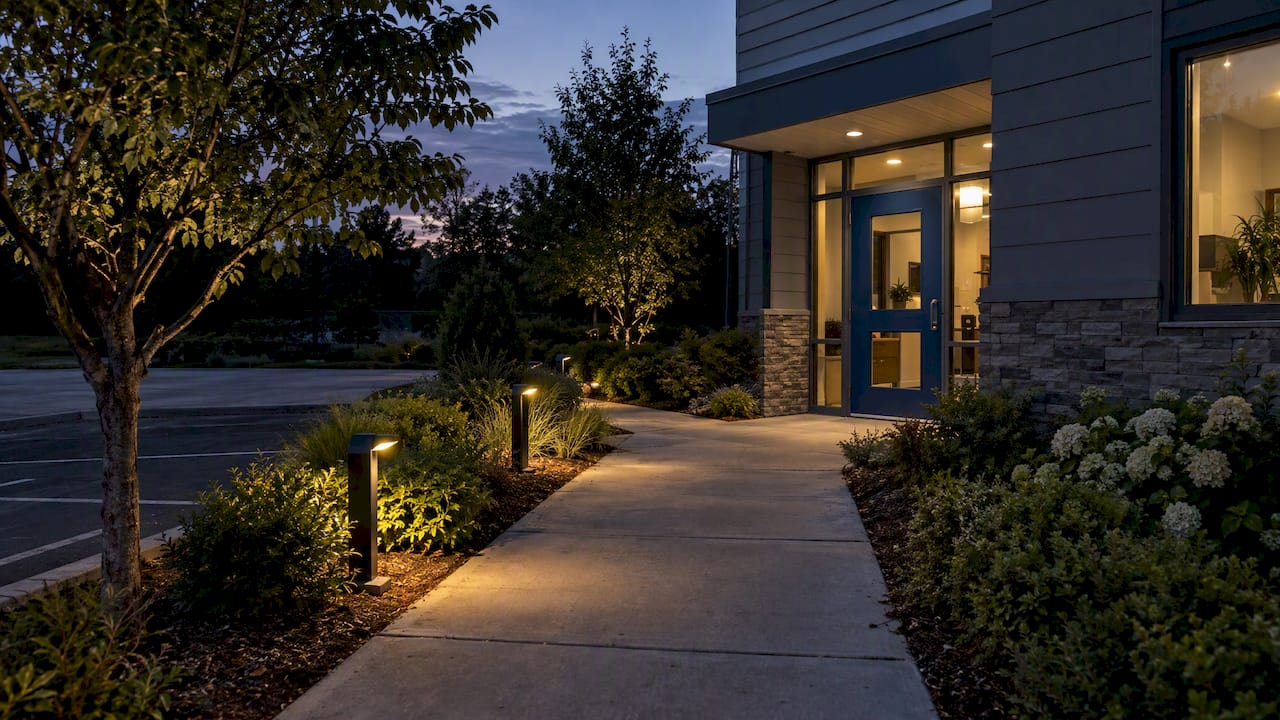
Good commercial landscape lighting uses layered, targeted light to improve safety, wayfinding, and curb appeal while keeping glare and light trespass under control. A design that follows IES lighting zones and BUG ratings.pdf) and pairs fixtures with smart controls earns its cost back in energy savings and fewer complaints. If you manage a commercial property, the next step is simple: commission a photometric layout from a qualified design-build contractor like Divine Landscaping LLC before you approve any fixture order.
TL;DR:
- Your site’s Lighting Zone sets allowable lighting power density, which ranges from roughly 0.04 to 0.08 watts per square foot across zones.
- Efficient LEDs need scheduling, occupancy sensors, and dimming to reduce full output hours; otherwise, the system misses available energy savings and adds fixture wear.
- Low voltage circuits at 12V or 24V can dim or shift color over long runs; hub wiring simplifies repairs and future fixture additions.
- Require a photometric layout, itemized costs for fixtures, labor, and controls, documented BUG ratings, commissioning results, and warranty terms before approving installation.
- Check local permit rules early, especially near homes, where glare limits may be stricter; approval before ordering fixtures helps avoid redesign.
Table of Contents
- Why Commercial Landscape Lighting Matters and Where It Pays Off
- Core Design Principles: Lighting Zones, LPD Thresholds, and BUG Ratings
- Fixture Types and Field Techniques for Commercial Sites
- Lighting Controls and Energy Strategies for Large Sites
- Installation Planning and Cost Expectations
- Electrical Constraints That Determine Long-Term Performance
- Maintenance and Performance Verification Over Time
- How to Choose a Commercial Landscape Lighting Contractor
- Navigating Local Permit Requirements for Commercial Lighting
- What to Expect From Design to Installation Completion
- Lessons From On-Site Commercial Lighting Work
- How We Help Commercial Clients Get Lighting Design Right
- FAQ
- Sources
Why Commercial Landscape Lighting Matters and Where It Pays Off
Commercial landscape lighting does more than make a property look finished after dark. It directs foot and vehicle traffic, marks property lines, and signals to visitors that a business is active, maintained, and worth stopping at.
The applications that matter most for commercial sites include:
- Entrances and storefronts, where lighting confirms the building is open and establishes a first impression.
- Walkways and plazas, where even, low-glare light keeps pedestrians moving safely after dusk.
- Parking areas, where visibility reduces trip hazards and supports a sense of security.
- Signage, where targeted illumination keeps a business visible from the road without spilling onto neighboring properties.
- Landscape features, such as mature trees, retaining walls, or entry gardens, where accent lighting reinforces brand identity.
The IES Five Principles draw a clear line between useful lighting and indiscriminate brightening: light should be useful, targeted, no brighter than necessary, controlled, and color-considered. A parking lot flooded with light at full output all night is not safer than one lit to the level pedestrians actually need, and it costs more to run. Done well, lighting design extends the hours a property functions as a business asset, from evening retail traffic to after-hours deliveries, while shaping how the space is perceived from the street.
Core Design Principles: Lighting Zones, LPD Thresholds, and BUG Ratings
A commercial lighting proposal should reference three standards-based checkpoints you can verify without a lighting degree.
Lighting Zones (LZ-1 through LZ-4) classify a site by its surrounding context, from dark rural areas to high-activity urban districts, and they set the ceiling on how much lighting power a design can use per square foot.
- LZ-1 covers the darkest contexts, where lighting must stay minimal to protect the nighttime environment.
- LZ-2 and LZ-3 apply to most suburban and mixed commercial corridors.
- LZ-4 applies to the highest-activity districts, where more lighting power is permitted.
Lighting power density (LPD) thresholds run from roughly 0.04 to 0.08 watts per square foot depending on the zone, with LZ-1 at the low end and LZ-4 at the high end, according to technical guidance on outdoor luminaire classification. Knowing your site’s zone tells you whether a proposed design is realistic or overbuilt before a single fixture goes in the ground.
BUG ratings (Backlight, Uplight, Glare) classify how a fixture’s optics control light spill in three directions. A fixture with a poor uplight rating sends light into the sky instead of the ground, and a poor glare rating creates the kind of harsh point-source brightness that draws complaints from neighbors and drivers. When you review proposals, ask for photometric reports and request that fixtures carry LM-79 or LM-64 testing documentation, since that data is what confirms a fixture performs as specified rather than as advertised.
Fixture Types and Field Techniques for Commercial Sites
Matching the right fixture to the right location is where most lighting designs succeed or fail. The common categories include: See examples in our Highway Gateway Commercial Plaza Rendering to understand fixture application in a real-world commercial setting.
- In-ground uplights for illuminating mature trees and architectural columns from below.
- Adjustable spotlights for highlighting signage, statuary, or focal planting beds.
- Bollards for marking pathway edges at a human scale without overhead glare.
- Wall washers for grazing building facades and creating a uniform glow across masonry or siding.
- Flood fixtures for loading docks, service entrances, and other areas that need higher output for security.
Beyond fixture selection, technique shapes how a space reads at night. Grazing places a fixture close to a textured surface, often 12 to 24 inches away at a 30 to 60 degree angle, to reveal brick or stone texture rather than flattening it with a direct wash, a technique lighting professionals describe in detail. Moonlighting mounts fixtures high in tree canopies and aims them downward to cast dappled shadows that mimic natural moonlight across lawns and walkways. Silhouetting and backlighting place a light source behind an object to create contrast against a wall or sky, useful for specimen trees or sculptural elements. Continuous path runs space fixtures evenly along walkways to guide movement rather than leaving dark gaps between pools of light; our own guidance on path layouts and simple uplighting covers how spacing affects that continuity.
Color temperature matters as much as placement. Warm white can create a natural, inviting effect for uplighting trees and architectural features. Test the color on-site before committing to a full layout, as outlined in our tree uplighting guidance. Beam spread, shielding, and BUG rating should all be confirmed for each fixture type before installation, since a fixture with the right color temperature but poor shielding can still create glare.
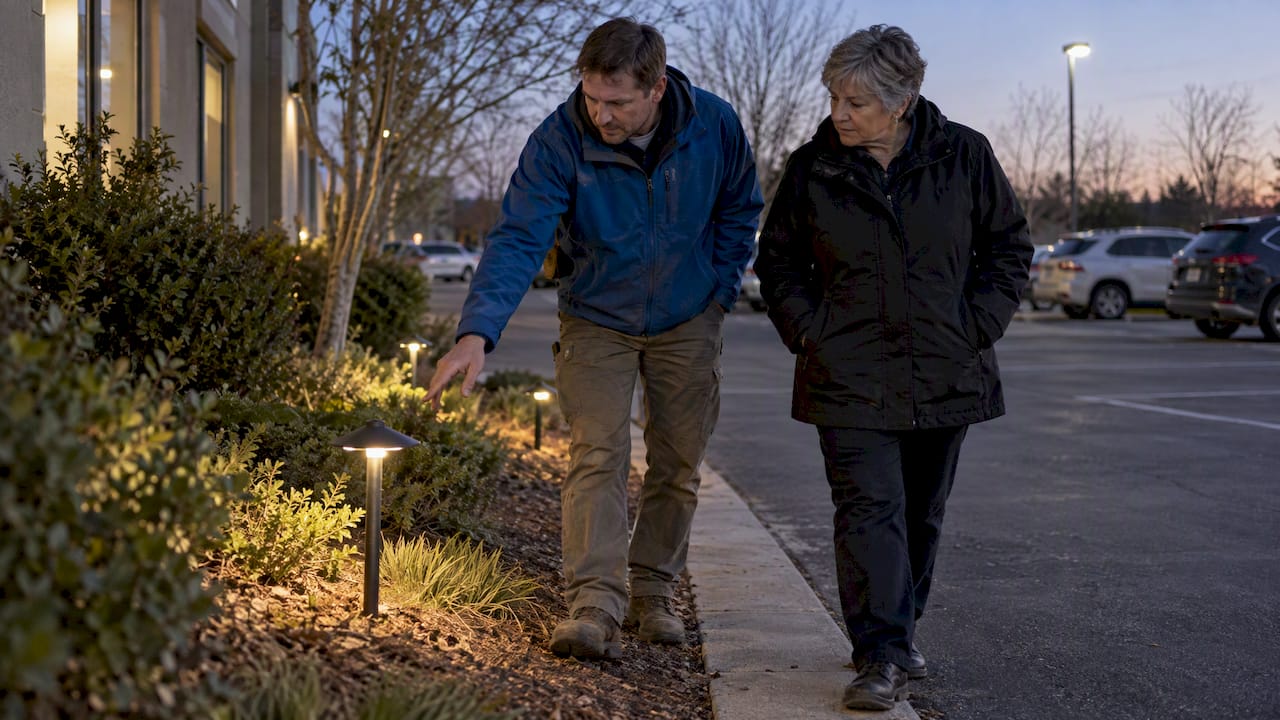
Pro Tip: Walk the site at dusk with sample fixtures staked in place before finalizing a design. What looks right on a photometric plan does not always feel right standing in the parking lot.
Lighting Controls and Energy Strategies for Large Sites
Controls are not an add-on to a commercial lighting system. They determine whether the investment delivers the energy savings and fixture longevity it was designed for.
- Scheduling turns fixtures on and off based on sunset and sunrise rather than a fixed clock, which adjusts automatically through the seasons.
- Occupancy sensors bring parking areas or side entrances up to full brightness only when someone is present.
- Dimming lets a site run at reduced output during low-traffic hours while retaining full output when needed.
- Scenes allow a property to shift its entire lighting profile for events, holidays, or seasonal promotions with one command.
Lighting-control specialists treat these features as standard requirements for maximizing return on an LED investment, noting that installing efficient LEDs without flexible controls leaves much of the available savings on the table, according to commercial lighting control guidance. Controls also reduce wear on drivers and LEDs by avoiding unnecessary full-output hours, which extends the service life of the fixtures themselves.
For larger commercial campuses, networked control platforms add wireless nodes, DALI protocol integration, and compatibility with building management systems through BACnet, allowing a property manager to monitor and adjust lighting across multiple buildings from a single interface. Enterprise platforms such as Lutron’s Athena system illustrate how networked controls scale lighting, shading, and commissioning support across a large property portfolio.
Installation Planning and Cost Expectations
A professional commercial lighting installation should produce a defined set of deliverables, not just a crew showing up with fixtures.
- Site survey documenting existing electrical capacity, soil conditions, and mature landscape features.
- Photometric layout showing projected light levels across the property in foot candles.
- Fixture schedule listing every fixture type, wattage, color temperature, and mounting location.
- Wiring and trenching plan identifying circuit runs, transformer locations, and conduit paths.
- Commissioning report confirming the system performs to the design’s specifications once installed.
- Warranty documentation covering fixtures, transformers, and labor.
Cost varies by site size, how difficult the ground is to trench (asphalt and established hardscape cost more to cross than open soil), the number and type of fixtures specified, whether the site needs electrical panel upgrades to support new circuits, and local permit fees. Rather than comparing flat lump-sum estimates between contractors, request an itemized proposal that breaks out fixtures, labor, controls, and photometric deliverables separately. That level of detail is also what lets you compare a bid’s photometric outputs against the IES and LPD benchmarks covered earlier. If your lighting project is part of a larger site renovation, our guide to planning a commercial landscape renovation covers how to sequence lighting alongside hardscape and planting work.
Electrical Constraints That Determine Long-Term Performance
Low-voltage LED systems, typically 12V or 24V, can be used across a large site, but they carry a real constraint: voltage drop. As a circuit run gets longer, voltage drop causes fixtures farther from the transformer to dim or shift color compared to those closer in. Designers calculate total circuit load and run distance before finalizing a layout, and account for both when managing voltage drop, as discussed in low-voltage landscape lighting guidance.
Wiring topology matters just as much as circuit length. Hub wiring, where each fixture runs its own line back to a central junction, reduces field splices and makes future troubleshooting or fixture additions far simpler than a daisy-chain layout, where fixtures wire sequentially from one to the next. A single bad connection in a daisy chain can take out every fixture downstream of it.
Finally, ask your contractor to confirm which listing and electrical requirements apply to the project, and request photometric commissioning that states the lumen depreciation (LLD) and dirt depreciation (LDD) assumptions used in the design.
Maintenance and Performance Verification Over Time
A commercial lighting system holds its value only if it is maintained on a schedule. Routine maintenance should include:
- Cleaning fixture lenses to remove dirt and pollen buildup that dims output over time.
- Checking gaskets and seals on in-ground and wall-mounted fixtures to prevent moisture intrusion.
- Re-aiming fixtures that have shifted from tree growth, settling, or lawn equipment contact.
- Testing transformers and drivers for consistent voltage output.
- Trimming vegetation that has grown to block or shade fixtures.
Two metrics worth tracking over the system’s life are lumen depreciation, often expressed as L70, the point at which output drops to 70 percent of initial lumens, and the LLD/LDD assumptions your contractor used during design, since both affect when a fixture needs replacement rather than simple cleaning. A well-commissioned system with networked controls flags failures faster, which keeps maintenance visits targeted instead of reactive.
How to Choose a Commercial Landscape Lighting Contractor
Comparing bids gets easier once you know what a qualified design-build contractor should bring to the table without being asked twice.
- A completed photometric layout, not just a sketch of fixture locations.
- Documented BUG ratings and Lighting Zone compliance for every fixture specified.
- A written controls plan covering scheduling, dimming, and sensor placement.
- A commissioning report and project-specific warranty delivered at project close.
When you meet with a contractor on-site, ask direct questions: “Can you show me the photometric files for this layout?” “What LLD and LDD values did you assume in your lumen calculations?” “What specifically prevents light trespass onto the neighboring property?” A contractor who answers these without hesitation is working from real design discipline, not a catalog of fixtures they install the same way on every job.
Pro Tip: Ask to see a finished commercial project in person rather than only photos. Lighting that photographs well can still feel harsh or uneven standing on-site.
Navigating Local Permit Requirements for Commercial Lighting
Local requirements for commercial outdoor lighting vary. Check with your planning or building department to learn whether zoning ordinances, site plan review, or other provisions apply to your property.
Because requirements vary significantly by municipality and even by zoning district within the same town, confirm permit requirements with your local planning or building department before finalizing a design, rather than assuming a layout that worked on one property will pass review on another. A qualified contractor should fold this step into the design phase, submitting photometric plans alongside permit applications so the layout you approve is the one that gets built, not a revised version forced by a rejected permit. Commercial sites near residential boundaries often face stricter glare and trespass limits, which is another reason BUG ratings belong in the conversation with your local reviewing authority from the start. Building this review into the early design phase, rather than treating it as a final step, avoids costly redesigns after fixtures have already been ordered.
What to Expect From Design to Installation Completion
A commercial landscape lighting project moves through distinct phases, and knowing the sequence helps you plan around a business’s operating schedule rather than being surprised by delays.
The process typically starts with a site survey and consultation, where a contractor assesses existing electrical infrastructure, mature landscaping, and the property’s Lighting Zone designation. From there, the design phase produces a photometric layout and fixture schedule for your review and any necessary permit submission. Once a design is approved and permits are secured, procurement and scheduling follow, accounting for fixture lead times and crew availability. Installation itself includes trenching, wiring, fixture placement and aiming, and finally commissioning, where the contractor verifies the system performs to the photometric plan before handing over documentation and warranty terms.
Larger commercial sites with multiple zones, extensive hardscape, or electrical panel upgrades naturally take longer than a single-entrance retail property. Building in time for permit review and any municipal back-and-forth up front keeps the installation phase from stalling once crews are already mobilized.
Lessons From On-Site Commercial Lighting Work
Every layout looks different once fixtures are staked and powered at dusk compared to how it reads on paper. We’ve found that aiming adjustments made on-site, after walking a property at night, consistently catch glare and uneven spacing that a photometric plan alone can miss. Coordinating fixture placement with ongoing landscape maintenance, so mowing crews and plant growth do not shift aim over a season, cuts down on return visits. Our project gallery reflects that hands-on approach. Good commissioning up front consistently means fewer nuisance complaints and lower long-term operating cost.
— Damian
How We Help Commercial Clients Get Lighting Design Right
We design and install commercial landscape lighting to suit each property. Our approach ties every layout back to the BUG and LPD checkpoints covered above, so what we propose is what gets verified at commissioning, not a guess adjusted after the fact.
If you manage a commercial property and are considering landscape lighting, our irrigation and lighting services page is the place to learn more. We also handle the broader landscape work that often accompanies a lighting upgrade:
- Full landscape design coordinated with new lighting layouts.
- Hardscape and masonry work for plazas, walkways, and retaining walls that lighting needs to highlight.
- Deck and outdoor living construction where accent lighting extends usable hours.
Reach out through our landscape design page or request a proposal for your property.
FAQ
What is the profit margin on landscape lighting?
Profit margins on landscape lighting installations vary by contractor, region, and project scope, and no single published figure applies across the industry. Property owners are better served comparing itemized proposals from qualified contractors than estimating margin from a general number.
How much does professional landscape lighting cost?
Cost depends on site size, trenching difficulty, fixture count and type, and whether controls or electrical upgrades are needed, which is why contractors provide itemized proposals rather than flat estimates. Request a site survey and photometric layout so the quote reflects your property’s actual conditions.
What is the moonlighting technique in landscape lighting?
Moonlighting mounts fixtures high in tree canopies and aims them downward to cast soft, dappled light across lawns and walkways, mimicking natural moonlight filtering through leaves. It can create a natural effect, especially when the color temperature is tested on-site.
What is the rule of thumb for outdoor lighting?
The widely cited standard is the IES Five Principles: light should be useful, targeted, no brighter than necessary, controlled, and color-considered, a framework IES advocates for balancing safety with reduced glare and light trespass. In practice, that means matching light levels to the Lighting Zone and task at hand rather than maximizing brightness everywhere.