
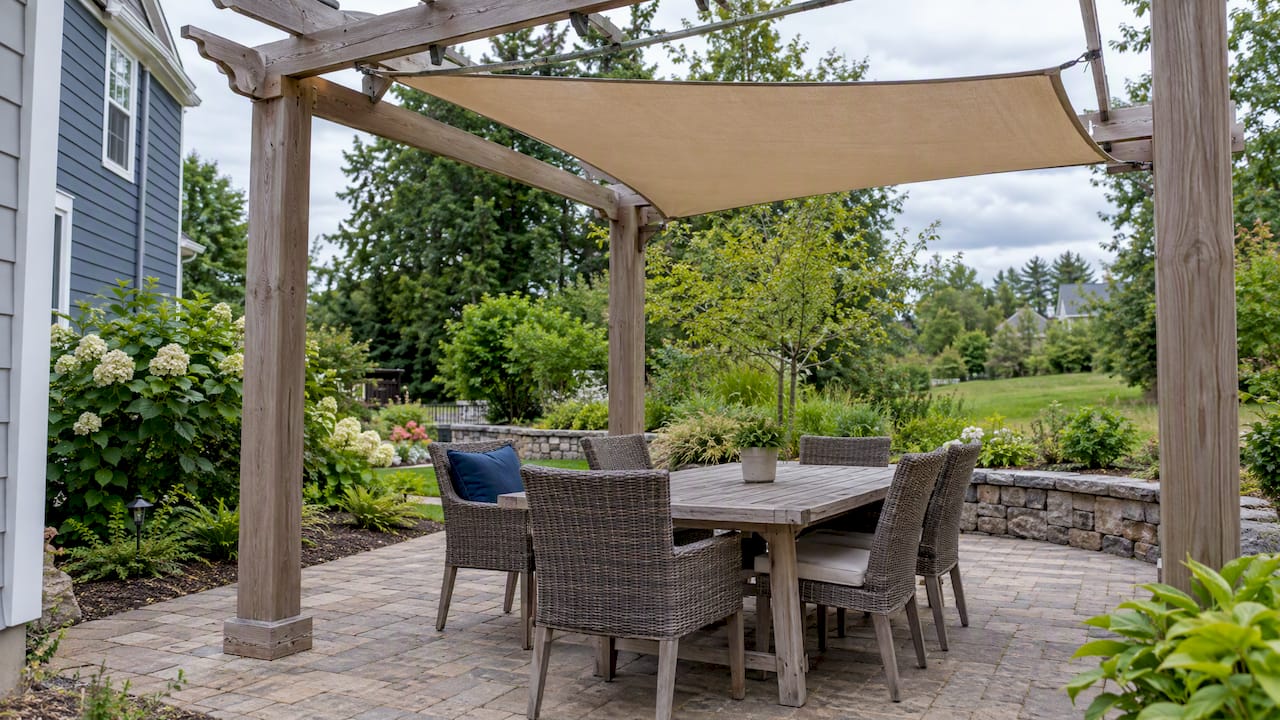
The main ways to shade a pergola are a fixed roof, adjustable louvers, a retractable canopy, a shade sail, vertical screens or curtains, and climbing plants. Fixed options give steady coverage with little upkeep. Adjustable options let you decide how much sun comes through. In New Hampshire, the right pick depends less on heat than on glare, low afternoon sun, rain, and a winter that can put real weight on anything overhead.
This guide walks through each option, what it does well, where it falls short, and how to choose for a New England yard. It is written for homeowners and business owners who plan to hire a contractor, so it also covers structure, permits and care.
TL;DR
- Fixed roofs and fixed louvers give constant shade with the least maintenance. Adjustable louvers and retractable canopies trade simplicity for control.
- Overhead shade does not stop low-angle sun from the side. Roller screens or outdoor curtains handle that and add privacy.
- Snow load and wind matter more here than in most of the country. Any cover has to suit the frame under it, and fabric usually comes off or retracts for winter.
- Check with your town’s building inspector before you build or add a roof. Rules and design loads differ from town to town.
- Plan the shade together with the pergola’s size, material and position, not as an afterthought.
Table of Contents
- How a pergola gives shade in the first place
- Fixed shade: roofs, louvers and lattice
- Adjustable shade: louvers and retractable canopies
- Shade sails
- Curtains, roller screens and side shade
- Living shade: vines and plantings
- Comparing the options at a glance
- Choosing for New Hampshire conditions
- Structure, snow and wind
- Permits and local rules
- Care and maintenance through the seasons
- Our perspective
- Plan your pergola with Divine Landscaping
- FAQ
- Sources
How a pergola gives shade in the first place
A classic pergola is an open structure. UF/IFAS Extension describes it as pillars supporting flat crossbeams and open latticework, often covered in vines. That open top breaks up sunlight but does not block much of it. Lattice itself is an open crisscross network that lets in light and air, so the shade it casts is dappled and partial.
That is fine for some yards. If you want to read a book at noon or keep a dining table out of the glare, you will probably want to add something. The options below run from permanent to seasonal, and from simple to motorized.
Fixed shade: roofs, louvers and lattice
Fixed shade stays where you put it. It is the simplest category and the one we recommend most often when a homeowner wants a dependable, low-fuss result.
Solid or paneled roof
A roof of metal or polycarbonate panels blocks most sun and sheds rain, so the space under it stays usable in a light shower. It also changes the look of the structure. A pergola with a solid roof reads more like a covered porch or a pavilion. That can be a benefit if you want an outdoor dining room, but it removes the open, airy feel and some of the evening sky.
Because it holds snow, a roofed pergola needs a stronger frame than an open one. We cover that in the structure section below.
Fixed louvers
Fixed louvers are angled slats that stay in one position. They stay put, give consistent shade, and need very little maintenance, since there are no moving parts to wear out. The angle is set at the design stage based on where the sun sits and which hours you care about most. The trade-off is that you cannot open them up on a cool day or close them for a storm.
Lattice and slatted tops
Adding closely spaced rafters or lattice panels is the lightest way to increase shade. You keep the open feel and good airflow, and the shadows move across the patio through the day. It will not give you full cover, but it is often enough for a seating area that gets sun for only a few hours.
Adjustable shade: louvers and retractable canopies
If you want sun in spring and fall and shade in July, an adjustable system makes sense.
Adjustable louvers
Adjustable louvers pivot, either by hand or with a motor. You can angle them to cut glare, open them for ventilation, or close them fully for a dry space when it rains. They cost more than fixed systems and have parts that need occasional service, so budget for both. Our pergola cost guide explains how the price range runs from simple kits to full louvered systems.
Retractable canopies
A retractable canopy slides fabric along tracks or cables. It extends over the pergola for shade and pulls back to open the sky. The Spruce describes a common build: fabric attached to support boards that glide along tensioned stainless-steel cables. Commercial versions use tracks and can be run by crank, motor or a smart-home system.
Canopies give softer, filtered light than a solid louver roof, and they usually cost less. Three details matter in practice:
- Slope and drainage. Fabric that sits flat will collect water. The canopy needs enough pitch for rain to run off, or a way to lower one end.
- Anchoring. The fabric acts like a sail in wind, so the posts, beams and fasteners must be secured properly.
- Seasonal removal. In our climate, plan to take fabric down or fully retract it before heavy snow and store it clean and dry.
When homeowners search for a retractable canopy, they often picture something that stays up all year. In New Hampshire, treat it as a three-season feature unless the manufacturer specifically rates it for snow.
Shade sails
A shade sail is a tensioned piece of durable, weather-resistant fabric stretched under or across the pergola. Sails come in many colors and UV ratings, and an angled or overlapping layout looks modern and also helps water run off.
Sails are a good fit if you want shade quickly and at a modest price. They need strong anchor points and proper tension, because slack fabric flaps in wind and wears faster. Like canopies, sails generally come down in winter.
Curtains, roller screens and side shade
Overhead shade solves the noon sun. It does not solve the low sun that comes in at 5 p.m. from the west. For that you need vertical coverage.
- Outdoor curtains are inexpensive and soft-looking. They can be drawn closed to block sun and tied back when you want a view. Long runs need a sturdy rod or cable, because a span of 15 feet or more puts real load on the hardware.
- Roller screens drop down the side of the pergola and roll up out of sight. They cut glare and wind, and they provide privacy from neighbors.
- Fixed side slats or lattice do the same job permanently and blend into the structure.
Side shade also helps with privacy. Our guide to patio privacy ideas that hold up in New Hampshire covers screens, plantings and fencing in more detail. If privacy is the larger goal, this overview of luxury home privacy shows how high-end properties approach screening and shading outdoor spaces together.
Living shade: vines and plantings
Climbing plants are the traditional pergola cover, and they give a cooling, natural effect. Shade builds slowly over a few seasons, and in New England deciduous vines drop their leaves, so you get sun back in winter.
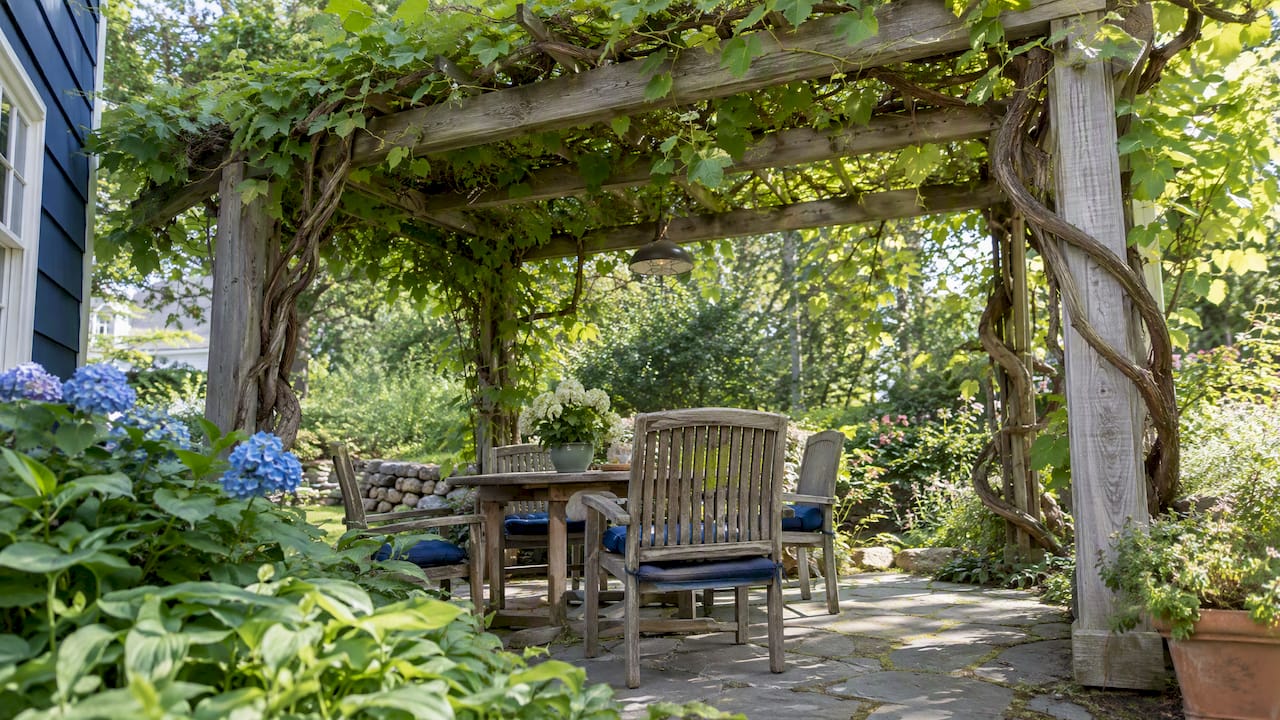
There are two cautions. First, mature vines get heavy. The University of Minnesota’s horticultural guidance on wisteria notes that living shade needs a structurally adequate pergola and regular pruning. A light kit pergola that looks fine on day one may not carry a vigorous vine. Second, vines need upkeep, and they are not a quick fix for a yard that needs shade next summer.
Many of our clients combine approaches: vines for part of the structure and a retractable canopy or screen over the dining area.
Comparing the options at a glance
| Option | Type of shade | Rain protection | Upkeep | Best for |
|---|---|---|---|---|
| Solid or paneled roof | Fixed, near full | Yes | Low | Dining area used in all weather |
| Fixed louvers | Fixed, consistent | Limited | Very low | Steady shade, simple design |
| Adjustable louvers | Adjustable | Yes when closed | Moderate (moving parts) | Control over sun, air and rain |
| Retractable canopy | Adjustable, filtered | Light | Moderate, seasonal removal | Flexible shade at a lower cost |
| Shade sail | Fixed, partial | Light | Moderate, seasonal removal | Quick, affordable coverage |
| Curtains and roller screens | Side, adjustable | Minimal | Low to moderate | Low sun and privacy |
| Vines | Dappled, seasonal | No | Pruning | A natural look, patience required |
Choosing for New Hampshire conditions
Here is how we would think it through with you on a site visit.
- Map the sun. Note which hours you use the space and where the sun sits then. A west-facing patio needs side shade as well as a top. A north-facing one may need little.
- Decide how you use the space. Dining and cooking want dependable cover. A quiet seating nook may only need partial shade.
- Decide whether you want weather cover. If you want to stay dry, you need a solid roof or closing louvers. Fabric is for sun.
- Match the shade to the structure. Heavier roofs need heavier posts, beams and footings.
- Plan for winter. Decide now whether the cover stays up or comes down, and where it is stored.
Size and placement matter too. Our guide to sizing a pergola for your patio explains how much of the patio a pergola should cover so the furniture still fits under the shade. The frame material also affects how well it carries a roof or canopy, as we explain in pergola materials that cut costs over 20 years.
Structure, snow and wind
New Hampshire design loads are serious. As one example, the Town of Alton lists a ground snow load of 90 pounds per square foot at 900 feet of elevation and a wind design speed of 115 mph. Other towns will differ, and your site’s elevation matters, but it shows why a roof or canopy that works in a mild climate may not survive here without the right framing.
In practice that means:
- Solid roofs and louver systems need a frame engineered for snow, not just a decorative one.
- Fabric covers should be retracted or removed before storms and winter.
- Anchors and footings must be sized for wind uplift, particularly on exposed lots.
- Roof pitch and drainage must keep water from pooling on the cover.
For metal frames, aluminum is light and resists corrosion, while steel is stronger over larger spans but needs protective coatings to prevent rust. The right choice depends on the span and the roof you plan to carry.
Permits and local rules
Before you add a roof to a pergola, call your town. Requirements vary. In Chesterfield, for example, the building ordinance tells owners to check with the Building Inspector about a building permit and to include a plot and building plan with the application. Setbacks and lot coverage can also apply.
Business owners should know that commercial work may trigger more review. Greenland, for instance, requires site-plan review for new non-residential or multi-family uses, and its regulations address landscaping and screening and snow storage. If you run a restaurant or multi-tenant property, see our notes on designing restaurant patios around operations. We can help you work out what your town needs before construction begins.
Care and maintenance through the seasons
Every option needs something, and the amount differs.
- Fixed roofs and louvers: rinse off pollen and debris, clear gutters or drainage channels, and check fasteners.
- Adjustable louvers and motors: test operation each spring and have moving parts and wiring checked.
- Canopies and sails: clean with mild soap and water, let them dry fully before storage, and inspect tracks, wheels and fasteners each year.
- Curtains and screens: take them down or roll them up in winter, and watch for mildew in damp spells.
- Vines: prune every year so growth stays within what the frame can carry.
If the pergola sits over a patio, drainage and freeze-thaw also matter for what is underneath. See our guides on fixing standing water on patios and preventing freeze-thaw paver damage.
Our perspective
We build outdoor spaces across New Hampshire, and the most common mistake we see is choosing the shade first and the structure second. A beautiful canopy on a frame that was never meant to carry it will not last a winter. We design the pergola and its shade together, around how you actually use the yard.
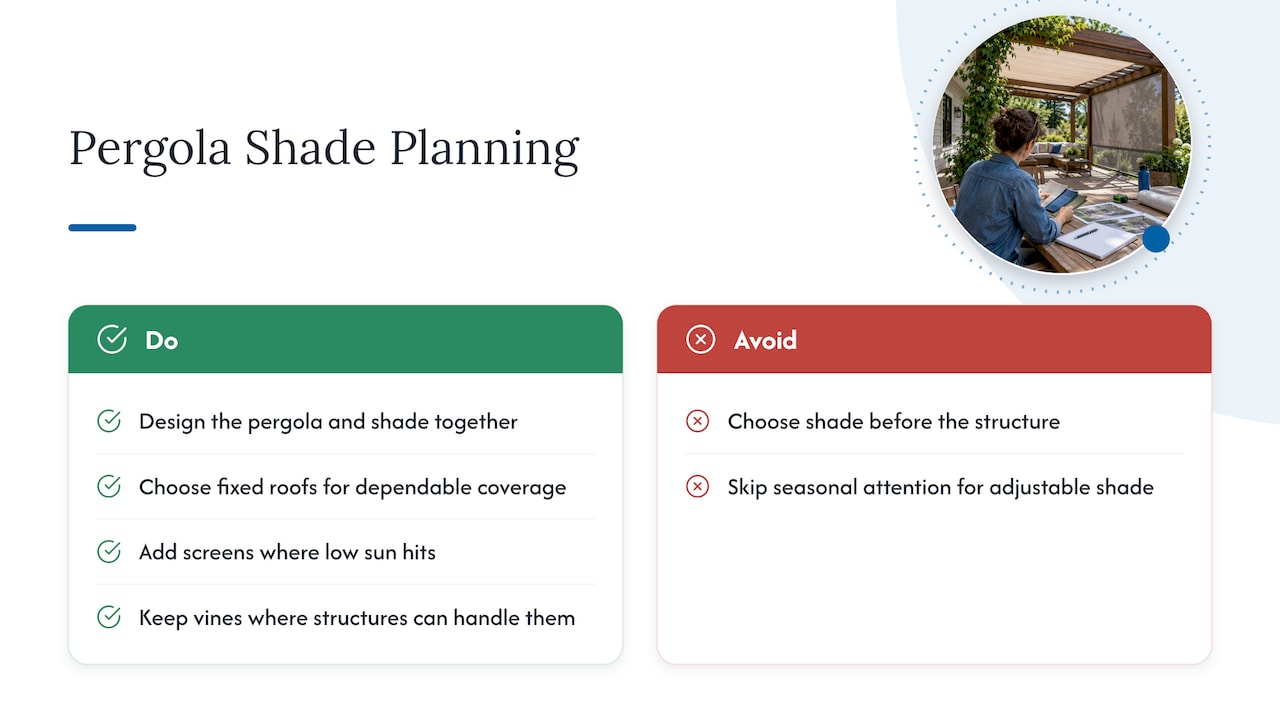
Our view is simple. If you want low maintenance and dependable coverage, go with a fixed roof or fixed louvers. If you want control, choose adjustable louvers or a retractable canopy and accept that it needs seasonal attention. Add vertical screens where the low sun hits, and keep vines for the places where the structure can handle them. For many homes, a mix works best.
We also think shade belongs in the larger plan. Grade, drainage, patio size, lighting and nearby plantings all shape how comfortable the space is. When those pieces are designed together, the pergola looks like it was always part of the property.
— Damian
Plan your pergola with Divine Landscaping
If you are weighing these options, we can help you choose and build. Our team designs and installs pergolas, gazebos, patios and outdoor living spaces for residential and commercial properties in New Hampshire. Start with landscape design to map the sun, the structure and the layout, or see our decks and outdoor living services for pergolas and gazebos built with decks. You can also browse covered deck ideas for New Hampshire homes for inspiration.
FAQ
What is the cheapest way to shade a pergola?
Shade sails and outdoor curtains are usually the lowest-cost fabric options, and they can be installed quickly. Both need sturdy anchor points and usually come down for winter. For a realistic range across all systems, see our pergola cost guide.
Can a retractable canopy stay up in winter in New Hampshire?
We advise against leaving fabric canopies up under snow. Retract them fully or remove them, clean them, and store them dry. If you want year-round cover, a solid roof or louver system on a frame designed for local snow load is the safer choice, and your town’s building inspector can confirm the requirements.
How do I block the low afternoon sun on a pergola?
Overhead cover will not do it, because the sun comes in from the side. Roller screens, outdoor curtains or fixed side slats on the west or south side solve it and also add privacy.
Do I need a permit to add a roof or canopy to my pergola?
It depends on your town and on how the cover attaches to the structure. Many towns require a building permit for roofed structures, so contact your building inspector before you start. Commercial properties can also face site-plan review.
Sources
- UF/IFAS Extension: Arbor, Trellis, or Pergola
- The Spruce: How to Build a DIY Retractable Pergola Canopy
- University of Minnesota: Wisteria
- Town of Alton, NH: Codes and Design Criteria
- Town of Chesterfield, NH: Building Ordinance 2024
- Town of Greenland, NH: 2025 Site Plan Review Regulations