
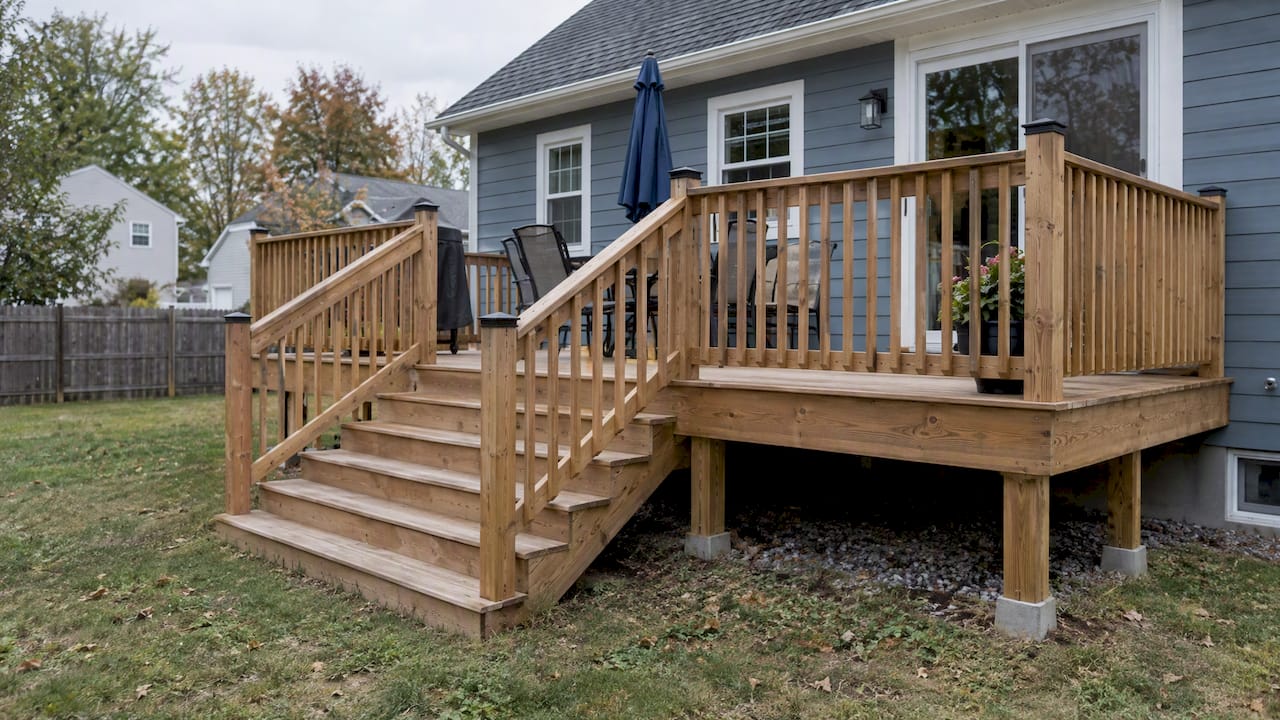
Most New Hampshire homeowners should budget roughly $19 to $54 per square foot for a new deck, installed, according to one 2026 state cost guide. That works out to about $4,400 for a basic 12×16 pressure-treated deck and more than $9,000 for the same footprint in composite. Your own number depends on material, height, railing, the footings your lot requires, and your town’s permit process.
This guide shows where those numbers come from. It also explains why New Hampshire decks cost what they do, and how to read a bid so you can compare quotes fairly.
TL;DR
- Published 2026 estimates for New Hampshire run from about $17 to $55 per square foot up to $19 to $54. Complex or premium builds can land above that range.
- A 12×16 deck is about $4,398 in pressure-treated pine and $9,303 in composite, installed.
- Frost depth, snow load and permits push New Hampshire costs above what a generic national calculator shows.
- Composite costs more up front. Wood costs less up front but needs cleaning and sealing for as long as you own it.
- Get at least two written bids that name the footing depth, decking brand, railing and who pulls the permit.
Table of Contents
- What a deck costs in New Hampshire per square foot
- Deck cost by size: worked examples
- Material is the biggest price lever
- Why New Hampshire decks cost what they do
- Permits and inspections
- How we think about deck budgets
- How to compare deck bids
- Ways to lower the cost without cutting quality
- Work with Divine Landscaping on your deck
- FAQ
- Sources
What a deck costs in New Hampshire per square foot
Contractors price decks by finished square footage, then adjust for height, stairs, railing and site problems. Two public 2026 estimates give a useful range for the state:
- CostFlowAI puts typical New Hampshire deck costs at $17 to $55 per square foot and notes that its figures are planning estimates, not a published wage series.
- SmartDeckingCalculator gives $19 to $54 per square foot and says the state sits about 2% below the U.S. average.
The two estimates agree more than they differ. Treat the range as a starting point. Anything under about $20 per square foot is hard to believe for a permitted, code-compliant deck with proper footings. Anything above $55 should come with a clear reason: composite or PVC boards, cable or glass railing, a second story, built-in seating, or a difficult lot.
We do not publish flat prices for our deck work, because every property is different. Instead, we measure the site and write a bid that itemizes the structure, surface, railing and permit work.
Deck cost by size: worked examples
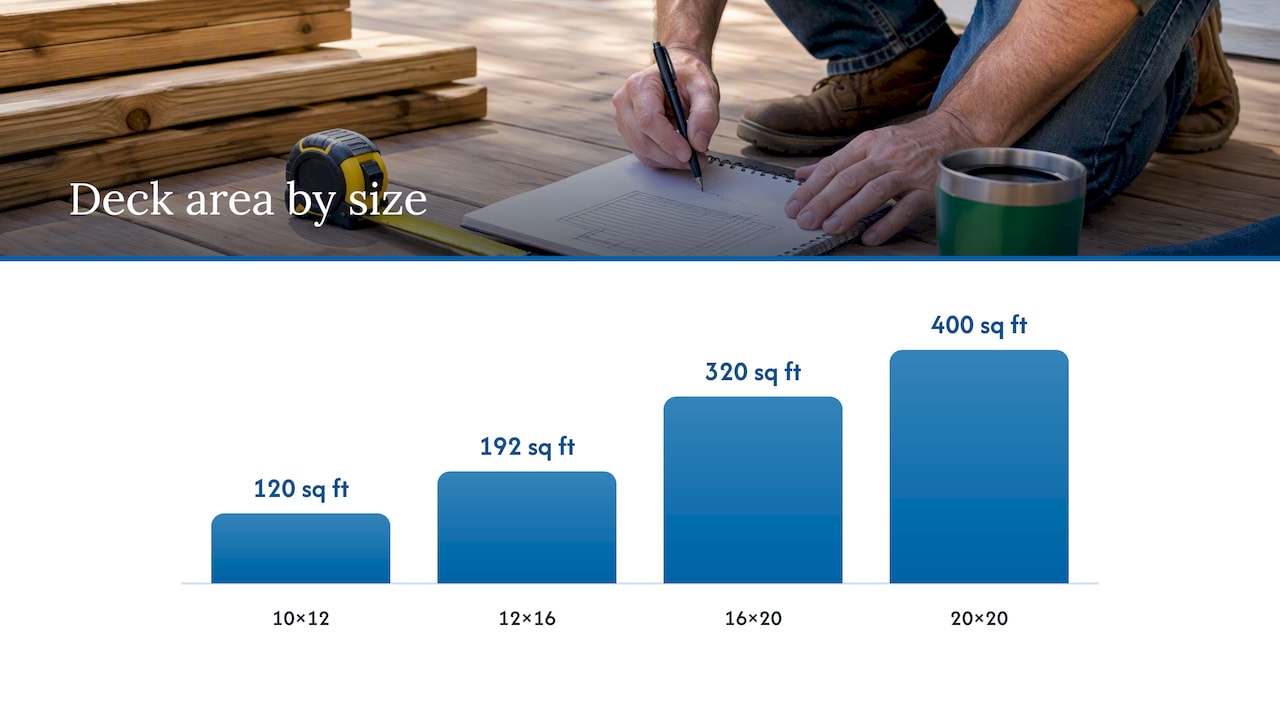
Here is what the per-square-foot range means in dollars. These multiply the $19 to $54 range above, so they are arithmetic, not quotes.
| Deck size | Square feet | Low ($19/sq ft) | High ($54/sq ft) |
|---|---|---|---|
| 10×12 | 120 | $2,280 | $6,480 |
| 12×16 | 192 | $3,648 | $10,368 |
| 16×20 | 320 | $6,080 | $17,280 |
| 20×20 | 400 | $7,600 | $21,600 |
For a more grounded reference point, the same state guide prices a 12×16 deck at about $4,398 in pressure-treated pine and $9,303 in composite. The gap between those two figures is the single biggest decision in your budget.
A 10×12 deck is a bistro-sized space: a small table and two chairs, or a grill and a bench. A 12×16 fits a dining table for six. At 16×20 and up you can zone the deck into dining and lounge areas, which is when design starts to matter more than raw square footage.
Material is the biggest price lever
Pressure-treated wood
Pressure-treated pine is the lowest-cost way to build. It is a good choice when the budget is tight, when the deck is low to the ground, or when you plan to sell in a few years. The tradeoff is upkeep. New Hampshire’s freeze-thaw cycles are hard on wood. Plan on regular cleaning and a fresh coat of stain or sealer to slow cracking and graying.
Composite and PVC
Composite boards cost more to buy and install, but they skip the annual staining. Our own composite deck cost checklist benchmarks U.S. composite builds at $40 to $85 per square foot. If you want to see what is behind that range, such as board lines, fascia, hidden fasteners and railing, start there.
Over a long ownership period the math often favors composite. You pay more on day one, then spend little on maintenance. If you plan to stay ten or twenty years, price both options and add the cost of re-staining a wood deck every few seasons. If you may sell soon, read our note on deck resale value, permits and right sizing before you spend extra on premium boards.
Railing, stairs and extras
Railing is where budgets drift. Basic wood balusters are the cheapest. Aluminum, cable and glass railing add noticeably to the bill. Stairs add cost per riser, and wide landings add framing. Built-in benches, skirting, lighting and privacy screens each add a line item.
A few extras that homeowners often add after the first quote:
- Low-voltage deck and stair lighting, which we can install alongside our lighting work
- A pergola or gazebo over part of the deck
- A grill station or full outdoor kitchen, covered in our guide to an outdoor kitchen on a deck
- Planters and container gardens to soften the edges. A commercial plantscaping firm’s planter cost guide shows how planter tiers from standard to custom affect a budget, though it is written for Canadian facilities, so use it for the logic rather than the prices.
Why New Hampshire decks cost what they do
A deck is a small structure. In New Hampshire it has to be built for frozen ground and heavy snow, and that shows up in the bid.
Frost depth and footings
Footing holes in New Hampshire generally have to reach below the frost line, which is typically 48 inches. The AWC DCA6 deck guide, posted by the Town of Alton, also says that near an existing house foundation, footings generally need to bear at the same elevation as the house footings to prevent settlement. A rough online estimate rarely accounts for that. Ledge, boulders and ledgy soil can make digging slower and more expensive. Our article on rocky New Hampshire lots explains how that affects any outdoor project.
Snow load
Snow load requirements vary by town and elevation. In Alton, for example, the ground snow load is 90 pounds per square foot at 900 feet of elevation. Your town may be lower or higher, so check with your building department. Higher design loads call for heavier framing, closer joist spacing or larger beams. That raises the structural cost compared with national averages, and skipping it at the design stage can cause a permit denial.
Labor and season
New Hampshire labor costs run above the national average, according to CostFlowAI’s regional multiplier of 1.10. Spring and early summer fill up quickly. If you book in fall or winter for a spring start, you get time to settle design, materials and permits before the ground thaws.
Permits and inspections
New Hampshire buildings must comply with the state building code under RSA 155-A, and your town handles permitting. One 2026 guide lists permit fees from $75 to $525 depending on the municipality and project scope, with inspections at stages such as footings and final framing.
Town rules differ on details like the height above grade that triggers a permit, setbacks and plan requirements. We walk through those in our New Hampshire deck permit checklist. Before you sign, ask each contractor one question: who pulls the permit, and is the fee in the price?
If you want a fire feature on or near the deck, the rules are separate. See our summary of New Hampshire fire pit regulations.
How we think about deck budgets
We build decks across New Hampshire and nearby Massachusetts, and the same pattern repeats. The homeowners who are happiest a few years later did not buy the cheapest deck or the most expensive one. They chose the right size for how they live, then spent where it matters: footings, framing, and a surface they can maintain.
Here is how we advise people:
- Do not trim the structure. Footings and framing are invisible once the boards are down, and they are what lasts. Savings belong in the surface or the extras.
- Size the deck to the furniture. Lay out where the table, grill and chairs will go. Many decks are bigger than needed, and square footage is what drives the price.
- Decide on upkeep honestly. If you will not stain every couple of years, composite is the better value for you, even at a higher price.
- Think about the whole yard. Grade, drainage, a walkway to the door and lighting decide whether a deck feels finished. Our guide to adding a deck to your outdoor living area covers that planning.
Our approach is a clear consultation, a custom design for your property, premium materials, and project management from first visit to final walkthrough. That is how we back the satisfaction guarantee we offer.
— Damian
How to compare deck bids
Two quotes for the same deck can differ by thousands of dollars. Usually the cause is what each one leaves out. Ask every contractor to put these in writing:
- Deck dimensions and height above grade
- Footing diameter and depth, and confirmation they go below the frost line
- Framing lumber, joist spacing and the snow load used
- Decking brand, line and color, with the fastener type
- Railing type and stair count
- Permit fee and inspections, and who handles them
- Removal of an old deck, if any
- Payment schedule, start window and the warranty terms
A low bid that skips the permit or names no footing depth is not a bargain. It is a different, smaller job.
Ways to lower the cost without cutting quality
- Build smaller and better. Spend the savings on a better surface or lighting.
- Choose a simpler shape. Angles, curves and multiple levels add framing and labor.
- Keep the deck low. A deck close to grade needs less railing and fewer stairs.
- Mix materials. Some builders use composite on the walking surface and wood for framing, which is common practice. Use composite only where the finish is visible.
- Phase extras. Frame in for a pergola or lighting now and add them later.
- Book off-season. Planning in winter helps you avoid the spring rush.
If an old deck is still sound, repair may cost far less than replacement. We handle deck renovations and repairs as well as new builds.
Work with Divine Landscaping on your deck
We design and build custom decks, deck renovations, pergolas and gazebos for homeowners and business owners in New Hampshire. Every project starts with a site visit, a design for your property and a written scope, so the bid you compare is complete. Learn more about our deck and outdoor living services, or see finished projects in our gallery. When you are ready, contact us to schedule a consultation.
FAQ
How much does a 12×16 deck cost in New Hampshire?
One 2026 guide estimates about $4,398 in pressure-treated pine and $9,303 in composite, installed. Railing, stairs, height and site conditions can move that up. A written bid for your lot is the only reliable number.
Is composite worth the extra cost in New Hampshire?
It often is if you plan to keep the deck for many years. Composite costs more up front but avoids the staining and sealing that wood needs after freeze-thaw winters. If you are selling soon, wood may be the better choice for your budget.
Do I need a permit to build a deck in New Hampshire?
In most cases, yes. The state building code applies, and your town issues the permit and sets the specifics. Call your building department before you sign a contract, and see our deck permit checklist.
Why are footings such a big part of the cost?
Footings must reach below the frost line, typically 48 inches in New Hampshire, so the deck does not heave as the ground freezes. Digging deep holes in rocky soil takes time and equipment. Footings are the one part of the deck you should never cut.
Sources
- SmartDeckingCalculator: Deck cost in New Hampshire 2026
- CostFlowAI: New Hampshire deck calculator 2026
- Town of Alton: Codes and design criteria
- AWC DCA6 prescriptive residential wood deck construction guide (hosted by the Town of Alton)
- New Hampshire RSA 155-A: State building code